
A fintech company publishes a curated transaction dataset to its catalog, documented well, and several teams build on it: credit risk modelling, financial reporting, and a fraud detection pipeline. A year later a model validation team asks a reasonable question, what did this table say on the fifteenth of March, and discovers the answer cannot be produced.
Late-arriving corrections had been applied in place, so the historical rows now reflect the current best understanding rather than what was known at the time. The data is more accurate today. It is also useless for validating a model trained last spring, and the reporting team has been unknowingly restating figures they already submitted.
Owner, contract, and a stated position on point-in-time correctness. Without the third, a fintech dataset is a moving target.
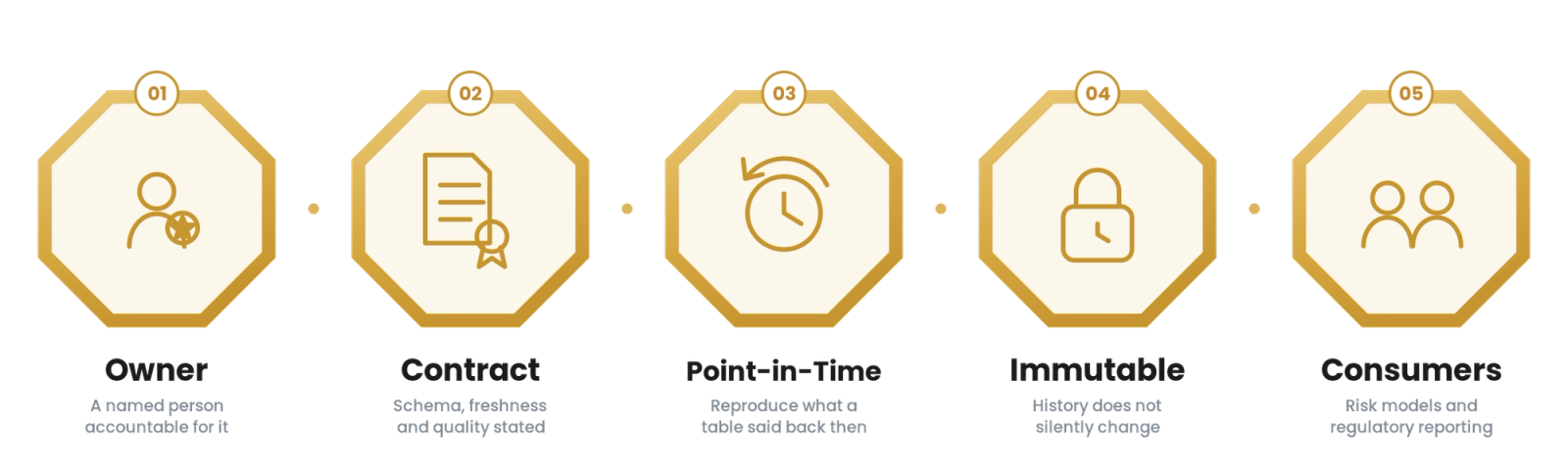
Data products for fintech means treating datasets as products with a named owner, a published contract covering schema, freshness, quality, and point-in-time reproducibility, and identified consumers, so risk models and regulatory reporting rest on data whose history does not silently change.
However, most programmes catalogue datasets and never state whether history is immutable, which means every consumer assumes reproducibility they do not have.
How to Design Data Products People Actually Use
Design data products around real consumer jobs and practical use cases.
If you are a CDO or VP of Data at a fintech company, the intent of this guide is:
- Define what makes a dataset a product rather than a table
- Show why point-in-time correctness is the critical contract term here
- Lay out how to start with the datasets risk and reporting depend on
To do that, let's start with the basics.
What Are Data Products for Fintech? The Basic Definition
At a high level, a data product in a fintech org is a dataset treated with the same discipline as a software product: a named owning team, a published contract covering schema, freshness, quality, and how history is treated, identified consumers, monitoring that detects contract violations, and a support path when they occur.
The clause that matters most in a financial estate is point-in-time correctness: whether the dataset can reproduce what it said on a given date, or whether late corrections are applied in place.
Both are legitimate designs for different purposes. Only one supports model validation and regulatory reproducibility, and leaving the choice unstated means consumers depend on a property nobody guaranteed.
To compare:
A catalogued dataset is a phone book listing. It confirms the number exists. A data product is a supplier with a contract: agreed delivery, a quality standard, a named contact, and an explicit statement about whether past invoices can be reissued unchanged.
In fintech that last clause decides whether you can validate a model or defend a submission. Most data programmes produce excellent phone books and then discover history moved.
Why Are Data Products Necessary for Fintech?
Issues that it addresses or resolves:
- Historical data restated in place, breaking reproducibility
- Datasets failing silently with no accountable owner
- Teams reimplementing the same transaction or customer logic differently
Resolved Issues by Data Products
- A named owner accountable when the dataset fails
- Point-in-time behavior stated explicitly in the contract
- Shared definitions replacing divergent per-team logic
Core Components of Data Products in Fintech
- A named owning team, not an individual
- A contract covering schema, freshness, quality, and point-in-time behavior
- Bitemporal or snapshot design where reproducibility is required
- Identified consumers, with regulated consumers flagged
- Monitoring that detects contract violations first
Modern Data Product Tooling for Fintech
- Data contracts defined as code alongside the pipeline
- Bitemporal modelling separating event time from knowledge time
- Immutable snapshots supporting as-of queries
- Lineage showing which models and reports depend on which product
- A catalog surfacing ownership, SLA, and reproducibility guarantees
These tools make accountability real. Separating when something happened from when you learned it is what lets a fintech dataset be both current and reproducible.
Other Core Issues They Will Solve
- Model validation can reproduce training inputs exactly
- Regulatory submissions rest on data that has not moved
- Teams stop maintaining private copies of shared logic
In Summary: Data products for fintech are datasets with an owner, a contract that states point-in-time behavior, and known consumers, so risk models and reporting rest on data whose history is defined.
Importance of Data Products for Fintech in 2026
Financial data increasingly feeds models that require validation and reports that require defence. Four reasons explain why this matters now.
1. Model validation demands reproducibility.
You cannot validate a model against inputs that have since been quietly corrected, and validators will ask.
2. Corrections are normal and currently invisible.
Late-arriving settlement and chargeback data is a fact of financial systems. How it is applied is a design decision usually made by default.
3. Restated figures create reporting exposure.
A dataset that silently updates history means submitted numbers no longer match their source, which is difficult to explain afterwards.
4. Cataloguing has already been tried.
Most fintechs have a catalog. The trust complaint persists, which suggests metadata was not the gap.
Traditional vs. Modern Fintech Data Delivery
- Datasets with descriptions vs. products with owners and contracts
- History corrected in place vs. point-in-time behavior stated and designed
- Failures found by consumers vs. failures detected by monitoring
- Every team defining its own logic vs. shared products consumed widely
In summary: A modern fintech approach attaches ownership, contracts, and an explicit reproducibility guarantee to the datasets risk and reporting depend on.
Details About the Core Components of Data Products in Fintech: What Are You Designing?
Let's go through each component.
1. Ownership Layer
Who is accountable.
Ownership decisions:
- A named team, never an individual
- Accountability for availability and correctness
- A published support path
2. Contract Layer
What consumers can expect.
Contract decisions:
- Schema, freshness, quality, and point-in-time behavior stated
- Contracts defined as code beside the pipeline
- Change governed by versioning
3. Temporal Layer
How history behaves.
Temporal decisions:
- Event time separated from knowledge time
- Corrections recorded as new facts, not overwrites
- As-of queries supported where validation requires it
4. Consumer Layer
Who depends on it.
Consumer decisions:
- Dependent models and reports identified
- Regulated and model-validation consumers flagged
- Notification before any change
5. Monitoring Layer
Detecting failure first.
Monitoring decisions:
- Freshness and quality checked continuously
- Restatement volume tracked and reported
- Alerts routed to the owning team
Benefits Gained from Data Products in Fintech
- Model validation able to reproduce training inputs exactly
- Reporting that matches its source months after submission
- Failures detected by the owner rather than found during validation
How It All Works Together
The fintech data team starts with the datasets risk and reporting actually run on rather than converting the whole estate. Transaction history, customer identity, and account position are the usual first candidates, because models and submissions both depend on them.
Each gets a named owning team so accountability survives role changes. A contract is published stating schema, freshness, quality thresholds, and, critically here, how history behaves. Where reproducibility is required, the design separates event time from knowledge time: a correction arriving in April about a March transaction is recorded as a new fact with its own knowledge timestamp rather than overwriting the original row.
That makes both questions answerable, what actually happened and what did we believe on a given date, which is what model validation and regulatory defence each need. Contracts live as code beside the pipeline so they can be tested.
Consumers are identified explicitly, with model-validation and regulated consumers flagged separately because their reproducibility requirements are stricter. Monitoring runs continuously and also tracks restatement volume, since a sudden rise in corrections is itself a signal worth routing to the owner.
Common Misconception
Correcting historical data in place makes the dataset more accurate, which is obviously better.
More accurate today, and unusable for anything that needs to know what you believed yesterday. That trade-off is fine if you make it deliberately and state it. The problem is that in-place correction is the default behavior of most pipelines, so the choice gets made by nobody, and consumers who need reproducibility discover the absence at the worst moment: during model validation, or when a submitted figure no longer matches its source.
The design that resolves this is not choosing between current and historical accuracy but recording both, treating a correction as a new fact with its own timestamp rather than an edit to an old one.
That costs some storage and some modelling effort, and it means you can answer both questions instead of permanently losing one.
Key Takeaway: In-place correction silently trades reproducibility for currency. Record corrections as new facts and you keep both.
Real-World Data Products for Fintech in Action
Let's take a look at how it operates with a real-world example.
We worked with a fintech data team whose transaction dataset applied corrections in place, with these constraints:
- Start with the datasets risk and reporting depend on
- State point-in-time behavior explicitly and design for it
- Attach an owner and monitoring to each product
Step 1: Pick the Datasets That Matter
Not the whole estate.
- Datasets feeding models and reports chosen first
- Reproducibility requirements assessed
- Scope kept deliberately small
Step 2: Assign Real Ownership
A team, not a person.
- Named owning team with capacity
- Accountability for correctness
- Support path published
Step 3: Design the Temporal Model
Two timelines.
- Event time separated from knowledge time
- Corrections recorded as new facts
- As-of queries supported
Step 4: Identify the Consumers
Flag the strict ones.
- Dependent models and reports recorded
- Validation and regulated consumers flagged
- Notification before change
Step 5: Monitor and Track Restatement
Owner finds out first.
- Freshness and quality checked continuously
- Restatement volume reported
- Alerts routed to the owning team
Where It Works Well
- Datasets feeding models that require validation
- Reporting pipelines whose figures must remain defensible
- Orgs willing to assign real ownership with capacity attached
Where It Does Not Work Well
- Attempting to convert an entire data estate at once
- Pipelines where corrections overwrite history by default
- Programmes that stop at cataloguing and call it done
Key Takeaway: Start with the datasets models and submissions depend on, state point-in-time behavior, and record corrections as facts rather than edits.
Common Pitfalls
i) Correcting history in place
The defaultpipelinebehavior destroys reproducibility silently, and the loss is only discovered during validation or after a submission no longer matches its source. Record corrections as new facts with their own timestamps.
- Model validation cannot reproduce training inputs
- Submitted figures drift from their source
- The problem is unrecoverable once history is overwritten
ii) Cataloguing instead of owning
Publishing descriptions improves discoverability and changes nothing about reliability. Attach an owner, a contract, and monitoring to a small number of datasets.
iii) Ownership assigned to an individual
A named person will change roles and the contract becomes fiction. Assign a team with capacity and a published support path.
iv) Not tracking restatement volume
A rising rate of corrections is a signal about upstream quality that most teams never measure. Report it to the owner as a first-class metric.
Takeaway from these lessons: Fintech data products need explicit temporal design, real ownership, and restatement monitoring, not more documentation.
Data Product Best Practices for Fintech: What High-Performing Teams Do Differently
1. Separate event time from knowledge time
Record when something happened and when you learned it, so both current accuracy and historical reproducibility remain available.
2. State point-in-time behavior in the contract
Say explicitly whether as-of queries are supported, because consumers will otherwise assume a guarantee nobody made.
3. Start with what models and reports run on
Pick the few datasets risk and reporting already depend on, since that is where a reproducibility gap costs the most.
4. Flag validation and regulated consumers separately
Their requirements are stricter and they need notification before any change to schema or temporal behavior.
5. Track restatement volume as a metric
A rising correction rate is an early signal about upstream quality, and almost nobody measures it.
Logiciel's value add is helping fintech data teams turn their most-depended-on datasets into products with real owners, explicit temporal contracts, and designs that keep history reproducible.
Takeaway for High-Performing Teams: Owner, contract, bitemporal design where validation requires it, and restatement tracked as a first-class metric.
Signals You Are Doing Data Products Well in Fintech
How do you know it is working? Not by how many datasets are catalogued, but by whether you can answer what a table said last March. These are the signals that separate products from listings.
As-of queries work. You can reproduce what the dataset said on a given date.
Corrections are facts. Late data is recorded rather than overwriting history.
Owners are teams. Every product has an accountable team with a support path.
Restatement is measured. Correction volume is reported to the owner.
Consumers are known. Validation and regulated dependencies are flagged specifically.
Adjacent Capabilities and Connected Work
This work does not exist in isolation. Data products depend on, and feed into, the surrounding data platform. Ignoring the adjacencies is the most common scoping mistake.
Data quality SLAs are what the contract formalises. Schema evolution policy governs how contracts change. Lineage identifies which models and reports depend on each product. Master data management determines whether shared customer definitions can exist.
Naming these adjacencies upfront keeps the work scoped and helps leadership see data products as a control and accountability model rather than a tooling purchase.
The common mistake is treating each adjacency as someone else's problem. The temporal design is your problem. The ownership assignment is your problem. The restatement metric is your problem. Pretend otherwise and a model validation exercise will eventually stall because history moved.
Own the adjacencies you depend on, partner with the teams that hold them, and share the contracts.
Conclusion
A dataset becomes a data product when a named team is accountable for it, a contract states what consumers can expect, and you know who depends on it. In a financial estate the contract needs a clause most organisations never write: whether history is reproducible.
Corrections are normal in financial data, and applying them in place is the default pipeline behavior, which quietly trades away the ability to validate a model or defend a submitted figure. Record corrections as new facts with their own timestamps, state the guarantee, flag your strict consumers, and track restatement volume. Cataloguing will not tell you what the table said last March.
Seven Things Every Data Contract Needs to Pin Down (Templates Included)
Define the seven essentials every reliable data contract should include.
Key Takeaways:
- Owner, contract, and known consumers are what make a dataset a product
- Point-in-time reproducibility is the critical contract term in financial data
- In-place correction is a default that silently removes model validation ability
Building data products requires real accountability. When done correctly, it produces:
- Model validation able to reproduce training inputs exactly
- Reporting that still matches its source months after submission
- Corrections recorded as facts rather than edits to history
- Failures detected by the owner rather than during a validation exercise
What Logiciel Does Here
If your pipelines correct history in place, we help you turn critical datasets into products with real owners, explicit temporal contracts, and designs that keep both current accuracy and reproducibility.
Learn More Here:
- Data Quality SLAs for Fintech
- Schema Evolution for Fintech
- Master Data Management and Shared Definitions
At Logiciel Solutions, we work with fintech data leaders on data product programmes. Our reference patterns come from estates supporting risk modelling and regulatory reporting together.
Read the guide on turning your critical datasets into reproducible data products.