
A SaaS data team spends six weeks comparing Delta Lake, Iceberg, and Hudi on features. They build a matrix, run benchmarks, and reach a conclusion that would have been different if they had run the exercise four months earlier or later, because the feature gaps between these formats close continuously.
What the matrix does not capture is the thing that will actually matter in three years: which query engines the organisation runs, which vendor's roadmap the format is aligned with, and how hard it would be to change their mind.
Those factors are stable. The feature comparison was obsolete before the document was circulated.
The feature gaps close. The engine coupling does not. Choose on the durable factor.
Delta Lake versus Iceberg for SaaS means choosing a lakehouse table format based on your query engine landscape, vendor alignment, and reversibility, because all three formats provide broadly equivalent core capabilities and the differences that persist are ecosystem rather than functional.
Iceberg, Delta Lake, or Hudi: The Open Table Format Endgame
Compare Iceberg, Delta Lake, and Hudi for open lakehouse decisions.
However, most teams run a feature comparison, reach a conclusion with a short shelf life, and never examine the coupling they are actually signing up for.
If you are a CDO or VP of Data at a SaaS company, the intent of this article is:
- Define what genuinely differs between the formats and what does not
- Show why engine landscape and vendor alignment are the durable criteria
- Lay out how to decide with reversibility in mind
To do that, let's start with the basics.
What Is the Delta and Iceberg Choice for SaaS? The Basic Definition
At a high level, Delta Lake, Apache Iceberg, and Apache Hudi are open table formats over object storage that provide the same category of capability: atomic commits, snapshot isolation, schema evolution, time travel, and metadata that makes large tables queryable efficiently.
They differ in implementation detail, in which engines support them best, in governance model, and in how closely each is associated with a particular vendor. The core functional differences narrow every release.
The ecosystem differences, which engines treat the format as first-class and which organisation drives its direction, change slowly and matter for the life of the estate.
To compare:
Choosing between these formats is like choosing between rail gauges. The trains are comparable and the journey is similar. What matters is which network your existing track connects to, who maintains the standard, and how expensive relaying track would be if you changed your mind.
Comparing the trains is the enjoyable part of the exercise and the least decision-relevant. Nobody regrets a format choice because of a feature; they regret it because of what it connected them to.
Why Does This Choice Matter for SaaS?
Issues that it addresses or resolves:
- Format decisions made on feature comparisons with short shelf lives
- Engine landscape ignored until practical friction appears
- Vendor coupling accepted without being examined
Resolved Issues by Choosing on Durable Criteria
- Format aligned with the engines you actually run
- Vendor alignment understood as a deliberate choice
- Reversibility assessed before commitment
Core Components of the Format Decision in SaaS
- An inventory of query engines in current and planned use
- Assessment of first-class support per engine per format
- Governance and vendor alignment understood
- Reversibility cost estimated honestly
- Interoperability options considered where they exist
Modern Format Tooling and Interoperability for SaaS
- Catalog implementations supporting one or more formats
- Interoperability layers translating between formats
- Engine connectors with varying maturity per format
- Migration tooling between formats
- Metadata monitoring regardless of choice
These tools soften the decision. Interoperability layers and multi-format catalogs mean the choice is less permanent than it was, though not free to reverse.
Other Core Issues They Will Solve
- Teams stop relitigating a decision whose basis keeps changing
- Practical friction with engines is anticipated rather than discovered
- Exit cost is known rather than assumed to be zero
In Summary: Delta versus Iceberg for SaaS is decided by engine landscape, vendor alignment, and reversibility, because core capabilities are broadly equivalent and converging.
Importance of This Choice for SaaS in 2026
Lakehouse formats have converged enough that the decision basis has shifted. Four reasons explain why this matters now.
1. Feature comparisons expire quickly.
A matrix built this quarter reaches a different conclusion next quarter, which makes it a poor basis for a multi-year commitment.
2. Engine support varies more than features.
The practical experience of using a format depends heavily on how well your specific engines treat it.
3. Vendor alignment is a real consideration.
Each format has a governance model and a commercial gravity, and both are worth examining deliberately.
4. Reversibility improved but is not free.
Interoperability layers and migration tooling exist, which lowers the stakes without eliminating them.
Traditional vs. Modern SaaS Format Selection
- Feature matrix comparison vs. engine landscape assessment
- Benchmark-driven choice vs. ecosystem-driven choice
- Vendor coupling unexamined vs. alignment as an explicit decision
- Assumed permanence vs. reversibility cost estimated
In summary: A modern SaaS approach chooses on engine support and vendor alignment, treats features as converging, and knows what changing its mind would cost.
Details About the Core Components of This Decision in SaaS: What Are You Designing?
Let's go through each component.
1. Engine Layer
What you actually run.
Engine decisions:
- Current and planned engines inventoried
- First-class support assessed per format
- Read and write support distinguished
2. Alignment Layer
Whose roadmap you follow.
Alignment decisions:
- Governance model understood per format
- Commercial gravity acknowledged
- Alignment treated as a choice, not an accident
3. Reversibility Layer
Cost of changing your mind.
Reversibility decisions:
- Migration path and cost estimated
- Interoperability options assessed
- Lock-in surface identified
4. Feature Layer
The converging part.
Feature decisions:
- Gaps checked for current blockers only
- Roadmap convergence assumed
- No multi-year weight on current gaps
5. Operational Layer
What you maintain either way.
Operational decisions:
- Compaction and file maintenance required regardless
- Snapshot expiry policy required regardless
- Metadata monitoring required regardless
Benefits Gained from Choosing on Durable Criteria in SaaS
- A format that works well with the engines you run
- Vendor coupling entered deliberately
- A known exit cost rather than an assumed one
How It All Works Together
The SaaS data team inventories the query engines it runs and plans to run, which is the criterion most predictive of day-to-day experience. For each engine, support for each format is assessed with read and write treated separately, because they frequently differ and the gap matters.
Vendor alignment is then examined explicitly: each format has a governance model and a commercial centre of gravity, and choosing one means following a roadmap somebody else sets, which is a reasonable thing to do deliberately and a poor thing to do by accident.
Reversibility is estimated rather than assumed, with migration tooling and interoperability layers considered, since those have improved enough to lower the stakes without making the choice free. Features are checked only for current blockers, on the assumption that gaps close, because weighting a multi-year decision on a difference that disappears next release is how teams end up with a well-documented conclusion that aged badly.
And the operational reality is acknowledged: compaction, snapshot expiry, and metadata monitoring are required under any of these formats, so none of them is a lower-maintenance choice.
Common Misconception
One of these formats is meaningfully better, and the analysis will reveal which.
The analysis will reveal which is better this quarter for your specific benchmark, which is a narrower and less useful finding than it appears. These formats are converging because they are solving the same problem under competitive pressure, so a feature advantage today is a footnote in eighteen months.
What does not converge is the ecosystem: which engines treat the format as first-class, who governs its direction, and what commercial relationships come with it. Teams that spend six weeks on feature comparison and ten minutes on engine support are optimising the variable that changes and ignoring the one that persists.
The honest answer for most SaaS organisations is that any of the three would work, and the decision should be made on ecosystem fit in an afternoon.
Key Takeaway: Any of these formats would probably work. Decide on engine support and vendor alignment, and stop benchmarking a converging difference.
Real-World Format Selection for SaaS in Action
Let's take a look at how it operates with a real-world example.
We worked with a SaaS data team whose six-week feature comparison had produced a conclusion that shifted with each release, with these constraints:
- Decide on engine landscape rather than feature matrix
- Examine vendor alignment as an explicit choice
- Estimate reversibility before committing
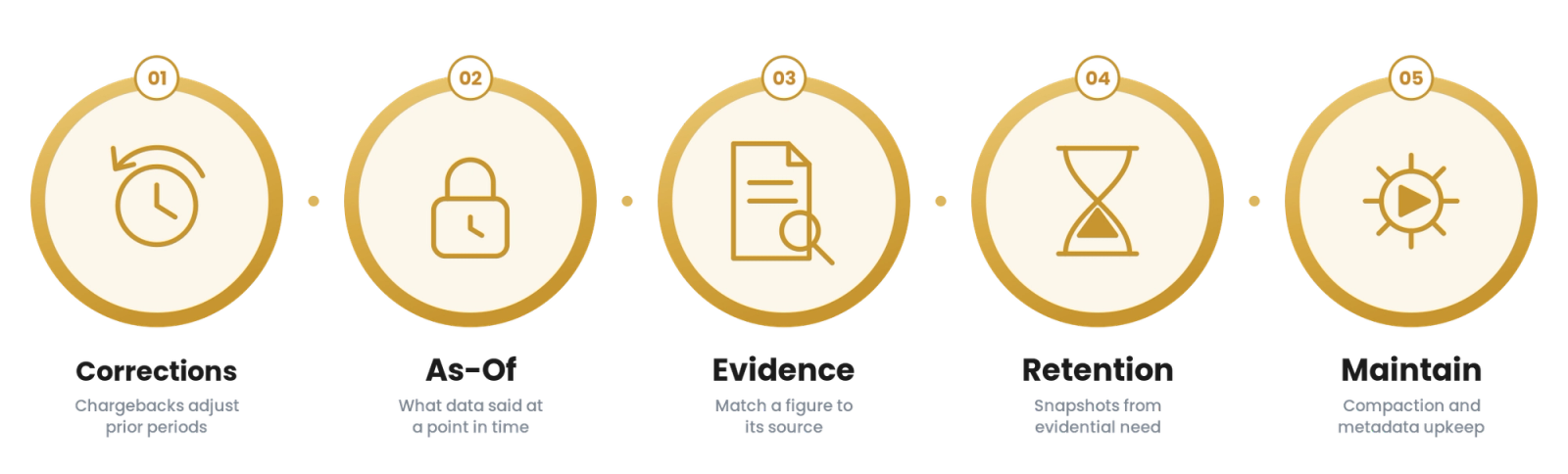
Step 1: Inventory the Engines
Current and planned.
- Query engines listed honestly
- Read and write support assessed per format
- Practical friction anticipated
Step 2: Examine Alignment
Whose roadmap.
- Governance model understood
- Commercial gravity acknowledged
- Alignment chosen deliberately
Step 3: Estimate Reversibility
Exit cost.
- Migration path and cost assessed
- Interoperability options considered
- Lock-in surface identified
Step 4: Check Features for Blockers Only
Not for advantage.
- Current blockers identified
- Convergence assumed
- No multi-year weight on transient gaps
Step 5: Accept the Maintenance
Same either way.
- Compaction required regardless
- Snapshot expiry required regardless
- Metadata monitoring required regardless
Where It Works Well
- Decisions made on engine support in a short exercise
- Estates with a clear dominant engine and vendor relationship
- Teams treating the choice as reversible at known cost
Where It Does Not Work Well
- Extended feature comparisons for a converging difference
- Ignoring engine support until practical friction appears
- Assuming any format reduces the maintenance burden
Key Takeaway: Decide on engine landscape and vendor alignment quickly, treat features as converging, and know the exit cost.
Common Pitfalls
i) Extended feature comparison
A matrix built over six weeks reaches a conclusion with a shelf life of one release cycle, which is a poor basis for a multi-year commitment. Check for current blockers and decide on ecosystem.
- Weeks spent on a transient difference
- The conclusion ages before it is implemented
- The durable criteria never get examined
ii) Ignoring engine support asymmetry
Read support and write support differ per engine per format, and the gap determines daily experience. Assess both explicitly against the engines you run.
iii) Unexamined vendor alignment
Choosing a format means following a roadmap somebody else sets. That is fine deliberately and poor by accident, so examine the governance model and commercial gravity.
iv) Assuming lower maintenance
Compaction, snapshot expiry, and metadata monitoring are required under all three. No format choice reduces the operational responsibility.
Takeaway from these lessons: The durable criteria are engine support, vendor alignment, and exit cost, and the decision should take an afternoon rather than a quarter.
Format Selection Best Practices for SaaS: What High-Performing Teams Do Differently
1. Decide on engine landscape first
Assess first-class read and write support across the engines you run and plan to run, because that determines daily experience.
2. Examine vendor alignment deliberately
Understand whose roadmap you are following and what commercial gravity comes with it, then choose it on purpose.
3. Check features for blockers only
Identify genuine current blockers and otherwise assume convergence, since gaps close faster than decisions get implemented.
4. Estimate the exit cost
Know what migrating away would involve, because that number determines how much the decision actually matters.
5. Budget the maintenance either way
Compaction, expiry, and metadata monitoring are required regardless, so plan them independently of the format choice.
Logiciel's value add is helping SaaS data teams make the lakehouse format decision quickly on durable criteria, then set up the compaction and metadata maintenance that every format requires.
Takeaway for High-Performing Teams: Decide on engines and alignment in an afternoon, check features for blockers only, and budget the maintenance regardless.
Signals You Are Doing This Well in SaaS
How do you know it is working? Not by how thorough the comparison was, but by whether the format works with your engines. These are the signals that separate a durable decision from a benchmark exercise.
Engines drove the choice. Support across your actual engines was the deciding factor.
Alignment was deliberate. Someone can state whose roadmap you chose to follow.
Exit cost is known. You have an estimate of what changing your mind would involve.
Maintenance is budgeted. Compaction and expiry are planned regardless of format.
The decision was quick. It took days rather than a quarter.
Adjacent Capabilities and Connected Work
This work does not exist in isolation. Format choice depends on, and feeds into, the surrounding data platform. Ignoring the adjacencies is the most common scoping mistake.
Your query engine landscape is the primary input. Catalog choice interacts closely with format support. Schema evolution policy determines which format features you exercise. Streaming and batch decisions determine write patterns and compaction load.
Naming these adjacencies upfront keeps the work scoped and helps leadership see the choice as ecosystem fit rather than a technology verdict.
The common mistake is treating each adjacency as someone else's problem. The engine assessment is your problem. The maintenance plan is your problem. The exit cost estimate is your problem. Pretend otherwise and you will produce a thorough comparison that answers the least durable question.
Own the adjacencies you depend on, partner with the teams that hold them, and share the reasoning.
Conclusion
Delta Lake, Iceberg, and Hudi solve the same problem and are converging under competitive pressure, which means a feature comparison produces a conclusion with a shelf life shorter than the implementation timeline.
The factors that persist are which engines treat each format as first-class for both reads and writes, whose roadmap and commercial gravity you are aligning with, and what changing your mind would cost.
Assess those, check features only for genuine current blockers, and decide in days. Then budget compaction, snapshot expiry, and metadata monitoring, because those are required under any of the three and are where the real ongoing work lives.
Key Takeaways:
- Core capabilities are broadly equivalent and converging; ecosystem differences persist
- Engine support and vendor alignment are the durable criteria
- No format choice reduces the compaction and metadata maintenance burden
Choosing a format well requires focusing on durable factors. When done correctly, it produces:
- A format that works well with the engines you actually run
- Vendor coupling entered deliberately rather than inherited
Stop Shipping Features Nobody Uses: A Guide to Outcome Engineering
Build features around outcomes that drive real, sustained product usage.
- A known exit cost rather than an assumed permanence
- A decision made in days rather than a quarter
What Logiciel Does Here
If you are weeks into a format comparison that keeps changing, we help you decide on engine landscape and vendor alignment, then set up the maintenance every format needs.
Learn More Here:
- Apache Iceberg for Technology & SaaS
- Schema Evolution for Technology & SaaS
- dbt at Scale for Technology & SaaS
At Logiciel Solutions, we work with SaaS data leaders on lakehouse architecture. Our reference patterns come from production estates on each of the major formats.
Book a technical deep-dive on making the format decision on criteria that will still hold in three years.