
A fintech platform team buys a developer portal and expects the compliance story to come with it. It does not. The product provides a catalog, templates, and a plugin framework, all of which are useful.
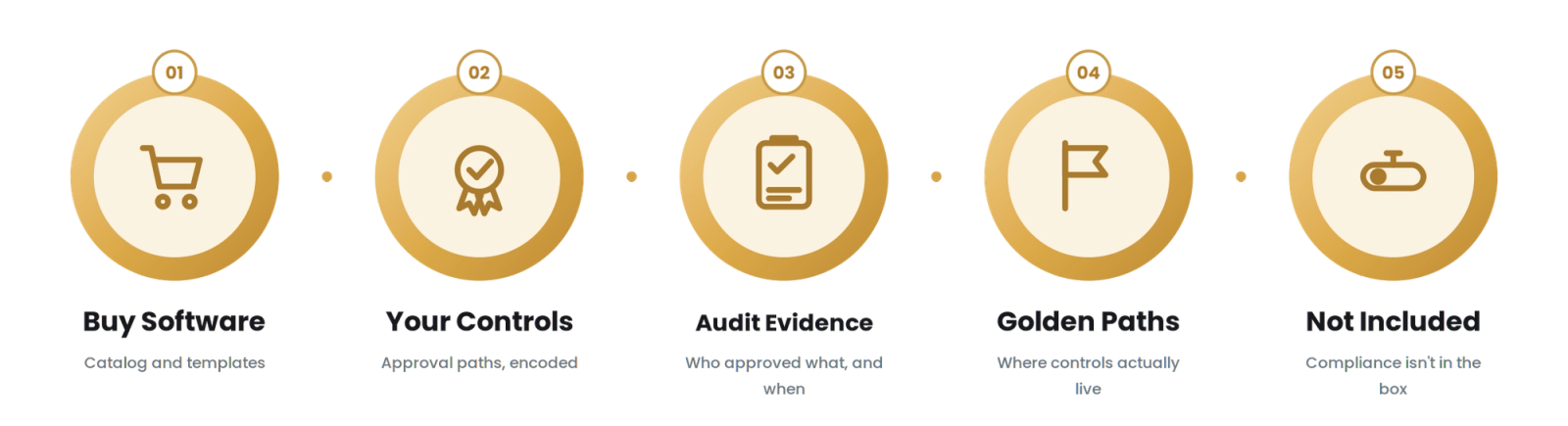
What it cannot provide is the knowledge that services touching cardholder data need a specific approval path, that certain changes require segregation of duties, or that your evidence pack needs a particular record of who approved what and when.
Those are your controls, encoded in your golden paths, and no vendor ships them. Six months in, the platform is deployed and the compliance workflows are still done by email.
Buying moves the work. In fintech, the work that remains is the part auditors ask about.
IDP build versus buy for fintech is a decision about which layers you own, the portal and orchestration versus the integrations, golden paths, approval workflows, and audit evidence, given that the control-bearing layers stay yours whichever way procurement goes.
However, most teams compare licence cost against headcount and assume compliance capability is included, then discover the control logic is entirely theirs to build.
Where to Put Cost Controls Before They Ever Reach the Cloud Bill
Embed cost controls early across architecture, provisioning, and deployment.
If you are a VP of Platform Engineering or Head of Developer Experience at a fintech company, the intent of this article is:
- Define which layers of an IDP are differentiating in a regulated org
- Show why controls and evidence cannot be bought
- Lay out how to decide honestly when audit is part of the requirement
To do that, let's start with the basics.
What Is the IDP Build vs Buy Decision for Fintech? The Basic Definition
At a high level, an internal developer platform has several layers: the portal teams interact with, the orchestration that provisions things, the integrations connecting it to source control, CI, cloud, and incident tooling, the catalog describing services and ownership, and the golden paths encoding how your org ships software.
In fintech there is a sixth layer that changes the calculation: the control layer, meaning approval workflows, segregation of duties, change records, and the evidence those produce. Products supply the first three layers well.
The catalog, golden paths, and control logic are yours in every scenario, and in a regulated org they are also the layers most likely to be examined.
To compare:
Buying an IDP is like buying a kitchen rather than building one from timber. You save real time on cabinets and plumbing. You still choose the layout, source the ingredients, and satisfy the food hygiene inspector, and the inspector is not interested in your cabinets.
Most fintech platform teams evaluate cabinets extensively and then improvise the hygiene records. The portal is the cabinets. Your golden paths and evidence trail are what gets inspected.
Why Does This Decision Matter for Fintech?
Issues that it addresses or resolves:
- Cost comparisons that price software and ignore control and integration work
- Assumptions that a purchased platform brings compliance capability
- Approval and evidence workflows left outside the platform entirely
Resolved Issues by Deciding Honestly
- Effort budgeted for control logic and evidence, not just deployment
- Undifferentiated portal infrastructure bought rather than rebuilt
- Approval workflows encoded in golden paths rather than run over email
Core Components of the IDP Build vs Buy Decision in Fintech
- An honest inventory of which layers are differentiating for you
- Control logic recognised as org-specific and unbuyable
- Integration effort estimated against your actual tool landscape
- Evidence generation designed into golden paths from the start
- Adoption planned as a programme with control owners involved
Modern IDP Options for Fintech
- Commercial developer portals with integration and plugin frameworks
- Open source portals requiring assembly and ongoing maintenance
- Composed platforms built on existing tooling with a thin interface
- Managed offerings reducing operational burden
- Hybrid approaches buying the portal and building the controls
These options differ mainly in how much commodity infrastructure you avoid building. None supply your control logic, approval paths, or evidence trail, which in a regulated org is where the effort and the scrutiny both concentrate.
Other Core Issues They Will Solve
- Platform teams stop rebuilding portal infrastructure that already exists
- Effort concentrates on controls and paths unique to your org
- Evidence becomes a by-product of the platform rather than a manual exercise
In Summary: IDP build versus buy for fintech is a decision about which layers you own, since the golden paths, approval workflows, and audit evidence remain yours in either case and carry most of the risk.
Importance of This Decision for Fintech in 2026
Regulated engineering orgs are under the same pressure to move fast as everyone else, with more to prove. Four reasons explain why deciding well matters now.
1. Controls in a platform beat controls in a process.
An approval encoded in the golden path happens every time. An approval described in a policy document happens when someone remembers.
2. Evidence should be a by-product.
If proving change control requires assembling screenshots, your audit cycle costs more than the platform saved.
3. The differentiating work is unbuyable.
No vendor knows which of your services fall inside a control scope or what your segregation requirements are.
4. Adoption failure is the common outcome.
Most disappointing platform programmes deployed successfully and were never used, because the compliant path was still slower than the workaround.
Traditional vs. Modern Fintech Platform Sourcing
- Build everything vs. buy undifferentiated infrastructure
- Compare licence to headcount vs. compare total effort by layer
- Controls in documents vs. controls encoded in golden paths
- Evidence assembled manually vs. evidence generated by the platform
In summary: A modern fintech approach buys the commodity layers and invests the team's time in golden paths, control logic, and the evidence they produce.
Details About the Core Components of This Decision in Fintech: What Are You Designing?
Let's go through each component.
1. Layer Layer
What is differentiating.
Layer decisions:
- Portal and orchestration assessed as commodity
- Golden paths and control logic recognised as org-specific
- Catalog data acknowledged as permanent work
2. Control Layer
Approvals and separation.
Control decisions:
- Approval paths encoded per service classification
- Segregation of duties enforced by the platform
- Emergency paths defined rather than improvised
3. Evidence Layer
What audit consumes.
Evidence decisions:
- Change records generated automatically
- Approvals attributable and timestamped
- Evidence retrievable without manual assembly
4. Integration Layer
Connecting to your tools.
Integration decisions:
- Effort estimated against your real toolchain
- Custom integrations budgeted honestly
- Maintenance owned by a named team
5. Adoption Layer
Getting teams to use it.
Adoption decisions:
- The compliant path made the fastest path
- Control owners involved early
- Feedback acted on visibly
Benefits Gained from Deciding Honestly in Fintech
- Controls applied consistently because they live in the platform
- Evidence produced automatically rather than assembled
- Engineering time spent on differentiating work rather than plumbing
How It All Works Together
The fintech platform team separates the layers instead of comparing products. Portal interface and orchestration are commodity, and building them consumes a small team for a year with no differentiation, so buying is usually right.
Integrations sit in the middle and need honest estimating against your actual toolchain rather than a vendor timeline. The layers that matter most are the ones no product supplies. Golden paths encode how your org ships software safely, which means they carry the control logic: a service handling cardholder data goes through a different approval path than an internal dashboard, and the platform should know that rather than relying on an engineer to check.
Segregation of duties is enforced by the workflow, not by trust. Every change generates a record with attributable approvals and timestamps, so evidence for an audit is retrieved rather than assembled from screenshots and email threads.
Catalog quality is permanent work, because control scope depends on knowing which services do what and who owns them, and that data goes stale quickly. Adoption then depends on the compliant path also being the fastest path, because if the golden path is slower, engineers will find a route around it and your controls will exist only on the paths nobody takes.
Common Misconception
A purchased developer platform brings compliance capability with it.
Products bring catalogs, templates, and plugin frameworks, all genuinely useful, and none of them know your control environment. No vendor can tell you which of your services fall inside a scope boundary, which changes need two approvers, or what your evidence pack must contain.
That knowledge is specific to your org and your regulators, and it has to be encoded by engineers who understand both. Teams that assume compliance is included deploy the platform, leave the approval workflows in email, and end up with a nice service catalog alongside exactly the manual process they had before.
The purchase is not the mistake. Believing it covered the control layer is. Buy the plumbing to free your engineers, then have those engineers build the controls into the paths.
Key Takeaway: Vendors ship portals, not controls. The approval logic and evidence trail are yours to build in every scenario.
Real-World IDP Sourcing for Fintech in Action
Let's take a look at how it operates with a real-world example.
We worked with a fintech platform team whose purchased portal sat alongside an unchanged email-based approval process, with these constraints:
- Separate commodity layers from control-bearing ones
- Encode approval workflows into golden paths
- Make audit evidence a by-product of the platform
Step 1: Separate the Layers
Commodity or control.
- Portal and orchestration treated as commodity
- Control logic recognised as org-specific
- Catalog quality accepted as ongoing work
Step 2: Encode the Controls
Into the paths.
- Approval paths per service classification
- Segregation of duties enforced by workflow
- Emergency paths defined in advance
Step 3: Generate the Evidence
Automatically.
- Change records produced by the platform
- Approvals attributable and timestamped
- Evidence retrievable on demand
Step 4: Estimate Integration Honestly
Against your toolchain.
- Effort scoped to real tools
- Custom integrations budgeted
- Maintenance owned by a team
Step 5: Make the Compliant Path Fastest
Or nobody uses it.
- Golden path faster than the workaround
- Control owners involved early
- Feedback acted on visibly
Where It Works Well
- Buying the portal when your interface requirements are ordinary
- Building control logic and golden paths yourself, always
- Teams that treat evidence generation as a design requirement
Where It Does Not Work Well
- Buying in the expectation that compliance is included
- Leaving approvals outside the platform in email or tickets
- Any golden path slower than the route around it
Key Takeaway: Buy the commodity layers, build the controls, and make sure the compliant path is also the fastest one.
Common Pitfalls
i) Assuming compliance is included
Products supply catalogs and templates, not your control environment. Budget engineering time to encode approval paths, segregation, and evidence generation from the start.
- Approvals stay in email while the portal sits unused
- Evidence still assembled manually each audit cycle
- The platform adds a catalog and changes nothing else
ii) Comparing licence cost to headcount
The comparison omits integration, control logic, and adoption, which dominate effort in both scenarios. Compare total effort by layer across three years.
iii) Making the compliant path slower
If the golden path takes longer than the workaround, engineers route around it and your controls apply only where nobody goes. Speed is a control requirement here.
iv) Treating the catalog as a migration
Control scope depends on knowing which services handle what. Ownership and classification data goes stale within weeks unless something keeps it current automatically.
Takeaway from these lessons: The decision is about which layers you own, and in fintech the unbuyable layers are the ones carrying your controls.
IDP Sourcing Best Practices for Fintech: What High-Performing Teams Do Differently
1. Buy the plumbing, build the controls
Purchase portal and orchestration if your needs are ordinary, and spend engineers on approval workflows and golden paths, because that is where your risk sits.
2. Design evidence as a by-product
Make every change generate an attributable record automatically, so audit becomes retrieval rather than assembly.
3. Encode classification into the paths
Let the platform know which services fall inside a control scope, so the right approval path applies without anyone checking a document.
4. Make the compliant path fastest
Optimise the golden path aggressively, because a slower compliant route guarantees workarounds and workarounds have no controls.
5. Keep the catalog current automatically
Source ownership and classification data from systems rather than surveys, since stale classification undermines every control built on it.
Logiciel's value add is helping fintech platform teams buy the commodity layers and build the control logic, approval workflows, and evidence generation that make a developer platform defensible as well as useful.
Takeaway for High-Performing Teams: Buy the portal, encode the controls into golden paths, generate evidence automatically, and make the compliant route the fast one.
Signals You Are Doing This Well in Fintech
How do you know it is working? Not by whether you shipped a portal, but by whether controls and speed both improved. These are the signals that separate a used platform from a deployed one.
Approvals live in the platform. Nothing consequential is approved over email.
Evidence is retrieved. Audit questions are answered from records the platform produced.
The compliant path is fastest. Engineers use it because it saves time, not because of a mandate.
Classification is current. The platform knows which services sit inside scope.
Engineers work on controls. Your team spends time on paths, not portal maintenance.
Adjacent Capabilities and Connected Work
This work does not exist in isolation. IDP sourcing depends on, and feeds into, the surrounding platform. Ignoring the adjacencies is the most common scoping mistake.
Golden paths carry your controls. Policy as code enforces what the paths declare. The service catalog holds the classification that decides which path applies. Secrets management and access control determine what the platform can provision.
Naming these adjacencies upfront keeps the work scoped and helps leadership see the purchase as one input rather than the answer.
The common mistake is treating each adjacency as someone else's problem. The control logic is your problem. The evidence trail is your problem. The classification data is your problem. Pretend otherwise and you own a catalog next to an unchanged manual process.
Own the adjacencies you depend on, partner with the teams that hold them, and share the controls.
Conclusion
In fintech, build versus buy is a question about which layers carry your controls. Portal interface and orchestration are commodity, and rebuilding them wastes a scarce platform team. Integrations are real work in either case.
Golden paths, approval workflows, segregation of duties, and evidence generation are entirely yours, and they are also the layers an auditor will examine. Buy the plumbing so your engineers can build the controls into the paths, make sure the compliant path is faster than the workaround, and design evidence as a by-product rather than an annual exercise.
A platform that deployed successfully and left approvals in email has solved nothing.
Where AI Should (and Should Never) Act Alone in Your Delivery Pipeline
Define where AI can act freely, require gates, or stop.
Key Takeaways:
- Buying moves the work; the control-bearing layers stay yours regardless
- Vendors ship portals and catalogs, never your approval logic or evidence trail
- If the compliant path is slower than the workaround, your controls apply to nothing
Deciding well requires honest scoping. When done correctly, it produces:
- Controls applied consistently because they live in the golden path
- Evidence generated automatically rather than assembled
- Engineering time spent on differentiating work rather than plumbing
- A compliant path engineers choose because it is faster
What Logiciel Does Here
If your purchased portal sits next to an unchanged email approval process, we help you encode controls into golden paths and make audit evidence a by-product of the platform.
Learn More Here:
- Policy as Code for Fintech
- Golden Paths for Fintech
- Developer Portals for Fintech
At Logiciel Solutions, we work with fintech platform leaders on developer platform strategy. Our reference patterns come from platforms operating in regulated environments.
Book a technical deep-dive on encoding your controls into the platform teams actually use.