
A retail platform team starts an internal developer platform programme in August, expecting to have it running by November. By late September the change freeze conversation begins, integration work is half done, and the whole thing gets parked until February.
When it restarts, the team has lost context, two engineers have moved on, and the business case has aged badly. Nothing about the technical decision was wrong. The timing was, because retail engineering runs on a calendar where roughly a third of the year is unavailable for anything risky, and platform programmes that ignore that calendar fail for reasons unrelated to build or buy.
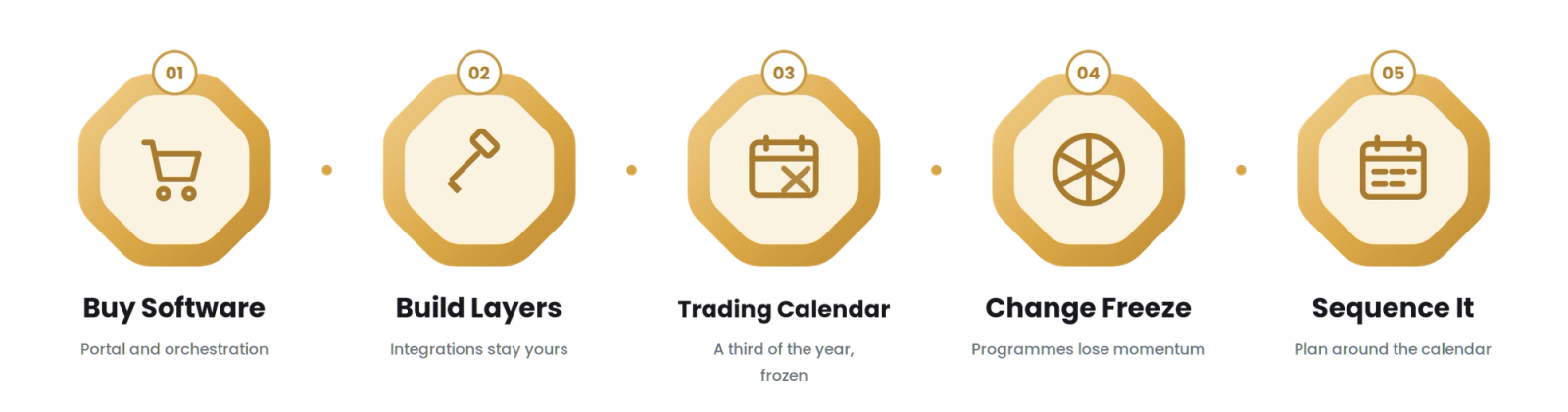
Buying moves the work. In retail, the timing decides whether the work ever finishes.
How a Platform Team Shipped an Internal Developer Platform in 120 Days
Learn how to launch an internal developer platform in 120 days.
IDP build versus buy for retail is a decision about which layers you own, the portal and orchestration versus the integrations, catalog quality, golden paths, and adoption work, made against a trading calendar that removes several months a year from serious platform change.
However, most teams compare licence cost against headcount and plan on a generic timeline, then lose the programme to a change freeze it was never scheduled around.
If you are a VP of Platform Engineering or Head of Developer Experience at a retail company, the intent of this article is:
- Define which layers of an IDP are actually differentiating
- Show why the trading calendar dominates the delivery plan
- Lay out how to decide and sequence honestly
To do that, let's start with the basics.
What Is the IDP Build vs Buy Decision for Retail? The Basic Definition
At a high level, an internal developer platform has several layers: the portal teams interact with, the orchestration that provisions things, the integrations connecting it to source control, CI, cloud accounts, and incident tooling, the catalog describing services and ownership, and the golden paths encoding how your org ships software.
Buying gives you the first two and a framework for the third. Catalog quality and golden paths are yours in every case. In retail there is an additional constraint that shapes everything: the calendar.
Peak trading periods impose freezes, and any platform change that is not fully bedded in before a freeze either waits or becomes a risk nobody will sign off.
To compare:
Buying an IDP is like buying a kitchen rather than building one from timber. You save real time on cabinets and plumbing. You still choose the layout, source the ingredients, and learn to cook, and if you are refitting the kitchen of a restaurant that does forty percent of its trade in December, the schedule matters as much as the cabinets.
Most retail platform teams evaluate cabinets thoroughly and plan the refit for November.
Why Does This Decision Matter for Retail?
Issues that it addresses or resolves:
- Cost comparisons that price software and ignore integration work
- Platform programmes scheduled without reference to the trading calendar
- Platforms deployed but unused because golden paths were never built
Resolved Issues by Deciding Honestly
- Effort budgeted for the layers that actually drive adoption
- Delivery sequenced around freezes rather than into them
- Undifferentiated infrastructure bought rather than rebuilt
Core Components of the IDP Build vs Buy Decision in Retail
- An honest inventory of which layers are differentiating for you
- A delivery plan built around the trading calendar
- Integration effort estimated against your actual tool landscape
- Golden paths recognised as org-specific and unbuyable
- Adoption planned for the quiet part of the year
Modern IDP Options for Retail
- Commercial developer portals with integration frameworks
- Open source portals requiring assembly and maintenance
- Composed platforms built on existing tooling with a thin interface
- Managed offerings reducing operational burden during peak
- Hybrid approaches buying the portal and building the paths
These options differ mainly in how much commodity infrastructure you avoid building. None supply your golden paths, catalog quality, or adoption, and none change the fact that half your year is unavailable for risky change.
Other Core Issues They Will Solve
- Platform teams stop rebuilding infrastructure that exists
- Effort concentrates on layers unique to your org
- Delivery lands in windows where change is actually permitted
In Summary: IDP build versus buy for retail is a decision about which layers you own and when you can deliver them, since golden paths and catalog quality remain yours and the trading calendar constrains everything else.
Importance of This Decision for Retail in 2026
Retail engineering teams carry the same platform pressures as everyone else with a much narrower delivery window. Four reasons explain why deciding well matters now.
1. The usable year is shorter than it looks.
Between peak preparation, freeze, and recovery, the window for significant platform change is roughly half the calendar.
2. Building the portal rarely justifies itself now.
Portal infrastructure is well-served by products, and a small retail platform team has better uses for a year.
3. Golden paths are what teams actually adopt.
The interface is not the value. The encoded path from idea to production is.
4. Managed options reduce peak-period risk.
During freeze, operating your own platform infrastructure is one more thing that can page someone at the worst time.
Traditional vs. Modern Retail Platform Sourcing
- Build everything vs. buy undifferentiated infrastructure
- Generic delivery timelines vs. plans built around the trading calendar
- Compare licence to headcount vs. compare total effort by layer
- Announce the platform vs. run adoption in the quiet months
In summary: A modern retail approach buys commodity layers, invests in golden paths, and sequences the whole programme around freeze windows.
Details About the Core Components of This Decision in Retail: What Are You Designing?
Let's go through each component.
1. Layer Layer
What is differentiating.
Layer decisions:
- Portal and orchestration assessed as commodity
- Golden paths recognised as org-specific
- Catalog data acknowledged as permanent work
2. Calendar Layer
When work can land.
Calendar decisions:
- Freeze windows mapped before planning
- Significant change scheduled to bed in well before peak
- Adoption pushed into the quiet season
3. Integration Layer
Connecting to your tools.
Integration decisions:
- Effort estimated against your real toolchain
- Store and e-commerce systems included honestly
- Maintenance owned by a named team
4. Content Layer
What teams consume.
Content decisions:
- Golden paths written for how your org ships
- Templates maintained as software
- Catalog quality measured continuously
5. Ownership Layer
Who runs it long term.
Ownership decisions:
- A named team with capacity outside peak
- Operational burden during freeze understood
- Exit costs known before commitment
Benefits Gained from Deciding Honestly in Retail
- Engineering time spent on differentiating work rather than plumbing
- Delivery that lands in windows where change is permitted
- Adoption built during the months teams have capacity to change habits
How It All Works Together
The retail platform team plans the layers and the calendar together, because either one alone produces a plan that fails. Portal interface and orchestration are commodity, so buying them frees a small team from a year of undifferentiated work.
Integration effort is estimated against the real toolchain, which in retail usually includes systems that are older and less API-friendly than the ones in a vendor demo, so the estimate needs to reflect that rather than the reference architecture.
Golden paths are built by the platform team because no product knows how your org ships software, and they are what determines whether anyone uses the platform at all. Catalog quality is permanent work, with ownership data sourced automatically because it goes stale faster than anyone expects.
Then the calendar shapes all of it: significant changes land early enough to bed in fully before freeze preparation begins, nothing risky goes near the peak window, and adoption work, which requires teams to change habits and therefore requires their attention, is scheduled for the months when they have some.
During freeze the platform must be boring and stable, which is a strong argument for managed options that reduce what your team operates directly. A programme sequenced this way delivers slower on paper and considerably faster in practice.
Common Misconception
Platform work can proceed on a normal timeline and pause for freezes.
Pausing is not free, and treating a freeze as a pause is how retail platform programmes die. When work stops for ten weeks, engineers get reassigned, context evaporates, half-finished integrations sit in an unclear state, and the business case ages against a budget cycle that has moved on.
Restarting costs far more than the calendar time suggests. The alternative is to plan in complete increments that finish and deliver value before the freeze window, so that if the programme stalls it stalls at a coherent point rather than mid-migration.
That means smaller scopes, earlier adoption pushes, and accepting that a twelve-month plan in retail is really two five-month plans with a gap. Teams that plan around the calendar deliver more per year than teams who plan through it and lose a quarter to restart cost.
Key Takeaway: A freeze is not a pause. Plan in increments that complete before it, or budget for the restart cost.
Real-World IDP Sourcing for Retail in Action
Let's take a look at how it operates with a real-world example.
We worked with a retail platform team whose programme stalled through peak and lost momentum, with these constraints:
- Separate commodity layers from differentiating ones
- Sequence delivery around the trading calendar
- Get adoption moving during the quiet months
Step 1: Separate the Layers
Commodity or not.
- Portal and orchestration treated as commodity
- Golden paths recognised as org-specific
- Catalog quality accepted as ongoing work
Step 2: Map the Calendar First
Before planning scope.
- Freeze windows identified
- Increments sized to complete before them
- Nothing risky near peak
Step 3: Estimate Integration Honestly
Against your real systems.
- Older store and commerce systems included
- Custom integrations budgeted
- Maintenance owned by a team
Step 4: Build the Golden Paths
The part nobody sells.
- Paths written for your org
- Templates maintained as software
- Catalog quality measured
Step 5: Run Adoption in the Quiet Season
When teams have attention.
- Early partners chosen deliberately
- Value demonstrated before mandate
- Feedback acted on visibly
Where It Works Well
- Buying the portal when requirements are ordinary
- Managed options that reduce what you operate during freeze
- Programmes sequenced in increments that complete before peak
Where It Does Not Work Well
- Any significant change landing close to peak trading
- Buying to avoid staffing a platform team
- Twelve-month plans that assume continuous delivery capacity
Key Takeaway: Buy the commodity layers, build the paths, and sequence everything so each increment finishes before the calendar closes.
Common Pitfalls
i) Planning through the freeze
Treating a freeze as a pause underestimates restart cost by a wide margin. Plan increments that complete and deliver value before the window closes.
- Context and people are lost during the gap
- Half-finished work sits in an unclear state
- The business case ages against a moved budget cycle
ii) Comparing licence cost to headcount
The comparison ignores integration, content, and adoption effort, which dominate in both scenarios. Compare total effort by layer across three years.
iii) Underestimating legacy integration
Retail estates carry older store and commerce systems that are far less API-friendly than a vendor demo suggests. Scope integration against what you actually run.
iv) Adoption pushes during peak preparation
Asking teams to change how they ship while they are preparing for the busiest quarter guarantees refusal. Schedule adoption when teams have attention to spare.
Takeaway from these lessons: In retail, the sourcing decision matters less than the sequencing, and both need to be honest about the calendar.
IDP Sourcing Best Practices for Retail: What High-Performing Teams Do Differently
1. Map the calendar before scoping
Identify freeze windows first and size increments to complete before them, because a plan that ignores the calendar is a plan that stalls.
2. Buy the plumbing, build the paths
Purchase portal and orchestration if your needs are ordinary, and spend engineers on golden paths, which is where adoption comes from.
3. Estimate integration against your real estate
Include the older systems, because retail toolchains are rarely as modern as the reference architecture assumes.
4. Prefer managed operation through peak
Reduce what your team runs directly during freeze, so platform infrastructure is not another thing that can page someone in December.
5. Run adoption in the quiet months
Ask teams to change habits when they have capacity, and let early partners carry the argument into the busy season.
Logiciel's value add is helping retail platform teams decide by layer and sequence by calendar, so platform programmes deliver in complete increments rather than stalling across a freeze and restarting from scratch.
Takeaway for High-Performing Teams: Buy the commodity layers, build the golden paths, and plan every increment to finish before the trading calendar closes.
Signals You Are Doing This Well in Retail
How do you know it is working? Not by whether you shipped a portal, but by whether increments completed and teams adopted. These are the signals that separate a delivered programme from a stalled one.
Increments complete. Each phase delivered value before a freeze window.
Teams use it voluntarily. Adoption grew during the quiet season without a mandate.
Golden paths are faster. Using the platform beats the alternative on time to production.
Peak is boring. The platform did not generate incidents during the busiest weeks.
The catalog is trusted. Ownership data stays current enough to rely on.
Adjacent Capabilities and Connected Work
This work does not exist in isolation. IDP sourcing depends on, and feeds into, the surrounding platform. Ignoring the adjacencies is the most common scoping mistake.
Golden paths determine whether the platform is worth using. The service catalog determines whether it can be trusted. Self-service infrastructure is what the portal invokes. Your freeze and change management process determines when any of it can move.
Naming these adjacencies upfront keeps the work scoped and helps leadership see the purchase as one input rather than the answer.
The common mistake is treating each adjacency as someone else's problem. The golden paths are your problem. The calendar sequencing is your problem. The adoption programme is your problem. Pretend otherwise and you own a portal that arrived in November and was never opened.
Own the adjacencies you depend on, partner with the teams that hold them, and share the plan.
Conclusion
Build versus buy in retail is two decisions in one. The first is about layers: portal and orchestration are commodity, integrations are real work in either case, and golden paths and catalog quality are yours and determine whether anyone uses the platform.
The second is about timing, and in retail it is the one that decides outcomes. Map the freeze windows before scoping anything, size increments to complete and deliver value before those windows close, keep the platform boring through peak, and run adoption when teams have the attention to change habits.
A well-chosen platform delivered in November is worth less than an adequate one delivered in May.
Build vs Buy in the AI Era: A Framework Before You Commit Budget
Evaluate build-versus-buy decisions using SaaS utilization signals before committing budget.
Key Takeaways:
- Buying moves the work; golden paths and catalog quality stay yours regardless
- The trading calendar removes roughly half the year from significant platform change
- A freeze is not a pause, and restart costs more than the calendar time suggests
Deciding well requires honest scoping and sequencing. When done correctly, it produces:
- Engineering time spent on differentiating work rather than plumbing
- Increments that complete before the calendar closes
- Adoption built when teams have capacity to change
- A platform that stays boring through peak trading
What Logiciel Does Here
If your platform programme keeps stalling across peak, we help you decide by layer, sequence by calendar, and build the golden paths that make adoption happen in the quiet months.
Learn More Here:
- Golden Paths and Self-Service Infrastructure
- Developer Portals and Catalog Quality
- Platform Engineering ROI for Retail
At Logiciel Solutions, we work with retail platform leaders on developer platform strategy. Our reference patterns come from platforms delivered around trading calendars.
Book a technical deep-dive on sequencing your platform programme around peak.