
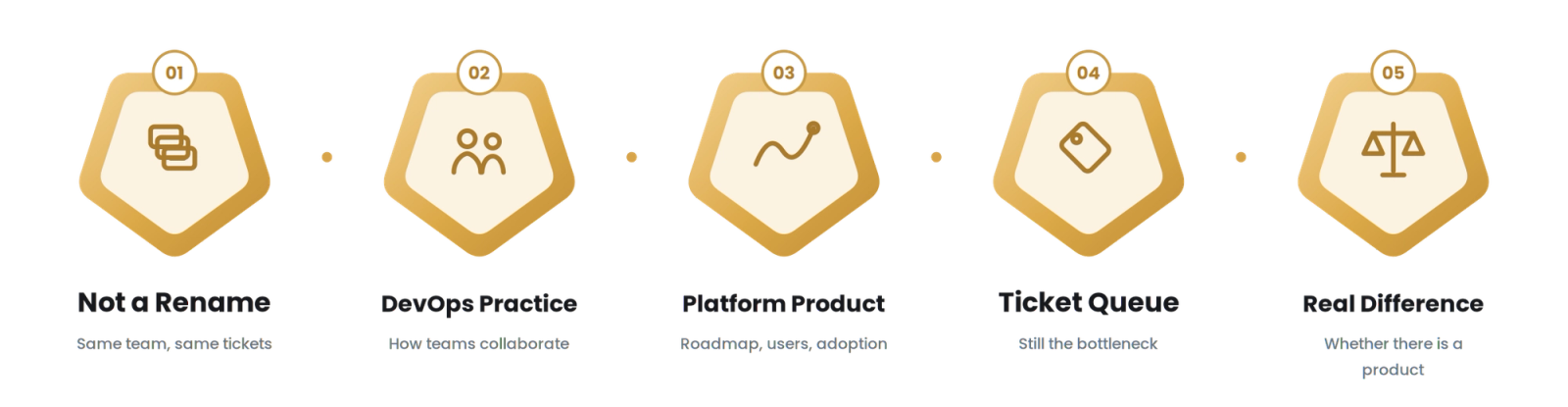
A SaaS company renames its DevOps team to Platform Engineering, changes nothing else, and waits for the benefits. Eighteen months later the team is still doing ticket-driven work, still the bottleneck for thirty product teams, and still measured on how quickly it closes requests.
The rename accomplished nothing because the difference between DevOps and platform engineering is not organisational. DevOps is a set of practices about how software teams work. A platform is a product with users, a roadmap, and an adoption problem.
If your team takes tickets rather than shipping capabilities people choose to use, you have renamed a service desk.
The difference is not who does the work. It is whether there is a product.
How a Platform Team Shipped an Internal Developer Platform in 120 Days
Learn how to launch an internal developer platform in 120 days.
Platform engineering for SaaS means building an internal product that product teams choose to use because it makes shipping faster, with a roadmap, users, and adoption metrics, whereas DevOps is a set of cultural and technical practices about collaboration between development and operations.
However, most orgs treat the terms as interchangeable, rename a team, and keep a ticket queue, which produces none of the benefits either idea promises.
If you are a VP of Platform Engineering or Head of Developer Experience at a SaaS company, the intent of this article is:
- Define the actual difference between a practice and a product
- Show why ticket-driven platform teams stay bottlenecks
- Lay out what changes when you treat the platform as a product
To do that, let's start with the basics.
What Is the Difference Between Platform Engineering and DevOps for SaaS? The Basic Definition
At a high level, DevOps is a way of working: shared ownership between development and operations, automation of build and deploy, fast feedback, and blameless response to failure. It is a practice, and it belongs to everyone rather than to a team.
Platform engineering is what you do when that practice needs to scale across many teams: you build an internal product, the platform, that packages the hard parts, paved paths, provisioning, observability defaults, deployment machinery, so thirty product teams do not each solve them separately.
The platform has users who can choose not to use it, which is what makes it a product rather than a service desk. That constraint changes everything about how you decide what to build.
To compare:
DevOps is a cooking philosophy: everyone in the kitchen shares responsibility for the meal. Platform engineering is building the kitchen: the ovens, the prep stations, the mise en place, so thirty cooks work fast without each sourcing their own equipment.
You can practise the philosophy in a bad kitchen and you can build a good kitchen for cooks with no shared philosophy. They are complementary, not sequential, and renaming your kitchen staff does not improve the equipment.
Why Does This Distinction Matter for SaaS?
Issues that it addresses or resolves:
- Renamed teams doing identical ticket-driven work
- Platform teams as bottlenecks rather than enablers for thirty teams
- Roadmaps driven by request volume instead of user need
Resolved Issues by Treating the Platform as a Product
- Capabilities shipped that teams choose to use
- Self-service replacing tickets for common needs
- Roadmaps driven by adoption and developer experience data
Core Components of Platform Engineering in SaaS
- A product with a roadmap, not a queue with a backlog
- Users who can decline to use it
- Golden paths encoding how your org ships
- Self-service capability replacing request handling
- Adoption and experience metrics guiding priorities
Modern Platform Engineering Practice for SaaS
- Product management applied to internal tooling
- Golden paths designed around real developer workflows
- Self-service provisioning through paved interfaces
- Developer experience measurement, both survey and telemetry
- Support models with published expectations
These practices are what separate a platform from a rebranded operations team. The differentiator is not the technology stack; it is whether anyone is doing product management on the internal product.
Other Core Issues They Will Solve
- Product teams unblock themselves for common needs
- Platform work prioritised by impact rather than by who asked loudest
- The platform improves because usage data says where it should
In Summary: Platform engineering for SaaS builds an internal product teams choose to use, with a roadmap and adoption metrics, while DevOps remains a practice about how teams work. Renaming one to the other changes nothing.
Importance of This Distinction for SaaS in 2026
Most SaaS orgs now have a platform team, and the variance in outcomes is enormous. Four reasons explain why the distinction matters.
1. Renames are common and rarely change behavior.
Many teams changed their name and kept their ticket queue, which produces disappointment attributed to the wrong cause.
2. Ticket-driven teams cannot scale to thirty consumers.
A queue grows linearly with team count. A product does not.
3. Optionality forces quality.
When teams can route around your platform, the platform has to be good, which is a healthier constraint than a mandate.
4. Measurement changes what gets built.
Teams that measure adoption and developer experience build different things than teams that measure ticket closure time.
Traditional vs. Modern SaaS Platform Work
- Ticket queue vs. product roadmap
- Requests handled vs. capabilities shipped
- Success measured by response time vs. measured by adoption
- Mandated usage vs. teams choosing the paved path
In summary: A modern SaaS approach runs the platform as a product with users and a roadmap, rather than as an operations queue with a new name.
Details About the Core Components of Platform Engineering in SaaS: What Are You Designing?
Let's go through each component.
1. Product Layer
The platform as product.
Product decisions:
- A roadmap driven by user need, not request volume
- Someone accountable for the product, not just delivery
- Capabilities shipped rather than tickets closed
2. User Layer
Who consumes it.
User decisions:
- Product teams treated as users with choice
- Research done rather than assumed
- Feedback loops that visibly change the roadmap
3. Path Layer
Golden paths.
Path decisions:
- The paved path faster than the alternative
- Standards encoded in the path
- Escape hatches documented, not hidden
4. Self-Service Layer
Removing the queue.
Self-service decisions:
- Common needs met without a ticket
- Guardrails replacing gatekeeping
- Requests treated as gaps in the product
5. Measurement Layer
Knowing if it works.
Measurement decisions:
- Adoption tracked per capability
- Developer experience measured through survey and telemetry
- Ticket volume read as a product defect signal
Benefits Gained from Platform Engineering in SaaS
- Product teams unblock themselves for common infrastructure needs
- Platform work prioritised by impact across thirty teams
- Standards applied because the fast path carries them
How It All Works Together
The SaaS platform team stops treating incoming requests as the work and starts treating them as data about the product. A request for a new environment is not a task to complete; it is evidence that provisioning is not yet self-service.
That reframing is the whole difference. The team runs a roadmap driven by user need, informed by actual research with product teams rather than assumptions about what they want, and ships capabilities rather than closing tickets.
Golden paths encode how the org ships software, with standards built in, and they are designed to be genuinely faster than the alternative, because teams can decline to use them. Escape hatches are documented rather than hidden, since a team with a legitimate edge case should not have to fight the platform or lie about it.
Self-service replaces gatekeeping for common needs, with guardrails ensuring that fast does not mean unsafe. And measurement drives priorities: adoption per capability, developer experience through both surveys and telemetry, and ticket volume read as a defect signal rather than a productivity metric.
Meanwhile DevOps practices, shared ownership, automation, fast feedback, blameless response, continue to apply to everyone including the platform team, because the platform is software and the people building it need the same practices they enable for others.
Common Misconception
Platform engineering replaced DevOps.
They are not the same category of thing, so one cannot replace the other, and treating them as sequential stages leads teams to abandon practices they still need. DevOps describes how teams work: shared ownership, automation, fast feedback, blameless failure response.
Those practices apply to a platform team as much as to a product team, and a platform built by people who do not practise them will be unreliable software with a nice interface.
Platform engineering describes what you build when those practices need to work across thirty teams without each one solving infrastructure separately. You can have excellent DevOps culture and no platform, which works until scale makes it expensive.
You can have a well-built platform and poor DevOps practice, which produces a good tool nobody operates well. The interesting orgs have both, and they never had to choose.
Key Takeaway: DevOpsis how teams work; a platform is what you build so that way of working scales. Neither replaces the other.
Real-World Platform Engineering for SaaS in Action
Let's take a look at how it operates with a real-world example.
We worked with a SaaS org that renamed its DevOps team and kept the ticket queue, with these constraints:
- Reframe requests as product signals rather than work
- Ship self-service capability for the highest-volume needs
- Measure adoption instead of ticket throughput
Step 1: Reframe the Requests
Signals, not tasks.
- Request patterns analysed for product gaps
- High-volume requests targeted for self-service
- Ticket volume read as defect data
Step 2: Build a Real Roadmap
User need, not queue order.
- Research done with product teams
- Capabilities prioritised by impact
- A named owner accountable for outcomes
Step 3: Pave the Paths
Faster than the alternative.
- Golden paths designed around real workflows
- Standards encoded in the path
- Escape hatches documented
Step 4: Replace Gatekeeping with Guardrails
Self-service.
- Common needs met without a ticket
- Guardrails keep fast paths safe
- Approval reserved for genuine risk
Step 5: Measure What Matters
Adoption, not throughput.
- Adoption tracked per capability
- Developer experience surveyed and instrumented
- Roadmap adjusted from the data
Where It Works Well
- Orgs with enough teams that a shared platform pays for itself
- Platform teams given room to run a roadmap rather than a queue
- Cultures where product teams can decline and the platform must earn use
Where It Does Not Work Well
- Small orgs where a platform costs more than it saves
- Teams measured on ticket closure time
- Any platform whose adoption depends on a mandate
Key Takeaway: Platform engineering works when the platform is a product with optional users; it fails when it is a renamed queue with mandated ones.
Common Pitfalls
i) Renaming without rewiring
Changing a team's name while keeping its intake process, metrics, and incentives produces exactly the previous behavior with new job titles. Change what gets measured first.
- Ticket queues persist under a new label
- The bottleneck moves nowhere
- Disappointment gets attributed to platform engineering itself
ii) Mandating adoption
A mandate hides the signal that would tell you whether the platform is good. Let teams choose, and treat non-adoption as feedback rather than non-compliance.
iii) No product management
Without someone doing research, prioritisation, and roadmap work, the platform becomes whatever the loudest team asked for most recently. Assign the role explicitly.
iv) Hiding the escape hatches
Teams with genuine edge cases will route around the platform regardless. Documenting the escape hatch keeps them visible and keeps you informed about where the paths fall short.
Takeaway from these lessons: The distinction is behavioral, not organisational, and the tell is whether requests are treated as work or as product signals.
Platform Engineering Best Practices for SaaS: What High-Performing Teams Do Differently
1. Treat requests as defect data
Every ticket for a common need is evidence the product has a gap. Fix the gap rather than getting faster at closing tickets.
2. Run a roadmap, not a queue
Do research with product teams, prioritise by impact across thirty teams, and ship capabilities on a schedule you own.
3. Make the paved path genuinely faster
Adoption follows speed, not policy, so optimise the golden path until using it is the obvious choice.
4. Keep usage optional
Let teams decline, because optionality is the feedback mechanism that keeps the platform honest and forces quality.
5. Measure adoption and experience
Track which capabilities are used and how developers actually feel, and let that drive the roadmap rather than request volume.
Logiciel's value add is helping SaaS orgs convert renamed operations teams into genuine platform products, with roadmaps, self-service capability, and adoption metrics that scale across many product teams.
Takeaway for High-Performing Teams: Run the platform as a product with optional users, treat tickets as defects, and let adoption rather than mandate prove the value.
Signals You Are Doing Platform Engineering Well in SaaS
How do you know it is working? Not by what the team is called, but by whether teams choose the platform. These are the signals that separate a product from a renamed queue.
Tickets fall for common needs. Self-service replaced the request path.
Adoption grew without a mandate. Teams use the platform because it is faster.
The roadmap is owned. Priorities come from research, not from request volume.
Escape hatches are visible. Edge cases are documented rather than hidden.
Experience is measured. You know how developers feel, not just how fast you respond.
Adjacent Capabilities and Connected Work
This work does not exist in isolation. Platform engineering depends on, and feeds into, the surrounding organisation. Ignoring the adjacencies is the most common scoping mistake.
Golden paths are the product's core feature. Self-service infrastructure is what removes the queue. Developer experience metrics tell you whether it is working. Team topologies determine whether the platform team is positioned to enable rather than gatekeep.
Naming these adjacencies upfront keeps the work scoped and helps leadership understand why a rename alone changes nothing.
The common mistake is treating each adjacency as someone else's problem. The intake process is your problem. The measurement model is your problem. The adoption story is your problem. Pretend otherwise and the ticket queue reappears under whatever name you chose.
Own the adjacencies you depend on, partner with the teams that hold them, and share the roadmap.
Conclusion
Platform engineering and DevOps are different categories. DevOps is a practice about how teams work together, and it applies to everyone including your platform team. Platform engineering is building an internal product so that practice scales across thirty teams without each solving infrastructure separately.
The test for whether you are actually doing it is simple: are incoming requests treated as work to complete, or as evidence of gaps in a product? Teams that answer the first way have renamed a service desk.
Teams that answer the second way have a roadmap, optional users, adoption they earned, and a platform that gets better because usage data tells them where.
The State of Platform Engineering 2026: How Fast Adoption Is Moving
See how quickly platform engineering adoption is accelerating across large organizations.
Key Takeaways:
- DevOps is a way of working; a platform is a product with users who can decline
- Renaming a ticket-driven team changes nothing about the bottleneck
- Requests for common needs are product defects, not the work itself
Running a platform as a product requires different measures. When done correctly, it produces:
- Product teams unblocking themselves for common needs
- A roadmap driven by research rather than request volume
- Adoption that grew because the paved path is faster
- Standards applied because the fast path carries them
What Logiciel Does Here
If your renamed platform team is still running a ticket queue, we help you rebuild it as a product with a roadmap, self-service capability, and adoption metrics that scale.
Learn More Here:
- Golden Paths for Technology & SaaS
- Self-Service Infrastructure for Technology & SaaS
- Developer Experience Metrics for Technology & SaaS
At Logiciel Solutions, we work with SaaS engineering leaders on platform strategy. Our reference patterns come from platforms serving many product teams.
Book a technical deep-dive on turning your platform team into a product team.