
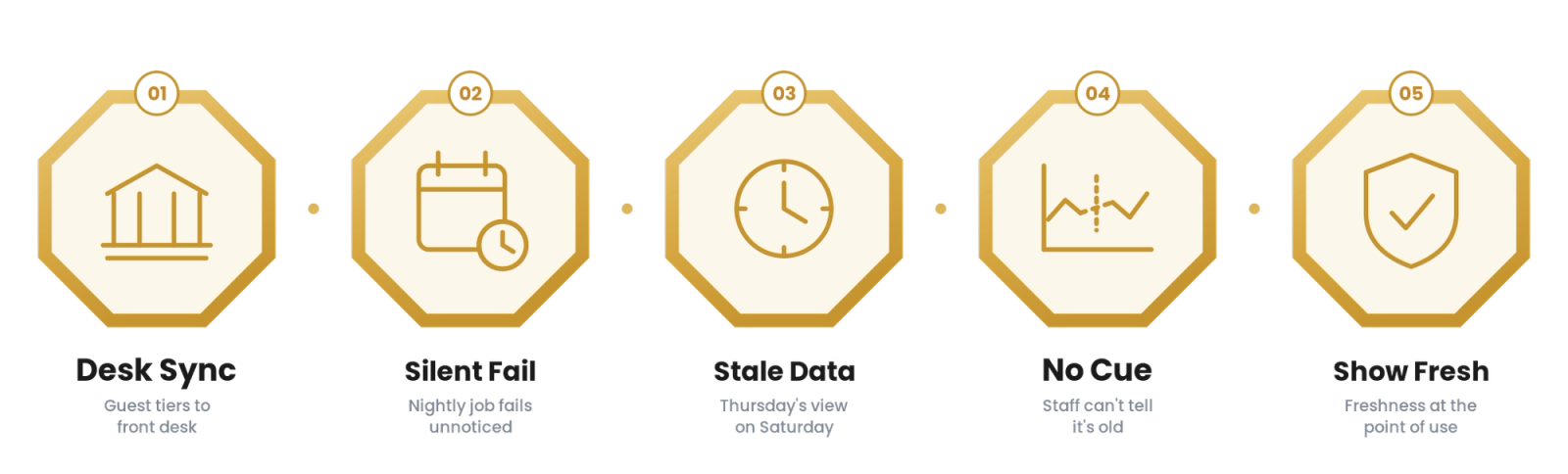
A hotel group syncs guest value tiers and preference flags from the warehouse into their property management system, so front desk staff see who they are checking in. It works well until a nightly job fails silently on a Friday.
Saturday morning, staff at eleven properties are looking at Thursday's data: a guest whose complaint was resolved still flagged as unhappy, a returning guest whose tier upgraded overnight still showing as standard.
Nobody at the desk knows the data is a day old, because the screen looks the same either way. Staff act on it confidently, which is exactly what you asked them to do, and the guest experience takes the hit.
Reverse ETL puts warehouse data in front of staff who cannot tell whether it is current.
Reverse ETL for hospitality means syncing modelled guest and operational data from the warehouse into the systems staff use, property management, CRM, service tooling, so insight reaches the point of guest contact, which makes freshness visibility a design requirement rather than a nice extra.
Why $400K of API Integrations Still Won't Fix Your Property Management Data
Identify property data model mismatches before costly integrations compound them.
However, most teams treat it as a data movement feature and forget that the person consuming the data at the desk has no way to know when it last updated.
If you are a CDO or VP of Data at a hospitality company, the intent of this article is:
- Define what reverse ETL changes when the consumer is a staff member
- Show why freshness must be visible at the point of use
- Lay out how to run activation safely across many properties
To do that, let's start with the basics.
What Is Reverse ETL for Hospitality? The Basic Definition
At a high level, reverse ETL moves modelled data out of the warehouse into the operational systems where staff work: guest value tiers and preferences into the property management system, service history into the front desk view, propensity signals into the reservations tool, maintenance patterns into housekeeping systems.
The mechanism is largely solved. The distinguishing factor in hospitality is the consumer. The person acting on the data is standing in front of a guest, has seconds to decide, and cannot see a pipeline status.
That makes staleness a service failure rather than an analytical inconvenience, and it makes freshness indicators part of the product rather than an operational detail.
To compare:
A dashboard consumer who sees odd data pauses and checks. A front desk agent who sees a guest flagged as a first-time visitor greets them as one, and if the guest has stayed eleven times the recovery costs far more than the flag was worth.
The data did not become less accurate at the desk. The ability to question it disappeared, because the person using it has no context about where it came from or when.
Why Does Reverse ETL Need Care in Hospitality?
Issues that it addresses or resolves:
- Guest insight trapped in dashboards while staff work in other systems
- Stale data reaching staff with no indication that it is stale
- Property-level inconsistency when syncs fail partially
Resolved Issues by Treating It as Production
- Guest data reaching the point of contact reliably
- Freshness visible to the person acting on it
- Partial sync failures detected rather than absorbed
Core Components of Reverse ETL in Hospitality
- Contracts on the models being synced
- Freshness timestamps surfaced in the staff-facing system
- Pre-flight anomaly detection before data leaves the warehouse
- Guardrails halting a sync on unexpected change
- Per-property monitoring, not just aggregate success
Modern Reverse ETL Tooling for Hospitality
- Sync platforms with field-level mapping and scheduling
- Data contracts defined as code on source models
- Anomaly detection on record counts and value distributions
- Freshness metadata carried into the destination
- Per-destination monitoring across properties
These tools make activation dependable at the desk. Carrying freshness metadata into the destination is what lets staff know whether to trust what they see.
Other Core Issues They Will Solve
- Staff act on guest data they can trust or knowingly discount
- Partial failures across properties are visible immediately
- Wrong data stops before it reaches a guest interaction
In Summary: Reverse ETL for hospitality delivers guest and operational data into staff-facing systems, and doing it safely means surfacing freshness and detecting failure before it reaches the desk.
Importance of Reverse ETL for Hospitality in 2026
Guest expectations around recognition and personalisation keep rising. Four reasons explain why this matters now.
1. Recognition is the promise.
Personalisation programmes depend on staff seeing accurate guest context, and wrong context is worse than none.
2. Staff cannot audit the data.
A front desk agent has no visibility into pipeline health and no time to check, so the system must tell them.
3. Partial failures hide in aggregates.
A sync that succeeded for ninety properties and failed for eleven reports as mostly working, which is not how a guest experiences it.
4. Recovery is expensive.
A service failure caused by wrong data costs a compensation gesture and a review, both of which exceed the value of the insight.
Traditional vs. Modern Hospitality Data Activation
- Manual exports to properties vs. scheduled automated syncs
- No freshness indication vs. timestamps surfaced at the point of use
- Aggregate sync success vs. per-property monitoring
- Models as analytical only vs. models with staff-facing consumers
In summary: A modern hospitality approach syncs guest data into staff systems while making freshness visible and detecting per-property failure.
Details About the Core Components of Reverse ETL in Hospitality: What Are You Designing?
Let's go through each component.
1. Contract Layer
What the sync depends on.
Contract decisions:
- Contracts on source models, defined as code
- Freshness and quality thresholds stated
- Schema change governed by versioning
2. Freshness Layer
Telling staff what they have.
Freshness decisions:
- Last-updated timestamp carried into the destination
- Staleness beyond threshold visibly flagged
- Absence of data distinguished from absence of a flag
3. Monitoring Layer
Catching it before the desk.
Monitoring decisions:
- Anomaly detection on counts and distributions
- Checks run before sync execution
- Per-property success tracked, not just aggregate
4. Guardrail Layer
Limiting blast radius.
Guardrail decisions:
- Syncs halt on unexpected volume change
- Maximum change per run capped
- Rollback path defined per destination
5. Operational Layer
Serving the front line.
Operational decisions:
- Staff told what to do when data is flagged stale
- Escalation path for suspected wrong data
- Feedback from the desk reaching the model owner
Benefits Gained from Disciplined Reverse ETL in Hospitality
- Staff acting on guest context they can trust
- Stale data flagged rather than presented as current
- Per-property failures caught before a shift starts
How It All Works Together
The hospitality data team designs for the person at the desk rather than for the pipeline. Contracts sit on the source models, stating freshness and quality expectations and governing schema change, because a shifting definition of guest tier reaches a human conversation.
Freshness metadata travels with the data into the destination, so the property management system can show when a guest record last updated and visibly flag anything beyond the acceptable threshold. That single design choice converts an invisible failure into an informed decision: an agent seeing a staleness flag greets the guest normally rather than confidently wrong.
Monitoring runs before data leaves the warehouse, with anomaly detection on counts and distributions, and crucially tracks success per property rather than in aggregate, because a sync that worked for ninety of a hundred properties is a failure at eleven front desks.
Guardrails halt on unexpected volume change with a rollback path per destination. And the operational side is designed too: staff know what to do when data shows as stale, there is an escalation path for records that look wrong, and that feedback reaches the model owner rather than dying in a property-level workaround.
Common Misconception
If the data is in the system, staff will use it correctly.
Staff will use it exactly as presented, which is the problem when it is presented without context. A guest tier displayed as a value carries an implicit claim that it is current, and nothing in a property management system tells an agent that the underlying sync failed overnight.
The failure mode is not staff misusing the data. It is staff using it appropriately based on a presentation that omitted the one thing they needed to know. Surfacing a last-updated timestamp and flagging staleness sounds like a small interface detail and is closer to the whole design.
It converts a silent wrong answer into a visible gap, and a visible gap is something a competent agent handles gracefully every day.
Key Takeaway: Staff use data as presented. If freshness is invisible, staleness becomes a confident service failure rather than a handled gap.
Real-World Reverse ETL for Hospitality in Action
Let's take a look at how it operates with a real-world example.
We worked with a hotel group whose overnight sync failure left eleven properties working from day-old guest data, with these constraints:
- Surface freshness at the point of use
- Detect per-property failure rather than aggregate success
- Give staff a defined response when data is flagged stale
Step 1: Contract the Source Models
Not just the sync.
- Freshness and quality thresholds stated
- Schema change governed by versioning
- Contracts defined as code
Step 2: Carry Freshness Through
To the screen.
- Last-updated timestamp in the destination
- Staleness visibly flagged
- Missing data distinguished from no flag
Step 3: Monitor Per Property
Not in aggregate.
- Success tracked per destination
- Anomaly detection before sending
- Alerts routed to the model owner
Step 4: Add Guardrails
Halt, do not proceed.
- Syncs stop on unexpected volume change
- Maximum change per run capped
- Rollback path per destination
Step 5: Design the Staff Response
Operational, not just technical.
- Staff know what to do with stale flags
- Escalation path for wrong-looking records
- Feedback reaches the model owner
Where It Works Well
- Guest context that staff genuinely use at the point of contact
- Systems where a freshness indicator can be surfaced
- Orgs willing to monitor per property rather than in aggregate
Where It Does Not Work Well
- Destinations that cannot display freshness metadata
- Aggregate-only monitoring across a large estate
- Any sync whose failure is invisible to the person consuming it
Key Takeaway: In hospitality the consumer is a person with seconds to act, so freshness visibility and per-property monitoring matter more than sync throughput.
Common Pitfalls
i) No freshness indicator
Data presented without a timestamp carries an implicit claim of currency that staff reasonably act on. Carry last-updated metadata through and flag staleness.
- Stale data drives confident wrong service
- Staff have no way to know or ask
- Recovery costs exceed the value of the insight
ii) Aggregate sync monitoring
Ninety-percent success reads as healthy and means eleven properties are working blind. Track success per destination and alert on any.
iii) Monitoring the sync instead of the data
Transport health is the least likely failure. Check counts, distributions, and null rates before sending.
iv) No staff response defined
A staleness flag with no guidance produces improvisation. Tell staff what to do and give them an escalation path that reaches the model owner.
Takeaway from these lessons: Hospitality activation succeeds when freshness is visible, failures are detected per property, and staff know how to respond.
Reverse ETL Best Practices for Hospitality: What High-Performing Teams Do Differently
1. Surface freshness at the point of use
Carry a last-updated timestamp into the staff-facing system and flag staleness, because the person acting cannot see your pipeline.
2. Monitor per property, not in aggregate
A sync that failed for a tenth of your estate is a failure at those front desks regardless of how the overall number reads.
3. Check the data before it leaves
Run anomaly detection on counts and distributions pre-flight, and halt rather than proceed on failure.
4. Distinguish missing from absent
An empty preference field should not look the same as a guest with no preferences, since staff will interpret both as the latter.
5. Design the operational response
Tell staff what to do when data is flagged stale and give them an escalation path that reaches the model owner rather than a local workaround.
Logiciel's value add is helping hospitality data teams build activation that staff can trust at the desk, with freshness visible, per-property monitoring, and a defined response when something looks wrong.
Takeaway for High-Performing Teams: Surface freshness, monitor per property, check before sending, and design what staff do when the data is not current.
Signals You Are Doing Reverse ETL Well in Hospitality
How do you know it is working? Not by sync uptime, but by whether staff know how current their data is. These are the signals that separate trusted activation from confident guesswork.
Freshness is visible. Staff can see when a guest record last updated.
Staleness is flagged. Data beyond threshold is marked rather than shown as current.
Monitoring is per property. Any failed destination raises an alert.
Checks run pre-flight. Anomalies stop the sync before it reaches a desk.
Staff know the response. There is guidance and an escalation path for stale or wrong data.
Adjacent Capabilities and Connected Work
This work does not exist in isolation. Reverse ETL depends on, and feeds into, the surrounding data platform. Ignoring the adjacencies is the most common scoping mistake.
Data products and contracts make source models dependable. Customer 360 work determines whether guest identity resolves correctly across properties. Data quality SLAs define the thresholds monitoring enforces. Your property systems determine whether freshness can be displayed at all.
Naming these adjacencies upfront keeps the work scoped and helps leadership see activation as a service reliability commitment rather than a connector purchase.
The common mistake is treating each adjacency as someone else's problem. The freshness display is your problem. The per-property monitoring is your problem. The staff guidance is your problem. Pretend otherwise and a failed overnight job becomes eleven properties delivering worse service than if they had no data at all.
Own the adjacencies you depend on, partner with the teams that hold them, and share the contracts.
Conclusion
Reverse ETL in hospitality puts warehouse data in front of someone standing across a desk from a guest, with seconds to act and no visibility into where the data came from. That consumer changes the design.
Carry a last-updated timestamp into the destination and flag staleness, because data presented without context carries an implicit claim of currency that staff will reasonably act on. Monitor success per property rather than in aggregate, since a ninety-percent success rate means eleven front desks working blind.
Run anomaly checks before sending, define rollback per destination, and tell staff what to do when the data is flagged. Wrong guest context is worse than none.
Key Takeaways:
- The consumer is a staff member with no ability to audit the data they are shown
- Freshness must be visible at the point of use or staleness becomes confident error
- Aggregate sync monitoring hides per-property failures that guests experience directly
Running reverse ETL safely requires designing for the front line. When done correctly, it produces:
- Staff acting on guest context they can trust or knowingly discount
- Stale data flagged rather than presented as current
Seven Things Every Data Contract Needs to Pin Down (Templates Included)
Define the seven essentials every reliable data contract should include.
- Per-property failures caught before a shift begins
- A defined response when something looks wrong
What Logiciel Does Here
If a failed overnight sync can leave your front desks working from yesterday's guest data without knowing it, we help you surface freshness, monitor per property, and design the staff response.
Learn More Here:
- Customer 360 for Hospitality
- Data Products and Contracts
- Data Quality SLAs and Monitoring
At Logiciel Solutions, we work with hospitality data leaders on data activation. Our reference patterns come from estates syncing guest data into property-level systems.
Book a technical deep-dive on making activation trustworthy at the desk.