
A SaaS platform team ships automation that restarts any unhealthy pod, and page volume across thirty product teams drops by half in a fortnight. Everyone is delighted. What nobody notices is that four services are now restarting dozens of times a day, and the automation is absorbing every one of those events silently.
Three months later, one of those services causes a customer-visible incident, and the postmortem reveals it had been failing continuously since the automation shipped. The platform team did not build a self-healing system.
They built a very effective mechanism for hiding defects from the teams who owned them.
Self-healing is not about fixing more. It is about fixing narrow known things and getting louder when they repeat.
How a Platform Team Shipped an Internal Developer Platform in 120 Days
Learn how to launch an internal developer platform in 120 days.
Self-healing infrastructure for SaaS means automated remediation loops that detect a specific known failure condition, apply a documented fix, verify recovery, and escalate to the owning team when the fix does not hold or fires too often, so recurring toil disappears across many teams without defects disappearing with it.
However, most platform teams build broad automation that restarts anything unhealthy, and end up running a service that quietly suppresses thirty teams' problems at once.
If you are a VP of Platform Engineering or Head of Developer Experience at a SaaS company, the intent of this article is:
- Define self-healing as narrow, verified remediation rather than blanket recovery
- Show why suppression scales badly in a multi-team org
- Lay out how to build remediation loops product teams actually trust
To do that, let's start with the basics.
What Is Self-Healing Infrastructure for SaaS? The Basic Definition
At a high level, self-healing infrastructure in a SaaS org is a set of automated loops that recognize one specific known failure, apply the exact remediation documented for it, verify the system actually recovered, and hand off to the owning team when it did not.
The important word is specific. A self-healing loop is not a general recovery mechanism; it automates one well-understood remediation your engineers have performed manually enough times to trust. Each loop is narrow, rate-limited, and reports its own frequency back to the team that owns the service, because in a platform serving thirty teams the automation must never become the reason a team stops seeing its own failures.
To compare:
Broad automation that restarts anything unhealthy is a smoke detector wired to a fan. The alarm stops, the room looks fine, the fire continues. A narrow remediation loop is a specific fix for a specific known problem that reports every firing back to the service owner, so the defect stays visible while the symptom is handled.
Both cut page volume in month one. Only one still tells thirty teams the truth in month six. The narrowness and the reporting, not the automation, are what make self-healing a platform capability instead of a suppression layer.
Why Is Narrow Self-Healing Necessary for SaaS?
Issues that it addresses or resolves:
- Recurring failures consuming platform and product team time on the same fix
- Blanket automation hiding chronic defects from the teams that own them
- Remediation running without verification, ownership routing, or escalation
Resolved Issues by Narrow Self-Healing
- Known failures fixed automatically with a documented, verified remediation
- Chronic defects routed to the owning team as tickets rather than absorbed
- Escalation whenever the fix does not hold or fires past its limit
Core Components of Self-Healing Infrastructure in SaaS
- Detection tied to a specific, well-defined failure condition
- A remediation drawn from an existing, proven runbook
- Verification that the system genuinely recovered
- Ownership routing so every firing reaches the right team
- Rate limits and escalation when the fix does not hold
Modern Self-Healing Tooling for SaaS
- Health checks precise enough to name the failure, not just flag unhealthiness
- Runbook automation executing documented steps without improvisation
- Post-remediation verification before the loop declares success
- Service catalog integration to route recurrence to the owning team
- Alerting on remediation frequency, not only on failure
These tools make self-healing trustworthy at multi-team scale. Narrow detection, verified remediation, and ownership-aware reporting are what stop platform automation from becoming an org-wide defect concealment service.
Other Core Issues They Will Solve
- Engineers stop performing the same manual fix across many teams
- Recovery happens in seconds rather than after a page and a login
- Chronic problems reach the owning team instead of the platform team's noise floor
In Summary: Self-healing infrastructure forSaaS automates specific documented remediations with verification and ownership-aware escalation, so toil disappears across thirty teams while defects still reach the people who can fix them.
Importance of Self-Healing Infrastructure for SaaS in 2026
A platform team serving many product teams cannot manually recover everything, and should not try. Four reasons explain why narrow self-healing matters now.
1. The service count exceeds human capacity.
Thirty teams shipping independently produce more recurring failures than any central rota can absorb by hand.
2. Suppression scales worse than toil.
A platform that hides defects hides them for every team at once, which is a far larger problem than the pages it removed.
3. Ownership gets lost by default.
In a multi-team org, an automated fix with no routing means nobody learns their service is broken.
4. Toil compounds invisibly.
The same manual restart twice a week across ten services is most of an engineer's year, spent on work nobody tracks.
Traditional vs. Modern SaaS Recovery
- Page a human for every failure vs. automate the known ones and page for the rest
- Restart anything unhealthy vs. apply a specific fix to a specific condition
- Assume the fix worked vs. verify recovery before closing the loop
- Silent remediation vs. recurrence routed to the owning team
In summary: A modern SaaS approach automates narrow, verified remediations and reports every firing to the service owner, rather than absorbing thirty teams' symptoms into platform silence.
Details About the Core Components of Self-Healing Infrastructure in SaaS: What Are You Designing?
Let's go through each component.
1. Detection Layer
A specific condition.
Detection decisions:
- Health checks identify the exact failure, not general unhealthiness
- Conditions defined narrowly enough to match one remediation
- False positives eliminated before automation is enabled
2. Remediation Layer
A documented fix.
Remediation decisions:
- Steps drawn from an existing proven runbook
- One remediation per condition, no improvised branching
- Nothing automated that has not been done manually many times
3. Verification Layer
Did it work.
Verification decisions:
- Recovery confirmed before the loop declares success
- Failure to recover escalates immediately
- Verification checks outcome, not just the action
4. Ownership Layer
Who hears about it.
Ownership decisions:
- Service catalog resolves the owning team
- Every firing visible to that team, not just the platform
- Recurrence becomes their ticket, not platform background noise
5. Escalation Layer
When humans take over.
Escalation decisions:
- Rate limits enforced with escalation past the cap
- Tight cycling treated as an incident
- Recurrence trends reviewed with owning teams
Benefits Gained from Narrow Self-Healing in SaaS
- Recurring failures resolved in seconds without a human across many teams
- Chronic defects routed to owners instead of absorbed centrally
- Platform toil reduced without reducing platform signal
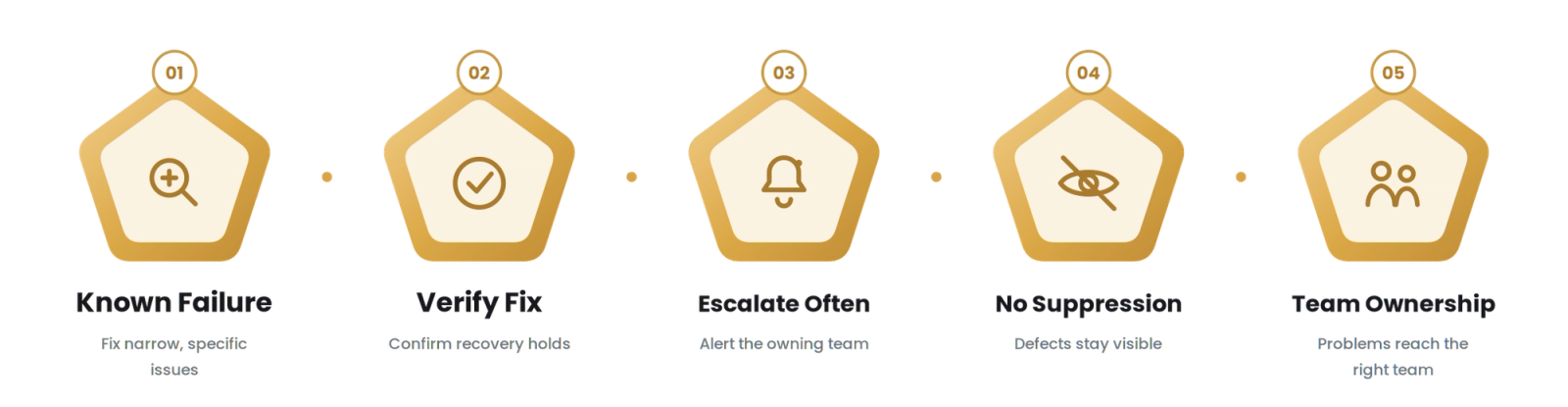
How It All Works Together
The SaaS platform team starts from the runbook rather than the automation tooling. They look for failures that engineers across teams have already fixed the same way many times, because those are the only remediations whose behavior is predictable.
Detection is written to identify that specific condition precisely, so a loop built for a stuck consumer cannot fire on an unrelated resource exhaustion problem in someone else's service. The remediation is the documented runbook step, unchanged, with no branching logic that tries to reason about the failure.
After the fix runs, verification confirms the system actually recovered, and if it did not, the loop escalates immediately instead of retrying. Because this is a platform serving thirty teams, ownership routing matters as much as the fix itself: the service catalog resolves who owns the thing that just got repaired, and that team sees every firing.
Rate limits cap how often a loop runs, and hitting the cap stops the automation and raises a human. Remediation frequency is alerted on and routed to owners, so a service failing forty times a week produces a ticket for its team rather than a quiet line in a platform dashboard. Known toil vanishes centrally; unknown problems get louder locally.
Common Misconception
The platform team should absorb as many failures as possible so product teams can focus.
That instinct is generous and produces exactly the wrong system. Absorbing a failure is only helpful when the failure is genuinely infrastructural and the remediation is complete. When the underlying cause lives in a product team's code, absorbing it means the platform team now owns a defect they cannot fix, on behalf of a team that no longer knows it exists.
Multiply that across thirty teams and the platform becomes a very expensive filter between engineers and reality. The better model is that the platform handles the mechanical recovery and makes sure the owning team sees every occurrence, so the toil is absorbed but the information is not. Coverage is not the goal. Trustworthy, ownership-aware loops are.
Key Takeaway: Absorb the toil, never the signal. A remediation that hides a product team's defect has made the platform team the owner of a bug they cannot fix.
Real-World Self-Healing for SaaS in Action
Let's take a look at how it operates with a real-world example.
We worked with a SaaS platform team whose blanket restart automation had been masking four services' chronic failures across teams, with these constraints:
- Automate only remediations already proven manually
- Verify recovery before declaring success
- Route every firing to the owning team
Step 1: Detect a Specific Condition
Precise, not general.
- Health checks identify the exact failure
- Conditions matched to one remediation
- False positives eliminated first
Step 2: Apply the Documented Fix
Runbook, unchanged.
- Steps taken directly from the runbook
- One remediation per condition
- No improvised branching
Step 3: Verify Recovery
Did it hold.
- Outcome confirmed, not just the action
- Failure escalates immediately
- No silent retries
Step 4: Route to the Owner
Who needs to know.
- Service catalog resolves ownership
- Every firing visible to that team
- Recurrence becomes their ticket
Step 5: Escalate on Recurrence
Surface the defect.
- Rate limits enforced with escalation
- Tight cycling treated as an incident
- Trends reviewed with owning teams
Where It Works Well
- Well-understood failures with a proven manual remediation
- Platforms with a reliable service catalog to resolve ownership
- Teams that treat remediation frequency as a defect signal
Where It Does Not Work Well
- Novel or poorly understood failures nobody has diagnosed
- Orgs with no ownership data, where firings route nowhere
- Platform teams measured purely on page volume reduction
Key Takeaway: Self-healing works where the failure is understood and ownership is known. It fails where the platform absorbs symptoms on behalf of teams who never hear about them.
Common Pitfalls
i) Automating before understanding
Teams automate a remediation performed twice, and the loop then runs it in situations a human would have recognised as different. Automate only what engineers have done enough times to find boring.
- The loop fires on conditions it should not
- Nobody can predict its behavior under stress
- Trust collapses across thirty teams after one bad recovery
ii) No ownership routing
An automated fix that only the platform team can see turns the platform into a filter between product teams and their own defects. Route every firing through the service catalog to the owner.
iii) No rate limits
Without a cap, a service failing every two minutes gets restarted every two minutes indefinitely. Cap the loop and treat hitting the cap as an incident.
iv) Measuring success by page reduction
Fewer pages is not the goal; fewer real problems is. A platform team rewarded for silence will build silence, and silence is what hid the defect for three months.
Takeaway from these lessons: Self-healing earns trust through narrowness, verification, ownership routing, and loudness, not through how many failure types it covers.
Self-Healing Best Practices for SaaS: What High-Performing Teams Do Differently
1. Start from the runbook, not the platform
Automate remediations engineers already perform reliably by hand, because those are the only ones whose behavior you can predict across many services.
2. Detect narrowly
Write health checks that identify one specific failure condition, so a loop never fires on a problem in another team's service that it was not designed for.
3. Verify every recovery
Confirm the system actually recovered before closing the loop, and escalate immediately when it did not.
4. Route recurrence to owners
Use the service catalog so every firing reaches the team that owns the service, because absorbing information is worse than absorbing toil.
5. Make repetition loud
Alert on remediation frequency so chronic defects become tickets for the owning team rather than a quiet line in a platform dashboard.
Logiciel's value add is helping SaaS platform teams build narrow, verified, ownership-aware remediation loops that remove real toil across thirty teams while keeping every defect visible to the team that can fix it.
Takeaway for High-Performing Teams: Automate a few remediations you fully understand, verify each one, and route every firing to the owning team so repetition cannot hide.
Signals You Are Doing Self-Healing Well in SaaS
How do you know it is working? Not by how many pages disappeared, but by whether product teams still learn about their own defects. These are the signals that separate trustworthy remediation from platform-level suppression.
Loops are narrow. Each one handles a single well-understood failure condition.
Recovery is verified. The loop confirms actual health before closing.
Owners hear everything. Every firing reaches the team that owns the service.
Cycling stops. Rate limits halt runaway loops and escalate to a human.
Product teams trust it. Nobody quietly disables the automation during an incident.
Adjacent Capabilities and Connected Work
This work does not exist in isolation. Self-healing depends on, and feeds into, the surrounding platform. Ignoring the adjacencies is the most common scoping mistake.
Observability is what makes detection precise enough to be safe. The service catalog is what resolves ownership so firings route correctly. Runbook automation is what the remediation executes. Incident management is where escalation lands.
Naming these adjacencies upfront keeps the work scoped and helps leadership see self-healing as an operational discipline rather than a way to shrink the on-call rota.
The common mistake is treating each adjacency as someone else's problem. The detection quality is your problem. The ownership data is your problem. The recurrence reporting is your problem. Pretend otherwise and the platform becomes the place thirty teams' defects go to be forgotten.
Own the adjacencies you depend on, partner with the teams that hold them, and share the signal.
See What Elite-Tier SaaS Engineering Teams Actually Look Like in 2026
See what elite SaaS engineering performance looks like across key metrics.
Conclusion
Self-healing infrastructure earns trust one narrow remediation at a time. Automate the failures your engineers already fix the same way every time, detect those conditions precisely, apply the documented runbook step, verify recovery actually held, route every firing to the team that owns the service, cap how often the loop may run, and make repetition loud enough to produce a defect ticket.
In a multi-team SaaS org the failure mode is not a broken loop. It is a platform that quietly absorbs thirty teams' symptoms and leaves them unaware. Absorb the toil. Never absorb the signal.
Key Takeaways:
- Self-healing means narrow, verified remediation of known failures, not blanket recovery
- In a multi-team org, suppression scales worse than the toil it replaced
- Ownership routing and recurrence alerting are what keep remediation honest
Building self-healing well requires restraint. When done correctly, it produces:
- Recurring failures resolved in seconds without a human
- Chronic defects routed to owners as tickets instead of absorbed
- Runaway loops stopped before they cycle indefinitely
- Product teams who trust the automation enough to leave it enabled
What Logiciel Does Here
If your remediation automation is quietly absorbing thirty teams' defects, we help you rebuild it as narrow, verified loops with ownership routing and escalation that keep problems visible.
Learn More Here:
- Runbook Automation for Technology & SaaS
- Service Catalog and Ownership Data
- AI Incident Management for Technology & SaaS
At Logiciel Solutions, we work with SaaS platform leaders on remediation automation. Our reference patterns come from production self-healing systems serving many product teams.
Book a technical deep-dive on remediation loops your product teams will actually leave switched on.