
A retailer rolls out natural language querying to merchandising and commercial teams. Adoption is immediate and enthusiastic. Two weeks later three people have asked for sales by category last month and received three different numbers, because one query used order date, one used ship date, one excluded cancellations, and none of them said which.
Every query was correct. The definitions were not agreed, so correctness at the query level produced disagreement at the business level, which is a worse outcome than nobody having access at all.
Three correct queries producing three different numbers is the specific failure. It does not look like a technical problem.
Text-to-SQL for retail means generating queries over a curated semantic layer with agreed metric definitions and explicit time period handling, so the same question produces the same number regardless of who asks it.
What Spider 2.0 and EntSQL 2026 Reveal About Text-to-SQL in Production
Understand where text-to-SQL benchmarks expose real production readiness gaps.
However, most deployments focus on generation accuracy, which is necessary and does nothing about the definitional disagreements that actually cause the arguments.
If you are a CDO or VP of Data at a retail company, the intent of this article is:
- Define why agreed definitions matter more than generation accuracy
- Show how retail date semantics create silent disagreement
- Lay out how to keep query cost from scaling with adoption
To do that, let's start with the basics.
What Is Text-to-SQL for Retail? The Basic Definition
At a high level, text to SQL turns a natural language question into a query and returns a result. In retail the questions are high volume and repetitive: sales by category, margin by supplier, stock cover by store, performance versus last year.
The technical challenge is modest. The real challenge is that most of those questions contain a term with several defensible definitions, and retail is unusually rich in them: which date, net or gross, including cancellations and returns or not, comparable stores or all.
Unless those are agreed and surfaced, the system produces correct queries and inconsistent answers.
To compare:
Text to SQL without agreed definitions is a very fast translator between two people who have not agreed what the words mean. The translation is accurate. The conversation still ends in disagreement, and now it ends there faster and more often, with each side holding a number that a system produced and therefore trusts.
Why Does Text-to-SQL Matter for Retail?
Issues that it addresses or resolves:
- Analyst queues for high volume repetitive questions
- The same question producing different numbers depending on asker
- Query cost scaling with adoption
Resolved Issues by Text-to-SQL Done Well
- Repetitive questions answered without a queue
- One number per question because definitions are agreed
- Cost controlled as usage grows
Core Components of Text-to-SQL in Retail
- A curated semantic layer with agreed metric definitions
- Explicit time period and date semantics
- Comparable period logic defined once
- Definitions surfaced with every answer
- Query cost controls as adoption grows
Modern Text-to-SQL Tooling for Retail
- Semantic layers exposing certified metrics
- Generation constrained to those metrics
- Definition display alongside results
- Result caching for repeated questions
- Query cost limits and monitoring per user
These tools produce consistency. Surfacing the definition with the answer is what turns a disputed number into a resolvable conversation.
Other Core Issues They Will Solve
- Commercial discussions starting from an agreed number
- Analyst time freed from repetitive lookups
- Cost that does not scale linearly with adoption
In Summary: Text to SQL for retail works when generation targets agreed metric definitions with explicit date semantics, so the same question always returns the same number.
Importance of Text-to-SQL for Retail in 2026
Retail questions are frequent and definitionally ambiguous. Four reasons explain why this matters now.
1. Retail terms have several defensible definitions.
Sales, margin, and comparable performance each have variants, and all of them are used somewhere in the business.
2. Fast wrong agreement is worse than slow right agreement.
Giving everyone instant access to differing numbers accelerates disagreement rather than decisions.
3. Date semantics are a silent divider.
Order date and ship date produce different monthly figures, and neither query is wrong.
4. Query cost scales with adoption.
A capability everyone uses hourly generates warehouse spend that needs controlling.
Traditional vs. Modern Retail Analytics Access
- Generation accuracy prioritised vs. definitional agreement prioritised
- Definitions implicit vs. certified and surfaced
- Date semantics assumed vs. stated per metric
- Cost unmanaged vs. caching and limits as adoption grows
In summary: A modern retail approach agrees definitions first and shows them with every answer.
Details About the Core Components of Text-to-SQL in Retail: What Are You Designing?
Let's go through each component.
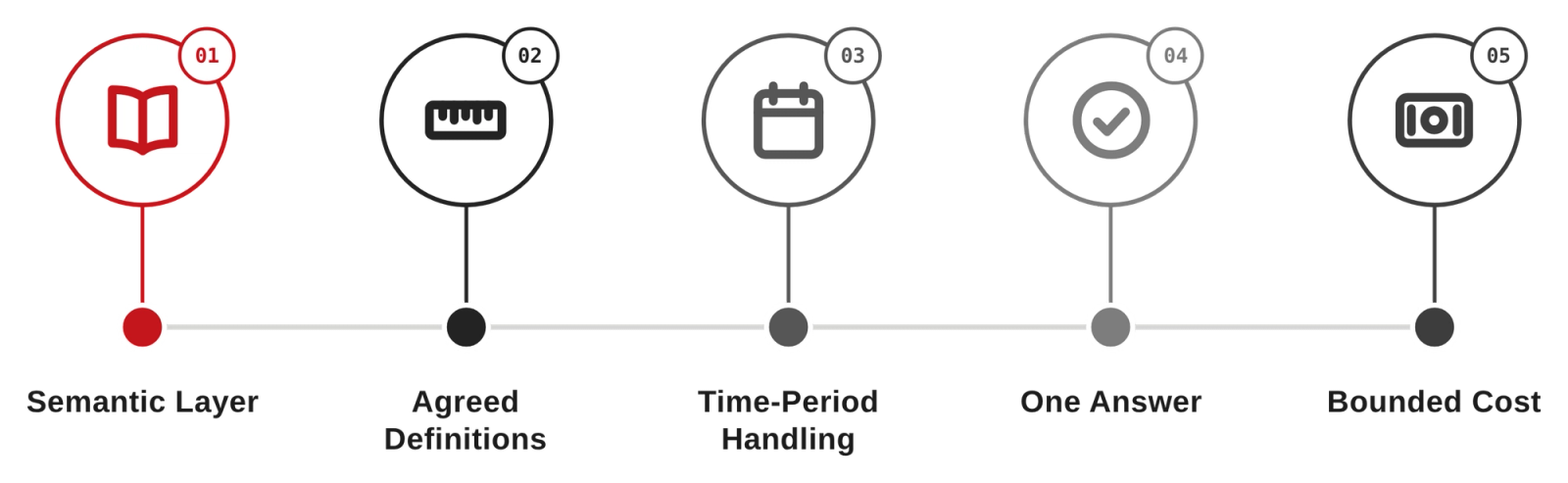
1. Definition Layer
Agreed meanings.
Definition decisions:
- Certified metrics with named owners
- Variants named distinctly rather than defaulted
- Definitions surfaced with answers
2. Time Layer
Which date.
Time decisions:
- Date semantics stated per metric
- Comparable period logic defined once
- Trading calendar handled explicitly
3. Semantic Layer
The generation target.
Semantic decisions:
- Generation constrained to certified metrics
- Join paths predefined
- Dimensions curated
4. Transparency Layer
Showing the basis.
Transparency decisions:
- Definition displayed with the number
- Query available on request
- Filters and exclusions stated
5. Cost Layer
Adoption has a bill.
Cost decisions:
- Repeated question results cached
- Per user query cost limits
- Expensive questions identified and pre-aggregated
Benefits Gained from Text-to-SQL in Retail
- One number per question across the business
- Repetitive lookups removed from analyst queues
- Cost controlled as usage grows
How It All Works Together
The retail data team agrees definitions before shipping the interface, because generation accuracy over ambiguous terms produces fast disagreement. Certified metrics are defined with named owners, and where several defensible variants exist they are named distinctly rather than one being silently defaulted, so net sales excluding cancellations and gross sales are separate selectable things rather than an assumption.
Date semantics are stated per metric, since order date and ship date produce different monthly numbers and neither is wrong, and comparable period logic including the trading calendar is defined once centrally.
Generation is constrained to those certified metrics with predefined join paths, so the model is selecting rather than inferring. Every answer displays the definition used, the date basis, and any exclusions, which converts a disputed number into a five second resolution rather than a meeting.
And because a capability everyone uses hourly generates real warehouse cost, repeated question results are cached, per user cost limits exist, and the expensive recurring questions get pre-aggregated.
Common Misconception
Once generation is accurate, we have solved the problem.
Generation accuracy means the query does what the question asked, which is necessary and insufficient, because most retail questions are ambiguous at the point of asking. Sales by category last month is four different queries depending on date basis, cancellation treatment, and whether returns net off, and a system that picks one silently is producing a correct answer to a question the asker did not know they were asking.
Three people then hold three numbers, each generated by a trusted system, and the resulting disagreement is harder to resolve than if they had all asked an analyst who would have said which definition they used. Accuracy without agreed definitions accelerates the argument.
Key Takeaway: Most retail questions are ambiguous when asked. A correct query to an unstated interpretation is a fast wrong agreement.
Real-World Text-to-SQL for Retail in Action
Let's take a look at how it operates with a real-world example.
We worked with a retailer where three people got three different answers to the same sales question, with these constraints:
- Agree and certify definitions before broadening access
- State date semantics per metric
- Control query cost as adoption grows
Step 1: Certify the Definitions
With owners.
- Metrics defined and owned
- Variants named distinctly
- Nothing silently defaulted
Step 2: State the Date Basis
Per metric.
- Date semantics explicit
- Comparable period logic central
- Trading calendar handled
Step 3: Constrain Generation
To certified metrics.
- Generation over the semantic layer
- Join paths predefined
- Dimensions curated
Step 4: Show the Basis
With every answer.
- Definition displayed
- Date basis and exclusions stated
- Query available on request
Step 5: Control the Cost
Adoption has a bill.
- Repeated results cached
- Per user limits set
- Expensive questions pre-aggregated
Where It Works Well
- High volume repetitive questions over certified metrics
- Organisations willing to agree definitions before rollout
- Estates that can cache and pre-aggregate common questions
Where It Does Not Work Well
- Rollout before definitional agreement
- Date semantics left to the generator
- Unmanaged query cost at scale
Key Takeaway: Agree definitions, state the date basis, show both with every answer, and control cost as usage grows.
Common Pitfalls
i) Shipping before agreeing definitions
Accurate generation over ambiguous terms produces multiple trusted numbers for one question, which is harder to resolve than no access. Certify metrics first.
- Three people hold three numbers
- Each trusts the system that produced theirs
- The disagreement takes a meeting to unpick
ii) Silent date defaults
Order date and ship date give different monthly figures, and a system choosing one silently is answering an unasked question. State the basis per metric.
iii) Definitions hidden
A number without its definition cannot be reconciled with another number. Display the definition, date basis, and exclusions.
iv) Unmanaged cost
Hourly usage across a commercial team generates real warehouse spend. Cache repeated results, set per user limits, and pre-aggregate the expensive recurring questions.
Takeaway from these lessons: In retail the definitional layer is the product, and the interface is the delivery mechanism.
Text-to-SQL Best Practices for Retail: What High-Performing Teams Do Differently
1. Certify definitions before rollout
Agree metrics with named owners and name the variants distinctly, because ambiguity plus speed produces fast disagreement.
2. State date semantics per metric
Make order date and ship date separate explicit choices rather than a silent default.
3. Display the definition with the number
Turn a disputed figure into a five second reconciliation rather than a meeting.
4. Cache and pre-aggregate
Identify the repeated expensive questions and serve them cheaply, because adoption multiplies query volume.
5. Set per user cost limits
Prevent a single exploratory session from generating a surprising warehouse bill.
Logiciel's value add is helping retail data teams certify the definitions and date semantics that make natural language querying produce one number per question, with cost controlled as adoption grows.
Takeaway for High-Performing Teams: Certify first, state the date basis, show the definition, cache the repeats, limit the cost.
Signals You Are Doing Text-to-SQL Well in Retail
How do you know it is working? Not by adoption, but by whether two people asking the same question agree. These are the signals that separate consistency from speed.
Definitions are certified. Every metric has an owner and a stated definition.
Date basis is explicit. Order and ship date are separate choices.
Answers show their basis. The definition and exclusions appear with the number.
Repeats are cheap. Common questions are cached or pre-aggregated.
Numbers agree. Two people asking the same thing get the same answer.
Adjacent Capabilities and Connected Work
This work does not exist in isolation. Text to SQL depends on, and feeds into, the surrounding data platform. Ignoring the adjacencies is the most common scoping mistake.
dbt practice is where certified metrics are modelled. Data catalogs surface the definitions. Warehouse cost optimization consumes the caching and limit decisions. Data quality SLAs formalise what the metrics promise. Naming these adjacencies upfront keeps the work scoped and helps leadership see definitional agreement as the deliverable.
The common mistake is treating each adjacency as someone else's problem. The certification is your problem. The date semantics are your problem. The cost controls are your problem. Pretend otherwise and you will have accelerated disagreement across the commercial team.
Own the adjacencies you depend on, partner with the teams that hold them, and share the definitions.
Conclusion
Text to SQL in retail succeeds or fails on definitions rather than on generation. Sales by category last month is several different queries depending on date basis, cancellation treatment, and returns handling, and a system that silently picks one produces a correct answer to a question nobody asked precisely.
Give three people that capability and you get three trusted numbers and a harder argument than before. Certify metrics with owners, name the variants distinctly, state date semantics per metric, display the definition and exclusions with every answer, and control cost through caching and per user limits as adoption grows.
Key Takeaways:
- Retail questions are ambiguous when asked, so definitions matter more than accuracy
- Order date versus ship date produces different numbers and neither query is wrong
- Query cost scales with adoption and needs caching and limits
Making text to SQL work requires definitional agreement. When done correctly, it produces:
- One number per question across the business
- Repetitive lookups removed from analyst queues
Why 'Buy vs Build' Is the Wrong Question for Enterprise AI
Rethink enterprise AI sourcing beyond a simple build-versus-buy decision.
- Disputes resolved in seconds because the basis is shown
- Cost that grows sublinearly with adoption
What Logiciel Does Here
If three people get three answers to the same question, we help you certify metrics, make date semantics explicit, and control query cost as adoption grows.
Learn More Here:
- Warehouse Cost Optimization for Retail
- dbt at Scale for Retail
- AI Data Catalogs and Certified Definitions
At Logiciel Solutions, we work with retail data leaders on analytics access. Our reference patterns come from estates serving high volume commercial questions.
Book a technical deep-dive on making natural language querying produce one number.