
A fintech adopts AI coding assistance and pull request volume rises noticeably within a quarter. Review absorbs the pressure the way review always does, by getting faster. Nine months later an examiner asks how changes to a payment service are reviewed and approved, and the honest answer is that approval times halved over the period while volume rose, which is a difficult thing to explain in a room where change control is the topic.
Nothing was bypassed. The control was nominally intact and substantively thinner, and the evidence trail records exactly that.
Review approving faster under rising volume is a control weakening on the record.
AI in DevOps for fintech means adopting generation assistance while expanding automated verification, protecting review depth on regulated paths, and keeping change control evidence honest as volume rises.
Modernizing DevOps for Regulated Healthcare Workloads Without the Risk
Modernize regulated healthcare delivery with stronger controls and safer change management.
However, most adoptions measure generation productivity and discover the consequence in an approval latency trend that an examiner reads differently than an engineering leader does.
If you are a VP of Engineering or Head of Infrastructure at a fintech company, the intent of this article is:
- Define why review depth is a control rather than a preference here
- Show how approval latency becomes audit evidence
- Lay out how to expand verification before volume arrives
To do that, let's start with the basics.
What Is AI in DevOps for Fintech? The Basic Definition
At a high level, AI in DevOps means using generation and assistance across the delivery pipeline: code, tests, configuration, and documentation. The effect on a delivery system is that one stage becomes elastic while the others stay bounded, so the constraint relocates to whichever had least slack, usually human review.
In a regulated estate that relocation has a second consequence. Review is not only a quality mechanism, it is a documented control with an evidence trail, and a measurable decline in review depth under rising volume is visible in that trail whether or not anyone intended it.
To compare:
In most organisations a reviewer spending less time per change is a quality trade made under pressure. In a regulated one it is also a data point in an audit record, sitting next to a rising volume trend, telling a story neither the reviewer nor their manager chose to tell. The behaviour is identical. The exposure is not.
Why Does AI in DevOps Matter for Fintech?
Issues that it addresses or resolves:
- Generation volume rising while review capacity stays fixed
- Approval latency falling in a way that appears in audit evidence
- Automated verification unchanged while volume grows
Resolved Issues by Deliberate Adoption
- Verification capacity expanded before volume arrives
- Review depth protected on regulated change paths
- Change control evidence that reflects a real control
Core Components of AI in DevOps in Fintech
- Automated checks expanded ahead of adoption
- Review depth protected on regulated services
- Segregation of duties preserved as volume rises
- Approval latency monitored as a control signal
- Generated tests reviewed for meaningful assertions
Modern AI in DevOps Tooling for Fintech
- Generation assistance in editors and pipelines
- Static analysis, policy checks, and dependency scanning in CI
- Coverage enforcement with assertion quality review
- Review load and approval latency metrics per service tier
- Change failure and revert rate tracking
These tools keep the control real. Approval latency monitored per service tier is what turns a quiet control decline into a visible signal.
Other Core Issues They Will Solve
- Throughput improvements that survive production
- Change control that still means something at volume
- Regulated paths reviewed at unchanged depth
In Summary: AI in DevOps for fintech relocates the delivery constraint to review, which is a documented control here, so verification capacity and review depth need expanding deliberately.
Importance of AI in DevOps for Fintech in 2026
Adoption is widespread and its second-order effects reach the control environment. Four reasons explain why this matters now.
1. Review is a control, not a preference.
Its depth is evidenced, and a decline appears in the record regardless of intent.
2. Generation capacity is elastic and review is not.
A volume increase lands entirely on a resource bounded by headcount and attention.
3. Approval latency is readable as evidence.
Falling approval times against rising volume is a trend an examiner will interpret without your framing.
4. Regulated paths need unchanged depth.
Efficiency gains that are acceptable on internal tooling are not acceptable on a payment service.
Traditional vs. Modern Fintech AI Adoption in Delivery
- Generation measured vs. verification capacity planned
- Review depth assumed stable vs. monitored per service tier
- Automated checks unchanged vs. expanded before volume
- Degradation found in failure rate vs. detected in approval latency
In summary: A modern fintech approach expands automated verification first and monitors review depth as a control signal rather than a productivity one.
Details About the Core Components of AI in DevOps in Fintech: What Are You Designing?
Let's go through each component.
1. Automation Layer
Absorbing volume.
Automation decisions:
- Static analysis and policy checks broadened
- Coverage enforced in CI
- Checks fast enough that nobody bypasses them
2. Tier Layer
Not all changes are equal.
Tier decisions:
- Regulated and transaction paths identified
- Review depth requirements set per tier
- Efficiency gains taken on lower tiers
3. Segregation Layer
Preserving separation.
Segregation decisions:
- Author and approver kept distinct at volume
- Approval delegation reviewed
- Emergency paths defined in advance
4. Signal Layer
Detecting decline.
Signal decisions:
- Approval latency monitored per tier
- Review load tracked per reviewer
- Sudden drops investigated
5. Evidence Layer
What the record shows.
Evidence decisions:
- Change control evidence retained per change
- Review depth demonstrable
- Trends explainable
Benefits Gained from Deliberate Adoption in Fintech
- Throughput gains that reach production safely
- Review depth maintained on regulated paths
- Change control evidence that reflects reality
How It All Works Together
The fintech engineering org expands automated verification before broadening generation adoption, because the constraint will move to review and review is a control here rather than a bottleneck to be optimised. Static analysis, policy checks, dependency scanning, and enforced coverage thresholds run in CI fast enough that engineers wait for them, and that automation absorbs volume human review structurally cannot.
Change paths are tiered, with regulated and transaction-touching services carrying review depth requirements that do not flex, so efficiency gains are taken on internal tooling and lower tiers where a thinner review costs less than a payment path.
Segregation of duties is checked at volume, since a growing queue creates pressure to widen approver pools or delegate in ways that quietly collapse separation. Approval latency is monitored per tier, and a sudden drop is investigated as a control signal rather than celebrated as throughput.
Generated tests are reviewed for meaningful assertions rather than counted. And the change control evidence retained per change demonstrates depth rather than merely recording an approval.
Common Misconception
Faster review is a productivity win.
It is a productivity win in some contexts and a control question in this one, and the difference is whether anyone will read the trend later. A halving of approval time against a rising volume of changes to a payment service is, on its face, evidence that the review control weakened.
That may be defensible if automated verification expanded correspondingly and you can show it, and it is indefensible if the only thing that changed was that reviewers were busier. The distinction lives entirely in what you can demonstrate, which is why the automation expansion needs to precede the volume rather than follow the audit question.
Nobody involved acted improperly. The record simply reflects a control that thinned.
Key Takeaway: Falling approval times against rising volume reads as a weakened control unless you can show what absorbed the difference.
Real-World AI in DevOps for Fintech in Action
Let's take a look at how it operates with a real-world example.
We worked with a fintech whose approval times halved as generated volume rose, with these constraints:
- Expand automated verification before broadening adoption
- Protect review depth on regulated paths
- Monitor approval latency as a control signal
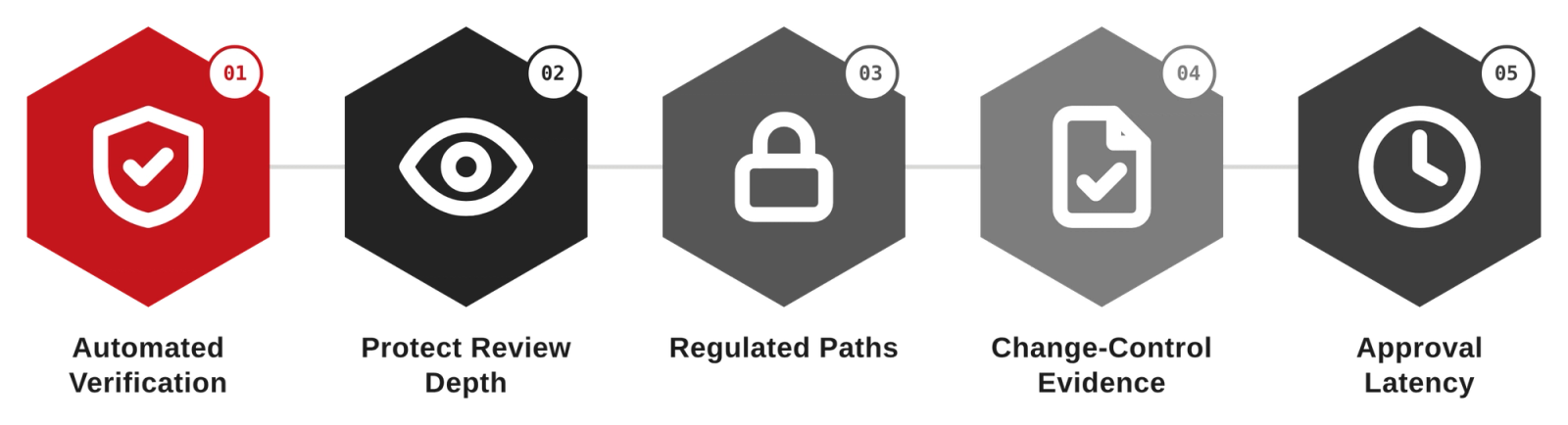
Step 1: Expand the Automation
Before the volume.
- Static analysis and policy checks broadened
- Coverage enforced in CI
- Checks kept fast
Step 2: Tier the Change Paths
Depth by consequence.
- Regulated and transaction paths identified
- Review depth fixed on those tiers
- Efficiency taken elsewhere
Step 3: Check Segregation at Volume
Separation under pressure.
- Author and approver kept distinct
- Delegation reviewed
- Emergency paths pre-defined
Step 4: Monitor Approval Latency
Per tier.
- Latency tracked by tier
- Sudden drops investigated
- Review load per reviewer watched
Step 5: Keep Evidence Honest
Depth demonstrable.
- Evidence retained per change
- Review depth shown
- Trends explainable
Where It Works Well
- Orgs that expand automated checks before volume arrives
- Estates with clear change path tiering
- Teams treating approval latency as a control metric
Where It Does Not Work Well
- Uniform review expectations across all change paths
- Adoption measured on generation productivity alone
- Segregation widened to clear a queue
Key Takeaway: Expand automation first, fix review depth on regulated paths, and read approval latency as a control signal.
Common Pitfalls
i) Letting review absorb the volume
Reviewers clearing a growing queue faster produces an approval latency trend that reads as control weakening. Expand automated checks so review does not have to absorb it.
- Approval times fall against rising volume
- The trend appears in audit evidence
- Nobody chose the outcome
ii) Uniform review expectations
Efficiency acceptable on internal tooling is not acceptable on a payment service. Tier change paths and fix depth on the regulated ones.
iii) Widening approver pools to clear queues
Pressure on a queue produces delegation and pool expansion that quietly collapses segregation. Check separation at volume explicitly.
iv) Trusting generated tests
Coverage without meaningful assertions creates confidence nothing supports. Review assertions rather than counting percentage.
Takeaway from these lessons: In a regulated estate, review depth is evidenced, so protecting it is a control requirement rather than a quality preference.
AI in DevOps Best Practices for Fintech: What High-Performing Teams Do Differently
1. Expand automated verification first
Broaden static analysis, policy checks, and coverage enforcement before volume arrives, because that is what absorbs pressure review otherwise takes.
2. Fix review depth on regulated paths
Take efficiency gains on lower tiers and hold depth where changes touch transactions or reported figures.
3. Monitor approval latency as a control signal
Treat a sudden drop as something to investigate rather than a throughput improvement.
4. Check segregation under volume
Watch for approver pool widening and delegation introduced to clear queues.
5. Review generated tests for assertions
Check that tests verify something rather than that coverage reached a number.
Logiciel's value add is helping fintech engineering orgs expand verification capacity alongside AI adoption, so throughput improves without change control evidence telling a story nobody intended.
Takeaway for High-Performing Teams: Automate first, tier the paths, watch approval latency, protect segregation, review the tests.
Signals You Are Doing AI in DevOps Well in Fintech
How do you know it is working? Not by generation output, but by whether review depth held on the paths that matter. These are the signals that separate throughput from a thinning control.
Automation expanded. Checks grew before volume did.
Depth held on regulated paths. Approval latency there is stable.
Segregation is intact. No pool widening or delegation crept in.
Latency is monitored. Drops are investigated rather than celebrated.
Evidence shows depth. Change records demonstrate review, not just approval.
Adjacent Capabilities and Connected Work
This work does not exist in isolation. AI in DevOps depends on, and feeds into, the surrounding platform. Ignoring the adjacencies is the most common scoping mistake.
Policy as code supplies the automated checks absorbing volume. dbt and analytics change control share the same tiering question. Blue-green and progressive delivery limit the cost of defects that pass review. Developer experience metrics reveal review load pressure.
Naming these adjacencies upfront keeps the work scoped and helps leadership see review depth as a control.
The common mistake is treating each adjacency as someone else's problem. The automation expansion is your problem. The tiering is your problem. The approval latency trend is your problem. Pretend otherwise and an examiner will read your control evidence before you do.
Own the adjacencies you depend on, partner with the teams that hold them, and share the tiers.
Conclusion
AI generation makes one delivery stage elastic and leaves the rest bounded, so the constraint moves to human review. In most organisations that is a throughput problem. In a fintech it is also a control problem, because review depth is evidenced and a halving of approval times against rising volume reads as a weakened control regardless of anyone's intent.
Expand automated verification before the volume arrives so something other than reviewer attention absorbs it. Tier change paths and hold review depth fixed where changes touch transactions. Watch segregation under queue pressure.
Monitor approval latency as a control signal, and keep evidence that demonstrates depth rather than recording approval.
Key Takeaways:
- Review is a documented control here, so its depth appears in audit evidence
- Falling approval latency against rising volume reads as control weakening
- Automated verification must expand before generation volume arrives
Adopting AI in delivery well requires protecting the control. When done correctly, it produces:
- Throughput gains that reach production safely
- Review depth maintained where changes touch transactions
An API Review Template Built for a World Where Agents Are Your Caller
Review APIs for agent callers before ambiguity becomes an integration risk.
- Segregation intact under queue pressure
- Change control evidence that reflects a real control
What Logiciel Does Here
If your approval times fell while change volume rose, we help you expand automated verification, tier review depth by consequence, and keep change control evidence honest.
Learn More Here:
- dbt at Scale for Fintech
- Blue-Green Deployment for Fintech
- Policy as Code and Automated Checks
At Logiciel Solutions, we work with fintech engineering leaders on delivery practice. Our reference patterns come from regulated estates adopting generation assistance.
Book a technical deep-dive on adopting AI generation without thinning your change control.