
A SaaS engineering org adopts AI coding assistance across thirty teams and pull request volume rises by roughly forty percent within two quarters. Throughput to production does not. Review becomes the constraint, reviewers start approving faster to clear the queue, and the change failure rate climbs slightly for three consecutive months before anyone connects it to the adoption.
Nothing malfunctioned. The generation capacity increased and the verification capacity did not, so the bottleneck moved to the place with the least slack and quietly degraded.
AI moves the bottleneck to whichever part of your pipeline had the least capacity. It does not remove it.
AI in DevOps for SaaS means adopting generation assistance while deliberately expanding verification capacity, so increased code volume meets proportionate review, testing, and deployment safety rather than overwhelming them.
The Scorecard That Tells You If Your AI Test Generator Is Actually Trustworthy
Measure whether AI-generated tests are trustworthy enough for CI.
However, most adoptions measure generation productivity, which improves immediately, and discover the consequence in a change failure rate three months later.
If you are a VP of Engineering or Head of Infrastructure at a SaaS company, the intent of this article is:
- Define why the bottleneck moves rather than disappears
- Show which verification capacity needs expanding first
- Lay out how to detect the degradation before the failure rate does
To do that, let's start with the basics.
What Is AI in DevOps for SaaS? The Basic Definition
At a high level, AI in DevOps means using generation and assistance across the software delivery pipeline: writing code, producing tests, generating configuration, drafting documentation, and summarising changes. The effect on a delivery system is that one stage gets substantially faster while the others do not, which relocates the constraint.
In most SaaS orgs the constraint moves to human review, because review capacity is fixed by headcount and attention while generation capacity is now elastic. Whether that produces throughput or degradation depends entirely on how strong verification was before adoption.
To compare:
Adding AI generation to a delivery pipeline is widening one lane of a road. Traffic moves faster until the junction, where the same number of cars can turn per minute as before, and the queue simply forms somewhere else.
Nobody drove badly. The system's capacity was set by the junction and the road widening did not touch it, which is why the measured improvement in lane speed did not become a shorter journey.
Why Does AI in DevOps Matter for SaaS?
Issues that it addresses or resolves:
- Generation capacity rising while review capacity stays fixed
- Reviewers approving faster to clear a growing queue
- Change failure rate climbing without an obvious cause
Resolved Issues by Deliberate Adoption
- Verification capacity expanded alongside generation
- Review quality protected rather than traded for throughput
- Degradation detected early rather than in a quarterly metric
Core Components of AI in DevOps in SaaS
- Verification capacity planned alongside generation adoption
- Automated checks expanded to catch what review now misses
- Review load monitored per reviewer
- Change failure rate watched as an early indicator
- Test coverage on generated code specifically
Modern AI in DevOps Tooling for SaaS
- Generation assistance in editors and pipelines
- Automated static analysis and policy checks in CI
- Test generation with coverage measurement
- Review load and latency metrics per team
- Change failure rate and revert rate tracking
These tools keep verification proportionate. Expanding automated checks is what absorbs volume that human review cannot.
Other Core Issues They Will Solve
- Throughput improvements that survive contact with production
- Review remaining meaningful rather than becoming approval
- Generated code covered by tests rather than assumed correct
In Summary: AI in DevOps for SaaS increases generation capacity, which moves the constraint to verification, and the outcome depends on expanding verification deliberately rather than measuring generation.
Importance of AI in DevOps for SaaS in 2026
Adoption is widespread and the second-order effects are now visible. Four reasons explain why this matters now.
1. Generation capacity is elastic and review is not.
Headcount and attention bound review, so a volume increase lands entirely on a fixed resource.
2. Reviewers absorb pressure by approving faster.
The adjustment is invisible, gradual, and rational from each individual reviewer's position.
3. Existing practice quality determines the outcome.
Strong testing absorbs volume. Weak testing means volume arrives at production instead.
4. The lagging indicator is change failure rate.
By the time it moves, three months of degraded review have already shipped.
Traditional vs. Modern SaaS AI Adoption in Delivery
- Generation measured vs. verification capacity planned
- Review capacity assumed fixed and adequate vs. monitored and expanded
- Automated checks unchanged vs. expanded to absorb volume
- Degradation found in quarterly metrics vs. detected through review load
In summary: A modern SaaS approach expands automated verification before generation volume arrives and watches review load as the leading indicator.
Details About the Core Components of AI in DevOps in SaaS: What Are You Designing?
Let's go through each component.
1. Capacity Layer
Verification alongside generation.
Capacity decisions:
- Review capacity assessed before adoption
- Automated checks expanded proportionately
- Adoption paced against verification readiness
2. Automation Layer
Absorbing volume.
Automation decisions:
- Static analysis and policy checks broadened
- Test coverage requirements enforced in CI
- Checks fast enough to be used
3. Review Layer
Keeping it meaningful.
Review decisions:
- Review load monitored per reviewer
- Approval latency watched for sudden drops
- Large diffs discouraged structurally
4. Test Layer
Generated code specifically.
Test decisions:
- Coverage measured on generated code
- Generated tests reviewed rather than trusted
- Assertions checked for meaning
5. Signal Layer
Detecting degradation early.
Signal decisions:
- Review latency and load as leading indicators
- Change failure and revert rate tracked
- Trends reviewed monthly rather than quarterly
Benefits Gained from Deliberate Adoption in SaaS
- Throughput gains that reach production
- Review that stays meaningful under volume
- Degradation caught in review metrics rather than incidents
How It All Works Together
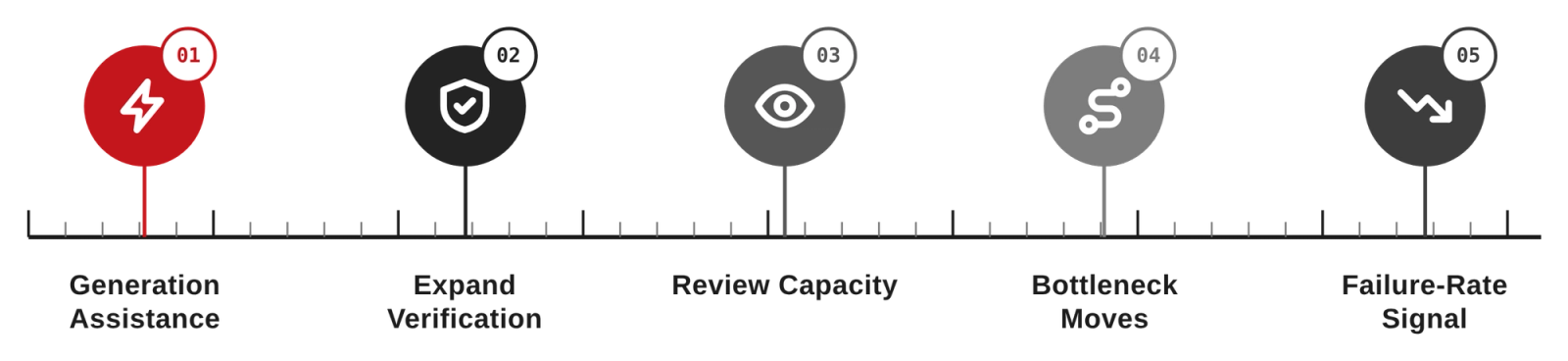
The SaaS engineering org assesses verification capacity before broadening generation adoption, because the constraint is going to move there and arriving prepared is considerably cheaper than reacting. Automated checks are expanded first: static analysis, policy checks, dependency scanning, and enforced coverage thresholds in CI, all fast enough that engineers wait for them.
That automation absorbs volume human review cannot, which is the mechanism by which generation gains survive. Review load is monitored per reviewer with approval latency watched specifically for sudden drops, because a reviewer clearing a growing queue faster is the earliest visible sign of quality being traded for throughput and it appears months before change failure rate moves.
Large diffs are discouraged structurally rather than requested politely, since generated changes tend to arrive larger and review quality falls with size. Generated tests are reviewed rather than trusted, with assertions checked for meaning rather than counted, because a test that passes without asserting anything useful is worse than no test. And the trend review happens monthly.
Common Misconception
AI adoption is a productivity question, so measure productivity.
Measuring generation productivity produces a number that improves immediately and tells you nothing about whether the system got faster. Delivery throughput is set by the slowest stage, and adoption makes one stage faster while leaving the others alone, so the honest measure is end to end lead time alongside change failure rate.
Teams reporting a large productivity gain from generation and flat deployment frequency are describing a bottleneck that moved, which is a useful finding presented as a success. The uncomfortable version is that in orgs where testing and review were already weak, adoption converts a generation improvement directly into a production defect increase, and the productivity metric will look excellent throughout.
Key Takeaway: Generation productivity improves regardless. Lead time and change failure rate tell you whether the system did.
Real-World AI in DevOps for SaaS in Action
Let's take a look at how it operates with a real-world example.
We worked with a SaaS org whose pull request volume rose forty percent while throughput stayed flat and change failure rate crept up, with these constraints:
- Expand automated verification before broadening adoption
- Monitor review load and latency as leading indicators
- Review generated tests rather than trusting them
Step 1: Assess Verification Capacity
Before adoption spreads.
- Review capacity measured
- Automated checks inventoried
- Adoption paced against readiness
Step 2: Expand Automated Checks
To absorb volume.
- Static analysis and policy checks broadened
- Coverage thresholds enforced in CI
- Checks kept fast enough to use
Step 3: Monitor Review Load
The leading indicator.
- Load per reviewer tracked
- Approval latency watched for drops
- Large diffs discouraged structurally
Step 4: Review Generated Tests
Do not trust them.
- Coverage measured on generated code
- Assertions checked for meaning
- Tests reviewed like other code
Step 5: Watch the Trends Monthly
Not quarterly.
- Lead time and change failure tracked
- Revert rate monitored
- Trends reviewed monthly
Where It Works Well
- Orgs with strong existing testing and review practice
- Programmes that expand automated checks before volume arrives
- Teams monitoring review load as a leading indicator
Where It Does Not Work Well
- Estates where testing was already weak before adoption
- Adoption measured on generation productivity alone
- Review capacity assumed adequate without monitoring
Key Takeaway: Expand verification before generation volume arrives, and watch review load rather than waiting for change failure rate.
Common Pitfalls
i) Measuring generation productivity
It improves immediately and says nothing about system throughput, so a bottleneck that moved reads as a success. Measure lead time and change failure rate.
- Reported productivity rises
- Deployment frequency stays flat
- Change failure rate moves three months later
ii) Leaving automated checks unchanged
Human review cannot absorb a forty percent volume increase. Broaden static analysis, policy checks, and coverage enforcement first.
iii) Trusting generated tests
A test that passes without meaningful assertions is worse than none because it produces false confidence. Review assertions, not counts.
iv) Quarterly trend review
Three months of degraded review ships a lot of code. Watch review latency and load monthly as leading indicators.
Takeaway from these lessons: The bottleneck moves to whichever stage had least slack, and the leading indicator is review behaviour.
AI in DevOps Best Practices for SaaS: What High-Performing Teams Do Differently
1. Expand automated verification first
Broaden static analysis, policy checks, and coverage enforcement before generation volume arrives, because human review cannot scale to meet it.
2. Monitor review load and latency
Watch for approval latency dropping under rising volume, which is the earliest sign of quality being traded for throughput.
3. Measure lead time, not generation output
Report end to end delivery time alongside change failure rate, since those describe the system rather than one stage of it.
4. Review generated tests properly
Check assertions for meaning rather than counting coverage, because generated tests can pass while verifying nothing.
5. Discourage large diffs structurally
Generated changes arrive larger and review quality falls with size, so make small changes the path of least resistance.
Logiciel's value add is helping SaaS engineering orgs expand verification capacity alongside AI generation adoption, so throughput gains reach production rather than becoming defects.
Takeaway for High-Performing Teams: Expand automation first, monitor review behaviour, measure lead time, review generated tests, keep diffs small.
Signals You Are Doing AI in DevOps Well in SaaS
How do you know it is working? Not by generation output, but by whether lead time improved and failure rate held. These are the signals that separate throughput from volume.
Lead time fell. End to end delivery time improved, not just generation speed.
Failure rate held. Change failure and revert rates are stable or better.
Review latency is stable. Approvals did not accelerate under rising volume.
Automated checks expanded. Coverage and policy enforcement grew with volume.
Generated tests assert. Coverage reflects meaningful verification.
Adjacent Capabilities and Connected Work
This work does not exist in isolation. AI in DevOps depends on, and feeds into, the surrounding platform. Ignoring the adjacencies is the most common scoping mistake.
Developer experience metrics tell you whether review load is becoming a burden. Policy as code supplies the automated checks absorbing volume. Blue-green deployment and progressive delivery limit the cost of defects that get through.
Platform engineering practice determines how fast CI feedback arrives. Naming these adjacencies upfront keeps the work scoped and helps leadership see verification capacity as the constraint.
The common mistake is treating each adjacency as someone else's problem. The automated check expansion is your problem. The review load monitoring is your problem. The measurement framing is your problem. Pretend otherwise and a productivity success will produce a defect trend nobody attributes correctly.
Own the adjacencies you depend on, partner with the teams that hold them, and share the metrics.
Conclusion
AI in DevOps increases generation capacity, and generation was rarely the constraint. Delivery throughput is set by the slowest stage, so making one stage elastic moves the queue to wherever there was least slack, which in most SaaS orgs is human review.
Reviewers absorb the pressure by approving faster, which is rational individually and shows up three months later as a change failure rate nobody connects to the adoption. Expand automated verification before the volume arrives, monitor review load and approval latency as leading indicators, review generated tests for meaningful assertions rather than counting coverage, and measure lead time rather than generation output.
Key Takeaways:
- AI moves the delivery bottleneck rather than removing it, usually to human review
- Reviewers absorb volume by approving faster, which precedes the failure rate moving
- Generation productivity improves regardless; lead time tells you if the system did
Adopting AI in delivery well requires expanding verification. When done correctly, it produces:
- Throughput gains that reach production
- Review that stays meaningful under higher volume
See What Elite-Tier SaaS Engineering Teams Actually Look Like in 2026
See what elite SaaS engineering performance looks like across key metrics.
- Generated code covered by tests that assert something
- Degradation detected in review metrics rather than incidents
What Logiciel Does Here
If your pull request volume rose and throughput did not, we help you expand automated verification, monitor review load, and measure the metrics that describe the system.
Learn More Here:
- Developer Experience Metrics for Technology & SaaS
- Policy as Code and Automated Checks
- Blue-Green Deployment for Technology & SaaS
At Logiciel Solutions, we work with SaaS engineering leaders on delivery practice. Our reference patterns come from orgs adopting generation assistance across many teams.
Book a technical deep-dive on expanding verification before generation volume arrives.