
A fintech keeps five years of transaction data in a lakehouse, and every month late settlement and chargeback data arrives with adjustments to prior periods. Under their existing setup, applying those adjustments rewrites partitions.
When a model validation team asks what the training table contained in March, the answer is unavailable, and when an auditor asks whether a submitted figure matches its source, the source has moved.
Nobody did anything wrong. The architecture simply had no concept of what the data said at a point in time, in a business where that is the question most likely to be asked formally.
Financial data gets corrected. If corrections destroy the prior state, you cannot evidence anything.
Apache Iceberg for fintech means adopting an open table format providing snapshot isolation, time travel, schema evolution, and engine independence over object storage, which suits financial estates where corrections are routine and as-of reproducibility is an evidential requirement rather than a convenience.
Iceberg, Delta Lake, or Hudi: The Open Table Format Endgame
Compare Iceberg, Delta Lake, and Hudi for open lakehouse decisions.
However, most teams adopt it as a format decision and set snapshot expiry to a default, which is how the reproducibility they adopted it for quietly expires.
If you are a CDO or VP of Data at a fintech company, the intent of this article is:
- Define what Iceberg provides and why as-of reproducibility matters here
- Show how snapshot retention should be derived from evidential requirements
- Lay out the compaction and metadata maintenance the format requires
To do that, let's start with the basics.
What Is Apache Iceberg for Fintech? The Basic Definition
At a high level, Iceberg is an open table format sitting over files in object storage, adding properties a directory of Parquet files lacks: atomic commits, snapshot isolation so readers are unaffected by concurrent writes, schema evolution without rewriting data, partition evolution, time travel to query a table as of a past snapshot, and multi-engine access.
In a financial estate the decisive property is time travel, because corrections to prior periods are routine and the questions asked most formally, what did this table say when the model trained, does this submitted figure match its source, are as-of questions. Everything else is useful. That one is load-bearing.
To compare:
A directory of Parquet files is a ledger written in pencil: corrections are made cleanly and the previous entry is gone. Iceberg is a ledger where corrections are new entries and the original remains legible.
In most businesses that is tidy. In a regulated financial business it is the difference between evidencing a submitted figure and asserting it, and assertion has a habit of becoming a finding.
Why Does Iceberg Matter for Fintech?
Issues that it addresses or resolves:
- Corrections to prior periods destroying the state a figure was based on
- Model validation unable to reproduce training inputs
- Concurrent readers seeing partial writes during correction batches
Resolved Issues by Iceberg
- Corrections applied while prior snapshots remain queryable
- As-of reproducibility for validation and audit
- Snapshot isolation protecting readers during correction runs
Core Components of Iceberg Adoption in Fintech
- Snapshot retention derived from evidential and validation requirements
- Corrections applied additively rather than destructively
- Compaction sized for actual write patterns
- Metadata and storage growth monitored
- Migration targeted at tables where reproducibility matters
Modern Iceberg Tooling for Fintech
- Catalog implementations with access control suited to regulated estates
- Compaction jobs tuned for write frequency
- Snapshot expiry policies aligned to retention obligations
- Access logging on table reads where required
- Metadata monitoring for table health
These tools make Iceberg defensible. Snapshot retention derived from stated obligations is what turns time travel from a feature into evidence.
Other Core Issues They Will Solve
- Model validation reproduces exact training inputs
- Submitted figures can be tied to the data state behind them
- Query performance survives years of accumulated corrections
In Summary: Iceberg for fintech provides non-destructive corrections and as-of reproducibility, which are evidential requirements here, provided snapshot retention is set from obligations rather than defaults.
Importance of Iceberg for Fintech in 2026
Financial data estates carry both correction volume and evidential obligations. Four reasons explain why this fit matters now.
1. Corrections are routine in financial data.
Late settlements, chargebacks, and reconciliation adjustments arrive continuously, and each destructive rewrite removes evidence.
2. Model validation is a formal exercise.
Validators ask what a model trained on, and answering requires the table state at that time rather than the current one.
3. Submitted figures must match a source.
If the source moved after submission, explaining the discrepancy is considerably harder than preventing it.
4. Default retention undermines the whole purpose.
A team that adopts Iceberg for reproducibility and leaves snapshot expiry at a default loses the states it needed.
Traditional vs. Iceberg Lakehouse Tables in Fintech
- Corrections overwrite history vs. corrections create new snapshots
- Current state only vs. as-of reproducibility for any retained snapshot
- Readers affected by correction batches vs. snapshot isolation
- Single engine ownership vs. multiple engines on the same tables
In summary: A modern fintech approach uses Iceberg for non-destructive correction and as-of reproducibility, with retention derived from evidential obligations.
Details About the Core Components of Iceberg Adoption in Fintech: What Are You Designing?
Let's go through each component.
1. Retention Layer
How far back you must reach.
Retention decisions:
- Snapshot expiry derived from evidential obligations
- Validation lookback requirements documented
- Storage cost of retention understood
2. Correction Layer
Additive, not destructive.
Correction decisions:
- Adjustments applied as commits
- Prior states remaining queryable
- Restatement volume tracked
3. Reproducibility Layer
Answering as-of questions.
Reproducibility decisions:
- Model training snapshots identified and pinned
- Submission-time states preserved
- Query patterns for as-of access documented
4. Compaction Layer
Keeping it fast.
Compaction decisions:
- Sized for actual write frequency
- File size targets set and monitored
- Schedule retuned as volume grows
5. Migration Layer
Where it matters.
Migration decisions:
- Tables feeding models and reporting first
- Nothing rewritten without reason
- Formats coexisting during transition
Benefits Gained from Iceberg in Fintech
- Corrections applied while prior states stay queryable
- Model validation reproducing exact training inputs
- Submitted figures tied to a preserved data state
How It All Works Together
The fintech data team starts with retention rather than with the format, because retention is what determines whether the adoption delivers anything. Snapshot expiry is derived from stated obligations: how far back model validation must reach, which submission-time states have to remain answerable, and what the applicable retention policy requires, with the storage cost of that retention understood and accepted rather than discovered.
Corrections then become additive: a late settlement adjustment is a commit creating a new snapshot, so the state behind March's submitted figure remains queryable in September. Snapshots corresponding to model training runs and regulatory submissions are identified and pinned explicitly, so a broad expiry policy cannot remove the specific states most likely to be asked about.
Restatement volume is tracked as a metric, since a rising correction rate is an upstream quality signal worth catching. Migration targets the tables feeding models and reporting rather than the whole estate, with both formats coexisting during transition.
And compaction is sized for the actual write frequency and monitored, because performance degradation from small file accumulation is gradual and easy to misdiagnose.
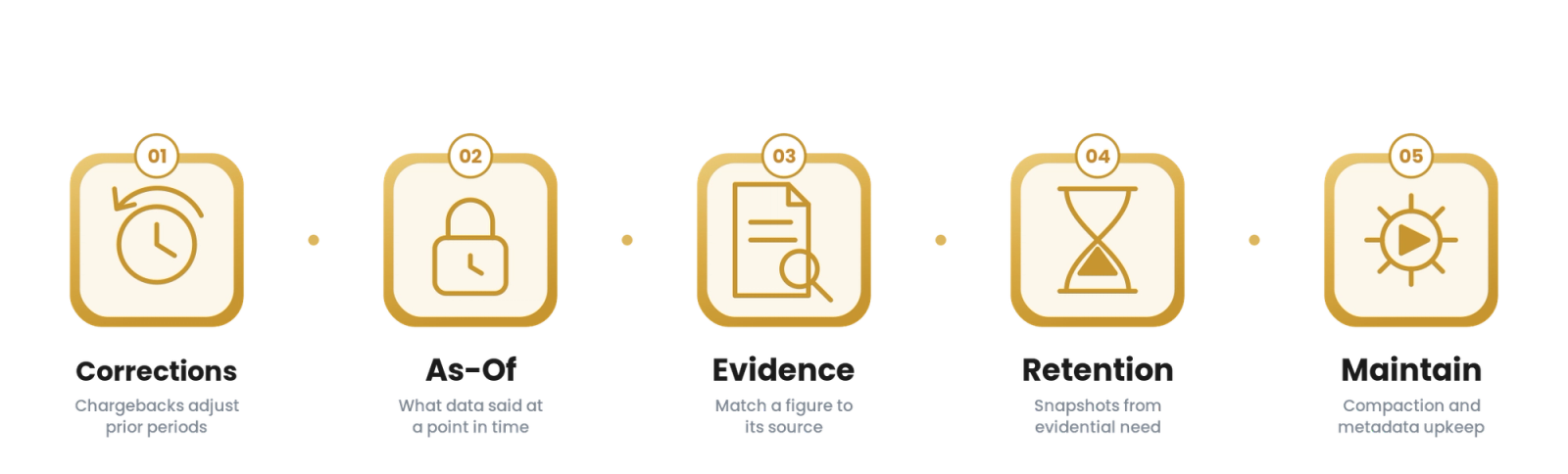
Common Misconception
We adopted Iceberg, so we have time travel.
You have the mechanism. Whether you have the capability depends entirely on snapshot expiry, and the default is almost certainly wrong for a regulated financial estate. Teams adopt Iceberg specifically for reproducibility, accept a retention default measured in days, and discover months later that the state behind a submitted figure expired long before anyone asked about it.
Worse, this failure is silent: nothing alerts you that a snapshot you would have wanted has gone, and you find out when a validator or auditor asks. The fix is unglamorous and essential.
Derive retention from documented obligations, pin the specific snapshots corresponding to submissions and model training runs, and accept the storage cost as the price of the property you adopted the format for.
Key Takeaway: Adopting Iceberg gives you the mechanism, not the capability. Default snapshot expiry silently discards the states you needed.
Real-World Iceberg for Fintech in Action
Let's take a look at how it operates with a real-world example.
We worked with a fintech whose monthly corrections destroyed the state behind previously submitted figures, with these constraints:
- Derive snapshot retention from evidential obligations
- Make corrections additive rather than destructive
- Pin the states behind submissions and model training
Step 1: Derive Retention
From obligations.
- Validation lookback documented
- Submission states identified
- Storage cost understood and accepted
Step 2: Make Corrections Additive
New snapshots, not rewrites.
- Adjustments applied as commits
- Prior states remaining queryable
- Restatement volume tracked
Step 3: Pin the Critical States
Explicitly.
- Model training snapshots pinned
- Submission-time states preserved
- Expiry unable to remove them
Step 4: Own Compaction
Performance over years.
- Sized for write frequency
- File size targets monitored
- Schedule retuned as volume grows
Step 5: Migrate Where It Matters
Not everywhere.
- Model and reporting tables first
- Nothing rewritten without reason
- Formats coexisting
Where It Works Well
- Transaction and position data receiving routine corrections
- Tables feeding models that require validation
- Reporting datasets whose figures must be evidenced later
Where It Does Not Work Well
- Small static reference data with no correction history
- Estates that accept default snapshot expiry
- Teams unwilling to own compaction and metadata maintenance
Key Takeaway: Iceberg suits fintech because corrections are routine and as-of questions are formal, provided retention is derived from obligations.
Common Pitfalls
i) Default snapshot expiry
Adopting the format for reproducibility and leaving retention at a default silently discards the states you needed, and you discover it when asked. Derive expiry from documented obligations.
- Submission-time states expire before anyone asks
- The loss is silent and unrecoverable
- The property you adopted the format for is absent
ii) Not pinning critical snapshots
A broad expiry policy will eventually remove a model training state or a submission state. Pin those explicitly so policy cannot reach them.
iii) Skipping compaction
Small file accumulation degrades performance gradually, and the symptom resembles a capacity problem. Size compaction for write frequency and monitor file sizes.
iv) Not tracking restatement volume
A rising correction rate is an upstream quality signal most teams never measure. Report it as a first-class metric to the data owner.
Takeaway from these lessons: In fintech the format is the easy part; retention policy and pinned snapshots are what make reproducibility real.
Iceberg Best Practices for Fintech: What High-Performing Teams Do Differently
1. Derive snapshot retention from obligations
Set expiry from documented validation lookback and evidential requirements, and accept the storage cost as the price of the capability.
2. Pin submission and training snapshots
Protect the specific states most likely to be asked about, so a general expiry policy cannot remove them.
3. Make corrections additive
Apply adjustments as commits creating new snapshots, so the state behind a past figure remains queryable months later.
4. Track restatement volume
Report correction rates to data owners, because a rising rate signals an upstream quality problem while it is still small.
5. Own compaction from day one
Size it for actual write frequency and monitor file sizes, since gradual degradation is easy to misdiagnose as a capacity issue.
Logiciel's value add is helping fintech data teams adopt Iceberg with retention derived from evidential obligations, so as-of reproducibility is a capability they actually have rather than a feature they enabled.
Takeaway for High-Performing Teams: Derive retention from obligations, pin the critical snapshots, keep corrections additive, and own compaction.
Signals You Are Doing Iceberg Well in Fintech
How do you know it is working? Not by whether time travel is available, but by whether the specific states you need still exist. These are the signals that separate real reproducibility from an enabled feature.
Retention is derived. Snapshot expiry comes from documented obligations.
Critical states are pinned. Submission and training snapshots survive general expiry.
Corrections are additive. Adjustments create snapshots rather than replacing partitions.
Restatement is measured. Correction volume is reported to data owners.
Compaction runs. File sizes are monitored and performance holds over years.
Adjacent Capabilities and Connected Work
This work does not exist in isolation. Table format choice depends on, and feeds into, the surrounding data platform. Ignoring the adjacencies is the most common scoping mistake.
Data products define what consumers expect, including point-in-time behaviour. Data quality SLAs formalise those expectations. Schema evolution policy governs how tables change. Your audit and retention policy determines snapshot expiry. Naming these adjacencies upfront keeps the work scoped and helps leadership see format choice as an evidential requirement question.
The common mistake is treating each adjacency as someone else's problem. The retention policy is your problem. The pinned snapshots are your problem. The compaction schedule is your problem. Pretend otherwise and the state behind a submitted figure will expire before an auditor asks about it.
Own the adjacencies you depend on, partner with the teams that hold them, and share the obligations.
Conclusion
Iceberg suits financial data estates because corrections are routine and the questions asked most formally are as-of questions: what did this table say when the model trained, does this submitted figure match its source.
Snapshots turn corrections into additive events so both remain answerable. But adopting the format only provides the mechanism. The capability depends on snapshot retention derived from documented obligations rather than a default, and on pinning the specific states corresponding to submissions and model training runs so a general expiry policy cannot silently discard them.
Add compaction sized for your write frequency, and track restatement volume while you are there.
Key Takeaways:
- As-of reproducibility is an evidential requirement in fintech, not a convenience
- Adopting Iceberg gives the mechanism; retention policy gives the capability
- Pin submission and training snapshots so general expiry cannot remove them
Adopting Iceberg well requires deriving retention from obligations. When done correctly, it produces:
- Corrections applied while prior states remain queryable
- Model validation reproducing exact training inputs
The State of Platform Engineering 2026: How Fast Adoption Is Moving
See how quickly platform engineering adoption is accelerating across large organizations.
- Submitted figures tied to a preserved data state
- Query performance that holds across years of corrections
What Logiciel Does Here
If your corrections destroy the state behind previously submitted figures, we help you adopt Iceberg with retention derived from your obligations and the critical snapshots pinned.
Learn More Here:
- Data Products for Fintech
- Streaming vs Batch for Fintech
- Schema Evolution for Fintech
At Logiciel Solutions, we work with fintech data leaders on lakehouse architecture. Our reference patterns come from regulated estates with routine corrections and formal validation.
Book a technical deep-dive on making as-of reproducibility a capability you actually have.