
A SaaS platform team runs a cloud waste exercise and finds a substantial list of idle resources: orphaned volumes, unattached addresses, load balancers with no targets, clusters from a spike two quarters ago.
They produce the list, circulate it to thirty teams, and delete roughly a fifth of it. The rest sits there because each item requires someone to confirm it is unused, that person is busy, and confirming carries a small risk while ignoring carries none.
Six months later the list is longer. The detection worked perfectly. The deletion is the part nobody designed.
Finding waste is a tooling problem and it is solved. Deleting it is an authority problem and it is not.
Cloud waste for SaaS means detecting idle and orphaned resources, attributing them to owning teams, and giving those teams both the evidence and the authority to delete, with lifecycle defaults that prevent the accumulation recurring.
The Cloud Waste Report: Why Wasted Spend Is Rising Again in 2026
Identify rising cloud waste and where AI workloads drive overspending.
However, most programmes invest in detection and circulate findings, which produces a list that grows because nobody is empowered or incentivised to act on it.
If you are a VP of Engineering or Head of Infrastructure at a SaaS company, the intent of this article is:
- Define why deletion authority is the binding constraint
- Show how lifecycle defaults prevent recurrence
- Lay out how to make deletion safe enough to happen
To do that, let's start with the basics.
What Is Cloud Waste for SaaS? The Basic Definition
At a high level, cloud waste is spend on resources delivering no value: idle compute, orphaned storage, unattached network resources, over-provisioned instances, environments outliving their purpose, and data in tiers nobody queries.
Detection is straightforward and well tooled. The reason waste persists in multi-team estates is not that it is hidden but that removing it requires a decision from someone with other priorities, for whom deleting something carries a small risk of breaking an unknown dependency while leaving it carries no visible cost at all. That asymmetry is the actual problem.
To compare:
A cloud waste report circulated to thirty teams is a tidy list of items in a shared cupboard with a note asking whoever owns them to remove theirs. Everyone reads it. Nobody is certain which items are theirs, throwing away something that turns out to matter is embarrassing, and the cupboard is not anyone's responsibility. The list is accurate and the cupboard fills up.
Why Does Cloud Waste Matter for SaaS?
Issues that it addresses or resolves:
- Idle resources accumulating because deletion is nobody's job
- Findings circulated without authority or evidence to act
- The same waste categories recurring after each cleanup
Resolved Issues by Waste Management Done Well
- Waste attributed to owning teams with evidence
- Deletion authority explicit and exercised
- Lifecycle defaults preventing recurrence
Core Components of Cloud Waste Management in SaaS
- Detection of idle and orphaned resource categories
- Attribution to owning teams from tags and catalog
- Evidence of non-use sufficient to make deletion safe
- Deletion authority granted explicitly per team
- Lifecycle defaults with expiry on non-production
Modern Cloud Waste Tooling for SaaS
- Idle and orphaned resource detection by category
- Attribution from enforced tagging
- Usage evidence over a defined window
- Automated expiry on non-production resources
- Team level waste reporting with trends
These tools make deletion possible. Usage evidence over a defined window is what converts a nervous decision into an obvious one.
Other Core Issues They Will Solve
- Non-production resources disappearing without intervention
- Teams seeing their own waste rather than an org-wide list
- Recurrence prevented by defaults rather than by cleanups
In Summary: Cloud waste in SaaS persists because deletion requires authority and carries asymmetric risk, so the fix is attribution, evidence, authority, and lifecycle defaults.
Importance of Cloud Waste for SaaS in 2026
Multi-team estates generate waste structurally. Four reasons explain why this matters now.
1. Provisioning is self-service and removal is not.
Thirty teams can create resources instantly and nothing removes them when a project ends.
2. Deletion risk is asymmetric.
Deleting something that mattered is embarrassing; leaving something idle costs nobody anything visible.
3. Cleanup exercises do not prevent recurrence.
A list cleared once refills, because the mechanism that produced it is unchanged.
4. Attribution is frequently missing.
Untagged resources cannot be routed to a team, so they default to nobody.
Traditional vs. Modern SaaS Waste Management
- Findings circulated vs. attributed to owning teams
- Deletion by request vs. authority granted explicitly
- Evidence absent vs. usage window provided
- Cleanup exercises vs. lifecycle defaults preventing recurrence
In summary: A modern SaaS approach attributes waste with evidence, grants deletion authority, and prevents recurrence through defaults.
Details About the Core Components of Cloud Waste Management in SaaS: What Are You Designing?
Let's go through each component.
1. Detection Layer
Finding the categories.
Detection decisions:
- Idle and orphaned categories defined
- Detection run continuously rather than periodically
- Categories reviewed as the estate changes
2. Attribution Layer
Whose resource is it.
Attribution decisions:
- Tagging enforced at admission
- Ownership resolved from tags and catalog
- Unattributable resources escalated
3. Evidence Layer
Making deletion safe.
Evidence decisions:
- Usage window recorded per resource
- Evidence presented with the finding
- Confidence stated
4. Authority Layer
Who may delete.
Authority decisions:
- Deletion authority granted per team
- Platform authority for unattributable resources
- Pause before delete where possible
5. Lifecycle Layer
Preventing recurrence.
Lifecycle decisions:
- Expiry on non-production by default
- Extension deliberate rather than automatic
- Defaults set in shared modules
Benefits Gained from Waste Management in SaaS
- Idle resources removed rather than listed
- Non-production spend disappearing automatically
- Recurrence prevented by defaults
How It All Works Together
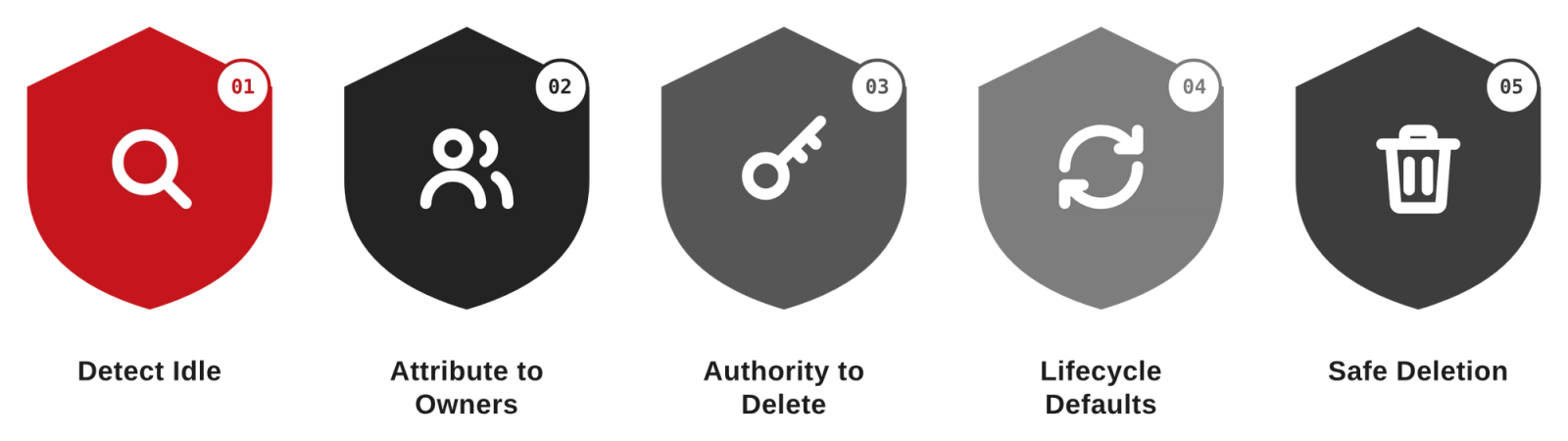
The SaaS platform team makes deletion easy rather than making detection better, because detection is already adequate. Attribution comes first: tagging is enforced at admission so resources cannot be created without an owner, and ownership resolves from tags joined to the catalog, with unattributable resources escalated rather than added to a list nobody owns.
Findings then arrive attributed, and crucially with evidence: this volume has had no I/O for ninety days, this load balancer has had no targets for four months, this cluster has had no scheduled workloads since March.
That evidence is what converts a nervous decision into an obvious one, and it is the component most reports omit. Deletion authority is granted explicitly per team for resources they own, with the platform team holding authority for unattributable ones, and where possible resources are paused before deletion so the first step is reversible.
Then lifecycle defaults prevent recurrence: non-production resources get expiry set in the shared modules, and extension is a deliberate act rather than the default.
Common Misconception
Better detection and reporting will reduce waste.
Detection is not the constraint. Most teams running a waste exercise produce an accurate list quickly, circulate it, and watch a minority of it get actioned, and then produce a longer list six months later.
The reason is that deleting a resource requires a busy person to accept a small risk for a benefit they do not experience, while leaving it costs them nothing. Improving the report does not change that calculation.
What changes it is evidence strong enough that the risk feels negligible, authority explicit enough that nobody needs to ask, and a pause step that makes the first action reversible. Beyond that, lifecycle defaults remove the need for the decision entirely, which is where most of the durable improvement comes from.
Key Takeaway: Detection is solved. Waste persists because deletion carries risk for the person doing it and no cost for not doing it.
Real-World Cloud Waste for SaaS in Action
Let's take a look at how it operates with a real-world example.
We worked with a SaaS platform team whose waste list grew after each cleanup, with these constraints:
- Attribute findings to owning teams with usage evidence
- Grant deletion authority explicitly
- Set lifecycle defaults so recurrence stops
Step 1: Enforce Attribution
At admission.
- Tagging enforced, untagged rejected
- Ownership from tags and catalog
- Unattributable resources escalated
Step 2: Provide Evidence
Make deletion obvious.
- Usage window recorded per resource
- Evidence presented with the finding
- Confidence stated
Step 3: Grant Authority
Explicitly.
- Deletion authority per team
- Platform authority for unattributable
- Pause before delete where possible
Step 4: Set Lifecycle Defaults
Prevent recurrence.
- Expiry on non-production by default
- Extension deliberate
- Defaults in shared modules
Step 5: Report Per Team
Not org-wide.
- Team level waste reported
- Trends shown
- Reviewed with teams
Where It Works Well
- Estates with enforced tagging supporting attribution
- Findings accompanied by usage evidence
- Teams granted explicit deletion authority
Where It Does Not Work Well
- Org-wide lists circulated without attribution
- Findings without evidence of non-use
- Cleanups without lifecycle defaults to prevent recurrence
Key Takeaway: Attribute with evidence, grant authority, pause before deleting, and set defaults so the decision stops being needed.
Common Pitfalls
i) Circulating an org-wide list
Thirty teams reading a shared list with no attribution produces action on a minority of it. Attribute per team and report to them.
- A fifth gets deleted
- The list is longer six months later
- The detection was never the problem
ii) Findings without evidence
A resource flagged as possibly idle requires someone to verify it, which is the work they will not do. Present the usage window so the conclusion is obvious.
iii) No deletion authority
If deleting requires asking, most items will not be deleted. Grant authority per team explicitly and hold platform authority for unattributable resources.
iv) Cleanup without defaults
Clearing a list leaves the mechanism intact, so it refills. Set expiry on non-production in shared modules.
Takeaway from these lessons: The durable improvement is lifecycle defaults, because they remove the decision rather than making it easier.
Cloud Waste Best Practices for SaaS: What High-Performing Teams Do Differently
1. Enforce tagging at admission
Reject untagged resources so attribution is possible, since everything downstream depends on knowing whose resource it is.
2. Present usage evidence with every finding
Give the window of non-use so deletion is an obvious call rather than a verification task.
3. Grant deletion authority explicitly
Remove the need to ask, because asking is where waste removal stalls.
4. Pause before deleting
Make the first step reversible so breakage surfaces safely and the fear that blocks deletion goes away.
5. Set lifecycle defaults in shared modules
Give non-production resources expiry by default, which prevents recurrence rather than treating it.
Logiciel's value add is helping SaaS platform teams turn cloud waste from a recurring detection exercise into attributed findings with evidence, authority, and lifecycle defaults that stop the accumulation.
Takeaway for High-Performing Teams: Attribute, evidence, authorise, pause, and default, because detection was never the constraint.
Signals You Are Doing Cloud Waste Well in SaaS
How do you know it is working? Not by how much waste you found, but by whether the list shrinks between exercises. These are the signals that separate removal from reporting.
Attribution is complete. Every resource maps to a team.
Evidence accompanies findings. Usage windows are shown, not implied.
Teams delete. Authority is exercised without a request queue.
Non-production expires. Resources disappear without intervention.
The list shrinks. Successive exercises find less, not more.
Adjacent Capabilities and Connected Work
This work does not exist in isolation. Waste management depends on, and feeds into, the surrounding platform. Ignoring the adjacencies is the most common scoping mistake.
FinOps guardrails supply the tagging enforcement and lifecycle defaults. Terraform module defaults are where expiry gets set. Ephemeral environment tooling handles non-production lifecycle. Warehouse cost work shares the same attribution dependency. Naming these adjacencies upfront keeps the work scoped and helps leadership see authority as the constraint.
The common mistake is treating each adjacency as someone else's problem. The tagging enforcement is your problem. The evidence presentation is your problem. The lifecycle defaults are your problem. Pretend otherwise and you will produce an accurate list annually and delete a fifth of it.
Own the adjacencies you depend on, partner with the teams that hold them, and share the authority.
Conclusion
Cloud waste in a multi-team SaaS estate is not a detection problem. Finding orphaned volumes, unattached addresses, and clusters from an old spike is straightforward, which is why the list is usually accurate and usually grows.
It persists because deleting something requires a busy person to accept a small risk of breaking an unknown dependency for a benefit they never see, while leaving it costs them nothing. Fix the asymmetry: enforce tagging so findings are attributable, present usage evidence so the call is obvious, grant deletion authority so nobody asks, pause before deleting so the first step is reversible, and set expiry defaults so the decision stops being needed.
Key Takeaways:
- Detection is adequate; deletion authority and risk asymmetry are the constraints
- Usage evidence is what converts a nervous decision into an obvious one
- Lifecycle defaults prevent recurrence, which cleanups do not
Managing cloud waste well requires fixing the asymmetry. When done correctly, it produces:
- Idle resources removed rather than listed
- Non-production spend disappearing without intervention
The FinOps Operating Model for the Fifth of Cloud Spend You're Wasting
Reduce cloud waste with a FinOps model built for efficiency.
- Findings teams can act on without verification work
- A list that shrinks between exercises
What Logiciel Does Here
If your waste list grows after every cleanup, we help you enforce attribution, present usage evidence, grant deletion authority, and set the lifecycle defaults that stop recurrence.
Learn More Here:
- FinOps Guardrails for Technology & SaaS
- Terraform Modules for Technology & SaaS
- Warehouse Cost Optimization for Technology & SaaS
At Logiciel Solutions, we work with SaaS engineering leaders on cloud cost. Our reference patterns come from estates with many self-service teams.
Book a technical deep-dive on making waste deletion happen rather than accumulate.