
An energy company audits its cloud estate and finds resources belonging to projects that finished years ago: analysis environments from a grid modernisation programme, storage from a regulatory submission in 2021, clusters provisioned for a pilot that never scaled.
Each item has a reason nobody can now verify, and several are protected by a claim that the data might be needed for compliance. Removing any of it requires establishing what it was for and whether the claim holds, which nobody has been assigned.
The audit is accurate. It is also the third one, and the estate is larger than at the second.
Long project cycles leave residue, and a compliance claim nobody has examined protects most of it.
Cloud waste for energy means detecting resources that outlived their projects, establishing whether retention claims actually apply, attributing what remains to owners, and giving lifecycle defaults to anything provisioned for a time-bounded purpose.
The Cloud Waste Report: Why Wasted Spend Is Rising Again in 2026
Identify rising cloud waste and where AI workloads drive overspending.
However, most audits stop at the first mention of a possible retention requirement, which protects the majority of the residue behind a claim covering a minority of it.
If you are a VP of Engineering or Head of Infrastructure at an energy company, the intent of this article is:
- Define why long project cycles produce durable residue
- Show how to test a compliance claim rather than accept it
- Lay out how to prevent project residue accumulating
To do that, let's start with the basics.
What Is Cloud Waste for Energy? The Basic Definition
At a high level, cloud waste is spend on resources delivering no value: idle compute, orphaned storage, environments outliving their purpose, data in tiers nobody queries. In an energy estate the dominant category is project residue.
Programmes run for years, provision substantial environments and datasets, and end without a decommissioning step, so the resources persist with a reason that decays and frequently with a retention claim attached. Testing whether that claim genuinely applies is the work that unlocks most of the reduction, and it is nobody's assigned job.
To compare:
An energy cloud estate after several long programmes is a building where each completed project left its equipment in place, and a note on some of it saying it may be needed for an inspection.
Nobody knows which notes are accurate. Removing anything requires checking, checking is unassigned, and the next programme brings its own equipment.
Why Does Cloud Waste Matter for Energy?
Issues that it addresses or resolves:
- Resources persisting after the projects that created them ended
- Retention claims protecting residue without being tested
- Attribution lost when project teams disbanded
Resolved Issues by Waste Management Done Well
- Project residue identified and decommissioned
- Retention claims tested against actual scope
- Ownership reassigned rather than orphaned
Core Components of Cloud Waste Management in Energy
- Detection of project residue by age and activity
- Retention claims mapped to actual obligations
- Ownership reassignment when projects end
- Deletion authority granted explicitly
- Lifecycle defaults on project-provisioned resources
Modern Cloud Waste Tooling for Energy
- Idle and orphaned detection with long observation windows
- Tagging including project and end date at creation
- Retention scope mapping per dataset
- Automated expiry on project resources
- Team level reporting with reassignment on project closure
These tools address residue specifically. Tagging with a project and an end date at creation is what makes decommissioning automatic rather than archaeological.
Other Core Issues They Will Solve
- Project closure including infrastructure decommissioning
- Retention obligations satisfied at appropriate cost
- Ownership surviving team disbandment
In Summary: Cloud waste in energy is dominated by project residue protected by untested retention claims, so the fix is tagging at creation, mapping obligations, and reassigning ownership at closure.
Importance of Cloud Waste for Energy in 2026
Long programmes and long retention interact badly. Four reasons explain why this matters now.
1. Programmes run for years and end without decommissioning.
Project closure covers deliverables and rarely covers infrastructure.
2. Reasoning decays past recovery.
After three years nobody can say what an environment was for, which makes removal an investigation.
3. Retention claims go untested.
A possible obligation protects everything near it, because testing the claim is unassigned work.
4. Ownership disappears with the team.
When a project team disbands, its resources have no owner and default to nobody.
Traditional vs. Modern Energy Waste Management
- Periodic audits vs. tagging and expiry at creation
- Retention claims accepted vs. mapped to actual obligations
- Ownership orphaned at closure vs. reassigned deliberately
- Removal by investigation vs. by scheduled expiry
In summary: A modern energy approach tags project resources at creation, tests retention claims, and reassigns ownership when programmes close.
Details About the Core Components of Cloud Waste Management in Energy: What Are You Designing?
Let's go through each component.
1. Tagging Layer
Project and end date.
Tagging decisions:
- Project and expected end date at creation
- Enforced at admission
- Owner recorded and maintained
2. Retention Layer
Testing the claim.
Retention decisions:
- Obligations mapped to specific datasets and periods
- Claims outside that scope challenged
- Scope documented and reviewed
3. Closure Layer
Decommissioning as a step.
Closure decisions:
- Infrastructure decommissioning in project closure
- Ownership reassigned where resources persist
- Residue identified before the team disbands
4. Detection Layer
Catching what escaped.
Detection decisions:
- Long observation windows for low-activity resources
- Evidence presented with findings
- Attribution attempted before escalation
5. Authority Layer
Who may remove.
Authority decisions:
- Deletion authority granted explicitly
- Platform authority for orphaned resources
- Pause before delete where possible
Benefits Gained from Waste Management in Energy
- Project residue decommissioned rather than accumulating
- Retention obligations satisfied at appropriate cost
- Ownership surviving programme closure
How It All Works Together
The energy engineering team attaches a project and an expected end date to every resource at creation, enforced at admission, so a resource provisioned for a programme declares its temporary nature while that is still obvious.
Project closure then includes infrastructure decommissioning as a step rather than covering deliverables only, and where resources must persist beyond the programme their ownership is reassigned deliberately before the team disbands rather than defaulting to nobody.
Retention claims are tested rather than accepted: obligations are mapped to specific datasets and periods, and anything outside that mapped scope is treated as available for removal or tiering rather than protected by proximity to something that genuinely is obligated.
Detection uses long observation windows because energy workloads can be legitimately quiet for months, with usage evidence presented and attribution attempted before escalation. And deletion authority is granted explicitly with a pause step where possible, so the first action is reversible.
Common Misconception
We cannot remove that because it might be needed for compliance.
The claim is real for the data it covers and it gets applied by proximity to everything else. In practice a fraction of project residue in an energy estate carries a genuine retention obligation, and the claim protects the remainder because testing it requires establishing what each dataset is, which obligation applies, and for how long, and that work is unassigned.
Once mapped, the obligation frequently turns out to cover a specific dataset for a specific period, satisfiable at a fraction of the current cost on a colder tier, while the surrounding environments and working copies carry no obligation at all.
The claim is not dishonest. It is unexamined, and examining it is where the reduction lives.
Key Takeaway: A retention claim protects far more than it covers, because testing it is unassigned work. Map the obligation to specific datasets.
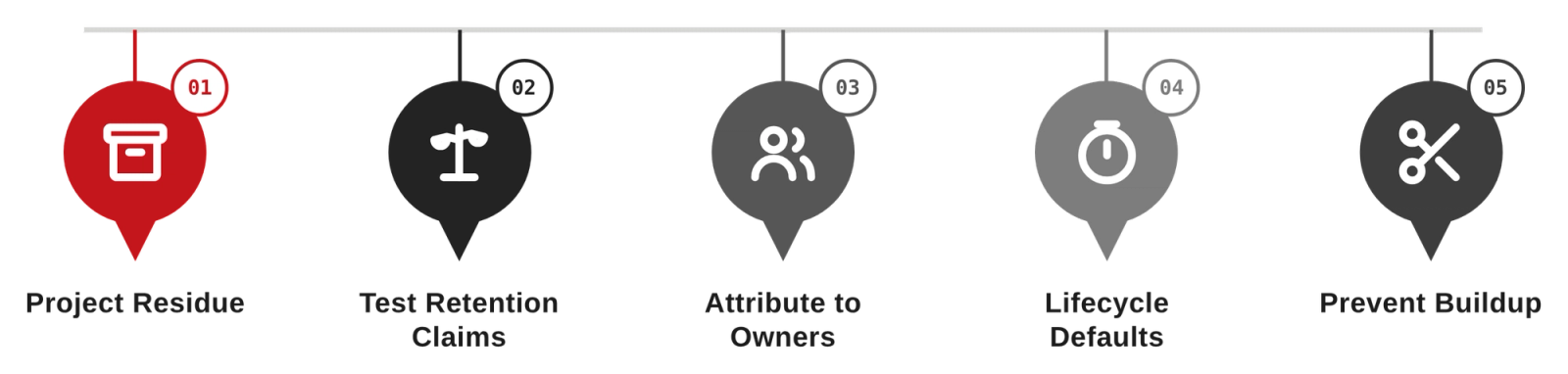
Real-World Cloud Waste for Energy in Action
Let's take a look at how it operates with a real-world example.
We worked with an energy engineering team on their third audit of an estate full of project residue, with these constraints:
- Tag project and end date at creation going forward
- Test retention claims against mapped obligations
- Reassign ownership at project closure
Step 1: Tag at Creation
Project and end date.
- Project and expected end date recorded
- Enforced at admission
- Owner recorded
Step 2: Map the Obligations
Test the claims.
- Obligations mapped to datasets and periods
- Claims outside scope challenged
- Scope documented
Step 3: Decommission at Closure
Make it a step.
- Infrastructure in the closure checklist
- Ownership reassigned where resources persist
- Residue identified before disbandment
Step 4: Detect With Long Windows
Energy workloads are quiet.
- Long observation windows used
- Evidence presented
- Attribution attempted first
Step 5: Grant Authority
With a pause step.
- Deletion authority explicit
- Platform authority for orphans
- Pause before delete
Where It Works Well
- Estates where project tagging can be enforced at creation
- Retention claims that can be mapped to specific datasets
- Programmes including decommissioning in closure
Where It Does Not Work Well
- Audits that accept retention claims without testing
- Detection with short observation windows on quiet workloads
- Resources orphaned when project teams disband
Key Takeaway: Tag at creation, map the obligations, decommission at closure, and use long detection windows.
Common Pitfalls
i) Accepting retention claims
A possible obligation protects everything near it because testing is unassigned. Map obligations to specific datasets and periods, then treat the remainder as available.
- The majority of residue is never examined
- Cost persists behind a partly valid claim
- The audit repeats annually with a larger estate
ii) Short detection windows
Energy workloads can be legitimately quiet for months, so a thirty day idle window produces false positives that discredit the whole exercise. Use long windows and present the evidence.
iii) Closure without decommissioning
Project closure covering deliverables only leaves infrastructure behind with a decaying reason. Add it to the checklist.
iv) Ownership orphaned at disbandment
Resources without an owner are removed by nobody. Reassign ownership before the team disperses.
Takeaway from these lessons: The reduction is behind an untested claim, and prevention is a tag at creation plus a closure step.
Cloud Waste Best Practices for Energy: What High-Performing Teams Do Differently
1. Tag project and end date at creation
Record the temporary nature while it is obvious, so decommissioning is scheduled rather than archaeological.
2. Map retention obligations to specific datasets
Test the claim rather than accepting it, since that examination is where most of the available reduction sits.
3. Put decommissioning in project closure
Make infrastructure removal a deliverable of closing a programme rather than an afterthought.
4. Reassign ownership before teams disband
Ensure every persisting resource has a named owner who can authorise removal later.
5. Use long detection windows
Account for legitimately quiet workloads so findings are credible rather than dismissed.
Logiciel's value add is helping energy engineering teams test retention claims, tag project resources at creation, and build decommissioning into programme closure.
Takeaway for High-Performing Teams: Tag at creation, test the claim, decommission at closure, reassign ownership, use long windows.
Signals You Are Doing Cloud Waste Well in Energy
How do you know it is working? Not by what the audit found, but by whether the estate is smaller than last time. These are the signals that separate removal from repeated auditing.
Obligations are mapped. Retention scope is documented per dataset.
Resources are tagged. Project and end date are recorded at creation.
Closure includes decommissioning. Programmes remove their infrastructure.
Ownership persists. No resource is orphaned by a disbanded team.
The estate shrank. Successive audits find less, not more.
Adjacent Capabilities and Connected Work
This work does not exist in isolation. Waste management depends on, and feeds into, the surrounding platform. Ignoring the adjacencies is the most common scoping mistake.
FinOps guardrails supply tagging enforcement and retention decisions at provisioning. Warehouse cost optimization faces the identical untested claim problem in the data platform. Terraform module defaults are where expiry gets set. Master data management supplies asset context.
Naming these adjacencies upfront keeps the work scoped and helps leadership see the retention claim as the unlock.
The common mistake is treating each adjacency as someone else's problem. The obligation mapping is your problem. The closure checklist is your problem. The tagging enforcement is your problem. Pretend otherwise and the fourth audit will find a larger estate.
Own the adjacencies you depend on, partner with the teams that hold them, and share the scope.
Conclusion
Cloud waste in an energy estate is mostly project residue, and the thing protecting it is usually a retention claim nobody has tested. Programmes run for years, provision substantial environments and datasets, end without a decommissioning step, and leave resources whose reason decays while a possible compliance obligation shields them from examination.
Map obligations to specific datasets and periods so the claim covers what it actually covers, tag project and end date at creation while the temporary nature is obvious, put infrastructure decommissioning into programme closure, reassign ownership before teams disband, and use detection windows long enough that findings are credible.
Key Takeaways:
- Project residue is the dominant waste category in long-cycle energy estates
- An untested retention claim protects far more than the obligation covers
- Detection needs long observation windows because energy workloads go quiet legitimately
Managing energy cloud waste requires testing the claim. When done correctly, it produces:
- Project residue decommissioned rather than accumulating
- Retention obligations satisfied at appropriate cost
How an Energy Platform Replatformed Onto Multi-Region Cloud
Build multi-region cloud resilience for critical energy workloads.
- Ownership that survives programme closure
- Audits that find less each time
What Logiciel Does Here
If your third audit found a larger estate than your second, we help you map retention obligations properly, tag project resources at creation, and build decommissioning into closure.
Learn More Here:
- FinOps Guardrails for Energy
- Warehouse Cost Optimization for Energy
- Terraform Modules for Energy
At Logiciel Solutions, we work with energy engineering leaders on cloud cost. Our reference patterns come from estates shaped by long programme cycles.
Book a technical deep-dive on testing the retention claims that protect your residue.