
A SaaS platform team debates replacing Terraform with Crossplane, and the discussion runs for two months without anyone stating the actual difference. It is not a tooling preference. Terraform is a pipeline: you describe desired state, run a plan, review the diff, apply it, and then nothing happens until someone runs it again.
Crossplane is a control plane: you declare desired state as a Kubernetes resource and a controller keeps reconciling toward it continuously, with or without you. Those are different operational models with different failure modes, and picking between them is a question about who provisions infrastructure and how often you want reality checked against intent.
Pipeline or control plane. That is the decision, and most SaaS orgs end up running both.
Why “Context” Is Becoming the New Cloud Infrastructure Layer
Understand how context infrastructure is reshaping retrieval and intelligent systems.
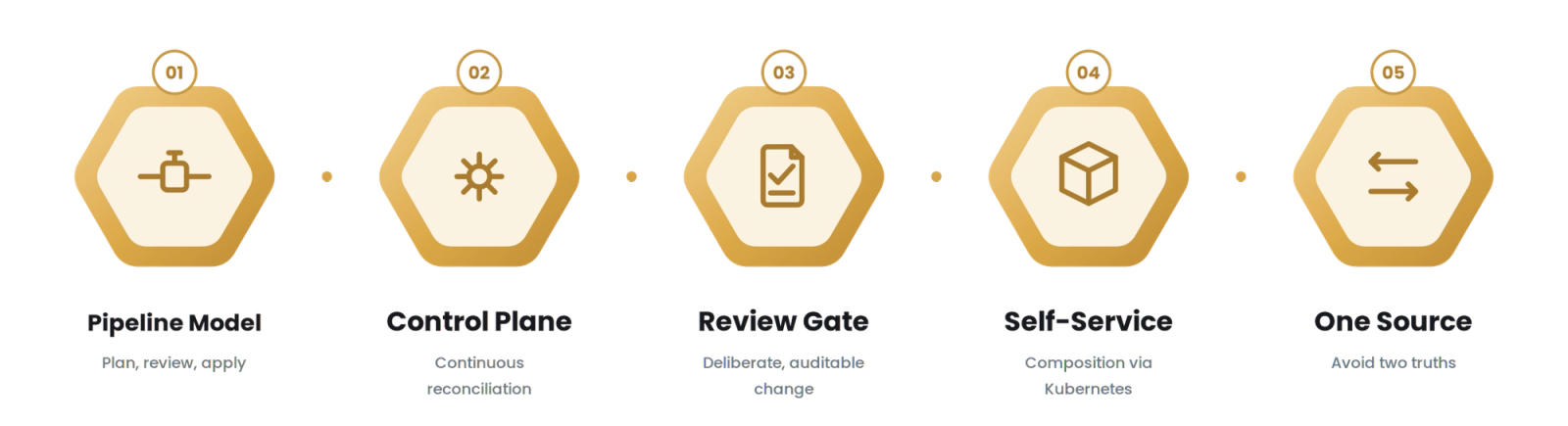
Crossplane versus Terraform for SaaS is a choice between continuous reconciliation through a Kubernetes control plane and deliberate, reviewed change through a plan-and-apply pipeline, where the right answer depends on whether the workflow needs self-service composition or an auditable review gate.
However, most teams frame it as a migration decision, and end up either rebuilding a working Terraform estate for no gain or bolting Crossplane onto workflows that needed a review gate.
If you are a VP of Platform Engineering or Head of Developer Experience at a SaaS company, the intent of this article is:
- Define the real difference between a control plane and a pipeline
- Show which workflows suit each model in a multi-team org
- Lay out how to run both without creating two sources of truth
To do that, let's start with the basics.
What Is the Crossplane and Terraform Choice for SaaS? The Basic Definition
At a high level, Terraform is a pipeline tool: infrastructure is described in configuration, a plan shows what will change, a human or CI system reviews and applies it, and state records what exists.
Drift accumulates silently between runs because nothing is watching. Crossplane installs into Kubernetes and turns infrastructure into custom resources reconciled by controllers, so declared state is continuously enforced and drift is corrected automatically.
Crossplane also lets platform teams compose higher-level abstractions that product teams consume as simple resources. The trade-off is that continuous reconciliation removes the review gate that many changes genuinely need, and it makes Kubernetes a hard dependency for provisioning everything.
To compare:
Terraform is a builder who comes when called, shows you the plans, and does the work while you watch. Crossplane is a caretaker who lives in the building and quietly fixes anything that drifts from the agreed state.
The caretaker is better for keeping thirty teams' environments consistent without anyone asking. The builder is better when you want to see exactly what is about to change to a production database before it happens.
Neither is the modern one. They answer different questions, and confusing them is how teams end up with a migration project that solves nothing.
Why Does This Choice Matter for SaaS?
Issues that it addresses or resolves:
- Self-service provisioning blocked behind a pipeline only platform engineers can run
- Drift accumulating silently between infrequent Terraform applies
- Review gates removed from changes that genuinely needed them
Resolved Issues by Choosing Deliberately
- Self-service composition where product teams should provision freely
- Continuous reconciliation where drift matters more than review
- Deliberate, reviewable change where blast radius is high
Core Components of the Crossplane and Terraform Decision in SaaS
- A clear split of which resources belong to which model
- Composition abstractions where teams self-serve
- Plan-and-review gates where change is consequential
- One source of truth per resource, never two
- Consistent policy enforcement across both paths
Modern Tooling for Both Models in SaaS
- Crossplane compositions exposing simple claims to product teams
- Terraform modules with narrow interfaces and semantic versioning
- Policy as code evaluating both control plane and pipeline changes
- Drift detection for Terraform-managed resources
- Provider coverage assessed honestly before committing
These tools make a two-model estate workable. What matters is that every resource has exactly one owner and one reconciliation path, because a resource managed by both will be fought over continuously.
Other Core Issues They Will Solve
- Product teams provision common infrastructure without a platform ticket
- Consequential changes still get a human review
- Drift stops accumulating in the environments where it matters
In Summary: Crossplane and Terraform answer different questions in SaaS, continuous self-service reconciliation versus deliberate reviewed change, and most orgs should run both with a clear split rather than migrating wholesale.
Importance of This Decision for SaaS in 2026
Platform teams serving many product teams are under pressure to offer self-service without giving up control. Four reasons explain why this decision matters now.
1. Self-service is the expectation.
Thirty product teams waiting on a platform pipeline is the bottleneck that platform engineering exists to remove.
2. Drift is invisible in a pipeline model.
Terraform only knows about reality when it runs, and in a large estate that gap is where surprises live.
3. Review gates still matter.
Not every change should happen automatically. Some deserve a human looking at a diff before anything moves.
4. Migrations are expensive and rarely necessary.
Rebuilding a working Terraform estate to adopt a control plane is a large project with a small payoff. Splitting by workflow is cheaper.
Traditional vs. Modern SaaS Provisioning
- Platform-run pipelines vs. self-service claims for common resources
- Drift discovered at next apply vs. drift reconciled continuously
- One model for everything vs. a deliberate split by blast radius
- Abstractions in module docs vs. abstractions as consumable resources
In summary: A modern SaaS approach splits provisioning by workflow, using a control plane where teams should self-serve and a pipeline where change deserves review.
Details About the Core Components of This Decision in SaaS: What Are You Designing?
Let's go through each component.
1. Split Layer
Which model owns what.
Split decisions:
- Self-service resources assigned to the control plane
- High blast radius resources kept in the pipeline
- No resource managed by both
2. Composition Layer
Abstractions teams consume.
Composition decisions:
- Claims expose intent, not provider detail
- Standards encoded in the composition
- Versioning applied to compositions too
3. Review Layer
Where humans look.
Review decisions:
- Plan and diff required for consequential change
- Approval paths defined per resource class
- Emergency paths documented, not improvised
4. Policy Layer
Consistent rules.
Policy decisions:
- The same standards enforced on both paths
- Admission control on control plane resources
- Plan-time policy checks in the pipeline
5. Ownership Layer
Who runs what.
Ownership decisions:
- Compositions owned like products
- Modules owned like APIs
- Provider coverage gaps tracked openly
Benefits Gained from a Deliberate Split in SaaS
- Product teams self-serve common infrastructure without tickets
- Consequential changes keep a human review gate
- Drift reconciled where it matters, reviewed where it does not
How It All Works Together
The SaaS platform team splits the estate by workflow rather than by preference. Resources that many product teams need repeatedly, application environments, queues, buckets, databases with standard shapes, move to Crossplane, where the platform team publishes compositions that expose a simple claim.
A product team writes a short resource declaring intent, the composition builds the underlying pieces with standards already encoded, and controllers reconcile continuously so drift disappears without anyone noticing it existed. Resources where a mistake is expensive, shared networking, production data stores, anything cross-team, stay in Terraform, where a plan shows exactly what will change and a human approves before it happens.
The critical rule is that no resource is managed by both, because two reconciliation loops with different opinions will fight indefinitely and produce incidents nobody can explain. Policy is enforced consistently across both paths, through admission control on the control plane side and plan-time checks in the pipeline, so standards do not depend on which route a team took.
Compositions and modules are both owned as products with versioning and support models, and provider coverage gaps are tracked openly rather than discovered mid-migration.
Common Misconception
Crossplane is the modern replacement for Terraform.
This framing has cost several teams a year of work. Continuous reconciliation is genuinely better for some things and genuinely worse for others, and the difference is not maturity. A control plane that automatically corrects drift will also automatically undo a deliberate manual intervention during an incident, which is exactly when you least want an argument with a controller.
It removes the plan step, and for a production database change the plan step is the entire point. It also makes Kubernetes a hard dependency for provisioning your infrastructure, which is a significant coupling decision that deserves discussion on its own terms.
Meanwhile Terraform's weakness, silent drift between runs, is real and worth fixing where it matters. The right concl
usion is not to pick a winner but to route each workflow to the model that fits it, which most mature SaaS platform teams end up doing anyway.
Key Takeaway: This is not a maturity ladder. Control planes suit self-service and drift correction; pipelines suit deliberate, reviewed change.
Real-World Crossplane and Terraform for SaaS in Action
Let's take a look at how it operates with a real-world example.
We worked with a SaaS platform team planning a full migration from Terraform to Crossplane, with these constraints:
- Enable self-service for common resources across thirty teams
- Keep review gates on consequential infrastructure
- Avoid a wholesale migration of a working estate
Step 1: Split by Workflow
Not by preference.
- Self-service resources identified
- High blast radius resources kept in the pipeline
- One model per resource enforced
Step 2: Build Compositions
Simple claims.
- Claims expose intent, not provider detail
- Standards encoded in the composition
- Compositions versioned like products
Step 3: Keep the Review Gate
Where it matters.
- Plan and diff required for consequential change
- Approval paths defined per resource class
- Emergency paths documented
Step 4: Enforce Policy Consistently
Same rules, both paths.
- Admission control on control plane resources
- Plan-time checks in the pipeline
- Standards independent of route
Step 5: Own Both
Products, not scripts.
- Compositions owned with support models
- Modules owned as versioned APIs
- Provider gaps tracked openly
Where It Works Well
- Crossplane for repetitive, standardised, self-service resources
- Terraform for shared networking, production data, and cross-team infrastructure
- Orgs willing to run both with a clear ownership split
Where It Does Not Work Well
- Any resource managed by both systems simultaneously
- Crossplane where the provider coverage is immature for your services
- Wholesale migrations undertaken for architectural fashion
Key Takeaway: Route each workflow to the model that fits it, and never let two reconciliation loops own the same resource.
Common Pitfalls
i) Treating it as a migration
Framing this as replacing Terraform turns a routing decision into a year-long project with unclear benefit. Split by workflow instead and migrate only what genuinely gains from continuous reconciliation.
- Working infrastructure gets rebuilt for no benefit
- Provider gaps surface halfway through
- The team loses a year they could have spent on developer experience
ii) Two systems owning one resource
A Terraform apply and a Crossplane controller with different opinions will fight forever, producing changes nobody initiated. Assign exactly one owner per resource and enforce it.
iii) Removing review gates by accident
Moving a production database to continuous reconciliation silently deletes the plan step. Decide deliberately which changes still deserve a human looking at a diff.
iv) Ignoring provider maturity
Control plane coverage varies considerably by cloud service. Check the specific providers you need before committing, because discovering a gap after migration is expensive.
Takeaway from these lessons: The decision is about routing workflows, not about choosing a winner, and the failure modes come from mixing models on the same resource.
Provisioning Model Best Practices for SaaS: What High-Performing Teams Do Differently
1. Split by blast radius and frequency
Put high-frequency, low-risk, self-service resources on the control plane and keep consequential change in the pipeline, because those workflows want opposite things.
2. Enforce one owner per resource
Never let both systems manage the same thing, since two reconciliation loops with different views produce incidents that are extremely hard to diagnose.
3. Compose for intent
Design Crossplane claims the way you design module interfaces: expose the decisions teams need and encode everything else, so self-service does not mean unstandardised.
4. Keep policy identical across paths
Enforce the same standards through admission control and plan-time checks, so the route a team takes never changes what is allowed.
5. Check provider coverage before committing
Validate that the specific services you depend on are well supported, because coverage gaps discovered mid-migration are expensive and demoralising.
Logiciel'svalue add is helping SaaS platform teams split provisioning between control plane and pipeline models by workflow, so thirty teams get self-service without losing the review gates that consequential changes deserve.
Takeaway for High-Performing Teams: Route workflows to the model that fits, keep one owner per resource, and enforce identical policy on both paths.
Signals You Are Doing This Well in SaaS
How do you know it is working? Not by which tool you standardised on, but by whether teams self-serve safely. These are the signals that separate a deliberate split from a half-finished migration.
The split is explicit. Someone can say which model owns which resource class and why.
No resource has two owners. Nothing is managed by both systems.
Teams self-serve. Common infrastructure is provisioned without a platform ticket.
Review gates survived. Consequential changes still show a diff to a human.
Policy is uniform. The same standards apply regardless of provisioning route.
Adjacent Capabilities and Connected Work
This work does not exist in isolation. Provisioning models depend on, and feed into, the surrounding platform. Ignoring the adjacencies is the most common scoping mistake.
Terraform module design determines how usable the pipeline path is. Policy as code enforces standards on both routes. Self-service infrastructure and golden paths determine what teams reach for. Kubernetes multi-tenancy matters because Crossplane runs in your cluster and shares its control plane.
Naming these adjacencies upfront keeps the work scoped and helps leadership see this as a routing decision rather than a tooling migration.
The common mistake is treating each adjacency as someone else's problem. The ownership split is your problem. The policy parity is your problem. The control plane load is your problem. Pretend otherwise and you end up with two sources of truth and no clear story.
Own the adjacencies you depend on, partner with the teams that hold them, and share the split.
Conclusion
Crossplane and Terraform answer different questions. A control plane reconciles continuously, which is what you want for self-service resources thirty teams create routinely and where drift is pure cost. A pipeline plans and applies deliberately, which is what you want when a human should see the diff before a production database changes.
Split your estate by workflow rather than migrating wholesale, make sure exactly one system owns each resource, enforce the same policy on both paths, and check provider coverage before committing to anything.
The teams that get this right are not the ones who picked correctly. They are the ones who stopped treating it as a choice.
The Architecture Layer That Decides If Your AI Product Survives Production
Build the architecture layers that make AI products production-ready.
Key Takeaways:
- Control planes suit continuous self-service; pipelines suit deliberate reviewed change
- No resource should ever be managed by both systems at once
- Splitting by workflow beats migrating wholesale in almost every SaaS org
Getting provisioning models right requires clear routing. When done correctly, it produces:
- Product teams self-serving common infrastructure without tickets
- Review gates preserved where blast radius is high
- Drift reconciled where it matters
- Consistent standards regardless of which path a team took
What Logiciel Does Here
If you are debating a migration from Terraform to Crossplane, we help you split provisioning by workflow instead, so teams self-serve where it is safe and review stays where it counts.
Learn More Here:
- Terraform Modules for Technology & SaaS
- Self-Service Infrastructure for Technology & SaaS
- Policy as Code Across Provisioning Paths
At Logiciel Solutions, we work with SaaS platform leaders on provisioning architecture. Our reference patterns come from estates running both control plane and pipeline models.
Book a technical deep-dive on splitting your provisioning by workflow rather than migrating.