
An energy company runs a two-year programme to adopt data mesh, reorganises around domain ownership, and publishes a set of principles about decentralised data products. Eighteen months in, the domains that had data engineers are doing well and the ones that did not are producing nothing, because a mesh distributes responsibility to teams and half the teams have no capacity to accept it.
Meanwhile nobody bought the integration and metadata layer that would have made cross-domain querying possible, so the successful domains cannot easily be joined. The strategy was not wrong. It confused an operating model with an architecture, and adopted the half that requires staffing without the half that can be bought.
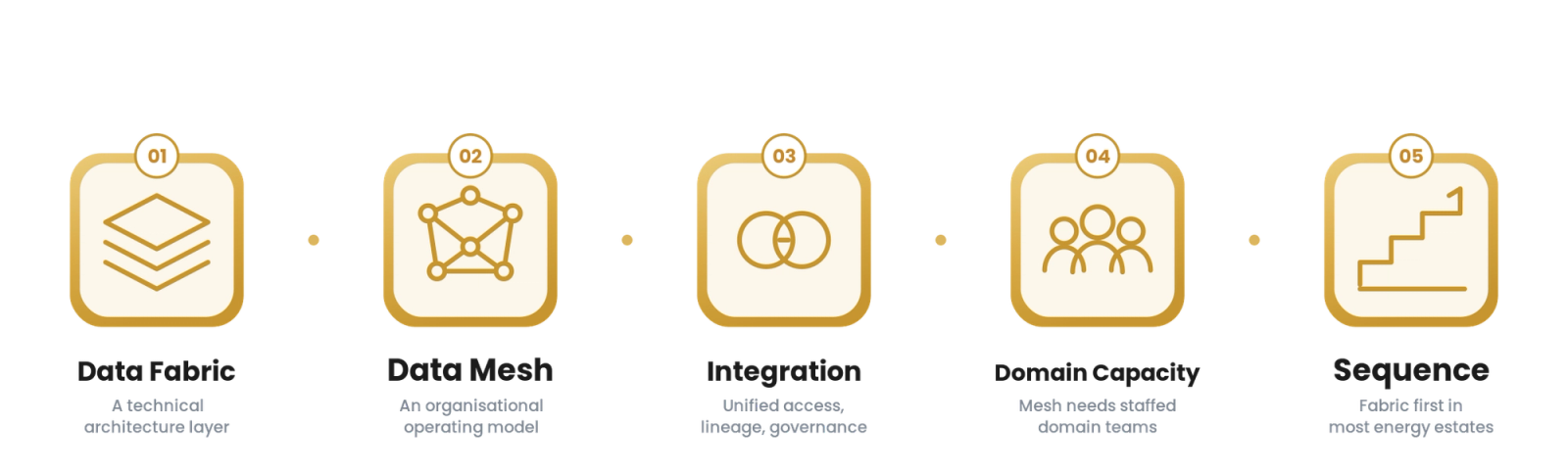
Fabric is architecture. Mesh is an operating model. They answer different questions and you probably need both.
Data fabric for energy means an integration and metadata layer that connects distributed data sources with unified access, lineage, and governance, whereas data mesh is an organisational model distributing data ownership to domains, so the first is a technical investment and the second is a staffing and accountability decision.
The Architecture Layer That Decides If Your AI Product Survives Production
Build the architecture layers that make AI products production-ready.
However, most orgs treat them as competing choices, adopt mesh language without the domain capacity to support it, and skip the integration layer entirely.
If you are a CDO or VP of Data at an energy company, the intent of this guide is:
- Define fabric and mesh as architecture and operating model respectively
- Show why energy estates usually need the fabric first
- Lay out how to sequence the two without confusing them
To do that, let's start with the basics.
What Is Data Fabric for Energy? The Basic Definition
At a high level, a data fabric is a technical layer that connects distributed data sources so consumers get unified access, consistent metadata, lineage, and governance regardless of where data physically lives.
It is architecture: you design and buy it, and it works whether or not your organisation is structured a particular way. Data mesh is different in kind. It is an operating model that assigns ownership of data products to the domains that generate them, with a platform team providing self-service capability.
Mesh requires domain teams with data engineering capacity and accountability. Fabric requires integration work. Confusing the two leads to reorganisations that solve technical problems and technical projects that solve organisational ones.
To compare:
A fabric is the road network: it connects places, and it works regardless of who owns the vehicles. A mesh is the decision that each district maintains its own fleet rather than a central depot.
You can build good roads and keep a central depot. You can distribute the fleet and have terrible roads, which is what most mesh programmes produce. In an energy estate, where data sits across SCADA historians, asset registries, GIS, and cloud warehouses, the roads are usually the more urgent problem.
Why Does This Distinction Matter for Energy?
Issues that it addresses or resolves:
- Mesh adopted as language without domain capacity to support it
- Integration and metadata layers skipped because mesh was chosen instead
- Distributed ownership assigned to teams that cannot accept it
Resolved Issues by Separating the Two
- Architecture investment made independently of reorganisation
- Domain ownership introduced only where capacity exists
- Cross-domain querying possible because the connective layer exists
Core Components of Data Fabric in Energy
- Connectivity to heterogeneous sources including operational systems
- A unified metadata layer covering all connected sources
- Lineage spanning systems, not just the warehouse
- Governance and access control applied consistently
- Query capability across sources without mandatory centralisation
Modern Data Fabric Tooling for Energy
- Connectors for historians, GIS, asset systems, and cloud stores
- Metadata catalogs populated automatically rather than manually
- Cross-system lineage tracking
- Policy-based access control applied at the fabric layer
- Federated query engines avoiding forced replication
These tools make distributed data usable. Automatic metadata population and cross-system lineage are what turn a collection of connectors into something a consumer can actually navigate.
Other Core Issues They Will Solve
- Analysts find and join data without knowing where it lives
- Governance applies consistently rather than per system
- Data does not have to be copied to be used
In Summary: Data fabric for energy is the architectural layer connecting distributed sources with unified metadata and governance, while mesh is a separate operating model decision about who owns what.
Importance of This Distinction for Energy in 2026
Energy data estates are unusually heterogeneous and unusually long-lived. Four reasons explain why this matters now.
1. The sources cannot be consolidated.
Historians, GIS, asset registries, and market systems are not moving into one warehouse, so connectivity matters more than centralisation.
2. Domain data capacity is uneven.
Some domains have engineers and some have a spreadsheet expert, and a mesh assigns the same accountability to both.
3. Mesh language travels faster than mesh capability.
The vocabulary is adopted in strategy documents long before anyone funds domain data teams.
4. Governance has to be consistent.
In a regulated estate, access control applied differently in each system is a finding waiting to be written.
Traditional vs. Modern Energy Data Architecture
- Centralise everything into one warehouse vs. connect sources where they live
- Metadata maintained manually vs. populated automatically
- Lineage within the warehouse vs. lineage spanning systems
- Governance per system vs. policy applied at the fabric layer
In summary: A modern energy approach connects heterogeneous sources with consistent metadata and governance, and treats ownership distribution as a separate decision made where capacity exists.
Details About the Core Components of Data Fabric in Energy: What Are You Designing?
Let's go through each component.
1. Connectivity Layer
Reaching the sources.
Connectivity decisions:
- Historians and operational sources connected read-only
- Cloud and on-premise sources treated equally
- No forced replication where federation suffices
2. Metadata Layer
Knowing what exists.
Metadata decisions:
- Populated automatically from sources
- Business definitions attached where they exist
- Coverage measured rather than assumed
3. Lineage Layer
Tracing across systems.
Lineage decisions:
- Lineage spanning systems, not just transformations
- Consumers able to trace a figure to its origin
- Gaps in lineage made visible
4. Governance Layer
Consistent control.
Governance decisions:
- Access policy applied at the fabric, not per system
- Classification carried through from source
- Access decisions logged centrally
5. Operating Model Layer
Who owns what.
Operating model decisions:
- Domain ownership introduced where capacity exists
- Central team retained where it does not
- The choice made per domain, not globally
Benefits Gained from Data Fabric in Energy
- Analysts finding and joining data without knowing where it lives
- Consistent governance across an estate that cannot be consolidated
- Ownership distributed deliberately rather than declared universally
How It All Works Together
The energy data team separates the architectural question from the organisational one and answers them independently. On the architecture side, the fabric connects what exists: historians and operational sources read-only, asset registries, GIS, market data, and cloud warehouses, without insisting that everything be replicated into one place, because in this estate consolidation is neither achievable nor necessary.
Metadata is populated automatically from those sources rather than maintained by hand, since manual catalogs decay within months, and coverage is measured so nobody assumes completeness. Lineage spans systems rather than stopping at the warehouse boundary, which is what lets a consumer trace a reported figure back to a specific asset reading.
Governance is applied at the fabric layer so access policy and classification are consistent rather than reimplemented per system, which matters in a regulated estate where inconsistent access control is difficult to defend.
On the organisational side, domain ownership is introduced where domains have the capacity to accept it, and the central team keeps responsibility where they do not, with the decision made per domain rather than declared as a universal principle.
That sequencing means the fabric delivers value regardless of how far the operating model gets.
Common Misconception
Data mesh is the modern approach and data fabric is the older centralised one.
They are not on the same axis, so neither can supersede the other, and this framing is why several programmes have reorganised without solving anything. Fabric is about how data is connected, described, and governed.
Mesh is about who is accountable for producing it. A well-run mesh still needs a connective layer or its domain products cannot be joined, and a fabric still needs someone accountable for each source or the metadata describes an unowned mess.
The genuinely useful question is not which to adopt but which constraint is currently binding: if analysts cannot find or join data, that is a fabric problem no reorganisation will fix. If datasets have no owner and break silently, that is an ownership problem no integration layer will fix.
Most energy orgs have both, and the fabric is the half you can buy.
Key Takeaway: Fabric and mesh are not alternatives. One is how data connects, the other is who is accountable, and a mature estate needs both.
Real-World Data Fabric for Energy in Action
Let's take a look at how it operates with a real-world example.
We worked with an energy data team whose mesh programme had stalled in domains without engineering capacity, with these constraints:
- Separate the architecture decision from the operating model
- Connect heterogeneous sources without forced consolidation
- Introduce domain ownership only where capacity exists
Step 1: Separate the Questions
Architecture or accountability.
- Fabric scoped as a technical investment
- Mesh treated as a staffing decision
- Neither used to justify the other
Step 2: Connect What Exists
No forced replication.
- Historians and operational sources connected read-only
- Cloud and on-premise treated equally
- Federation used where copying is unnecessary
Step 3: Populate Metadata Automatically
Manual catalogs decay.
- Metadata harvested from sources
- Coverage measured rather than assumed
- Business definitions attached where available
Step 4: Apply Governance Centrally
Once, not per system.
- Access policy at the fabric layer
- Classification carried from source
- Access decisions logged
Step 5: Distribute Ownership Selectively
Where capacity exists.
- Domain ownership per domain, not global
- Central team retained elsewhere
- Capacity assessed honestly
Where It Works Well
- Heterogeneous estates that cannot realistically be consolidated
- Orgs needing consistent governance across many systems
- Domains with genuine data engineeringcapacity, for mesh specifically
Where It Does Not Work Well
- Mesh declared universally across domains without capacity
- Fabric treated as a substitute for anyone owning the data
- Programmes that reorganise before building connectivity
Key Takeaway: Build the fabric because it delivers value independently, and distribute ownership only where a domain can genuinely accept it.
Common Pitfalls
i) Adopting mesh language without capacity
Declaring domain ownership across an organisation where half the domains have no data engineers produces good intentions and no products. Assess capacity per domain and distribute accordingly.
- Well-resourced domains succeed and others produce nothing
- The programme is judged a failure of the model rather than of staffing
- Central responsibility is abandoned before anything replaces it
ii) Skipping the connective layer
A mesh of domain products that cannot be joined is a collection, not an estate. Build the integration and metadata layer regardless of the operating model.
iii) Maintaining metadata by hand
Manually curated catalogs decay within months in a large estate. Harvest metadata automatically and measure coverage.
iv) Governance per system
Reimplementing access control in each source produces inconsistency that is hard to evidence. Apply policy at the fabric layer.
Takeaway from these lessons: Treat fabric as an architecture you build and mesh as an accountability model you introduce selectively, and never let one stand in for the other.
Data Fabric Best Practices for Energy: What High-Performing Teams Do Differently
1. Separate the architecture from the operating model
Decide connectivity and governance independently of who owns what, because conflating them produces reorganisations that fix nothing technical.
2. Connect rather than consolidate
Federate across historians, GIS, and warehouses instead of insisting everything moves, since in this estate consolidation is not achievable.
3. Harvest metadata automatically
Populate the catalog from sources and measure coverage, because hand-maintained metadata decays faster than anyone expects.
4. Apply governance once at the fabric
Put access policy and classification at the connective layer so control is consistent and evidenceable rather than reimplemented per system.
5. Distribute ownership where capacity exists
Introduce domain ownership per domain based on honest capacity assessment, and keep central responsibility everywhere else.
Logiciel's value add is helping energy data teams build the connective and governance layer their estate actually needs, then introduce domain ownership where domains can genuinely support it.
Takeaway for High-Performing Teams: Build the fabric because it pays off regardless, and treat mesh as a staffing decision made domain by domain.
Signals You Are Doing This Well in Energy
How do you know it is working? Not by which term appears in your strategy, but by whether analysts can find, join, and trace data. These are the signals that separate a connected estate from a renamed one.
Data is findable across systems. Analysts do not need to know where something physically lives.
Metadata is automatic. The catalog reflects reality without manual curation.
Lineage spans systems. A reported figure can be traced back to its source reading.
Governance is consistent. Access policy is applied once, not per system.
Ownership matches capacity. Domains own data where they can, and the centre owns the rest.
Adjacent Capabilities and Connected Work
This work does not exist in isolation. Fabric and mesh decisions depend on, and feed into, the surrounding data platform. Ignoring the adjacencies is the most common scoping mistake.
Data products are what domain ownership actually produces. Data quality SLAs are how those products become dependable. Master data management determines whether shared definitions exist across sources. Your catalog surfaces what the fabric harvests.
Naming these adjacencies upfront keeps the work scoped and helps leadership see fabric as an architecture and mesh as an accountability model rather than two competing purchases.
The common mistake is treating each adjacency as someone else's problem. The metadata coverage is your problem. The governance consistency is your problem. The honest capacity assessment is your problem. Pretend otherwise and you will reorganise around a principle half the organisation cannot act on.
Own the adjacencies you depend on, partner with the teams that hold them, and share the architecture.
Conclusion
Data fabric and data mesh answer different questions. Fabric is architecture: how heterogeneous sources are connected, described, governed, and traced, which in an energy estate spanning historians, GIS, asset registries, and warehouses is usually the binding constraint.
Mesh is an operating model: which domains are accountable for producing data products, which requires those domains to have engineering capacity that is rarely evenly distributed. Build the fabric, because it delivers value regardless of how your organisation is structured.
Introduce domain ownership deliberately, domain by domain, where capacity genuinely exists. Adopting the vocabulary of one while needing the other is how two-year programmes end with nothing joinable.
How an Energy Company Stopped Paying for Silent Data Quality Failures
Detect silent data quality failures faster and reduce operational risk.
Key Takeaways:
- Fabric is architecture you build; mesh is accountability you staff
- Energy estates cannot be consolidated, so connectivity matters more than centralisation
- Mesh without domain capacity produces principles rather than products
Getting this right requires separating the two questions. When done correctly, it produces:
- Data findable and joinable across systems that will never merge
- Governance applied consistently and evidenceably
- Lineage that traces a report back to a source reading
- Ownership distributed where teams can actually accept it
What Logiciel Does Here
If your mesh programme stalled in domains without engineering capacity, we help you build the connective and governance layer your estate needs and distribute ownership only where it can work.
Learn More Here:
- Data Products for Energy
- AI Data Catalogs for Energy
- Master Data Management for Energy
At Logiciel Solutions, we work with energy data leaders on data architecture and operating models. Our reference patterns come from heterogeneous, regulated estates.
Read the guide on separating your data architecture from your operating model.