
A fintech builds a benchmarking product from aggregated transaction data and sells it to merchant customers, and the first year goes well. Then a customer's compliance team asks a question the product was not designed to answer: which permissible purpose covers the underlying data, and can you demonstrate that consumers consented to this specific use.
The aggregation is genuinely sound and the product is useful. What does not exist is a documented chain from the original permissible purpose to this commercial application, because the data was collected to provide a payment service and nobody revisited the basis when it became a revenue line. The product works. The paper trail does not.
Permissible purpose decides what you can sell. Aggregation does not create a basis you never had.
Data monetization for fintech means generating revenue from financial data through products, benchmarking, or partnerships, with permissible purpose validated per use, consumer consent traced, and the recurring compliance obligations priced into the business case.
How to Design Data Products People Actually Use
Design data products around real consumer jobs and practical use cases.
However, most programmes model the revenue and the aggregation, and treat the regulatory basis as something to confirm later rather than the thing that determines feasibility.
If you are a CDO or VP of Data at afintech company, the intent of this article is:
- Define why permissible purpose decides feasibility here
- Show what the compliance bill actually contains
- Lay out how to validate the basis before commercial commitment
To do that, let's start with the basics.
What Is Data Monetization for Fintech? The Basic Definition
At a high level, data monetization in fintech means generating revenue from financial data assets: benchmarking products showing customers how they compare, market and spending insight sold to institutions, enrichment or scoring services, or partnerships where data supports another party's product.
The distinguishing constraint is regulatory. Financial data is collected under a permissible purpose, consumers have consent and disclosure expectations, and the applicable frameworks constrain secondary use regardless of how well the data is aggregated.
What you can sell is determined by the basis under which you hold the data, and that assessment belongs before the business case rather than after it.
To compare:
Monetizing fintech data looks like selling insight from an asset you already own. It is closer to becoming a regulated supplier: your customers have compliance teams, your regulator has views on secondary use, and consumers have expectations about what their transaction history is used for.
Owning the data is necessary and nowhere near sufficient. The permissible purpose is the licence, and unlike a commercial licence you cannot renegotiate it after launch.
Why Does Permissible Purpose Matter So Much for Fintech?
Issues that it addresses or resolves:
- Secondary use assumed permissible because the data is aggregated
- No documented chain from original purpose to commercial application
- Consumer disclosure that does not mention the intended use
Resolved Issues by Validating the Basis
- Feasibility established before commercial commitment
- A documented chain from purpose to product
- Product scope matched to what the basis permits
Core Components of Data Monetization in Fintech
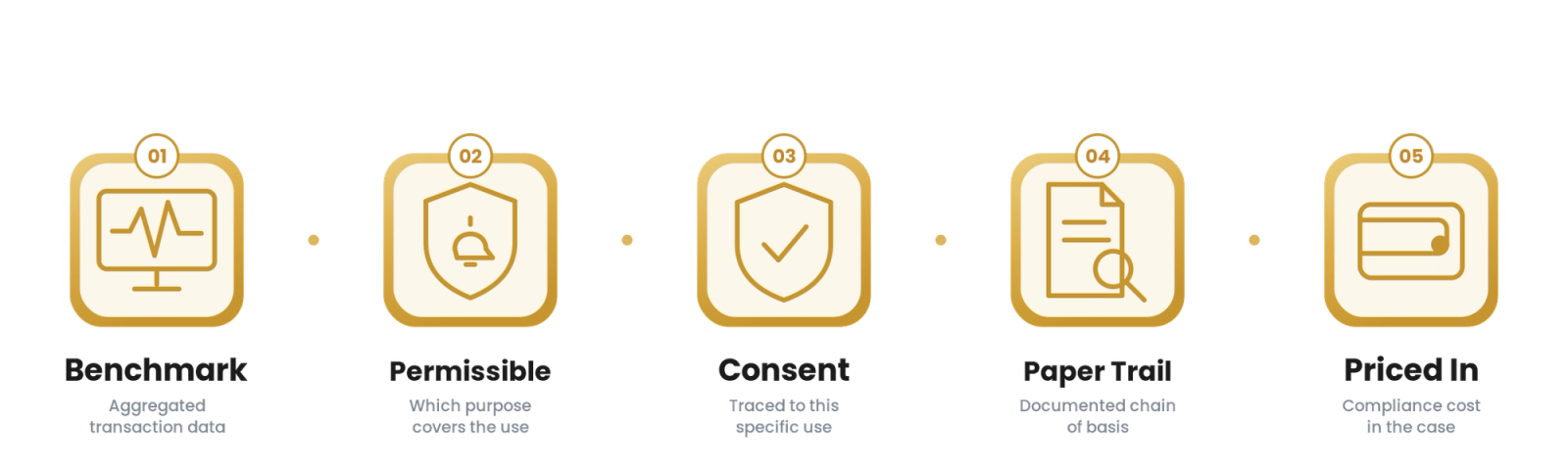
- Permissible purpose validated for the specific commercial use
- Consumer consent and disclosure traced and current
- Aggregation and de-identification standards documented
- Products with owners, contracts, and audit-grade access logging
- A cost model including recurring compliance effort
Modern Data Monetization Tooling for Fintech
- Consent and purpose registries queryable by engineers
- Documented de-identification and aggregation thresholds
- Data contracts and SLAs defined as code
- Access control with logging suitable for customer and regulator audits
- Usage metering for commercial and compliance reconciliation
These tools make monetization defensible. Recording permissible purpose in a form product teams can query is what stops a commercial application from outrunning its regulatory basis.
Other Core Issues They Will Solve
- Customer compliance questions answered from documentation
- Product scope decided from the basis rather than from optimism
- Aggregation standards consistent and evidenceable
In Summary: Data monetization for fintech generates revenue from financial data, and feasibility is decided by permissible purpose and consumer disclosure rather than by what aggregation makes technically safe.
Importance of Getting This Right for Fintech in 2026
Financial data products are commercially valuable and closely examined. Four reasons explain why this matters now.
1. Secondary use is under scrutiny.
Regulators and consumers both take an interest in what transaction data is used for beyond the service it was collected to provide.
2. Your customers have compliance teams.
Institutional buyers ask about basis and consent because their own obligations depend on your answer.
3. Aggregation is not a legal argument by itself.
Sound de-identification reduces risk and does not automatically create a permissible purpose for a new use.
4. Remediation after launch is severe.
Withdrawing a product or re-establishing a basis mid-contract is costly commercially and reputationally.
Traditional vs. Modern Fintech Data Monetization
- Model revenue on available data vs. model on permissible use
- Basis confirmed at launch vs. validated before commitment
- Aggregation treated as sufficient vs. aggregation plus documented purpose
- Compliance evidence assembled on request vs. produced as a by-product
In summary: A modern fintech approach establishes the permissible purpose first, documents the chain to the product, and prices ongoing compliance as an operating cost.
Details About the Core Components of Data Monetization in Fintech: What Are You Designing?
Let's go through each component.
1. Purpose Layer
What you are permitted to do.
Purpose decisions:
- Permissible purpose validated for the specific commercial use
- Chain from collection to application documented
- Registry queryable by product teams
2. Consent Layer
What consumers were told.
Consent decisions:
- Disclosure checked against the intended use
- Withdrawal propagating to derived products
- Records retained and retrievable
3. Aggregation Layer
How identity is removed.
Aggregation decisions:
- Thresholds documented and consistently applied
- Re-identification risk assessed, not assumed away
- Standards reviewed as the dataset grows
4. Product Layer
What you are selling.
Product decisions:
- Named owner and published contract
- Service level stated and monitored
- Audit-grade access logging from day one
5. Cost Layer
The real model.
Cost decisions:
- Recurring compliance review estimated honestly
- Audit response effort included
- Margin recalculated after obligations
Benefits Gained from Validating the Basis in Fintech
- Product scope that survives regulatory and customer scrutiny
- Compliance questions answered from documentation rather than research
- Commercial commitments made against defensible use
How It All Works Together
The fintech data team establishes the regulatory position before the commercial one, which inverts the usual order and prevents the expensive version of this problem. The permissible purpose for the specific intended commercial use is validated, and the chain from original collection through to the product is documented, so a customer's compliance team gets a written answer rather than a reassurance.
Consumer disclosure is checked against the intended use, and withdrawal mechanisms are traced through to derived products, because a consent withdrawal that does not propagate is worse than no mechanism at all.
Aggregation and de-identification thresholds are documented and applied consistently, with re-identification risk assessed rather than assumed away, and reviewed as the dataset grows since thresholds that were safe at one scale may not remain so.
What gets sold is built as a data product with a named owner and a monitored contract, since institutional buyers have contractual expectations. Access is logged to a standard suitable for both customer and regulator audits from day one, because assembling that retrospectively is expensive and unconvincing.
The cost model then includes recurring compliance review, audit response, and support as permanent operating cost, which frequently changes the assessment of which opportunities are worth pursuing.
Common Misconception
If the data is properly aggregated and de-identified, we can sell it.
Aggregation addresses privacy risk. It does not address permissible purpose, and conflating the two is the most common and most consequential error in financial data monetization. The question a regulator or a customer's compliance team asks is not only whether individuals can be identified but whether the use itself is within the basis under which the data was collected and disclosed to consumers.
A perfectly aggregated product built from data collected solely to provide a payment service may still constitute a secondary use requiring its own basis. Sound de-identification is necessary and it is a risk control, not a permission.
Establish the purpose, document the chain, then apply the aggregation standards as an additional protection rather than as the argument.
Key Takeaway: Aggregation is a risk control, not a permission. It reduces privacy exposure without creating a permissible purpose you did not have.
Real-World Data Monetization for Fintech in Action
Let's take a look at how it operates with a real-world example.
We worked with a fintech whose benchmarking product had no documented chain from purpose to application, with these constraints:
- Validate permissible purpose for the specific commercial use
- Document the chain from collection to product
- Price recurring compliance obligations honestly
Step 1: Validate the Purpose
Before the business case.
- Permissible purpose checked for the specific use
- Secondary use assessed explicitly
- Findings recorded in a queryable registry
Step 2: Trace Consumer Disclosure
What people were told.
- Disclosure checked against intended use
- Withdrawal propagation verified
- Records retained and retrievable
Step 3: Document the Aggregation
Standards, not instincts.
- Thresholds written down and applied consistently
- Re-identification risk assessed
- Standards reviewed as data grows
Step 4: Build It as a Product
Owner and contract.
- Named owning team
- Service level stated and monitored
- Audit-grade logging from day one
Step 5: Recalculate the Margin
With obligations included.
- Recurring compliance review included
- Audit response effort estimated
- Opportunity reassessed honestly
Where It Works Well
- Products whose use falls within a documented permissible purpose
- Benchmarking and insight services with sound, documented aggregation
- Orgs willing to treat compliance review as recurring operating cost
Where It Does Not Work Well
- Secondary uses with no basis beyond aggregation quality
- Products where consumer disclosure does not cover the use
- Business cases that model build cost and ignore compliance operations
Key Takeaway: Validate the permissible purpose first, document the chain, and treat aggregation as an additional control rather than the justification.
Common Pitfalls
i) Treating aggregation as the permission
Sound de-identification reduces privacy risk and does not establish a basis for a new use. Validate purpose separately and document the chain.
- A customer's compliance team asks a question with no written answer
- The product may need withdrawing or re-basing mid-contract
- Trust with institutional buyers is difficult to rebuild
ii) Confirming the basis after the business case
Once revenue is forecast and a launch date is set, an unfavourable legal finding is resisted rather than acted on. Validate before commitment.
iii) Consent withdrawal that does not propagate
A withdrawal mechanism that stops at the source system while derived products retain the data is worse than none. Trace propagation and verify it.
iv) Assembling audit evidence retrospectively
Customer and regulator audits recur, and retrospective evidence is expensive and unpersuasive. Log to audit standard from day one.
Takeaway from these lessons: In fintech, permissible purpose determines feasibility, aggregation is a control, and compliance is a recurring operating cost.
Data Monetization Best Practices for Fintech: What High-Performing Teams Do Differently
1. Validate permissible purpose before the business case
Establish the regulatory position first, because an unfavourable finding after a launch date is set gets argued with rather than acted on.
2. Document the chain from collection to product
Give customer compliance teams a written answer rather than a reassurance, since they will ask and their obligations depend on yours.
3. Treat aggregation as a control, not a permission
Document thresholds, assess re-identification risk, and review as the dataset grows, while establishing purpose separately.
4. Verify consent withdrawal propagates
Trace withdrawal through to derived products and test it, because a mechanism that stops at the source is a liability.
5. Log to audit standard from day one
Produce compliance evidence as a by-product, because retrospective assembly is both costly and unconvincing.
Logiciel'svalue add is helping fintech data teams validate permissible purpose and document the chain to the product, then build the aggregation, logging, and ownership that make financial data products defensible.
Takeaway for High-Performing Teams: Purpose decides feasibility, documentation decides defensibility, and recurring compliance decides margin.
Signals You Are Doing Data Monetization Well in Fintech
How do you know it is working? Not by revenue booked, but by whether you can answer a compliance question from documents. These are the signals that separate a defensible product from a profitable risk.
Purpose is documented. A written chain runs from collection to commercial use.
Disclosure covers the use. Consumers were told about this, not something adjacent.
Withdrawal propagates. A consent withdrawal reaches derived products and is tested.
Evidence is automatic. Audits are answered from existing logs.
Margin was recalculated. The model includes recurring compliance and audit effort.
Adjacent Capabilities and Connected Work
This work does not exist in isolation. Data monetization depends on, and feeds into, the surrounding data platform. Ignoring the adjacencies is the most common scoping mistake.
Data products are what you actually sell. Data quality SLAs are what the contract commits you to. Consent and purpose registries decide permissibility. Lineage and access logging produce the audit evidence. Naming these adjacencies upfront keeps the work scoped and helps leadership see monetization as a regulatory question with an operating cost rather than an asset sale.
The common mistake is treating each adjacency as someone else's problem. The purpose documentation is your problem. The withdrawal propagation is your problem. The audit logging is your problem. Pretend otherwise and a customer's compliance team will find the gap before you do.
Own the adjacencies you depend on, partner with the teams that hold them, and share the basis.
Conclusion
Selling financial data makes you a regulated supplier, and the constraint that decides feasibility is permissible purpose rather than aggregation quality. Validate the basis for the specific commercial use before the business case exists, because an unfavourable finding after a launch date is set gets argued with instead of acted on.
Document the chain from collection through disclosure to product so a customer's compliance team receives a written answer. Treat de-identification as an additional control with documented thresholds rather than as the justification.
Verify that consent withdrawal propagates to derived products. Log to audit standard from day one, and price recurring compliance as permanent operating cost.
Key Takeaways:
- Permissible purpose decides feasibility; aggregation is a risk control, not a permission
- Customer compliance teams will ask for a documented chain, so build one
- The compliance and audit burden is recurring and belongs in the margin model
Costing monetization properly requires establishing the basis. When done correctly, it produces:
- Product scope that survives regulatory and customer scrutiny
- Compliance questions answered from documentation in minutes
The Governance Operating Model That Cuts Compliance Incidents
Apply federated governance and automated enforcement to reduce compliance incidents.
- Consent withdrawal that reaches derived products
- Business cases that hold up beyond the first year
What Logiciel Does Here
If your data product cannot show a documented chain from permissible purpose to commercial use, we help you establish the basis, propagate consent properly, and log to audit standard.
Learn More Here:
- Data Products for Fintech
- Data Quality SLAs for Fintech
- Policy as Code for Fintech
At Logiciel Solutions, we work with fintech data leaders on data monetization programmes. Our reference patterns come from regulated estates serving external data customers.
Book a technical deep-dive on validating your basis before you commit commercially.