
A retailer stands up a data product programme, publishes forty datasets to a catalog with descriptions and tags, and declares the first phase complete. Six months later a merchandising team building a markdown model discovers the inventory position dataset stopped updating during peak, nobody noticed for eleven days, and the person listed as owner left in March.
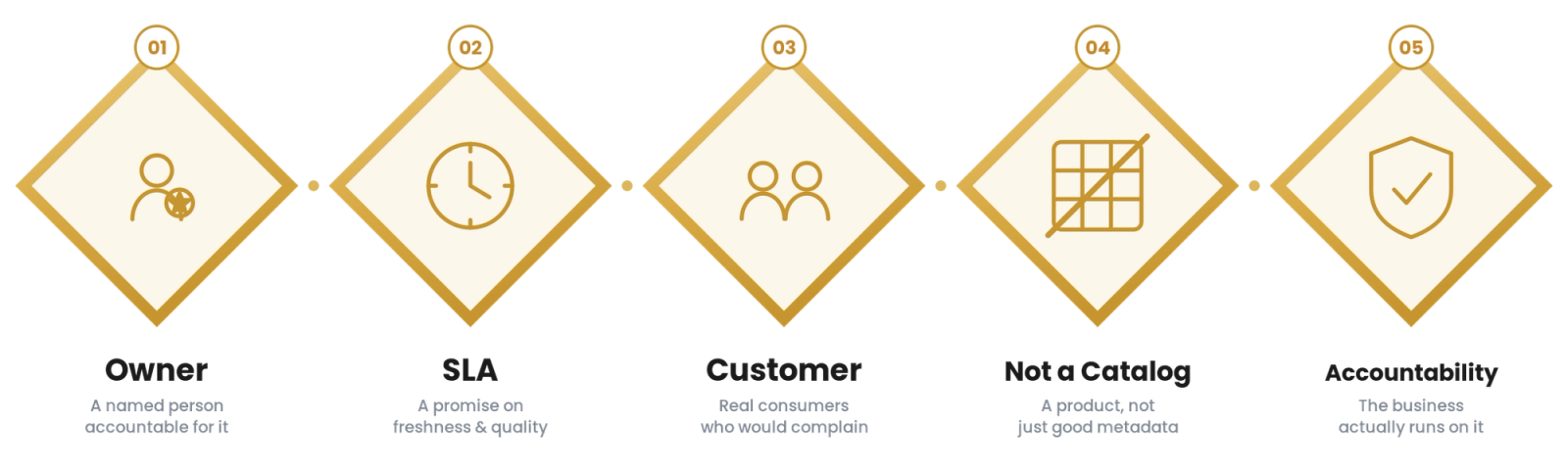
The dataset was documented, discoverable, and well named. It was not a product, because a product has someone accountable for it working, a stated promise about freshness, and customers who would notice and complain.
Forty tables in a catalog is a directory. It is a useful thing to have and it is not what anyone meant by data products.
How to Design Data Products People Actually Use
Design data products around real consumer jobs and practical use cases.
Owner, SLA, customer. Without all three you have a table with better metadata.
Data products for retail means treating datasets as products with a named owner, a published service level for freshness and quality, and identified consumers whose workflows depend on them, so the data the business runs on has accountability rather than just documentation.
However, most programmes start with cataloguing and stop there, and end up with excellent discoverability over datasets nobody is responsible for.
If you are a CDO or VP of Data at a retail company, the intent of this guide is:
- Define what makes a dataset a product rather than a table
- Show why ownership and SLAs matter more than cataloguing
- Lay out how to start with the datasets the business actually runs on
To do that, let's start with the basics.
What Are Data Products for Retail? The Basic Definition
At a high level, a data product in a retail org is a dataset treated with the same discipline as a software product: it has a named owning team, a published contract covering schema, freshness, and quality, identified consumers who depend on it, monitoring that detects when the contract is broken, and a support path when it is.
The distinction from a well-catalogued table is accountability. A catalog entry tells you a dataset exists and what the columns mean. A data product tells you who is responsible when it stops arriving, what you are entitled to expect, and who to talk to.
In retail the products that matter most are the ones several teams build on: inventory position, product hierarchy, customer identity, price and promotion.
To compare:
A catalogued dataset is a phone book listing. It tells you the number exists. A data product is a supplier with a contract: agreed delivery times, a quality standard, a named account manager, and consequences when it fails.
Most retail data programmes produce excellent phone books and then wonder why the business still does not trust the numbers. Discoverability was never the problem. Accountability was.
Why Are Data Products Necessary for Retail?
Issues that it addresses or resolves:
- Datasets breaking silently because nobody is accountable for them
- Teams rebuilding the same inventory or product logic independently
- No stated expectation for freshness, so every consumer assumes differently
Resolved Issues by Data Products
- A named owner accountable when the dataset fails
- Published freshness and quality expectations consumers can rely on
- Shared definitions replacing per-team reimplementation
Core Components of Data Products in Retail
- A named owning team, not an individual
- A published contract covering schema, freshness, and quality
- Identified consumers and their dependent workflows
- Monitoring that detects contract violations
- A documented support and change path
Modern Data Product Tooling for Retail
- Data contracts defined as code alongside the pipeline
- Freshness and quality monitoring with alerting to the owner
- Schema versioning with deprecation windows for consumers
- Lineage showing which workflows depend on which product
- A catalog that surfaces ownership and SLA, not just descriptions
These tools make accountability real. Contracts as code and monitoring wired to the owning team are what separate a data product from a dataset with a good description.
Other Core Issues They Will Solve
- Consumers find out about breaking changes before they break
- Teams stop maintaining private copies of shared logic
- Trust in the numbers improves because failures are visible and owned
In Summary: Data products for retail are datasets with an owner, a published contract, and known consumers, so the data the business runs on is accountable rather than merely documented.
Importance of Data Products for Retail in 2026
Retail decisions increasingly run on shared data across merchandising, supply chain, and digital. Four reasons explain why this matters now.
1. The same datasets underpin everything.
Inventory position, product hierarchy, and customer identity feed dozens of workflows, so a silent failure in one propagates widely.
2. Seasonal load exposes fragility.
Pipelines that cope for ten months break during peak, which is exactly when the business least tolerates stale numbers.
3. Cataloguing has already been tried.
Most retailers have a catalog. The complaint about trusting the data has not changed, which suggests the missing piece is not metadata.
4. Duplicate logic is expensive and divergent.
When each team defines available inventory slightly differently, reconciling the answers costs more than the original work.
Traditional vs. Modern Retail Data Delivery
- Datasets with descriptions vs. products with owners and SLAs
- Failures found by consumers vs. failures detected by monitoring
- Schema changes announced late vs. versioned with deprecation windows
- Every team defining its own logic vs. shared products consumed widely
In summary: A modern retail approach attaches ownership, contracts, and monitoring to the datasets the business depends on, rather than describing everything and owning nothing.
Details About the Core Components of Data Products in Retail: What Are You Designing?
Let's go through each component.
1. Ownership Layer
Who is accountable.
Ownership decisions:
- A named team, never an individual
- Accountability for availability and quality
- A published support path
2. Contract Layer
What consumers can expect.
Contract decisions:
- Schema, freshness, and quality stated explicitly
- Contracts defined as code beside the pipeline
- Change governed by versioning
3. Consumer Layer
Who depends on it.
Consumer decisions:
- Dependent workflows identified and recorded
- Consumers notified of changes in advance
- Feedback routed to the owner
4. Monitoring Layer
Detecting failure first.
Monitoring decisions:
- Freshness and quality checks running continuously
- Alerts routed to the owning team
- Consumers informed when the contract breaks
5. Lifecycle Layer
Change and retirement.
Lifecycle decisions:
- Schema versioned with deprecation windows
- Retirement possible once consumers migrate
- Duplicates consolidated deliberately
Benefits Gained from Data Products in Retail
- Failures detected by the owner rather than discovered by a consumer
- Shared definitions replacing divergent per-team logic
- Trust in the numbers because expectations are stated and monitored
How It All Works Together
The retail data team starts with the datasets the business actually runs on rather than trying to convert the whole estate. Inventory position, product hierarchy, customer identity, and price and promotion are the usual first candidates, because several teams depend on each of them and a failure in any one is visible within a day.
Each gets a named owning team, which means a team rather than an individual, so accountability survives someone changing roles. A contract is published stating schema, freshness expectation, and quality thresholds, and that contract lives as code alongside the pipeline rather than in a wiki, so it can be tested and enforced.
Consumers are identified explicitly, which matters because the list is usually longer and stranger than anyone expected, and it becomes the notification list for changes. Monitoring runs continuously against the contract, and alerts go to the owning team, so a stale dataset is a page for the owner rather than a discovery by a merchandiser eleven days later.
Schema changes are versioned with deprecation windows so consumers migrate deliberately. And where two teams maintain overlapping definitions, one becomes the product and the other is retired rather than both being catalogued.
Common Misconception
Building a data catalog is the foundation of a data product programme.
A catalog is genuinely useful and it is not the foundation, and mistaking one for the other is why so many programmes deliver metadata and no change in trust. Cataloguing makes datasets findable, which helps when the problem is that people cannot locate data.
The complaint in most retail organisations is different: people can find the data and do not trust it, because nobody is accountable when it is wrong and nobody has stated what right looks like.
Those are ownership and contract problems, and a catalog addresses neither. The practical consequence is that a programme which catalogues forty datasets has forty entries and zero products, while a programme that puts an owner, a contract, and monitoring on four datasets has four products the business can actually rely on. Start with the four.
Key Takeaway: A catalog answers where the data is. A data product answers who is accountable when it breaks. The second question is the one being asked.
Real-World Data Products for Retail in Action
Let's take a look at how it operates with a real-world example.
We worked with a retailer whose catalogued inventory dataset failed silently through peak, with these constraints:
- Start with the datasets several teams already depend on
- Attach an owner, a contract, and monitoring to each
- Identify consumers before changing anything
Step 1: Pick the Datasets That Matter
Not the whole estate.
- Datasets with multiple dependent teams chosen first
- Business impact of failure assessed
- Scope kept deliberately small
Step 2: Assign Real Ownership
A team, not a person.
- Named owning team with capacity
- Accountability for availability and quality
- Support path published
Step 3: Publish the Contract
Schema, freshness, quality.
- Expectations stated explicitly
- Contract defined as code
- Change governed by versioning
Step 4: Identify the Consumers
The list is longer than you think.
- Dependent workflows recorded
- Notification list established
- Feedback routed to the owner
Step 5: Monitor the Contract
Owner finds out first.
- Freshness and quality checked continuously
- Alerts routed to the owning team
- Consumers informed on breach
Where It Works Well
- Datasets several teams depend on, where failure is visible quickly
- Orgs willing to assign real ownership with capacity attached
- Teams that can express contracts as code beside the pipeline
Where It Does Not Work Well
- Attempting to convert an entire data estate at once
- Ownership assigned to individuals or to a central team by default
- Programmes that stop at cataloguing and call it done
Key Takeaway: Start with the few datasets the business runs on, attach owner, contract, and monitoring, and expand from proven examples.
Common Pitfalls
i) Cataloguing instead of owning
Publishing descriptions makes data findable and changes nothing about reliability. Attach an owner, a contract, and monitoring to a small number of datasets instead.
- Metadata improves while trust does not
- Failures are still found by consumers
- The programme is judged a success and the complaint persists
ii) Assigning ownership to an individual
A named person is a single point of failure who will change roles. Assign a team with capacity and a published support path.
iii) Contracts in a wiki
A contract that is not code cannot be tested or enforced, so it becomes an aspiration. Define it alongside the pipeline and monitor against it.
iv) Converting everything at once
A programme that tries to productise the whole estate delivers shallow coverage everywhere. Do four properly and let those become the pattern.
Takeaway from these lessons: Data products need ownership, contracts, and monitoring on a small set of important datasets, not documentation across all of them.
Data Product Best Practices for Retail: What High-Performing Teams Do Differently
1. Start with what the business runs on
Pick the four or five datasets multiple teams already depend on, because those are where accountability pays off immediately.
2. Assign ownership to a team with capacity
Never to an individual, and never as an unfunded addition to an existing backlog, or the contract becomes fiction within a quarter.
3. Define contracts as code
Put schema, freshness, and quality expectations beside the pipeline so they can be tested and enforced rather than aspired to.
4. Find your consumers before you change anything
The dependency list is always longer and more surprising than expected, and it is also your notification list for every future change.
5. Monitor so the owner finds out first
Wire freshness and quality alerts to the owning team, because a consumer discovering a stale dataset is a trust failure regardless of how quickly it is fixed.
Logiciel's value add is helping retail data teams turn their most-depended-on datasets into genuine products with owners, contracts, and monitoring, rather than adding another layer of metadata to an existing catalog.
Takeaway for High-Performing Teams: Owner, contract, monitoring, on a small number of important datasets, expanded from examples that already work.
Signals You Are Doing Data Products Well in Retail
How do you know it is working? Not by how many datasets are catalogued, but by who finds out first when something breaks. These are the signals that separate products from listings.
Owners are teams. Every product has an accountable team with a support path.
Contracts exist as code. Freshness and quality expectations are testable, not aspirational.
Owners find out first. Monitoring alerts the owning team before a consumer notices.
Consumers are known. You can list the workflows depending on each product.
Changes are versioned. Schema changes come with deprecation windows.
Adjacent Capabilities and Connected Work
This work does not exist in isolation. Data products depend on, and feed into, the surrounding data platform. Ignoring the adjacencies is the most common scoping mistake.
Data quality SLAs are what the contract formalises. Lineage tells you who your consumers actually are. Your catalog surfaces ownership and SLA rather than just descriptions. Master data management determines whether shared definitions can exist at all.
Naming these adjacencies upfront keeps the work scoped and helps leadership see data products as an accountability model rather than a tooling purchase.
The common mistake is treating each adjacency as someone else's problem. The ownership assignment is your problem. The contract enforcement is your problem. The consumer list is your problem. Pretend otherwise and you will publish forty entries and hear the same complaint about trust next year.
Own the adjacencies you depend on, partner with the teams that hold them, and share the contracts.
Conclusion
A dataset becomes a data product when three things are true: a named team is accountable for it working, a contract states what consumers can expect from schema, freshness, and quality, and you know who depends on it well enough to tell them before you change anything.
Cataloguing delivers none of those, which is why so many retail data programmes improve discoverability and hear the same complaint about trust a year later. Start with the four or five datasets several teams already build on, attach real ownership with capacity, define contracts as code, monitor so the owner finds out first, and let those become the pattern.
Seven Things Every Data Contract Needs to Pin Down (Templates Included)
Define the seven essentials every reliable data contract should include.
Key Takeaways:
- Owner, contract, and known consumers are what make a dataset a product
- Cataloguing answers where the data is, not who is accountable when it breaks
- Four properly owned products beat forty catalogued datasets
Building data products requires real accountability. When done correctly, it produces:
- Failures detected by the owner rather than discovered by a consumer
- Shared definitions replacing divergent per-team logic
- Consumers who learn about changes before they break
- Numbers the business is willing to act on
What Logiciel Does Here
If your catalog is full and trust in the data has not improved, we help you turn your most-depended-on datasets into products with real owners, contracts as code, and monitoring that pages the right team.
Learn More Here:
- Data Quality SLAs and Contracts
- Master Data Management for Retail
- Customer 360 for Retail
At Logiciel Solutions, we work with retail data leaders on data product programmes. Our reference patterns come from estates supporting merchandising, supply chain, and digital together.
Read the guide on turning your critical datasets into accountable data products.