
A retailer's dbt project runs comfortably for most of the year. Then peak arrives, data volumes go up several times, the full refresh that used to take ninety minutes takes six hours, and it collides with the morning reporting deadline for three consecutive days.
The team switches models to incremental to cope, which works until a restatement arrives in January requiring a rebuild of two months of history, and the incremental logic turns out to have been written without a reliable way to reprocess a date range.
Both decisions were reasonable in isolation. Together they produced a pipeline that is fast when volumes are high and unfixable when history changes.
Peak volume and restatements pull in opposite directions. Build for both or pick one and regret it.
dbt at scale for retail means running a large analytics codebase that holds up under seasonal volume swings and routine restatements, with incremental models designed for reprocessing, tests asserting business rules, and CI fast enough to survive a freeze period.
The Scorecard That Tells You If Your AI Test Generator Is Actually Trustworthy
Measure whether AI-generated tests are trustworthy enough for CI.
However, most teams optimise for one of those pressures at a time, and end up with pipelines that either miss the morning deadline in November or cannot rebuild history in January.
If you are a CDO or VP of Data at a retail company, the intent of this article is:
- Define why seasonal volume and restatements create opposing requirements
- Show how incremental models should be designed for reprocessing
- Lay out what to test and how to keep CI usable through freeze
To do that, let's start with the basics.
What Is dbt at Scale for Retail? The Basic Definition
At a high level, running dbt at scale in retail means keeping a large analytics codebase maintainable and dependable when volumes swing seasonally and history gets restated regularly. Three requirements pull against each other.
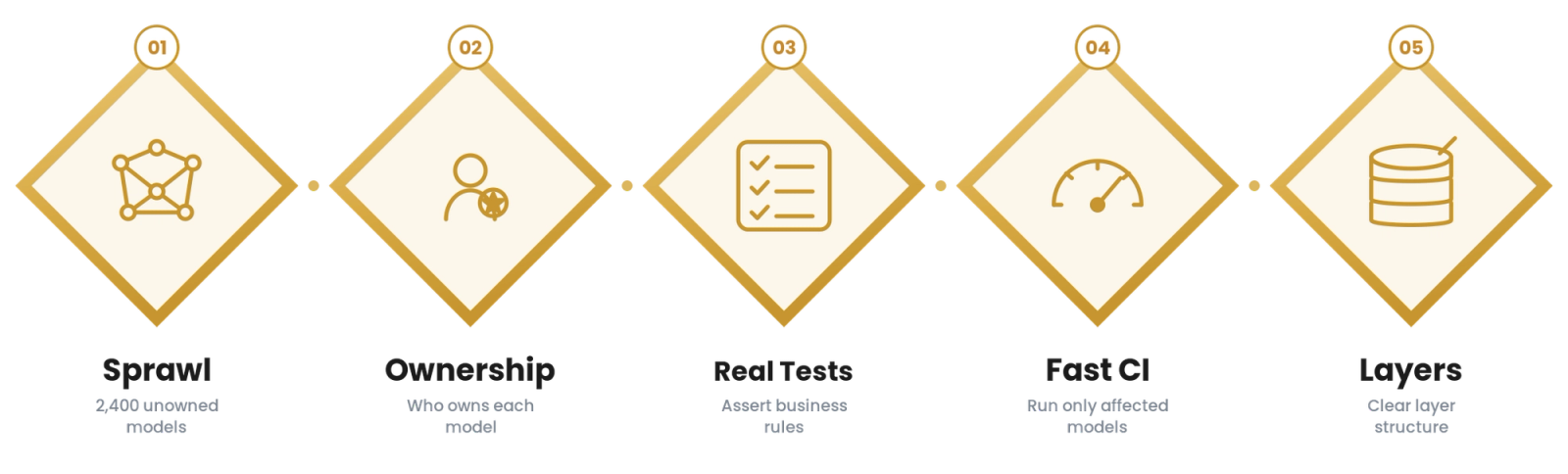
Runtime must hold at peak volumes, which pushes toward incremental models. Reprocessing must remain possible, because restatements to prior periods are routine, which pushes toward full refreshes. And the codebase must stay navigable across contributors, which requires ownership rather than conventions.
Designing incremental models that can reprocess a bounded date range cleanly is what resolves the first two, and it needs deciding upfront rather than retrofitted.
To compare:
A retail dbt project is a kitchen that has to serve a normal Tuesday and Christmas dinner from the same equipment, and occasionally remake last week's meals because the ingredients list was wrong.
Optimising purely for Christmas gives you a kitchen that cannot remake anything. Optimising for remaking gives you one that cannot serve Christmas. The design that works handles both, and it is chosen when the kitchen is built rather than during service.
Why Does dbt Scale Discipline Matter for Retail?
Issues that it addresses or resolves:
- Full refresh runtimes colliding with morning deadlines at peak
- Incremental models that cannot cleanly reprocess a date range
- CI too slow to be usable during freeze periods
Resolved Issues by Designing for Both Pressures
- Runtime that holds at peak volumes
- Bounded reprocessing available when restatements arrive
- CI fast enough to use when change is most tightly controlled
Core Components of dbt at Scale in Retail
- Incremental models designed with reprocessing built in
- Layer ownership with deletion authority
- Tests asserting business rules, including seasonal plausibility
- Selective CI with a defended duration target
- Runtime monitored against peak projections
Modern dbt Tooling for Retail
- Incremental strategies supporting bounded backfill by date range
- State comparison for selective CI runs
- Test frameworks supporting custom business assertions
- Run-time monitoring per model with peak projections
- Usage tracking identifying unused models
These tools make seasonal scale manageable. Incremental strategies that support bounded reprocessing are the single design decision that matters most here.
Other Core Issues They Will Solve
- Morning deadlines hold through peak
- Restatements are rebuilds rather than projects
- Contributors get fast feedback even during freeze
In Summary: dbt at scale for retail requires incremental models designed for bounded reprocessing, business-rule tests, ownership, and CI that stays fast when volumes and change control are both tightest.
Importance of dbt Discipline for Retail in 2026
Retail analytics carries both a volume problem and a correctness problem. Four reasons explain why this matters now.
1. Peak multiplies runtime unpredictably.
A model that takes ninety minutes in March may take several hours at peak volume, and the deadline does not move.
2. Restatements are routine.
Returns, adjustments, and reconciliations mean prior periods change regularly, so reprocessing must be a normal operation.
3. Freeze periods restrict fixes.
A pipeline problem discovered during freeze is harder to fix, so it needs to have been designed against.
4. Incremental logic is easy to write badly.
Many incremental models work correctly for forward loads and have no reliable path to rebuild a bounded historical window.
Traditional vs. Modern Retail Analytics Codebases
- Full refresh everywhere vs. incremental with bounded reprocessing
- Runtime measured at current volume vs. projected to peak
- Schema tests only vs. tests asserting business and seasonal plausibility
- CI running everything vs. selective runs with a duration target
In summary: A modern retail approach designs incremental models for reprocessing from the start and validates runtime against peak projections.
Details About the Core Components of dbt at Scale in Retail: What Are You Designing?
Let's go through each component.
1. Incremental Layer
Fast forward, rebuildable backward.
Incremental decisions:
- Reprocessing by bounded date range supported
- Idempotent merge logic
- Full refresh path retained and tested
2. Runtime Layer
Holding at peak.
Runtime decisions:
- Model runtimes projected to peak volumes
- Critical path to the morning deadline identified
- Headroom validated before the season
3. Test Layer
What is actually asserted.
Test decisions:
- Business rules encoded as tests
- Seasonal plausibility ranges rather than fixed thresholds
- Reconciliation between models asserted
4. Ownership Layer
Who is accountable.
Ownership decisions:
- Every model assigned to an owning team
- Deletion authority explicit
- Unowned models removed
5. CI Layer
Usable during freeze.
CI decisions:
- Selective runs based on changed models
- Duration target defended
- Freeze-period change path defined
Benefits Gained from dbt Discipline in Retail
- Morning deadlines that hold through peak volumes
- Restatements handled as bounded rebuilds
- Tests that account for seasonal variation rather than firing constantly
How It All Works Together
The retail data team designs incremental models with reprocessing as a first-class requirement rather than an afterthought. Every incremental model supports rebuilding a bounded date range, with merge logic that is idempotent so a rerun over the same window produces the same result, and the full refresh path stays tested rather than becoming theoretical.
That single design decision is what lets the same pipeline be fast at peak and rebuildable in January. Runtimes are projected to peak volumes rather than measured at current ones, with the critical path to the morning reporting deadline identified explicitly and headroom validated before the season starts.
Tests assert business rules with seasonal awareness: a fixed threshold on daily order volume fires every day in December and gets muted, so plausibility ranges need to account for the calendar or they train people to ignore alerts.
Reconciliation between models is asserted, since that catches the logical errors schema tests never will. Ownership carries deletion authority so the project does not only grow. And CI runs selectively with a defended duration target, because during freeze a slow pipeline is the difference between shipping a fix and not.
Common Misconception
We can switch models to incremental if runtime becomes a problem at peak.
Switching to incremental under deadline pressure produces incremental logic written for forward loads with no thought given to reprocessing, which is exactly the trap. It works, the runtime problem goes away, and the cost appears in January when a restatement requires rebuilding two months of history and there is no reliable path to do it.
The team then either writes a bespoke backfill script under pressure or accepts that history is now wrong. Designing the incremental strategy properly, with bounded date-range reprocessing and idempotent merges, takes moderately longer upfront and is not remotely comparable in cost to retrofitting it.
Decide this when you build the model, in a quiet month, not in the second week of November.
Key Takeaway: Incremental logic written under deadline pressure handles forward loads only. Design bounded reprocessing upfront or pay for it during a restatement.
Real-World dbt at Scale for Retail in Action
Let's take a look at how it operates with a real-world example.
We worked with a retailer whose peak-driven switch to incremental left them unable to rebuild history for a January restatement, with these constraints:
- Design incremental models for bounded reprocessing
- Project runtimes to peak rather than current volumes
- Keep tests seasonally aware so they stay trusted
Step 1: Design Incremental Properly
Reprocessing first.
- Bounded date-range rebuild supported
- Merge logic idempotent
- Full refresh path retained and tested
Step 2: Project Runtime to Peak
Not current volume.
- Runtimes projected at peak multiples
- Critical path to deadline identified
- Headroom validated pre-season
Step 3: Make Tests Seasonally Aware
Or they get muted.
- Plausibility ranges accounting for calendar
- Reconciliation between models asserted
- Failures triaged rather than silenced
Step 4: Assign Ownership
With deletion authority.
- Every model owned by a team
- Deletion authority explicit
- Unowned models removed
Step 5: Keep CI Fast Through Freeze
When it matters most.
- Selective runs on changed models
- Duration target defended
- Freeze change path defined
Where It Works Well
- Estates with pronounced seasonal volume swings
- Teams that treat restatement as a normal operation
- Projects where incremental design is decided upfront
Where It Does Not Work Well
- Incremental models retrofitted under deadline pressure
- Fixed test thresholds in a seasonal business
- CI too slow to use during freeze periods
Key Takeaway: Design incremental models for bounded reprocessing, project runtime to peak, and keep tests seasonally aware.
Common Pitfalls
i) Incremental without a reprocessing path
Logic written for forward loads works until history changes, at which point there is no reliable way to rebuild a window. Support bounded date-range rebuilds from the start.
- Restatements become bespoke scripts written under pressure
- Or history stays wrong and everyone knows it
- Retrofitting costs far more than designing it in
ii) Fixed test thresholds
An order volume test tuned for March fires every day in December and gets muted, which removes the test permanently. Build seasonal awareness into plausibility ranges.
iii) Measuring runtime at current volume
A ninety-minute model may take hours at peak, and the morning deadline does not move. Project runtimes and validate headroom before the season.
iv) Slow CI during freeze
Freeze is when you most need to ship a small fix safely, and a slow pipeline is when you least can. Defend a duration target year-round.
Takeaway from these lessons: Retail dbt discipline means designing for peak runtime and restatement simultaneously, and keeping tests trustworthy across the calendar.
dbt Best Practices for Retail: What High-Performing Teams Do Differently
1. Design incremental models for reprocessing
Support bounded date-range rebuilds with idempotent merges from the start, because retrofitting this during a restatement is expensive and rushed.
2. Project runtime to peak volumes
Validate that the critical path to your morning deadline has headroom at seasonal multiples, before the season rather than during it.
3. Make tests seasonally aware
Use plausibility ranges that account for the calendar, since fixed thresholds fire constantly in December and get muted permanently.
4. Assign ownership with deletion authority
Give teams responsibility for clearing their layers, because a project where nothing may be deleted can only grow.
5. Defend a CI duration target
Keep selective runs fast year-round, because freeze is when you most need to ship a fix and least want to wait.
Logiciel'svalue add is helping retail data teams build dbt projects that hold up under both peak volume and routine restatement, with incremental designs that reprocess cleanly and tests that stay trusted through December.
Takeaway for High-Performing Teams: Design reprocessing in, project runtime to peak, keep tests seasonal, and defend CI speed.
Signals You Are Doing dbt at Scale Well in Retail
How do you know it is working? Not by how fast the pipeline runs in March, but by whether November and January both work. These are the signals that separate seasonal design from seasonal survival.
Reprocessing works. Any date range can be rebuilt reliably.
Peak has headroom. Runtime projections were validated before the season.
Tests stay on. Nothing is muted for December because thresholds account for it.
CI is fast in freeze. Small fixes can be shipped safely when change is restricted.
Models get deleted. The graph shrinks sometimes rather than only growing.
Adjacent Capabilities and Connected Work
This work does not exist in isolation. dbt practice depends on, and feeds into, the surrounding data platform. Ignoring the adjacencies is the most common scoping mistake.
Data products and contracts define what models must guarantee. Reverse ETL determines which models have operational consumers and higher stakes. Your table format determines how tractable reprocessing is. The freeze calendar governs when changes can ship.
Naming these adjacencies upfront keeps the work scoped and helps leadership see seasonal resilience as a design property rather than an operational effort.
The common mistake is treating each adjacency as someone else's problem. The reprocessing design is your problem. The runtime projection is your problem. The seasonal test thresholds are your problem. Pretend otherwise and you will choose between the November deadline and the January restatement.
Own the adjacencies you depend on, partner with the teams that hold them, and share the standards.
Conclusion
Retail dbt projects face two pressures that pull in opposite directions. Peak volume pushes toward incremental models for runtime, and routine restatement pushes toward full refreshes for correctness. The resolution is designing incremental models with bounded date-range reprocessing and idempotent merges from the outset, which takes moderately longer to build and is dramatically cheaper than retrofitting during a January restatement.
Add runtime projections validated against peak multiples, tests with seasonally aware plausibility ranges so nothing gets muted in December, ownership with deletion authority, and a CI duration target defended year-round because freeze is when speed matters most.
Key Takeaways:
- Peak runtime and restatement reprocessing are opposing pressures that must both be designed for
- Incremental logic written under deadline pressure handles forward loads only
- Fixed test thresholds get muted in December and never come back
Running dbt at scale in retail requires seasonal design. When done correctly, it produces:
- Morning deadlines that hold through peak volumes
- Restatements handled as bounded rebuilds rather than projects
How a Real Estate Platform Hit 5x Scale Without a Re-Platform
Scale platform capacity dramatically without the cost of re-platforming.
- Tests that stay enabled across the whole calendar
- CI fast enough to ship a fix during freeze
What Logiciel Does Here
If your incremental models cannot rebuild a historical window, we help you redesign for bounded reprocessing, project runtimes against peak, and make your tests survive December.
Learn More Here:
- Apache Iceberg and Reprocessing
- Reverse ETL for Retail
- Data Quality SLAs and Monitoring
At Logiciel Solutions, we work with retail data leaders on analytics engineering practice. Our reference patterns come from dbt estates running through severe seasonal swings.
Book a technical deep-dive on making your pipeline work in both November and January.