
An energy company selects a lakehouse table format for a telemetry estate that will hold twenty years of readings. The evaluation compares features and performance, reaches a defensible conclusion, and the migration proceeds.
Six years later the organisation is renegotiating with a different cloud provider, the analytical engine strategy has changed twice, and the format that was tightly coupled to the original vendor's ecosystem is now the thing making both changes expensive.
Nothing about the original analysis was wrong. It simply optimised for a two-year horizon on a dataset with a twenty-year life.
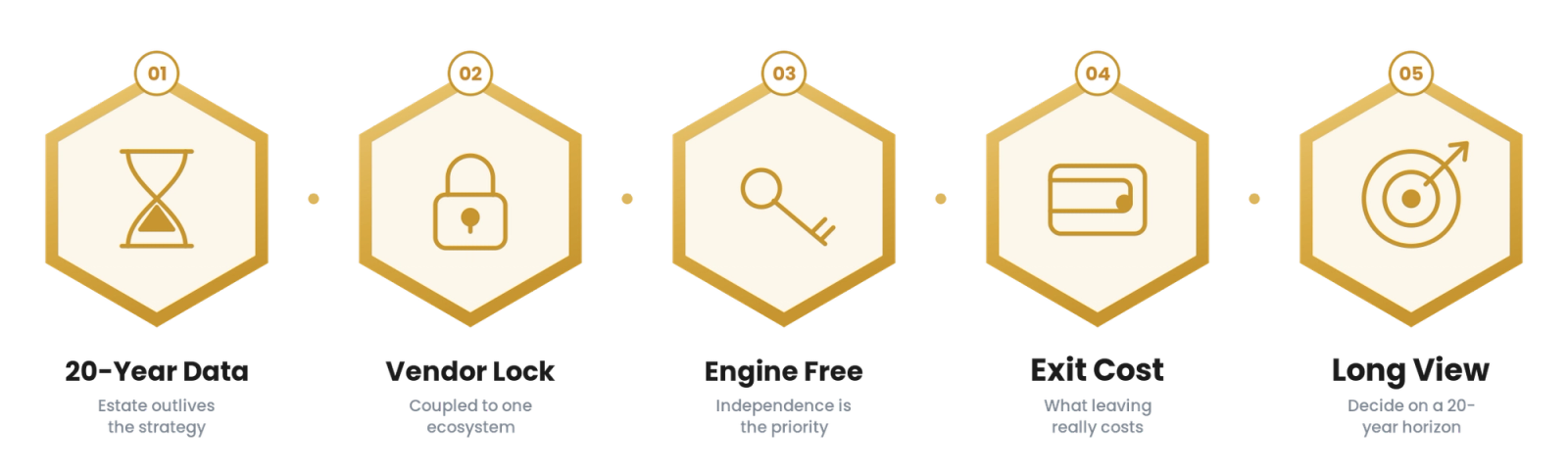
Your energy data will outlast your vendor relationships. Choose the format that survives them.
Delta Lake versus Iceberg for energy means choosing a lakehouse table format weighted toward engine independence and exit cost, because energy data estates have lifespans measured in decades while engine strategies, vendor relationships, and feature comparisons all turn over far faster.
Iceberg, Delta Lake, or Hudi: The Open Table Format Endgame
Compare Iceberg, Delta Lake, and Hudi for open lakehouse decisions.
However, most evaluations compare current features and performance, which are the least durable factors for a dataset that will outlive several rounds of platform strategy.
If you are a CDO or VP of Data at an energy company, the intent of this article is:
- Define what genuinely differs between the formats and what does not
- Show why engine independence dominates for long-lived estates
- Lay out how to decide with a twenty-year horizon in mind
To do that, let's start with the basics.
What Is the Delta and Iceberg Choice for Energy? The Basic Definition
At a high level, Delta Lake, Apache Iceberg, and Apache Hudi are open table formats over object storage providing the same category of capability: atomic commits, snapshot isolation, schema evolution, partition evolution, time travel, and metadata making large tables efficiently queryable.
All three suit long-lived time-series data functionally. They differ in which engines treat them as first-class, in governance model, and in how tightly each is associated with a particular vendor's ecosystem. For a dataset with a twenty-year horizon, the question is not which is better now but which leaves you least constrained when your engine and vendor decisions change, which they will.
To compare:
Choosing a format for a twenty-year dataset is like choosing a building's structural standard rather than its interior fit-out. The fit-out will be replaced several times and the structure will not. Feature comparisons are fit-out questions: important now, replaced later.
Engine independence and exit cost are structural, because they determine what you can do in year eight when the analytical strategy changes and the storage is still there.
Why Does This Choice Matter for Energy?
Issues that it addresses or resolves:
- Format decisions optimised for a horizon far shorter than the data's life
- Vendor coupling that becomes expensive during later renegotiation
- Engine strategy changes constrained by an earlier format choice
Resolved Issues by Weighting Independence
- Format choice that survives engine strategy changes
- Vendor coupling entered deliberately and bounded
- Exit cost known rather than discovered in year six
Core Components of the Format Decision in Energy
- An honest estimate of the data's expected lifespan
- Engine independence weighted above current features
- Governance and vendor alignment examined explicitly
- Exit cost estimated across a long horizon
- Maintenance obligations understood as format-independent
Modern Format Tooling and Interoperability for Energy
- Catalog implementations supporting one or more formats
- Interoperability layers translating between formats
- Engine connectors with varying maturity per format
- Migration tooling between formats
- Metadata monitoring required under any choice
These tools soften the decision without removing it. For a twenty-year estate, the existence of migration paths matters more than any current feature difference.
Other Core Issues They Will Solve
- Engine strategy can change without a storage migration
- Vendor renegotiation is not constrained by format lock-in
- Maintenance is planned independently of the choice
In Summary: Delta versus Iceberg for energy is decided by engine independence and exit cost, because the data will outlast the engine strategies and vendor relationships that current comparisons optimise for.
Importance of This Choice for Energy in 2026
Energy data has an unusually long life and platform strategies do not. Four reasons explain why this matters now.
1. The data horizon is decades.
Twenty years of telemetry will outlive several rounds of engine and vendor decisions, so the format has to survive them too.
2. Feature comparisons expire in quarters.
A matrix built now reaches a different conclusion next year, which makes it a weak basis for a decades-long commitment.
3. Vendor renegotiation happens repeatedly.
Over twenty years you will renegotiate cloud and platform relationships several times, and format coupling affects your position each time.
4. Engine strategies turn over.
The analytical engine you standardise on today is unlikely to be the only one you use in a decade.
Traditional vs. Modern Energy Format Selection
- Feature matrix comparison vs. engine independence assessment
- Two-year horizon vs. horizon matched to data lifespan
- Vendor coupling unexamined vs. coupling bounded deliberately
- Assumed permanence vs. exit cost estimated explicitly
In summary: A modern energy approach weights engine independence and exit cost heavily, treats features as converging, and matches the decision horizon to the data's life.
Details About the Core Components of This Decision in Energy: What Are You Designing?
Let's go through each component.
1. Horizon Layer
How long the data lives.
Horizon decisions:
- Expected data lifespan stated explicitly
- Retention obligations factored in
- Decision horizon matched to it
2. Independence Layer
How many engines can read it.
Independence decisions:
- Breadth of engine support assessed
- First-class read and write support distinguished
- Future engine flexibility weighted
3. Alignment Layer
Whose ecosystem.
Alignment decisions:
- Governance model understood per format
- Vendor coupling bounded deliberately
- Renegotiation position considered
4. Exit Layer
Cost of changing.
Exit decisions:
- Migration path and cost estimated
- Interoperability options assessed
- Tooling coupling identified
5. Maintenance Layer
Same under any choice.
Maintenance decisions:
- Compaction required regardless
- Snapshot expiry required regardless
- Metadata monitoring required regardless
Benefits Gained from Weighting Independence in Energy
- Engine strategy changes without a storage migration
- Vendor renegotiations conducted from a stronger position
- A decision that still looks reasonable in year eight
How It All Works Together
The energy data team states the expected lifespan of the data first, which reframes the entire evaluation. Twenty years of telemetry with regulatory retention obligations will outlive the current engine strategy, the current cloud contract, and several rounds of platform preference, so the decision horizon has to match the data rather than the project.
With that framing, engine independence becomes the dominant criterion: how many engines treat the format as first-class, and how likely is that breadth to grow. Vendor alignment is examined explicitly and bounded deliberately, because over two decades you will renegotiate platform relationships repeatedly and format coupling affects your position each time.
Exit cost is estimated across the long horizon, including tooling that would need rebuilding, since the existence of a migration path matters more here than any current feature difference. Features are checked only for genuine blockers, on the assumption that gaps close well within the data's lifespan.
And maintenance is budgeted independently, because compaction, snapshot expiry, and metadata monitoring are obligations under any of these formats and are where the ongoing effort actually goes.
Common Misconception
We should choose the format that performs best on our current workloads.
Current workload performance is a reasonable input and a poor primary criterion for data with a twenty-year life, because the workloads will change several times before the data is retired. The queries you run in year eight will come from analytical tools that may not exist yet, run by teams organised differently, answering questions nobody is asking now.
What you can predict is that you will want those future tools to be able to read this data without a migration, and that you will renegotiate the platform relationship you are currently entering.
Optimising a decades-long storage decision for this year's benchmark results is a category error, and it is the specific error that leaves organisations constrained in year six.
Key Takeaway: Current performance optimises for workloads that will change. Engine independence optimises for the fact that they will.
Real-World Format Selection for Energy in Action
Let's take a look at how it operates with a real-world example.
We worked with an energy data team whose earlier format choice constrained both engine strategy and vendor renegotiation six years later, with these constraints:
- Match the decision horizon to the data's lifespan
- Weight engine independence above current features
- Estimate exit cost across a long horizon
Step 1: State the Horizon
Decades, not quarters.
- Expected data lifespan stated
- Retention obligations factored in
- Decision horizon matched
Step 2: Weight Independence
Breadth of support.
- Engine support breadth assessed
- Read and write distinguished
- Future flexibility valued
Step 3: Bound the Coupling
Deliberately.
- Governance model understood
- Vendor alignment chosen consciously
- Renegotiation position considered
Step 4: Estimate Exit Cost
Across the horizon.
- Migration path and cost assessed
- Interoperability options considered
- Tooling coupling identified
Step 5: Budget Maintenance Separately
Format-independent.
- Compaction planned regardless
- Snapshot expiry planned regardless
- Metadata monitoring planned regardless
Where It Works Well
- Long-lived estates where engine independence is weighted heavily
- Organisations that renegotiate platform relationships periodically
- Teams treating exit cost as a first-class input
Where It Does Not Work Well
- Decisions optimised for current benchmark performance
- Vendor coupling accepted without examination
- Assuming any format reduces maintenance obligations
Key Takeaway: For decades-long estates, weight engine independence and exit cost, and treat current feature differences as noise.
Common Pitfalls
i) Matching the decision horizon to the project
A format chosen for a two-year project constrains a twenty-year dataset. State the data's lifespan first and let it set the evaluation frame.
- The decision looks reasonable and ages badly
- Engine strategy changes become storage migrations
- Vendor renegotiation happens from a weaker position
ii) Optimising for current performance
Workloads will change several times before the data retires. Weight breadth of engine support over this year's benchmark results.
iii) Unexamined vendor coupling
Over two decades you will renegotiate repeatedly, and coupling affects your position each time. Examine and bound it deliberately.
iv) Assuming lower maintenance
Compaction, snapshot expiry, and metadata monitoring are required under all three formats. None is a lower-maintenance option.
Takeaway from these lessons: For long-lived energy estates the durable criteria are engine independence and exit cost, and the decision frame should match the data's life.
Format Selection Best Practices for Energy: What High-Performing Teams Do Differently
1. State the data lifespan before evaluating
Let the horizon set the frame, because a twenty-year dataset and a two-year project deserve different criteria.
2. Weight engine independence heavily
Prefer breadth of first-class support, since the analytical tools of year eight are unknown and you want them to read this data without migration.
3. Bound vendor coupling deliberately
Understand the governance model and commercial gravity, and choose the degree of coupling consciously rather than inheriting it.
4. Estimate exit cost across the horizon
Include tooling that would need rebuilding, because that number tells you how consequential the decision really is.
5. Budget maintenance independently
Compaction, expiry, and metadata monitoring are obligations under any choice, so plan them separately from the format decision.
Logiciel's value add is helping energy data teams choose lakehouse formats against the actual lifespan of their data, weighting engine independence and exit cost over feature comparisons that expire in quarters.
Takeaway for High-Performing Teams: Match the horizon to the data, weight independence, bound the coupling, and budget maintenance regardless.
Signals You Are Doing This Well in Energy
How do you know it is working? Not by benchmark results, but by whether an engine strategy change would require a storage migration. These are the signals that separate a durable decision from a quarterly one.
The horizon was stated. Data lifespan framed the evaluation explicitly.
Independence was weighted. Breadth of engine support drove the choice.
Coupling is bounded. Someone can state how tied you are and to whom.
Exit cost is known. You have an estimate including tooling rebuild.
Maintenance is budgeted. Compaction and expiry are planned regardless of format.
Adjacent Capabilities and Connected Work
This work does not exist in isolation. Format choice depends on, and feeds into, the surrounding data platform. Ignoring the adjacencies is the most common scoping mistake.
Your engine landscape and its expected evolution are the primary input. Catalog choice interacts closely with format support. Retention obligations set the data lifespan. Streaming and batch decisions determine write patterns and compaction load.
Naming these adjacencies upfront keeps the work scoped and helps leadership see the choice as a long-horizon structural decision.
The common mistake is treating each adjacency as someone else's problem. The horizon estimate is your problem. The exit cost is your problem. The maintenance plan is your problem. Pretend otherwise and a reasonable decision will constrain you in year six.
Own the adjacencies you depend on, partner with the teams that hold them, and share the reasoning.
Conclusion
Energy data estates have lifespans measured in decades while engine strategies, vendor relationships, and feature comparisons turn over in quarters or years. That mismatch should determine how the format decision is made.
State the expected lifespan first, weight breadth of engine support heavily because the analytical tools of year eight are unknown, examine and bound vendor coupling deliberately since you will renegotiate several times, and estimate the exit cost including tooling rebuild.
Check features only for genuine current blockers. Then budget compaction, snapshot expiry, and metadata monitoring, which are obligations under any of these formats and where the real ongoing effort goes.
Key Takeaways:
- Match the decision horizon to the data's lifespan, not the project's
- Engine independence and exit cost are the criteria that persist for decades
- No format choice reduces compaction and metadata maintenance obligations
Choosing a format well requires a long horizon. When done correctly, it produces:
- Engine strategy changes that do not require a storage migration
- Vendor renegotiations conducted from a stronger position
How an Energy Company Stopped Paying for Silent Data Quality Failures
Detect silent data quality failures faster and reduce operational risk.
- A decision that still looks reasonable in year eight
- Maintenance planned independently of the format
What Logiciel Does Here
If your format choice is constraining engine strategy or vendor renegotiation, we help you evaluate against your data's actual lifespan and weight the criteria that persist.
Learn More Here:
- Apache Iceberg for Energy
- Data Products for Energy
- Streaming vs Batch for Energy
At Logiciel Solutions, we work with energy data leaders on lakehouse architecture. Our reference patterns come from estates holding decades of time-series data.
Book a technical deep-dive on choosing a format your data will outlive gracefully.