
An energy company's platform team discovers that a sensor telemetry pipeline has been writing to hot storage for three years because someone set retention to indefinite during a proof of concept and nobody revisited it.
The data is genuinely needed, some of it for regulatory reasons, which is exactly why nobody questioned the bill. The problem was never that the data was retained. It was that retention was never a decision: no tier chosen, no lifecycle set, no owner asked.
Across an estate full of long-lived time-series data, that pattern accumulates quietly for years, and no monthly cost review catches it because the line item looks like a legitimate cost of doing business.
Cost reviews find spend after you committed to it. Guardrails make retention and sizing a decision at creation.
Where to Put Cost Controls Before They Ever Reach the Cloud Bill
Embed cost controls early across architecture, provisioning, and deployment.
FinOps guardrails for energy means making budgets, cost attribution, and retention policy primitives of the platform, enforced when infrastructure is provisioned rather than reviewed later, so long-lived data and heavy compute carry a deliberate cost decision from day one.
However, most teams treat FinOps as reporting, and in an estate of multi-year datasets that means discovering a decision nobody made, several years after it was made.
If you are a VP of Platform Engineering or Head of Developer Experience at an energy company, the intent of this article is:
- Define guardrails as provisioning-time controls, not periodic reports
- Show why retention and storage tiering dominate cost here
- Lay out how to make budgets a platform primitive in a long-lived estate
To do that, let's start with the basics.
What Are FinOps Guardrails for Energy? The Basic Definition
At a high level, FinOps guardrails in an energy org are controls built into the provisioning path that make cost a property of infrastructure at the moment it is created. Every resource carries attribution to a team and a system.
Storage tiering and retention are set explicitly rather than defaulting to indefinite. Compute sizing for analytical and simulation workloads requires a decision rather than inheriting an example. Budgets exist per team with automated behavior at thresholds.
And regulatory retention requirements are distinguished from convenience retention, because conflating them is how an entire data estate ends up on expensive storage forever.
To compare:
A monthly cost review is a bank statement. Accurate, useful, and delivered after the money left. A guardrail is the moment someone asks how long you actually need this and on which tier, while the answer can still change the cost curve for the next four years.
In an estate where a storage decision compounds across years of time-series data, the difference between those two moments is very large.
Why Are FinOps Guardrails Necessary for Energy?
Issues that it addresses or resolves:
- Retention set to indefinite because no one was asked to choose
- Long-lived data sitting on hot storage it does not need
- Heavy compute sized by copying an earlier example
Resolved Issues by Guardrails
- Retention and tiering decided deliberately at creation
- Regulatory retention separated from convenience retention
- Cost attributable to a team and system without investigation
Core Components of FinOps Guardrails in Energy
- Mandatory attribution tags enforced at admission
- Retention and storage tier required as an explicit input
- Cost-aware defaults for compute and storage
- Per-team budgets with automated responses
- Regulatory retention classified separately from the rest
Modern FinOps Tooling for Energy
- Policy as code rejecting untagged or untiered resources
- Terraform modules requiring retention as a deliberate choice
- Lifecycle rules moving data down tiers automatically
- Budget alerts routed to owning teams
- Cost estimates surfaced in pull requests
These tools shift FinOps left. Requiring a retention decision at creation and tiering data automatically afterwards are what stop a multi-year estate from quietly compounding cost.
Other Core Issues They Will Solve
- Engineers see the multi-year cost consequence while it is still changeable
- Data moves down storage tiers without anyone remembering to do it
- Central FinOps effort shifts from investigation to design
In Summary: FinOps guardrails for energy make budgets, attribution, and retention platform primitives enforced at provisioning, so cost in a long-lived estate is designed rather than discovered.
Importance of FinOps Guardrails for Energy in 2026
Energy data estates are large, growing, and expensive to hold. Four reasons explain why guardrails matter now.
1. Storage decisions compound for years.
A retention setting on a telemetry pipeline determines cost across the whole life of the dataset, which is usually longer than the person who set it stays on the team.
2. Regulatory retention gets over-applied.
Because some data must be kept, teams keep everything, on the tier that was easiest at the time.
3. Analytical compute is lumpy and easy to oversize.
Simulation and modelling workloads get sized for the worst case and left there.
4. Reporting does not change behavior.
Cost dashboards have been available for years. Spend kept rising, because a dashboard is not a decision point.
Traditional vs. Modern Energy Cost Control
- Periodic cost review vs. decisions required at provisioning
- Retention left at default vs. retention as a mandatory input
- Tagging by convention vs. attribution enforced at admission
- Cost discovered on the invoice vs. cost shown in the pull request
In summary: A modern energy approach requires a retention and sizing decision at creation and tiers data automatically thereafter, rather than reviewing accumulated spend annually.
Details About the Core Components of FinOps Guardrails in Energy: What Are You Designing?
Let's go through each component.
1. Attribution Layer
Whose spend is it.
Attribution decisions:
- Ownership tags mandatory at admission
- Untagged resources rejected, not reported
- Tags sourced from the service catalog
2. Retention Layer
How long, on what tier.
Retention decisions:
- Retention required as an explicit input
- Regulatory need distinguished from convenience
- Indefinite retention requiring justification
3. Tiering Layer
Data moving down.
Tiering decisions:
- Lifecycle rules applied at creation
- Access patterns reviewed against tier
- Archive tiers used rather than discussed
4. Compute Layer
Sizing analytical workloads.
Compute decisions:
- Sizing requires a decision, not an inherited example
- Burst capacity separated from steady state
- Idle analytical clusters expired
5. Budget Layer
Limits per team.
Budget decisions:
- Budgets held by owning teams
- Automated behavior at thresholds
- Alerts routed to the team first
Benefits Gained from FinOps Guardrails in Energy
- Retention and tiering decided once, correctly, at creation
- Long-lived data cost that grows predictably rather than surprisingly
- Every cost attributable to a team and system
How It All Works Together
The energy platform team starts with attribution, because nothing else works without it. Ownership tags become mandatory at admission, sourced from the service catalog rather than typed by hand, and untagged resources are rejected rather than logged for later cleanup.
With attribution in place, the highest-leverage control in this estate is retention. Shared modules require retention and storage tier as explicit inputs with no default, so a team provisioning a telemetry pipeline has to answer how long the data is needed and on which tier before anything gets created.
Regulatory retention is classified separately from convenience retention, which prevents the common pattern where everything gets kept forever because some of it must be. Lifecycle rules are applied at creation so data moves down tiers automatically rather than depending on someone remembering in three years.
Analytical and simulation compute requires a sizing decision rather than inheriting a copied example, with burst capacity separated from steady state and idle clusters expiring. Budgets sit with owning teams and alerts route to them rather than to a central inbox.
Cost estimates appear in pull requests, which for a storage decision means showing the multi-year figure rather than the monthly one, because that is the number that makes the choice obvious.
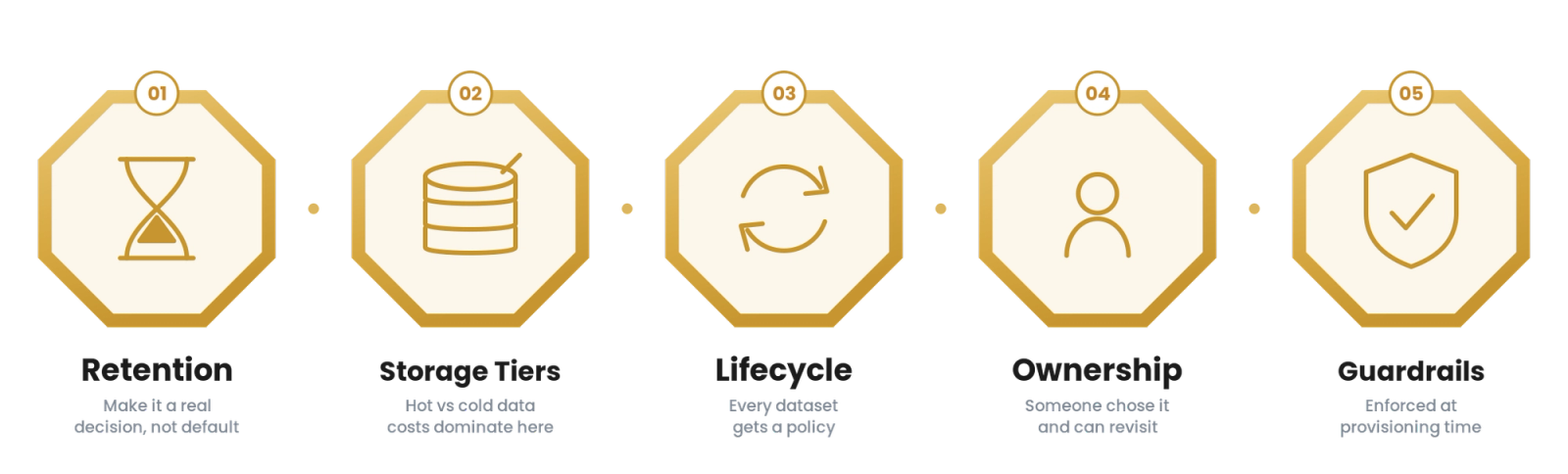
Common Misconception
We have to keep this data anyway, so the cost is unavoidable.
Retention is a requirement. The tier, the format, the access pattern, and how much of the data actually falls under that requirement are all decisions, and they are usually made once by accident.
In practice a fraction of an energy data estate carries a genuine regulatory retention obligation, and that fraction rarely needs to sit on the storage tier that supports interactive querying. The rest is kept because deleting things feels risky and nobody was asked to distinguish the cases.
Separating regulatory retention from convenience retention, and applying lifecycle rules that move data to archive tiers automatically, typically cuts storage cost substantially without changing what is retained at all. The obligation is real. The bill attached to it is negotiable.
Key Takeaway: You may have to keep the data. You almost never have to keep it on that tier, in that format, for that long.
Real-World FinOps Guardrails for Energy in Action
Let's take a look at how it operates with a real-world example.
We worked with an energy platform team whose telemetry pipeline had written to hot storage for three years, with these constraints:
- Enforce attribution before attempting anything else
- Make retention and tier explicit decisions at creation
- Separate regulatory retention from convenience retention
Step 1: Enforce Attribution
Reject, do not report.
- Ownership tags mandatory at admission
- Untagged resources rejected
- Tags sourced from the catalog
Step 2: Require a Retention Decision
No default.
- Retention and tier as mandatory inputs
- Indefinite retention requires justification
- Regulatory need classified separately
Step 3: Apply Lifecycle at Creation
Data moves itself.
- Tiering rules set from day one
- Archive tiers used by default for cold data
- Access patterns reviewed against tier
Step 4: Size Compute Deliberately
Not by copying.
- Sizing requires a decision
- Burst separated from steady state
- Idle analytical clusters expire
Step 5: Distribute the Budgets
Teams own their spend.
- Budgets held by owning teams
- Automated behavior at thresholds
- Multi-year estimates shown in diffs
Where It Works Well
- Estates with large, long-lived time-series or telemetry data
- Orgs with shared modules that can require inputs
- Teams willing to reject provisioning rather than report on it
Where It Does Not Work Well
- Estates with no reliable attribution
- Orgs where all retention is treated as regulatory
- Any approach relying on annual reviews to change behavior
Key Takeaway: In energy, retention and tiering are the dominant cost levers, and both have to be decisions made at creation rather than settings discovered later.
Common Pitfalls
i) Treating all retention as regulatory
Because some data must be kept, everything gets kept on the easiest tier. Classify the genuine obligation separately and apply lifecycle rules to the rest.
- The whole estate sits on expensive storage
- Cost grows with data volume indefinitely
- Nobody challenges it because compliance is cited
ii) Tagging by convention
A tagging standard in a document produces partial coverage, which makes every cost conversation an argument about data quality. Enforce tags at admission.
iii) Retention with a default
If retention has a default, the default becomes the answer. Require it as an explicit input with no fallback, so someone has to think for ten seconds.
iv) Showing monthly cost for multi-year decisions
A storage choice that looks like a small monthly number is a large multi-year one. Surface the multi-year estimate, because that is the figure that changes the decision.
Takeaway from these lessons: Guardrails work in energy through enforced attribution, mandatory retention decisions, automatic tiering, and deliberate compute sizing, not through periodic review.
FinOps Guardrail Best Practices for Energy: What High-Performing Teams Do Differently
1. Enforce attribution first
Reject untagged resources at admission, because every later control depends on knowing whose spend it is.
2. Make retention a required input
Remove the default so provisioning cannot proceed without someone deciding how long the data is needed and on which tier.
3. Separate regulatory from convenience retention
Classify the genuine obligation explicitly, so compliance stops being the reason nothing is ever tiered or deleted.
4. Apply lifecycle rules at creation
Set tiering from day one so data moves down automatically rather than waiting for someone to remember in three years.
5. Show the multi-year number
Surface lifetime cost estimates in pull requests, because storage decisions compound and the monthly figure hides that entirely.
Logiciel's value add is helping energy platform teams turn FinOps into provisioning-time guardrails, so retention and sizing are decisions made once and correctly rather than settings discovered years later.
Takeaway for High-Performing Teams: Enforce attribution, require retention decisions, tier automatically, size compute deliberately, and show engineers the multi-year cost.
Signals You Are Doing FinOps Guardrails Well in Energy
How do you know it is working? Not by how detailed your cost reports are, but by whether retention was ever actually decided. These are the signals that separate guardrails from reporting.
Attribution is complete. Every resource maps to a team and system without investigation.
Retention was chosen. No dataset has indefinite retention that nobody justified.
Tiering is automatic. Cold data moves down without human intervention.
Compliance is scoped. Regulatory retention is a defined subset, not a blanket claim.
Cost appears in diffs. Engineers see the multi-year figure while the choice is open.
Adjacent Capabilities and Connected Work
This work does not exist in isolation. FinOps guardrails depend on, and feed into, the surrounding platform. Ignoring the adjacencies is the most common scoping mistake.
Terraform module defaults and required inputs are where most cost control lives. Policy as code enforces attribution at admission. Your data classification determines what retention is genuinely obligatory. The service catalog supplies ownership.
Naming these adjacencies upfront keeps the work scoped and helps leadership see FinOps as platform engineering rather than a finance exercise.
The common mistake is treating each adjacency as someone else's problem. The module inputs are your problem. The tagging enforcement is your problem. The lifecycle automation is your problem. Pretend otherwise and the estate keeps compounding cost that nobody chose.
Own the adjacencies you depend on, partner with the teams that hold them, and share the budgets.
Conclusion
In an energy estate the dominant cost lever is not instance sizing; it is what happens to years of data nobody made a decision about. Enforce attribution so every cost has an owner, remove the default from retention so provisioning cannot proceed without someone choosing a period and a tier, classify genuine regulatory obligations separately so compliance stops being the reason everything is kept hot forever, apply lifecycle rules at creation so data tiers itself, and show engineers the multi-year cost rather than the monthly one.
Reporting will tell you what three years of hot storage cost. Guardrails would have asked the question on day one.
Find the Hidden Cost Your Data Infrastructure Is Racking Up
Identify hidden infrastructure costs before they quietly drain your data budget.
Key Takeaways:
- Guardrails act at provisioning; reviews arrive years after a storage decision compounds
- Retention obligations are real, but the tier and format attached to them are choices
- Removing the default from retention is the highest-leverage change in this estate
Building FinOps guardrails requires moving controls left. When done correctly, it produces:
- Retention and tiering decided deliberately at creation
- Cold data moving down tiers without human intervention
- Every cost attributable to a team and system
- Engineers seeing the multi-year consequence of a storage choice
What Logiciel Does Here
If your data estate has been growing on hot storage since a proof of concept, we help you move cost controls into the provisioning path with enforced attribution, mandatory retention decisions, and automatic tiering.
Learn More Here:
- Terraform Modules for Energy
- Policy as Code for Energy
- Warehouse Cost Optimization for Energy
At Logiciel Solutions, we work with energy platform leaders on cost guardrails. Our reference patterns come from long-lived, regulated data estates.
Book a technical deep-dive on making retention a decision rather than a default.