
A SaaS platform team runs a monthly cost review, and every month it finds the same category of problem: a test cluster nobody turned off, a log retention setting somebody copied from an example, an instance family chosen because it was in a tutorial.
The review is thorough and the findings are correct. It is also six weeks late every time, because the spend already happened, and by the time the chart shows it the team that created it has moved on to something else.
Across thirty product teams that pattern is not a reporting problem. It is a design problem, and the fix is at provisioning rather than in a dashboard.
Cost reviews find waste after you paid for it. Guardrails stop it being created.
FinOps guardrails for SaaS means making budgets, cost attribution, and spend limits primitives of the platform itself, enforced when infrastructure is provisioned rather than reviewed after the invoice, so thirty product teams cannot create spend nobody agreed to.
Where to Put Cost Controls Before They Ever Reach the Cloud Bill
Embed cost controls early across architecture, provisioning, and deployment.
However, most orgs treat FinOps as a reporting function, and end up with excellent visibility into money already gone.
If you are a VP of Platform Engineering or Head of Developer Experience at a SaaS company, the intent of this article is:
- Define guardrails as provisioning-time controls, not monthly reports
- Show why attribution is the prerequisite for everything else
- Lay out how to make budgets a platform primitive across many teams
To do that, let's start with the basics.
What Are FinOps Guardrails for SaaS? The Basic Definition
At a high level, FinOps guardrails in a SaaS org are controls built into the provisioning path that make cost a property of infrastructure at the moment it is created. That means every resource carries attribution to a team and a service, defaults are chosen for cost as well as function, expensive choices require an explicit decision rather than a default, budgets exist per team with automated behavior when they are approached, and non-production environments have a lifecycle rather than living forever.
The distinction from FinOps reporting is timing. A report tells you what happened. A guardrail decides what is allowed to happen, which is the only mechanism that scales to thirty teams provisioning independently.
To compare:
A monthly cost review is a bank statement. It is accurate, it is useful, and it arrives after you spent the money. A guardrail is a card limit: the transaction that would have been a surprise simply does not complete, and you find out at the moment you can still make a different choice.
Most SaaS orgs have excellent statements and no limits, then hold meetings about the statements. The statement is not the control.
Why Are FinOps Guardrails Necessary for SaaS?
Issues that it addresses or resolves:
- Waste discovered weeks after it was created and paid for
- Spend that cannot be attributed to a team or service
- Expensive defaults chosen because nobody made a decision
Resolved Issues by Guardrails
- Cost controlled at provisioning rather than reviewed afterwards
- Every resource attributable to a team and service automatically
- Expensive choices requiring explicit intent rather than inheritance
Core Components of FinOps Guardrails in SaaS
- Mandatory attribution tags enforced at admission
- Cost-aware defaults in every provisioning path
- Per-team budgets with automated responses
- Lifecycle policies on non-production resources
- Cost visible to engineers at the moment of choosing
Modern FinOps Tooling for SaaS
- Policy as code rejecting untagged or oversized resources
- Terraform modules with cost-conscious defaults
- Budget alerts wired to team ownership rather than a central inbox
- Automated cleanup of expired ephemeral environments
- Cost estimates surfaced in pull requests
These tools shift FinOps left. Attribution enforced at admission and cost shown at decision time are what make thirty teams cost-aware without a central team policing them.
Other Core Issues They Will Solve
- Engineers see the cost consequence while they can still change it
- Non-production spend stops accumulating indefinitely
- Central FinOps effort shifts from chasing to designing
In Summary: FinOpsguardrails for SaaS make budgets and attribution platform primitives enforced at provisioning, so cost is a design-time property rather than a monthly discovery across many teams.
Importance of FinOps Guardrails for SaaS in 2026
Cloud spend is under real scrutiny and platform teams are being asked to own it. Four reasons explain why guardrails matter now.
1. Reporting does not change behavior.
Teams have had cost dashboards for years. Spend kept rising, because a dashboard is not a decision point.
2. Attribution is the hard prerequisite.
Without reliable tagging, every cost conversation is an argument about whose spend it is, and nothing gets fixed.
3. Thirty teams provision faster than one team reviews.
Self-service made provisioning fast, which means the control must be in the path rather than behind it.
4. Defaults dominate outcomes.
Most spend decisions are not decisions. They are inherited from an example, which makes module defaults the highest-leverage control you have.
Traditional vs. Modern SaaS Cost Control
- Monthly cost review vs. limits enforced at provisioning
- Tagging by convention vs. attribution enforced at admission
- Central team chasing waste vs. teams owning their own budgets
- Cost discovered on the invoice vs. cost shown in the pull request
In summary: A modern SaaS approach puts cost controls in the provisioning path and shows engineers the consequence while the choice is still open.
Details About the Core Components of FinOps Guardrails in SaaS: What Are You Designing?
Let's go through each component.
1. Attribution Layer
Whose spend is it.
Attribution decisions:
- Ownership tags mandatory at admission
- Untagged resources rejected, not reported
- Tags sourced from the service catalog
2. Defaults Layer
What happens without a decision.
Defaults decisions:
- Instance families and storage classes chosen for cost
- Retention periods set deliberately, not copied
- Expensive options requiring explicit opt-in
3. Budget Layer
Limits per team.
Budget decisions:
- Budgets held by owning teams, not centrally
- Automated behavior as thresholds approach
- Overruns visible to the team first
4. Lifecycle Layer
Things that should not live forever.
Lifecycle decisions:
- Non-production resources given expiry
- Ephemeral environments cleaned automatically
- Extension possible but deliberate
5. Feedback Layer
Cost at decision time.
Feedback decisions:
- Estimates surfaced in pull requests
- Alerts routed to owning teams
- Trends reviewed with teams, not at them
Benefits Gained from FinOps Guardrails in SaaS
- Waste prevented at creation rather than found on an invoice
- Every cost attributable without an investigation
- Engineers making cost-aware choices without a central gatekeeper
How It All Works Together
The SaaS platform team starts with attribution, because nothing else works without it. Ownership tags become mandatory at admission, sourced from the service catalog rather than typed by hand, and untagged resources are rejected rather than logged for later cleanup.
With attribution in place, defaults become the main lever: instance families, storage classes, and log retention are set in the shared Terraform modules for cost as well as function, so a team that makes no explicit choice gets a reasonable one.
Expensive options remain available but require an explicit opt-in, which converts an inherited cost into a decision somebody made. Budgets are then held by owning teams rather than centrally, with automated behavior as thresholds approach and alerts routed to the team rather than to a central inbox where they are somebody else's problem.
Non-production resources get expiry by default, so ephemeral environments actually disappear and the test cluster from a spike two quarters ago does not still exist. And cost estimates appear in pull requests, which is the single change most likely to alter behavior, because it puts the number in front of an engineer while the choice is still open rather than six weeks after it closed.
Common Misconception
FinOps is a finance and reporting function, and engineering just needs better visibility.
Visibility has been available for years and spend kept climbing, which is reasonably strong evidence that visibility is not the constraint. The problem is that cost information arrives at the wrong time and to the wrong person.
A dashboard shows an aggregate to someone who cannot change the decision that produced it, weeks after an engineer picked a default they never thought about. Guardrails move the information and the control to the moment of choosing: a rejected untagged resource, a cost estimate in a diff, a default that is already the sensible option.
That is engineering work, not reporting work, and it belongs to the platform team because the provisioning path is theirs. Finance can tell you the number. Only the platform can change what happens when nobody makes a decision.
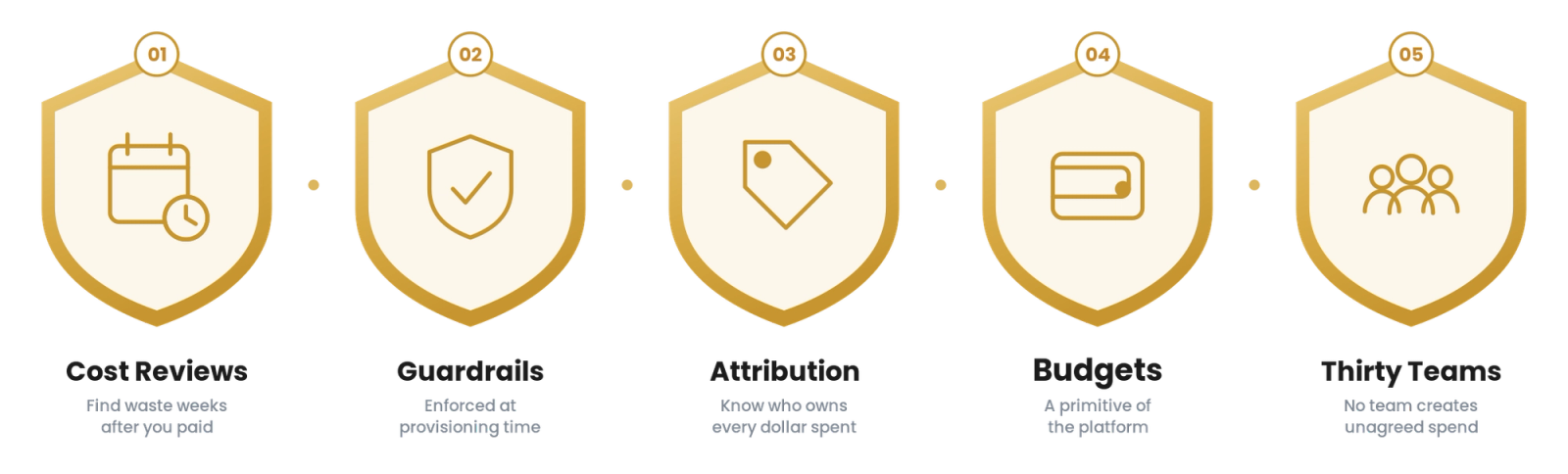
Key Takeaway: Visibility is not a control. Cost information has to arrive at the decision point, and that means in the provisioning path.
Real-World FinOps Guardrails for SaaS in Action
Let's take a look at how it operates with a real-world example.
We worked with a SaaS platform team whose monthly review kept finding the same waste six weeks late, with these constraints:
- Enforce attribution before attempting anything else
- Move cost control into the provisioning path
- Give budgets to owning teams rather than a central function
Step 1: Enforce Attribution
Reject, do not report.
- Ownership tags mandatory at admission
- Untagged resources rejected
- Tags sourced from the catalog
Step 2: Fix the Defaults
Cost-aware by default.
- Instance families and storage chosen for cost
- Retention set deliberately
- Expensive options require opt-in
Step 3: Distribute the Budgets
Teams own their spend.
- Budgets held by owning teams
- Automated behavior at thresholds
- Alerts routed to the team
Step 4: Expire the Non-Production
Nothing lives forever.
- Expiry on non-production resources
- Ephemeral environments cleaned automatically
- Extension deliberate
Step 5: Show Cost at Decision Time
In the pull request.
- Estimates surfaced in diffs
- Trends reviewed with teams
- Behavior changes while the choice is open
Where It Works Well
- Orgs with self-service provisioning and shared modules
- Teams with a service catalog good enough to source ownership from
- Platform teams willing to reject rather than report
Where It Does Not Work Well
- Estates with no reliable attribution
- Orgs where FinOps sits entirely in finance
- Any approach relying on monthly meetings to change behavior
Key Takeaway: Guardrails work when attribution is enforced and cost appears at the decision point; reviews alone change nothing across thirty teams.
Common Pitfalls
i) Tagging by convention
A tagging standard in a document produces roughly seventy percent coverage, which is enough to make every cost conversation an argument. Enforce tags at admission and reject what lacks them.
- Spend cannot be attributed to a team
- Cleanup requires archaeology
- Nobody owns the waste, so nobody fixes it
ii) Reporting instead of controlling
Dashboards inform people who cannot change the decision, weeks later. Put the control where the resource is created.
iii) Central budget ownership
A budget held centrally is a constraint on someone else, which nobody optimises against. Give budgets to the teams whose choices create the spend.
iv) Ignoring defaults
Most spend decisions are inherited rather than made. Setting cost-aware defaults in shared modules moves more money than any amount of education.
Takeaway from these lessons: Guardrails work through enforced attribution, cost-aware defaults, distributed budgets, and feedback at decision time, not through reporting discipline.
FinOps Guardrail Best Practices for SaaS: What High-Performing Teams Do Differently
1. Enforce attribution first
Reject untagged resources at admission, because every later control depends on knowing whose spend it is.
2. Make defaults the main lever
Set cost-conscious instance families, storage classes, and retention in shared modules, since most teams never override a default.
3. Give budgets to owning teams
Move the constraint to the people making the choices, with alerts routed to them rather than to a central inbox.
4. Expire non-production by default
Give test and ephemeral resources a lifecycle so waste cannot accumulate quietly for quarters.
5. Show the number in the diff
Surface cost estimates in pull requests, because that is where an engineer can still make a different decision.
Logiciel's value add is helping SaaS platform teams turn FinOps from a reporting function into provisioning-time guardrails, so thirty teams make cost-aware choices without a central team policing invoices.
Takeaway for High-Performing Teams: Enforce attribution, fix the defaults, distribute budgets, expire non-production, and put cost in the pull request.
Signals You Are Doing FinOps Guardrails Well in SaaS
How do you know it is working? Not by how detailed your cost reports are, but by whether waste gets created at all. These are the signals that separate guardrails from reporting.
Attribution is complete. Every resource maps to a team and service without investigation.
Untagged resources fail. Admission rejects them rather than flagging them.
Defaults are cheap. A team that makes no choice gets a reasonable cost outcome.
Budgets sit with teams. Alerts reach the people whose decisions created the spend.
Cost appears in diffs. Engineers see the number while the choice is still open.
Adjacent Capabilities and Connected Work
This work does not exist in isolation. FinOps guardrails depend on, and feed into, the surrounding platform. Ignoring the adjacencies is the most common scoping mistake.
Terraform module defaults are where most cost control actually lives. Policy as code enforces attribution at admission. The service catalog supplies ownership data. Ephemeral environment tooling handles the lifecycle. Naming these adjacencies upfront keeps the work scoped and helps leadership see FinOps as platform engineering rather than a finance report.
The common mistake is treating each adjacency as someone else's problem. The module defaults are your problem. The tagging enforcement is your problem. The cleanup automation is your problem. Pretend otherwise and you will keep finding the same waste six weeks late forever.
Own the adjacencies you depend on, partner with the teams that hold them, and share the budgets.
Conclusion
Monthly cost reviews are accurate and too late. Across thirty product teams provisioning independently, the only control that scales is one that lives in the provisioning path: attribution enforced at admission so untagged resources simply do not get created, cost-aware defaults in shared modules so the common case is already reasonable, budgets held by the teams whose choices create the spend, expiry on everything non-production, and a cost estimate in the pull request where an engineer can still choose differently.
Reporting tells you what you spent. Guardrails decide what gets spent, which is a different job and an engineering one.
The FinOps Operating Model for the Fifth of Cloud Spend You're Wasting
Reduce cloud waste with a FinOps model built for efficiency.
Key Takeaways:
- Guardrails act at provisioning; reports arrive after the money is gone
- Enforced attribution is the prerequisite for every other cost control
- Module defaults move more spend than any amount of cost education
Building FinOps guardrails requires moving controls left. When done correctly, it produces:
- Waste prevented at creation rather than found on an invoice
- Every cost attributable without an investigation
- Teams owning budgets they can actually influence
- Engineers making cost-aware choices without a gatekeeper
What Logiciel Does Here
If your monthly cost review keeps finding the same waste six weeks late, we help you move cost controls into the provisioning path with enforced attribution, cheaper defaults, and team-owned budgets.
Learn More Here:
- Terraform Modules for Technology & SaaS
- Policy as Code for Admission Control
- Cloud Waste for Technology & SaaS
At Logiciel Solutions, we work with SaaS platform leaders on cost guardrails. Our reference patterns come from platforms serving many product teams.
Book a technical deep-dive on making cost a provisioning-time property.