
A SaaS platform team runs thirty product teams on a shared cluster with namespace isolation, and it works well right up until one team's operator starts creating custom resources in a tight loop and takes the API server down for everyone.
The postmortem asks why thirty teams shared a control plane. The honest answer is that nobody made that decision; the cluster grew and the isolation model never got revisited. Multi-tenancy in Kubernetes is not a question you answer once.
It is a blast-radius decision you should be re-examining every time the number of tenants, or the trust level between them, changes materially.
Namespaces, virtual clusters, or separate clusters is not a cost question. It is a question about what one tenant can do to the others.
Kubernetes multi-tenancy for SaaS means choosing an isolation model, namespaces within a shared cluster, virtual clusters, or fully separate clusters, that matches the blast radius you can tolerate between product teams, and then enforcing that boundary with quotas, policy, and network controls rather than convention.
Three PHI Isolation Gaps Standard RBAC Doesn't Cover in Multi-Tenant AI
Identify PHI isolation gaps standard RBAC misses in multi-tenant AI systems.
However, most teams pick namespaces because that is where they started, and discover the shared control plane is the boundary that actually mattered.
If you are a VP of Platform Engineering or Head of Developer Experience at a SaaS company, the intent of this article is:
- Define the three isolation models and what each actually isolates
- Show why control plane contention is the failure most teams underestimate
- Lay out how to pick and enforce a boundary that holds at thirty teams
To do that, let's start with the basics.
What Is Kubernetes Multi-Tenancy for SaaS? The Basic Definition
At a high level, Kubernetes multi-tenancy in a SaaS org is how you let many product teams share infrastructure without letting them affect each other. There are three practical models. Namespaces give logical separation inside one cluster, with a shared control plane and shared nodes unless you separate them.
Virtual clusters give each tenant their own API server view while sharing the underlying nodes, which isolates control plane behavior without the cost of separate infrastructure. Separate clusters isolate everything and cost the most to operate.
Each model trades isolation against operational overhead, and the right choice depends on what your least careful tenant can do and how much you can tolerate that.
To compare:
Namespaces are flatmates sharing a house: separate rooms, one fuse box, and if someone overloads it everybody is in the dark. Virtual clusters are separate flats in one building: your own fuse box, shared foundations.
Separate clusters are separate houses. The mistake is assuming the fuse box is never the problem, then discovering that in Kubernetes the control plane is exactly the shared resource that fails first when one tenant behaves badly. What you isolate matters more than how many boundaries you draw.
Why Is a Deliberate Multi-Tenancy Model Necessary for SaaS?
Issues that it addresses or resolves:
- One team's workload or controller degrading the cluster for everyone
- Isolation enforced by convention rather than by quotas and policy
- An isolation model that was never chosen, just inherited from the first cluster
Resolved Issues by a Deliberate Model
- Blast radius matched to the trust level between teams
- Boundaries enforced with quotas, policy, and network controls
- Operational overhead priced honestly against isolation gained
Core Components of Kubernetes Multi-Tenancy in SaaS
- A chosen isolation model with a written rationale
- Resource quotas and limit ranges per tenant
- Network policy denying cross-tenant traffic by default
- RBAC scoped so teams cannot reach each other's resources
- Control plane protection through rate limits and priority
Modern Multi-Tenancy Tooling for SaaS
- Virtual clusters for control plane isolation without cluster sprawl
- Admission policy enforcing quotas, labels, and security context
- Network policy as the default-deny baseline
- API priority and fairness protecting the control plane from noisy tenants
- Node pools or taints separating workloads with different risk profiles
These tools make multi-tenancy hold under load. The isolation model is the decision; quotas, policy, and control plane protection are what turn that decision into an actual boundary rather than a diagram.
Other Core Issues They Will Solve
- Noisy neighbours contained rather than tolerated
- Security boundaries that hold without depending on team discipline
- Predictable behavior as the number of teams grows
In Summary: Kubernetes multi-tenancy for SaaS matches the isolation model to the blast radius you can tolerate between product teams, then enforces it with quotas, policy, and control plane protection rather than convention.
Importance of Multi-Tenancy Decisions for SaaS in 2026
Platform teams are serving more teams on the same infrastructure than they were three years ago. Four reasons explain why the isolation model matters now.
1. Team count outgrew the original design.
The cluster designed for five teams is now serving thirty, and nobody re-examined whether the boundary still fits.
2. Control plane contention is the real failure mode.
Node isolation is well understood. API server saturation from one team's controller is the incident that surprises people.
3. Virtual clusters changed the trade-off.
The choice used to be namespaces or expensive cluster sprawl. Control plane isolation without full separation is now practical.
4. Security boundaries are being audited.
Customers increasingly ask how tenant workloads are separated, and "we use namespaces" is an answer that invites follow-up questions.
Traditional vs. Modern SaaS Cluster Tenancy
- Namespaces by default vs. an isolation model chosen deliberately
- Quotas set once vs. quotas enforced and monitored per tenant
- Open cluster networking vs. default-deny network policy
- Shared control plane for all vs. control plane isolation where warranted
In summary: A modern SaaS approach picks isolation based on blast radius and enforces it in policy, rather than inheriting namespaces and hoping teams behave.
Details About the Core Components of Multi-Tenancy in SaaS: What Are You Designing?
Let's go through each component.
1. Isolation Layer
The model itself.
Isolation decisions:
- Namespaces, virtual clusters, or separate clusters chosen with a rationale
- Control plane isolation considered separately from node isolation
- The model revisited as tenant count and trust change
2. Resource Layer
Quotas and limits.
Resource decisions:
- Quotas and limit ranges per tenant, enforced at admission
- Node pools separating workloads with different risk profiles
- Requests and limits mandatory, not optional
3. Network Layer
Traffic between tenants.
Network decisions:
- Default-deny between namespaces
- Explicit allow rules for genuine dependencies
- Egress controlled, not just ingress
4. Access Layer
Who can do what.
Access decisions:
- RBAC scoped so teams cannot reach other tenants
- Cluster-scoped resources restricted tightly
- CRD creation controlled, since it affects everyone
5. Control Plane Layer
Protecting the shared brain.
Control plane decisions:
- API priority and fairness configured
- Rate limits on high-volume clients
- Controller behavior monitored per tenant
Benefits Gained from Deliberate Multi-Tenancy in SaaS
- One team's mistake stays that team's problem
- Security boundaries that hold without relying on discipline
- Predictable cluster behavior as team count grows
How It All Works Together
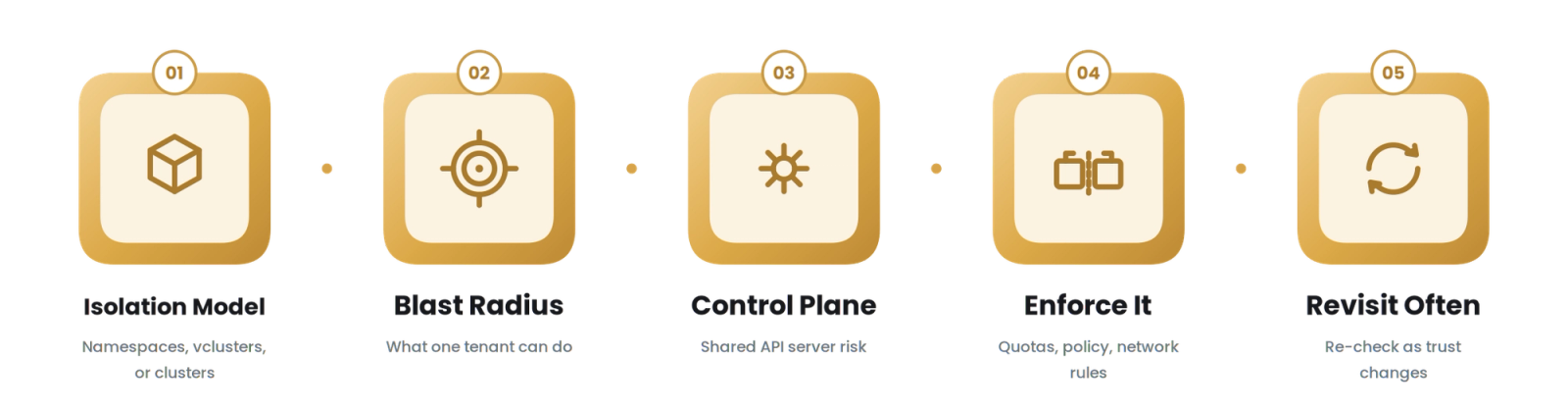
The SaaS platform team starts by asking what one tenant can do to another, because that question determines the model rather than cost or convenience. If teams are trusted, workloads are similar, and no team runs controllers that hammer the API server, namespaces with strong quotas and policy are sufficient and cheapest to operate.
If some teams run their own operators or generate heavy control plane traffic, virtual clusters give each tenant its own API server view while sharing nodes, which contains exactly the failure mode namespaces do not.
Fully separate clusters are reserved for tenants with genuinely different trust or compliance requirements, since the operational overhead of running thirty clusters is real and permanent. Whatever the model, the boundary is then enforced rather than assumed: quotas and limit ranges are mandatory at admission, network policy denies cross-tenant traffic by default with explicit allows for real dependencies, RBAC prevents teams reaching cluster-scoped resources that affect everyone, and API priority and fairness protects the control plane from a single misbehaving client.
Per-tenant control plane usage is monitored, so a team whose controller starts thrashing is visible before it becomes an incident. The model gets revisited whenever team count or trust level changes materially.
Common Misconception
Namespaces are enough for internal teams because everyone is on the same side.
Trust is not the variable that matters; capability is. Your internal teams are not malicious, but one of them will eventually deploy a controller with a bug that lists every resource in the cluster every second, and the API server does not care about intent.
In a shared control plane that becomes an outage for thirty teams, and no amount of goodwill prevents it. The relevant question is not whether you trust a team but what that team is technically able to do to the shared resource.
Namespaces isolate names and, with policy, network and resources. They do not isolate the control plane, and the control plane is what fails first in a large SaaS org. If teams run their own operators, the isolation you need is control plane isolation, and namespaces will not provide it no matter how much everyone likes each other.
Key Takeaway: Namespaces isolate resources, not the control plane. If teams run their own controllers, that is the boundary that matters.
Real-World Multi-Tenancy for SaaS in Action
Let's take a look at how it operates with a real-world example.
We worked with a SaaS platform team whose shared cluster went down when one team's controller saturated the API server, with these constraints:
- Choose isolation based on blast radius, not on cost
- Enforce boundaries in policy rather than convention
- Protect the control plane from any single tenant
Step 1: Decide the Model
Blast radius first.
- Namespaces, virtual clusters, or separate clusters chosen deliberately
- Control plane isolation assessed separately
- Rationale written down and revisited
Step 2: Enforce Resource Limits
Quotas at admission.
- Quotas and limit ranges per tenant
- Requests and limits mandatory
- Node pools separating risk profiles
Step 3: Lock Down the Network
Default deny.
- Cross-tenant traffic denied by default
- Explicit allows for real dependencies
- Egress controlled too
Step 4: Scope Access
RBAC boundaries.
- Teams cannot reach other tenants
- Cluster-scoped resources restricted
- CRD creation controlled
Step 5: Protect the Control Plane
Fairness and limits.
- API priority and fairness configured
- Rate limits on heavy clients
- Per-tenant usage monitored
Where It Works Well
- Namespaces for many similar, well-behaved workloads with strong policy
- Virtual clusters where teams run their own controllers or CRDs
- Separate clusters for genuinely different trust or compliance profiles
Where It Does Not Work Well
- Namespaces where tenants generate heavy control plane traffic
- Any model enforced by convention instead of admission policy
- Separate clusters adopted before the team can operate them at that count
Key Takeaway: Pick the isolation model your least careful tenant justifies, and enforce it in policy; convention does not survive thirty teams.
Common Pitfalls
i) Inheriting the isolation model
Most teams never chose namespaces; the first cluster had them and the org grew. Revisit the model deliberately whenever tenant count or trust changes, and write down why the current choice is still right.
- The boundary no longer matches the risk
- Nobody can say what one tenant could do to another
- The first serious incident is org-wide
ii) Quotas as guidance
A quota that is not enforced at admission is a suggestion. Make requests and limits mandatory and reject workloads that omit them, or capacity planning becomes guesswork.
iii) Open cluster networking
Default-allow networking means any compromised workload can reach every other tenant. Deny by default, allow explicitly, and control egress as well as ingress.
iv) Ignoring the control plane
Teams protect nodes carefully and leave the API server unprotected. Configure priority and fairness, rate limit heavy clients, and monitor control plane usage per tenant.
Takeaway from these lessons: Multi-tenancy holds when the model is chosen deliberately and enforced technically, not when it is inherited and maintained by good manners.
Multi-Tenancy Best Practices for SaaS: What High-Performing Teams Do Differently
1. Choose isolation by blast radius
Ask what your least careful tenant can do to the others, and pick the model that contains it, because trust is not a control.
2. Isolate the control plane where teams run controllers
Use virtual clusters when tenants deploy their own operators, since that is the failure namespaces cannot contain.
3. Enforce quotas at admission
Reject workloads without requests and limits, so capacity is predictable and one tenant cannot starve others.
4. Default-deny the network
Allow cross-tenant traffic only for real dependencies, and control egress too, because lateral movement is the thing you are preventing.
5. Revisit the model on growth
Re-examine the decision when tenant count or trust level changes materially, because the model that fit five teams rarely fits thirty.
Logiciel'svalue add is helping SaaS platform teams choose an isolation model that matches their actual blast radius and enforce it with quotas, policy, and control plane protection that hold as team count grows.
Takeaway for High-Performing Teams: Choose isolation deliberately, isolate the control plane where teams run controllers, and enforce every boundary in admission policy.
Signals You Are Doing Multi-Tenancy Well in SaaS
How do you know it is working? Not by how few clusters you run, but by whether one team's mistake stays contained. These are the signals that separate a real boundary from a diagram.
The model is deliberate. Someone can explain why this isolation level, and when it will be revisited.
Quotas are enforced. Workloads without requests and limits are rejected at admission.
The network denies by default. Cross-tenant traffic requires an explicit allow.
The control plane is protected. Priority, fairness, and rate limits are configured and monitored.
Incidents stay local. A misbehaving tenant degrades itself, not thirty teams.
Adjacent Capabilities and Connected Work
This work does not exist in isolation. Multi-tenancy depends on, and feeds into, the surrounding platform. Ignoring the adjacencies is the most common scoping mistake.
Policy as code is what enforces quotas, labels, and security context at admission. Your operator strategy determines how much control plane pressure tenants generate. Self-service infrastructure determines how easily teams create resources that affect the boundary.
Observability tells you which tenant is saturating what. Naming these adjacencies upfront keeps the work scoped and helps leadership see tenancy as an ongoing design decision rather than a one-time cluster setup.
The common mistake is treating each adjacency as someone else's problem. The admission policy is your problem. The control plane protection is your problem. The revisit cadence is your problem. Pretend otherwise and the boundary quietly stops matching the risk.
Own the adjacencies you depend on, partner with the teams that hold them, and share the limits.
Conclusion
Multi-tenancy in Kubernetes is a blast-radius decision. Namespaces isolate resources and, with policy, network traffic, but they share a control plane, and the control plane is what fails when one team's controller misbehaves.
Virtual clusters isolate that failure mode without the cost of running thirty clusters. Separate clusters isolate everything and cost the most to operate forever. Pick the model your least careful tenant justifies, enforce it with quotas, network policy, RBAC, and control plane protection rather than convention, and revisit the decision as team count grows.
The isolation model you inherited from your first cluster is almost certainly not the one you need now.
Key Takeaways:
- Isolation model is a blast-radius decision, not a cost decision
- Namespaces do not isolate the control plane, which is the failure that surprises people
- Boundaries hold only when enforced in admission policy, never by convention
Getting multi-tenancy right requires deliberate choice. When done correctly, it produces:
- One team's mistake contained to that team
- Security boundaries that hold without relying on discipline
- Predictable cluster behavior as team count grows
- An isolation model someone can justify and knows when to revisit
Why More Regions Doesn't Mean a More Resilient System
Identify hidden dependencies that undermine resilience across multi-region architectures.
What Logiciel Does Here
If thirty teams share a control plane nobody chose, we help you pick an isolation model that matches your real blast radius and enforce it with quotas, policy, and control plane protection.
Learn More Here:
- Kubernetes Operators for Technology & SaaS
- Policy as Code for Admission Control
- Self-Service Infrastructure for Technology & SaaS
At Logiciel Solutions, we work with SaaS platform leaders on cluster tenancy design. Our reference patterns come from production clusters serving many product teams.
Book a technical deep-dive on whether your isolation model still fits your team count.