
A SaaS platform team writes an operator because thirty product teams keep deploying the same messaging component slightly differently. Eighteen months later the operator has two hundred lines of reconciliation logic, one person who understands it, and a queue of feature requests from teams whose use case does not fit the CRD.
The original problem, inconsistent deployment, could have been solved with a Helm chart and a policy check. The operator is now a product with a single maintainer and no roadmap. This is the most common operator failure in a multi-team SaaS org, and it is not a technical failure. It is a decision made at the wrong level of abstraction.
Operators are powerful and expensive. The question is whether your resource has lifecycle logic that justifies both.
Kubernetes operators for SaaS means encoding operational knowledge about a specific resource into a controller that continuously reconciles desired state, so many product teams can consume a complex capability through a simple custom resource instead of each team reimplementing the operational logic themselves.
The Operating Manual for Running Your Platform Like a Product
Run your platform like a product with clear ownership and lifecycle.
However, most teams reach for an operator when they need consistency rather than lifecycle logic, and end up maintaining a control loop where a template would have done.
If you are a VP of Platform Engineering or Head of Developer Experience at a SaaS company, the intent of this article is:
- Define what an operator actually buys you over templating
- Show when a CRD is the right abstraction for many teams and when it is not
- Lay out how to build and run operators without creating an orphan
To do that, let's start with the basics.
What Are Kubernetes Operators for SaaS? The Basic Definition
At a high level, a Kubernetes operator is a controller that watches a custom resource and continuously works to make reality match what that resource declares. The operational knowledge lives in the reconciliation loop: how to bootstrap a cluster, how to handle a failover, how to run a version upgrade in the right order, how to recover from a partial failure.
A product team writes a short custom resource, and the operator does the rest, forever, not just at install time. That "forever" is the distinguishing feature. Templating tools render manifests once. An operator keeps acting, which is why it is the right answer for stateful and lifecycle-heavy resources, and overkill for almost everything else.
To compare:
A Helm chart is a recipe. It tells the kitchen what to make once, and after that nobody is watching the oven. An operator is a chef who stays in the kitchen, notices the temperature drifting, and adjusts.
If your dish is toast, you do not need a chef standing there. If it is a soufflé that needs attention over hours, you do. The mistake most SaaS platform teams make is hiring a chef to watch toast, and then discovering the chef needs a salary, holiday cover, and someone to replace them when they leave.
Why Are Operators Necessary for SaaS?
Issues that it addresses or resolves:
- Complex stateful resources reimplemented differently by each product team
- Operational knowledge trapped in runbooks nobody follows consistently
- Lifecycle events like upgrades and failover handled manually per team
Resolved Issues by Operators
- Operational logic encoded once and consumed by many teams
- Lifecycle handled continuously rather than at install time
- Product teams consuming a complex capability through a simple resource
Core Components of Kubernetes Operators in SaaS
- A custom resource definition describing the desired state
- A reconciliation loop that continuously converges reality toward it
- Lifecycle handling for upgrades, scaling, and failure recovery
- Status reporting that tells consuming teams what is actually happening
- A named owner and a support model, because it is a product
Modern Operator Tooling for SaaS
- Controller frameworks that handle the boilerplate of watching and queuing
- CRD validation and defaulting so bad specs fail at admission
- Status conditions and events consumable by product teams
- Testing harnesses that exercise reconciliation against real clusters
- Upgrade paths for the CRD schema itself, versioned properly
These tools make operators sustainable across many teams. The framework is the easy part. Versioned schemas, honest status reporting, and a real support model are what stop an operator becoming an orphan.
Other Core Issues They Will Solve
- Product teams stop reimplementing the same operational logic
- Lifecycle events happen consistently rather than depending on who is on call
- Complex capabilities become self-service without becoming unsafe
In Summary: Kubernetes operators for SaaS encode operational knowledge into a reconciliation loop, so many product teams consume complex stateful capabilities through a simple resource rather than each team reinventing the lifecycle logic.
Importance of Operators for SaaS in 2026
Kubernetes is settled infrastructure now, and the interesting question is what abstractions sit on top of it. Four reasons explain why operator decisions matter.
1. Multi-team consistency is a real cost.
Thirty teams each running their own database configuration is thirty different failure modes for one platform team to understand.
2. Lifecycle logic does not belong in runbooks.
Knowledge that only exists in a document gets applied inconsistently, especially at three in the morning.
3. Operators are products, and products need owners.
An operator with no maintainer becomes a dependency nobody can upgrade, which is worse than the inconsistency it replaced.
4. Most teams over-reach.
The default failure is writing an operator for something a chart and a policy check would have handled, and paying for it for years.
Traditional vs. Modern SaaS Resource Management
- Manifests copied between teams vs. a shared custom resource
- Install-time templating vs. continuous reconciliation
- Runbooks describing lifecycle vs. lifecycle encoded in code
- Every team owning operational logic vs. one team owning it for all
In summary: A modern SaaS approach uses operators where lifecycle logic is genuinely continuous, and simpler templating everywhere else, rather than reaching for a controller by default.
Details About the Core Components of Operators in SaaS: What Are You Designing?
Let's go through each component.
1. API Layer
The custom resource.
API decisions:
- The spec describes intent, not implementation detail
- Validation and defaulting run at admission
- Schema versioned from the first release
2. Reconciliation Layer
The control loop.
Reconciliation decisions:
- Idempotent, level-triggered, safe to run repeatedly
- Partial failure handled without leaving broken state
- Backoff and rate limits on retries
3. Lifecycle Layer
Upgrades and failure.
Lifecycle decisions:
- Version upgrades sequenced correctly
- Failover and recovery encoded, not documented
- Destructive operations gated
4. Status Layer
What teams see.
Status decisions:
- Conditions reported honestly, including failure
- Events useful enough to debug without cluster access
- Product teams can self-diagnose from status alone
5. Ownership Layer
Who maintains it.
Ownership decisions:
- A named owning team, not an individual
- A support model and response expectation
- A deprecation path for CRD versions
Benefits Gained from Operators in SaaS
- Operational knowledge encoded once and used by every team
- Lifecycle events handled consistently and continuously
- Complex capabilities offered as self-service without unsafe defaults
How It All Works Together
The SaaS platform team decides first whether the resource actually has lifecycle logic, because that decision determines everything else. If the answer is no, they ship a chart and a policy check and move on.
If the answer is yes, they design the custom resource around intent rather than implementation, so a product team declares what it needs and not how the platform should build it. Validation and defaulting run at admission so a malformed spec fails immediately with a clear message rather than half-creating something.
The reconciliation loop is level-triggered and idempotent, safe to run a thousand times, and handles partial failure without leaving orphaned resources behind. Lifecycle logic that used to live in runbooks, upgrade ordering, failover, recovery from a lost replica, is encoded in the controller, with genuinely destructive operations gated behind explicit confirmation.
Status conditions are reported honestly, including failure states, so a product team can debug their own resource without needing cluster-admin access or a platform engineer in a call. And the operator has a named owning team with a support model, because in a thirty-team org an unmaintained operator becomes a dependency that blocks upgrades for everyone.
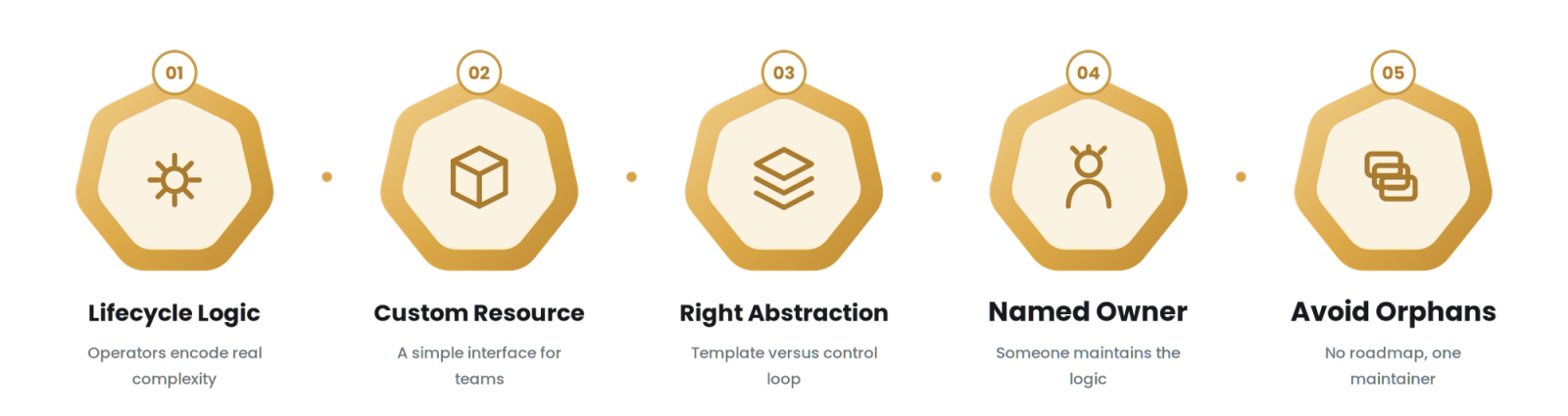
Common Misconception
Operators are the modern way to deploy things on Kubernetes.
They are the modern way to deploy a narrow category of things, and treating them as a general deployment pattern is how platform teams accumulate maintenance debt they never budgeted for. An operator is justified when a resource requires ongoing operational decisions: a database that needs failover, a messaging cluster that needs careful rebalancing during upgrades, a system where the correct action depends on current state rather than a fixed sequence.
If the resource is deployed once and then left alone, a chart does the job with a fraction of the cost. The tell is simple: if you cannot describe what the reconciliation loop does on its second run, you do not need a loop.
Writing an operator for a stateless service is a decision you will still be paying for in three years, staffed by one person who is planning to leave.
Key Takeaway: Operators are for resources with continuous lifecycle logic. If you cannot say what reconciliation does after the first pass, use a chart.
Real-World Operators for SaaS in Action
Let's take a look at how it operates with a real-world example.
We worked with a SaaS platform team whose operator had become an unmaintained dependency across thirty teams, with these constraints:
- Decide honestly which resources justify an operator
- Design the CRD around intent, not implementation
- Give every operator a named owner and support model
Step 1: Justify the Abstraction
Lifecycle or not.
- Continuous operational logic identified
- Chart-plus-policy chosen where sufficient
- Cost of maintenance made explicit
Step 2: Design the API
Intent over implementation.
- Spec describes what, not how
- Validation and defaulting at admission
- Schema versioned from day one
Step 3: Build the Loop
Idempotent reconciliation.
- Level-triggered and safe to repeat
- Partial failure handled cleanly
- Backoff on retries
Step 4: Encode the Lifecycle
Upgrades and recovery.
- Upgrade ordering in code
- Failover encoded, not documented
- Destructive actions gated
Step 5: Assign Ownership
It is a product.
- Named owning team
- Support model and response expectation
- Deprecation path for CRD versions
Where It Works Well
- Stateful systems with genuine failover and upgrade complexity
- Capabilities many teams need identically and cannot safely run themselves
- Platform teams with the capacity to own an operator as a product
Where It Does Not Work Well
- Stateless services that a chart deploys perfectly well
- One-off needs used by a single team
- Teams with no capacity to maintain a controller long term
Key Takeaway: Operators pay off for stateful, lifecycle-heavy resources consumed by many teams; they are a liability for anything a template could deploy.
Common Pitfalls
i) Writing an operator for consistency
Consistency is a policy problem, not a control-loop problem. If the goal is that thirty teams deploy the same way, ship a chart and enforce it with admission policy rather than building a controller.
- Maintenance cost far exceeds the problem
- A single maintainer becomes a bus factor
- Teams whose use case does not fit start working around it
ii) Leaking implementation into the CRD
A spec that mirrors the underlying manifests gives teams no abstraction and locks you out of changing implementation later. Describe intent, and keep implementation detail inside the loop.
iii) Reconciliation that is not idempotent
A loop that assumes it runs once will eventually run twice and leave broken state. Make reconciliation level-triggered, repeatable, and safe under partial failure.
iv) No owner
An operator without a named owning team becomes a dependency nobody can upgrade, which blocks every team that consumes it. Assign ownership before you ship, not after someone leaves.
Takeaway from these lessons: Operators succeed when justified, intent-shaped, idempotent, and owned, and fail when written to enforce consistency a chart could have delivered.
Operator Best Practices for SaaS: What High-Performing Teams Do Differently
1. Justify the loop before writing it
Ask what reconciliation does on its second run. If there is no good answer, ship a chart and a policy check instead.
2. Design the CRD around intent
Let teams declare what they need rather than how to build it, so you can change implementation without breaking thirty consumers.
3. Make reconciliation boring
Level-triggered, idempotent, backed off, and safe under partial failure, because a control loop that surprises you at scale is worse than manual work.
4. Report status honestly
Surface real conditions including failure, so product teams debug their own resources instead of opening a ticket with your team.
5. Own it like a product
Name the team, publish a support model, version the schema, and plan deprecations, because an orphaned operator blocks everyone.
Logiciel's value add is helping SaaS platform teams decide honestly when an operator is the right abstraction, then design CRDs and reconciliation loops that many teams can consume without creating a single-maintainer dependency.
Takeaway for High-Performing Teams: Write operators only for resources with real lifecycle logic, shape the API around intent, and treat every operator as a product with an owner.
Signals You Are Doing Operators Well in SaaS
How do you know it is working? Not by how many CRDs you have, but by whether teams consume them without needing you. These are the signals that separate a useful operator from an expensive one.
The loop is justified. You can explain what reconciliation does on the second and hundredth run.
The API hides implementation. Teams declare intent and never see underlying manifests.
Status is self-serving. Product teams debug their resources from status without cluster access.
Reconciliation is boring. Repeated runs are safe and partial failures recover cleanly.
Ownership is named. A team, not an individual, maintains it with a published support model.
Adjacent Capabilities and Connected Work
This work does not exist in isolation. Operators depend on, and feed into, the surrounding platform. Ignoring the adjacencies is the most common scoping mistake.
Policy as code is what enforces consistency where an operator is not warranted. Your golden paths determine which custom resources teams actually reach for. Multi-tenancy design determines what an operator may do across namespaces.
Observability tells you when a reconciliation loop is thrashing. Naming these adjacencies upfront keeps the work scoped and helps leadership see an operator as a maintained product rather than a one-time build.
The common mistake is treating each adjacency as someone else's problem. The consistency requirement is your problem. The upgrade path is your problem. The maintenance cost is your problem. Pretend otherwise and the operator becomes an unowned dependency blocking thirty teams.
Own the adjacencies you depend on, partner with the teams that hold them, and share the roadmap.
Conclusion
Operators are the right abstraction for a narrow, genuinely valuable category: stateful resources with continuous lifecycle logic that many teams need and none should run themselves. For everything else, a chart plus an admission policy is cheaper, simpler, and does not create a maintenance obligation you will carry for years.
Before writing a controller, ask what reconciliation does on its second run. If the answer is "nothing much," you have a templating problem, not a control-loop problem. And if you do write one, treat it as a product with a named owner, an honest status API, and a versioned schema, because in a thirty-team org an orphaned operator blocks everybody.
Key Takeaways:
- Operators are justified by continuous lifecycle logic, not by a need for consistency
- CRDs should express intent so implementation can change without breaking consumers
- An operator without a named owning team becomes a dependency nobody can upgrade
Building operators well requires honesty about cost. When done correctly, it produces:
- Operational knowledge encoded once and consumed by every team
- Lifecycle events handled consistently rather than by whoever is on call
- Complex capabilities offered as safe self-service
- A maintained product rather than an orphaned controller
See What Elite-Tier SaaS Engineering Teams Actually Look Like in 2026
See what elite SaaS engineering performance looks like across key metrics.
What Logiciel Does Here
If your operator has become a single-maintainer dependency across many teams, we help you decide what genuinely needs a control loop, reshape the API around intent, and put a real ownership model behind it.
Learn More Here:
- Kubernetes Multi-Tenancy for Technology & SaaS
- Policy as Code for Consistency Without Controllers
- Golden Paths and Self-Service Infrastructure
At Logiciel Solutions, we work with SaaS platform leaders on Kubernetes abstractions. Our reference patterns come from production operators serving many product teams.
Book a technical deep-dive on whether your next abstraction should be an operator at all.