
A fintech instruments its payment services with OpenTelemetry and gains genuinely better visibility into transaction paths. Then a review of telemetry storage finds card fragments in span attributes, account identifiers in trace names, and customer email addresses in error messages, all of it exported to a vendor backend with a retention period nobody chose.
Every developer who added those attributes was trying to make debugging easier and succeeded. Nobody had defined which attributes were permissible, and telemetry had quietly become a copy of production data in a system with different controls.
Telemetry becomes a copy of your production data. Nobody treats it that way until someone looks.
OpenTelemetry for fintech means adopting vendor-neutral instrumentation with sensitive attribute filtering enforced at collection, retention decided deliberately, and sampling that preserves transaction completeness, so better visibility does not create an uncontrolled data copy.
Why “Context” Is Becoming the New Cloud Infrastructure Layer
Understand how context infrastructure is reshaping retrieval and intelligent systems.
However, most adoptions focus on coverage and sampling, and discover during a review that telemetry contains regulated data in a system outside the usual control perimeter.
If you are a VP of Engineering or Head of Infrastructure at a fintech company, the intent of this article is:
- Define why telemetry is a data control surface
- Show how attribute filtering must be enforced at collection
- Lay out what sampling means for transaction investigation
To do that, let's start with the basics.
What Is OpenTelemetry for Fintech? The Basic Definition
At a high level, OpenTelemetry is a vendor-neutral standard for generating and collecting traces, metrics, and logs, with a collector layer that processes and exports to backends. In a financial estate the collector layer carries an additional responsibility: filtering attributes that should not leave the production perimeter.
Developers add context to make debugging possible, which is correct behaviour, and the useful context frequently includes identifiers that are regulated. Deciding what may be attached, enforcing it centrally, and setting retention deliberately is what keeps improved observability from becoming a data governance gap.
To compare:
Telemetry in a regulated estate is a set of photocopies taken to help people work faster. The copies are useful and they contain whatever was on the original, and they go into a filing system with different access rules and a retention period nobody set.
The photocopying is worth doing. Someone has to decide what gets redacted first.
Why Does OpenTelemetry Matter for Fintech?
Issues that it addresses or resolves:
- Sensitive identifiers reaching telemetry backends unfiltered
- Retention set by vendor default rather than by policy
- Sampling producing incomplete transaction traces
Resolved Issues by OpenTelemetry Done Well
- Sensitive attributes filtered before export
- Retention aligned to policy deliberately
- Transaction traces complete enough to investigate
Core Components of OpenTelemetry Adoption in Fintech
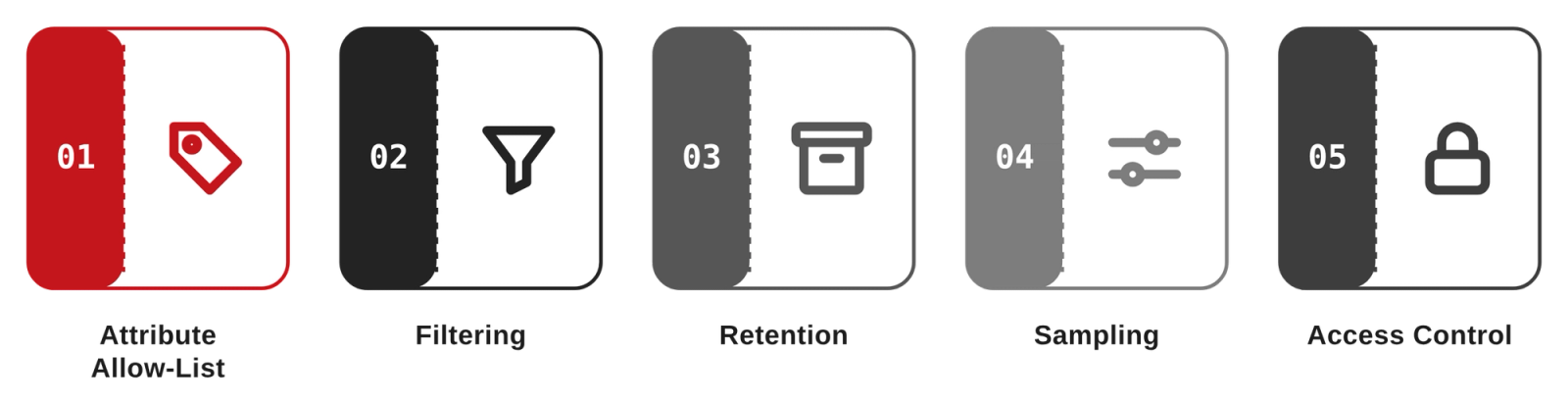
- Permissible attribute definitions with enforcement at collection
- Sensitive attribute filtering and redaction in the collector
- Retention set by policy rather than default
- Sampling preserving transaction path completeness
- Access controls on telemetry backends
Modern OpenTelemetry Tooling for Fintech
- Collector pipelines with attribute filtering and redaction
- Allow-list based attribute policies
- Tail-based sampling for complete transaction traces
- Retention configuration per signal type
- Access logging on telemetry backends
These tools keep telemetry controlled. Allow-list attribute policies enforced in the collector are what prevent a well-intentioned debugging attribute becoming a compliance finding.
Other Core Issues They Will Solve
- Transaction investigation possible on sampled traces
- Telemetry backend access controlled and logged
- Data copies bounded by policy
In Summary: OpenTelemetry for fintech improves visibility and creates a data copy, so attribute filtering, retention, and access control belong in the adoption rather than in a later review.
Importance of OpenTelemetry for Fintech in 2026
Better observability on transaction paths is valuable and carries data implications. Four reasons explain why this matters now.
1. Useful context is frequently regulated.
The identifiers that make a trace debuggable are often the ones subject to controls.
2. Developers add attributes correctly and unaware.
Attaching context is good practice, and nothing tells them which fields are restricted.
3. Retention defaults are somebody else's choice.
A vendor default retention period becomes your data retention decision unless you set it.
4. Sampling affects investigability.
An incomplete transaction trace is frequently worse than none when reconstructing a payment path.
Traditional vs. Modern Fintech Telemetry
- Attributes added freely vs. permissible set defined and enforced
- Retention by default vs. set by policy
- Head-based sampling vs. tail-based for transaction completeness
- Telemetry outside the control perimeter vs. inside it
In summary: A modern fintech approach treats telemetry as a controlled data copy and enforces the controls at collection.
Details About the Core Components of OpenTelemetry Adoption in Fintech: What Are You Designing?
Let's go through each component.
1. Attribute Layer
What may be attached.
Attribute decisions:
- Permissible attributes defined as an allow-list
- Sensitive fields identified explicitly
- Enforcement at collection rather than in guidance
2. Filtering Layer
Redaction before export.
Filtering decisions:
- Filtering and redaction in the collector
- Unknown attributes dropped rather than passed
- Filter coverage monitored
3. Retention Layer
How long copies persist.
Retention decisions:
- Retention set per signal type by policy
- Vendor defaults overridden explicitly
- Deletion verified
4. Sampling Layer
Investigability.
Sampling decisions:
- Tail-based sampling for transaction completeness
- Error and slow paths retained preferentially
- Rates reviewed against investigation needs
5. Access Layer
Who can read it.
Access decisions:
- Backend access controlled by role
- Access logged
- Export destinations reviewed
Benefits Gained from OpenTelemetry in Fintech
- Transaction visibility without an uncontrolled data copy
- Traces complete enough to reconstruct a payment path
- Retention and access aligned to policy
How It Works Together
The fintech engineering team defines the permissible attribute set before broadening instrumentation, as an allow-list rather than a list of prohibitions, because a prohibition list cannot anticipate the next helpful field a developer adds.
Filtering and redaction run in the collector with unknown attributes dropped rather than passed through, which means a well-intentioned addition fails safely instead of exporting a card fragment. Filter coverage is monitored, since new services and new attributes arrive constantly.
Retention is set per signal type by policy rather than inherited from a vendor default, with deletion verified rather than assumed. Sampling uses tail-based decisions so a sampled transaction trace is complete across its hops, with error and slow paths retained preferentially because those are what get investigated.
Backend access is controlled by role and logged, and export destinations are reviewed, because telemetry leaving to a vendor is a data transfer with the properties of one.
Common Misconception
Telemetry is operational data, so data controls do not really apply to it.
Telemetry is a copy of whatever developers attached to it, and in a payment service the useful attachments include account identifiers, transaction references, and occasionally card fragments or customer contact details in error messages.
The copy sits in a backend with its own access model, its own retention, and frequently its own geography, none of which were chosen with data controls in mind. Nothing about the operational purpose changes the nature of the data.
Treating telemetry as outside the perimeter is how a debugging improvement becomes a finding, and the fix is straightforward if applied at adoption and awkward once several quarters of history exist.
Key Takeaway: Telemetry is a data copy in a system with different controls. Operational purpose does not change what the data is.
Real-World OpenTelemetry for Fintech in Action
Let's take a look at how it operates with a real-world example.
We worked with a fintech whose telemetry contained card fragments and account identifiers, with these constraints:
- Define permissible attributes as an allow-list
- Enforce filtering in the collector
- Set retention and access by policy
Step 1: Define the Allow-List
Not a prohibition list.
- Permissible attributes defined
- Sensitive fields identified
- Unknown attributes excluded by default
Step 2: Filter at Collection
Before export.
- Filtering and redaction in the collector
- Unknown attributes dropped
- Coverage monitored
Step 3: Set Retention by Policy
Override defaults.
- Retention per signal type
- Vendor defaults replaced
- Deletion verified
Step 4: Sample for Completeness
Tail-based.
- Complete transaction traces retained
- Error and slow paths preferred
- Rates reviewed
Step 5: Control Access
And log it.
- Backend access by role
- Access logged
- Export destinations reviewed
Where It Works Well
- Estates able to enforce allow-list filtering centrally
- Transaction paths needing complete traces
- Programmes setting retention deliberately
Where It Does Not Work Well
- Prohibition lists that cannot anticipate new attributes
- Head-based sampling on transaction paths
- Telemetry backends outside access review
Key Takeaway: Allow-list the attributes, filter at collection, set retention by policy, and sample for completeness.
Common Pitfalls
i) Prohibition lists
A list of banned fields cannot anticipate the next helpful attribute a developer adds. Use an allow-list so unknown attributes fail safely.
- A new attribute exports regulated data
- The developer was following good practice
- The gap appears in a review
ii) Vendor default retention
An unset retention period is a data retention decision made by a vendor. Set it per signal type by policy and verify deletion.
iii) Head-based sampling on transaction paths
Independent per-service sampling produces incomplete traces, which is frequently worse than none when reconstructing a payment. Use tail-based.
iv) Unreviewed export destinations
Telemetry leaving to a vendor backend is a data transfer. Review destinations and geography as such.
Takeaway from these lessons: The collector is where telemetry becomes controlled, and the control has to be an allow-list.
OpenTelemetry Best Practices for Fintech: What High-Performing Teams Do Differently
1. Allow-list permissible attributes
Define what may be attached and drop everything else, since prohibition lists cannot anticipate the next well-intentioned addition.
2. Filter and redact in the collector
Enforce centrally so a code-level mistake does not become an export.
3. Set retention per signal type
Replace vendor defaults with policy and verify that deletion happens.
4. Use tail-based sampling on transaction paths
Retain complete traces and prefer error and slow paths, because partial payment traces are frequently useless.
5. Treat backends as data destinations
Control access by role, log it, and review export geography.
Logiciel's value add is helping fintech engineering teams enforce attribute allow-lists and retention policy at collection, so observability improves without creating an uncontrolled data copy.
Takeaway for High-Performing Teams: Allow-list attributes, filter centrally, set retention, sample for completeness, control access.
Signals You Are Doing OpenTelemetry Well in Fintech
How do you know it is working? Not by coverage, but by whether telemetry contains what you intended. These are the signals that separate controlled telemetry from a data copy.
Attributes are allow-listed. Unknown fields are dropped rather than exported.
Filtering is central. Code-level mistakes fail safely at collection.
Retention is set. Policy replaced the vendor default and deletion is verified.
Traces are complete. Sampled transaction paths can be reconstructed.
Access is controlled. Backend reads are role-based and logged.
Adjacent Capabilities and Connected Work
This work does not exist in isolation. OpenTelemetry adoption depends on, and feeds into, the surrounding platform. Ignoring the adjacencies is the most common scoping mistake.
AI data catalog classification identifies which fields are sensitive. AIOps consumes the telemetry for correlation. Data quality and retention policy govern the backend. AI incident management uses traces as evidence. Naming these adjacencies upfront keeps the work scoped and helps leadership see telemetry as a data surface.
The common mistake is treating each adjacency as someone else's problem. The allow-list is your problem. The retention setting is your problem. The export review is your problem. Pretend otherwise and a debugging improvement will become a finding.
Own the adjacencies you depend on, partner with the teams that hold them, and share the policy.
Conclusion
OpenTelemetry gives a fintech better visibility into transaction paths, and it also creates a copy of whatever developers attached to spans, in a backend with its own access model, retention, and geography.
The identifiers that make a trace debuggable in a payment service are frequently the ones subject to controls, and developers adding them are following good practice with no signal telling them which fields are restricted.
Define permissible attributes as an allow-list so unknown fields fail safely, filter and redact at collection, set retention per signal type by policy, use tail-based sampling so transaction traces are complete, and treat backends as data destinations.
Key Takeaways:
- Telemetry is a data copy in a system with different controls
- Allow-lists fail safely; prohibition lists cannot anticipate new attributes
- Head-based sampling produces partial transaction traces that cannot be reconstructed
Adopting OpenTelemetry well requires central filtering. When done correctly, it produces:
- Transaction visibility without an uncontrolled data copy
- Traces complete enough to reconstruct a payment path
Why Great CTOs Don't Just Build, They Evaluate
Learn how disciplined evaluation separates credible AI systems from hype.
- Retention and access aligned to policy
- Code-level mistakes failing safely at collection
What Logiciel Does Here
If your telemetry contains identifiers nobody approved, we help you define attribute allow-lists, enforce filtering at collection, and set retention and access by policy.
Learn More Here:
- AI Data Catalogs for Fintech
- AIOps for Fintech
- AI Incident Management for Fintech
At Logiciel Solutions, we work with fintech engineering leaders on observability. Our reference patterns come from regulated estates instrumenting transaction paths.
Book a technical deep-dive on keeping telemetry inside your control perimeter.