
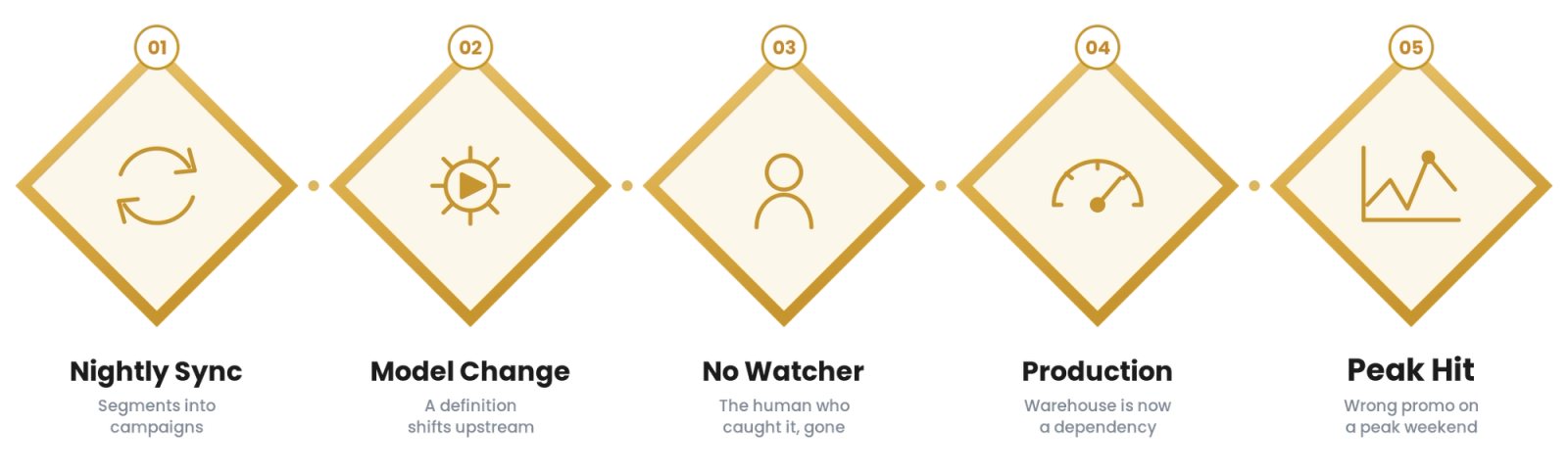
A retailer wires reverse ETL from the warehouse into their marketing platform, pushing customer segments computed nightly into campaign audiences. It works well for two months. Then a dbt model upstream gets refactored, a segment definition changes subtly, and forty thousand customers receive a promotion intended for a different cohort during a peak weekend.
The sync worked exactly as designed. What changed was that a warehouse model, previously read by analysts who would have noticed something odd, became a production dependency feeding a customer-facing system with no one watching the handoff.
Reverse ETL did not create the error. It removed the human who used to catch it.
Reverse ETL is easy to set up and turns your warehouse into production. Those are the same sentence.
Reverse ETL for retail means syncing modelled data from the warehouse into operational tools where teams work, marketing platforms, store systems, service desks, so insight reaches the point of action, which makes the warehouse a production dependency requiring the reliability treatment that implies.
Is Your Engineering Velocity Real, or Just a Reporting Illusion?
Discover whether your engineering velocity reflects real output or hidden inefficiency.
However, most teams treat it as a data movement feature and discover they have quietly promoted analytical models into customer-facing infrastructure.
If you are a CDO or VP of Data at a retail company, the intent of this article is:
- Define what reverse ETL changes about warehouse reliability expectations
- Show why the handoff needs contracts and monitoring, not just a sync
- Lay out how to run it safely around peak trading
To do that, let's start with the basics.
What Is Reverse ETL for Retail? The Basic Definition
At a high level, reverse ETL moves modelled data out of the warehouse and into the operational systems where people and processes act on it: customer segments into a marketing platform, replenishment signals into store or supply systems, propensity scores into a service desk, lifetime value into a loyalty tool.
The technical mechanism is straightforward and largely solved. The consequential change is organisational: data that previously informed a dashboard now drives a customer-facing action, so the freshness, accuracy, and change management standards that apply to production systems now apply to your dbt models, and the analyst who would have spotted an anomaly is no longer in the loop.
To compare:
Reverse ETL is like connecting your planning spreadsheet directly to the till. The spreadsheet was always used to make decisions, and a person read it first, noticed when a number looked wrong, and asked.
Wire it straight through and the wrong number becomes a price on a shelf. The spreadsheet did not get less reliable. The error-catching human got removed, and nobody replaced them with monitoring.
Why Does Reverse ETL Need Care in Retail?
Issues that it addresses or resolves:
- Insight trapped in dashboards nobody acts on
- Manual export and upload cycles between systems
- Warehouse models silently promoted to production without controls
Resolved Issues by Treating It as Production
- Modelled data reaching the point of action reliably
- Contracts and monitoring on the data feeding operational systems
- Change management applied to models with downstream consumers
Core Components of Reverse ETL in Retail
- Contracts on the models being synced, not just the sync config
- Freshness and quality monitoring before data leaves the warehouse
- Change management on models with operational consumers
- Guardrails limiting the blast radius of a bad sync
- Peak-aware scheduling and freeze discipline
Modern Reverse ETL Tooling for Retail
- Sync platforms with field-level mapping and scheduling
- Data contractsdefined as code on the source models
- Anomaly detection on segment sizes and value distributions
- Sync guardrails halting on unexpected volume changes
- Lineage showing which operational systems depend on which model
These tools make reverse ETL safe. Anomaly detection on what is about to be synced and guardrails that halt unexpected changes are what replace the analyst who used to notice.
Other Core Issues They Will Solve
- Teams act on current data in the tools they already use
- Model changes reach downstream owners before they cause incidents
- Bad syncs are caught before they reach customers
In Summary: Reverse ETL for retail delivers modelled data to operational tools, and doing it safely means treating the source models as production with contracts, monitoring, and change management.
Importance of Reverse ETL for Retail in 2026
Retail teams work in operational tools, not in the warehouse. Four reasons explain why this matters now.
1. Insight only matters at the point of action.
A segment in a dashboard changes nothing; the same segment in a campaign tool changes revenue.
2. The promotion to production happens silently.
Nobody announces that a dbt model is now customer-facing, which is precisely why controls do not follow it.
3. Peak amplifies every error.
A bad segment sync on a quiet Tuesday is a mistake. The same sync during peak reaches vastly more customers.
4. Analysts were the unacknowledged control.
Human review of a dashboard caught anomalies. Removing the human without adding monitoring is a net reduction in safety.
Traditional vs. Modern Retail Data Activation
- Manual exports and uploads vs. scheduled automated syncs
- Warehouse models as analytical only vs. models with production consumers
- No monitoring before sync vs. anomaly detection on outbound data
- Model changes made freely vs. change management for downstream owners
In summary: A modern retail approach syncs modelled data into operational tools while treating the source models with production reliability discipline.
Details About the Core Components of Reverse ETL in Retail: What Are You Designing?
Let's go through each component.
1. Contract Layer
What the sync depends on.
Contract decisions:
- Contracts placed on source models, not just sync configs
- Freshness and quality thresholds stated
- Schema changes governed by versioning
2. Monitoring Layer
Catching it before it leaves.
Monitoring decisions:
- Anomaly detection on segment size and distributions
- Checks run before sync, not after
- Alerts routed to the model owner
3. Guardrail Layer
Limiting blast radius.
Guardrail decisions:
- Syncs halt on unexpected volume changes
- Maximum change per run capped
- Rollback path defined per destination
4. Change Layer
Managing model evolution.
Change decisions:
- Downstream operational consumers identified
- Owners notified before model changes ship
- Breaking changes scheduled, not surprising
5. Peak Layer
Seasonal discipline.
Peak decisions:
- Sync changes frozen alongside other production changes
- Monitoring thresholds tightened during peak
- Manual approval for large audience changes
Benefits Gained from Disciplined Reverse ETL in Retail
- Teams acting on current data in the tools they already use
- Bad syncs caught before they reach customers
- Model changes that do not surprise operational owners
How It All Works Together
The retail data team treats the models being synced as production systems, because that is what they became the moment a sync was configured. Contracts are placed on the source models rather than only on the sync configuration, stating freshness and quality expectations and governing schema change through versioning, so a refactor cannot silently alter what a campaign audience means.
Monitoring runs before data leaves the warehouse, with anomaly detection on the things that actually go wrong in this context: a segment that suddenly doubles in size, a value distribution that shifts, a field that is newly null for a fifth of rows.
Alerts route to the model owner rather than to the person who configured the sync, since the owner is who can fix the cause. Guardrails halt a sync when volume changes unexpectedly and cap how much can change in a single run, so a bad model produces a stopped sync rather than a customer incident, with a defined rollback path per destination.
Downstream operational consumers are identified explicitly, which means model owners know that changing a definition affects a live campaign platform and notify accordingly. And around peak, sync changes are frozen with everything else, monitoring thresholds tighten, and large audience changes require manual approval.
Common Misconception
Reverse ETL is just another data pipeline, so our existing data quality practices cover it.
Existing practices were designed for a consumer who was a human reading a dashboard, and that human was doing more work than anyone credited. An analyst looking at a segment count that jumped by forty percent would ask a question before acting.
A sync does not ask; it delivers. That single change means data quality issues that were previously caught by informal human review now propagate directly into customer-facing systems within a scheduled window.
The practices that need adding are the ones production systems have and analytical pipelines usually do not: pre-flight anomaly checks, guardrails that halt rather than proceed, explicit downstream consumer registration, change notification, and a rollback path.
Treating reverse ETL as ordinary data movement is exactly how a model refactor becomes a promotional error during peak.
Key Takeaway: The analyst reading the dashboard was an unacknowledged control. Removing them without adding monitoring reduces safety rather than improving efficiency.
Real-World Reverse ETL for Retail in Action
Let's take a look at how it operates with a real-world example.
We worked with a retailer whose segment sync sent a wrong-cohort promotion during peak, with these constraints:
- Treat synced models as production with contracts
- Detect anomalies before data leaves the warehouse
- Freeze sync changes alongside other production changes at peak
Step 1: Contract the Source Models
Not just the sync.
- Freshness and quality thresholds stated
- Schema change governed by versioning
- Contracts defined as code
Step 2: Monitor Before Sending
Pre-flight checks.
- Anomaly detection on segment size and distributions
- Checks run before the sync executes
- Alerts routed to the model owner
Step 3: Add Guardrails
Halt, do not proceed.
- Syncs stop on unexpected volume change
- Maximum change per run capped
- Rollback path defined per destination
Step 4: Register Downstream Consumers
Owners should know.
- Operational consumers identified per model
- Notification before model changes ship
- Breaking changes scheduled
Step 5: Apply Peak Discipline
Freeze and tighten.
- Sync changes frozen with other production changes
- Monitoring thresholds tightened
- Large audience changes manually approved
Where It Works Well
- Modelled data that operational teams genuinely act on
- Destinations with a workable rollback path
- Orgs willing to apply production discipline to warehouse models
Where It Does Not Work Well
- Models with no owner or no quality monitoring
- Destinations where a bad sync cannot be undone
- Any sync introduced or changed during peak trading
Key Takeaway: Reverse ETL works when the source models get production treatment; it fails when analytical pipelines are wired to customer-facing systems unchanged.
Common Pitfalls
i) Contracting the sync but not the model
A sync configuration cannot protect you from a model whose meaning changed. Put contracts on the source models and govern their schema evolution.
- A refactor silently alters what a segment means
- The sync delivers the new meaning faithfully
- Customers receive the consequence
ii) Monitoring after the sync
Detecting a bad audience after it has been used is too late. Run anomaly checks before data leaves the warehouse and halt on failure.
iii) No downstream consumer registry
Model owners who do not know their model feeds a live campaign platform will change it freely. Register operational consumers and notify before changes.
iv) Changing syncs during peak
A sync change close to peak trading is a production change at the worst possible time. Freeze it alongside everything else.
Takeaway from these lessons: Reverse ETL needs contracts on models, pre-flight monitoring, halting guardrails, consumer registration, and peak freeze discipline.
Reverse ETL Best Practices for Retail: What High-Performing Teams Do Differently
1. Contract the models, not the syncs
Place freshness, quality, and schema guarantees on the source models, since that is where the meaning lives and where change happens.
2. Check before you send
Run anomaly detection on segment sizes and value distributions before the sync executes, and halt rather than proceed on failure.
3. Cap the blast radius
Limit how much a single run may change and define a rollback path per destination, because some operational tools make undo genuinely hard.
4. Register operational consumers
Tell model owners which live systems depend on them, so a refactor becomes a notified change rather than a surprise incident.
5. Treat sync changes as production changes at peak
Freeze them with everything else, tighten monitoring, and require manual approval for large audience movements.
Logiciel's value add is helping retail data teams apply production reliability discipline to the warehouse models feeding operational tools, so activation happens without customer-facing surprises.
Takeaway for High-Performing Teams: Contract the models, check before sending, cap the blast radius, register consumers, and freeze at peak.
Signals You Are Doing Reverse ETL Well in Retail
How do you know it is working? Not by how many syncs run, but by whether a bad model stops before it reaches a customer. These are the signals that separate production discipline from data movement.
Models have contracts. Freshness and quality are stated and monitored at source.
Checks run pre-flight. Anomalies are caught before the sync executes.
Syncs halt safely. Unexpected volume changes stop the run rather than proceeding.
Owners know their consumers. Model changes are notified to operational teams.
Peak is frozen. Sync changes stop alongside other production changes.
Adjacent Capabilities and Connected Work
This work does not exist in isolation. Reverse ETL depends on, and feeds into, the surrounding data platform. Ignoring the adjacencies is the most common scoping mistake.
Data products and contracts are what make source models dependable. Data quality SLAs define the thresholds monitoring enforces. Lineage identifies which operational systems depend on which model. Your change freeze calendar governs when syncs may change.
Naming these adjacencies upfront keeps the work scoped and helps leadership see reverse ETL as a reliability commitment rather than a connector purchase.
The common mistake is treating each adjacency as someone else's problem. The model contract is your problem. The pre-flight monitoring is your problem. The consumer registry is your problem. Pretend otherwise and a refactor becomes a customer incident during your busiest weekend.
Own the adjacencies you depend on, partner with the teams that hold them, and share the contracts.
Conclusion
Reverse ETL is trivial to configure and it changes what your warehouse is. The moment a model feeds a campaign platform or a store system, it is production infrastructure, and the analyst who used to read that data and notice when something looked wrong is no longer in the path.
Replace them deliberately: contracts on the source models, anomaly detection before data leaves the warehouse, guardrails that halt rather than proceed, a registry of operational consumers so model owners know what they affect, and freeze discipline around peak.
The sync will always work. Whether it sends the right thing is a reliability question you now own.
Key Takeaways:
- Reverse ETL promotes warehouse models into production silently
- The analyst reviewing a dashboard was an informal control that must be replaced
- Anomaly checks belong before the sync, and guardrails should halt rather than proceed
Running reverse ETL safely requires production discipline. When done correctly, it produces:
- Teams acting on current data in the tools they already use
- Bad models stopped before they reach customers
Why “Context” Is Becoming the New Cloud Infrastructure Layer
Understand how context infrastructure is reshaping retrieval and intelligent systems.
- Model changes that reach operational owners in advance
- Peak periods where activation does not add risk
What Logiciel Does Here
If a warehouse model refactor can reach your customers through a sync, we help you put contracts, pre-flight monitoring, and halting guardrails around your activation path.
Learn More Here:
- Data Products for Retail
- Data Quality SLAs and Contracts
- Customer 360 for Retail
At Logiciel Solutions, we work with retail data leaders on data activation. Our reference patterns come from estates syncing warehouse models into customer-facing systems.
Book a technical deep-dive on making your activation path production-grade.