
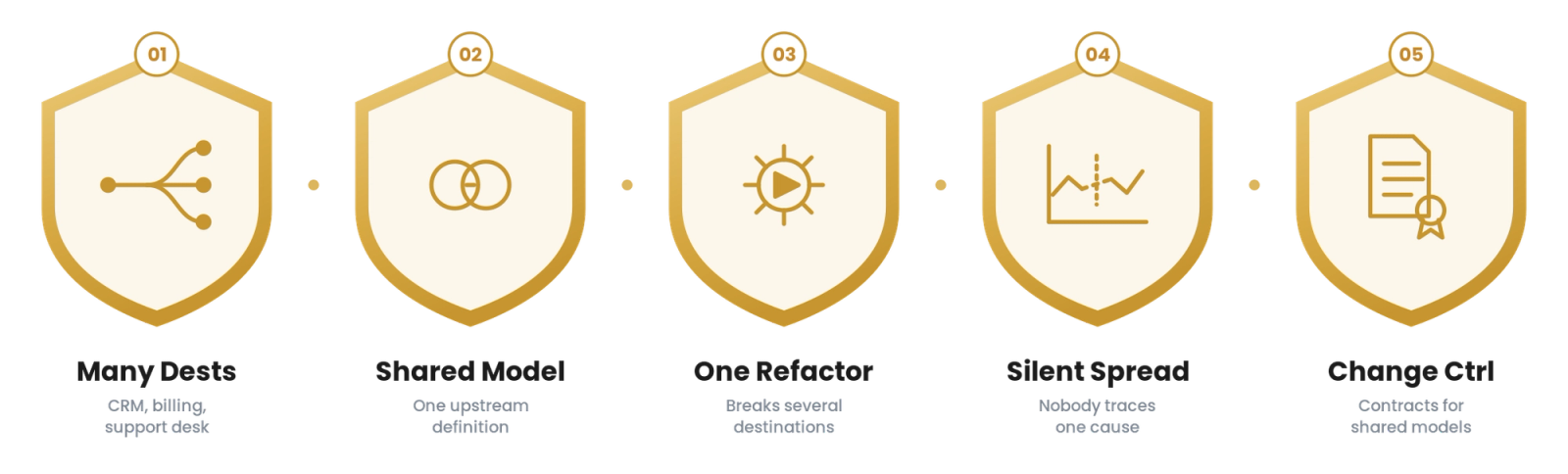
A SaaS data team wires reverse ETL from the warehouse into the tools other teams work in: product-qualified lead scores into the CRM, usage tiers into the billing system, health scores into the support desk.
It works. Then someone refactors a shared upstream model, the definition of an active workspace shifts by one condition, and three destinations receive different wrong answers simultaneously. Sales chases the wrong accounts, support prioritises the wrong tickets, and nobody connects the three symptoms for a week because each team assumed the problem was theirs.
The sync worked perfectly. What broke was a shared dependency nobody had registered as production.
Reverse ETL is easy to configure and turns your warehouse into a production dependency for every team consuming it.
Reverse ETL for SaaSmeans syncing modelled data from the warehouse into the operational tools where teams work, so insight reaches the point of action, which makes shared warehouse models production infrastructure for many teams at once and demands the contracts and change management that implies.
The Architecture Layer That Decides If Your AI Product Survives Production
Build the architecture layers that make AI products production-ready.
However, most teams treat it as a data movement feature and discover that one model refactor produces incidents in several destinations no one traced back to a single cause.
If you are a CDO or VP of Data at a SaaS company, the intent of this article is:
- Define what reverse ETL changes about shared model reliability
- Show why multi-destination fan-out makes change management critical
- Lay out how to run activation safely across many consuming teams
To do that, let's start with the basics.
What Is Reverse ETL for SaaS? The Basic Definition
At a high level, reverse ETL moves modelled data out of the warehouse into the systems where teams act: lead scores into the CRM, entitlement and usage data into billing, account health into support tooling, activation signals into product analytics.
The mechanism is largely solved. The consequential change in a multi-team SaaS org is fan-out: a single warehouse model frequently feeds several destinations owned by several teams, so a change to that model has a blast radius nobody sees from inside the model repository.
Production reliability standards now apply to analytics code, and the coordination problem is larger than the technical one.
To compare:
A shared warehouse model feeding five destinations is a library dependency with no version pinning. In software nobody would refactor a widely imported function without checking callers, because the tooling makes callers visible.
In a warehouse the callers are sync configurations in another product owned by another team, so the refactor happens with confidence and the breakage arrives distributed across five places. The model did not get worse. Its consumers became invisible.
Why Does Reverse ETL Need Care in SaaS?
Issues that it addresses or resolves:
- Insight trapped in dashboards while teams work elsewhere
- Shared models refactored without visibility into downstream consumers
- One model change producing incidents in several destinations at once
Resolved Issues by Treating It as Production
- Modelled data reaching every team's tools reliably
- Downstream consumers visible before a model changes
- Contracts and monitoring on models with operational dependents
Core Components of Reverse ETL in SaaS
- Contracts on shared models, not just on sync configurations
- A registry of which destinations depend on which model
- Pre-flight anomaly detection before data leaves the warehouse
- Guardrails halting a sync on unexpected change
- Change management proportional to fan-out
Modern Reverse ETL Tooling for SaaS
- Sync platforms with field-level mapping and scheduling
- Data contracts defined as code on source models
- Lineage extending into operational destinations
- Anomaly detection on record counts and value distributions
- Sync guardrails that stop rather than proceed
These tools make activation safe at multi-team scale. Lineage that reaches into destinations is what turns an invisible fan-out into a list of teams you can notify.
Other Core Issues They Will Solve
- Teams act on current data without exporting anything
- Model owners know the blast radius before they refactor
- Bad syncs stop before several teams act on them
In Summary: Reverse ETL for SaaS delivers modelled data into operational tools across many teams, and doing it safely means treating shared models as production with contracts, visible consumers, and change management.
Importance of Reverse ETL for SaaS in 2026
Multi-team SaaS orgs activate warehouse data into more destinations every quarter. Four reasons explain why this matters now.
1. Fan-out grows silently.
Each new sync adds a consumer to a model, and nothing in the model repository records that it happened.
2. Distributed breakage is hard to diagnose.
Three teams reporting three different symptoms from one root cause takes far longer to resolve than one obvious failure.
3. Analytics code now has production consumers.
The review standards that applied to a dashboard model are insufficient once billing depends on it.
4. The promotion to production is never announced.
Nobody files a ticket saying this model is now customer-facing, which is exactly why controls do not follow.
Traditional vs. Modern SaaS Data Activation
- Manual exports vs. scheduled automated syncs
- Models as analytical only vs. models with operational dependents
- Consumers unknown vs. destinations registered per model
- Refactor freely vs. change management proportional to fan-out
In summary: A modern SaaS approach syncs modelled data widely and makes the resulting dependencies visible so shared models can change without distributed incidents.
Details About the Core Components of Reverse ETL in SaaS: What Are You Designing?
Let's go through each component.
1. Contract Layer
What consumers can rely on.
Contract decisions:
- Contracts on shared models, defined as code
- Freshness and quality thresholds stated
- Schema change governed by versioning
2. Registry Layer
Who depends on this.
Registry decisions:
- Destinations recorded per model
- Owning teams identified per destination
- Registry maintained automatically where possible
3. Monitoring Layer
Catching it before it leaves.
Monitoring decisions:
- Anomaly detection on counts and distributions
- Checks run before sync execution
- Alerts routed to the model owner
4. Guardrail Layer
Limiting blast radius.
Guardrail decisions:
- Syncs halt on unexpected volume change
- Maximum change per run capped
- Rollback path defined per destination
5. Change Layer
Managing shared model evolution.
Change decisions:
- Notification proportional to fan-out
- Breaking changes scheduled with consumers
- Deprecation windows published
Benefits Gained from Disciplined Reverse ETL in SaaS
- Every team acting on current data in their own tools
- Model owners seeing blast radius before they change anything
- Bad data stopped before several teams act on it
How It All Works Together
The SaaS data team treats shared warehouse models as production libraries with visible callers. Contracts sit on the models themselves rather than only on sync configurations, stating freshness and quality expectations and governing schema change through versioning, because the meaning lives in the model and that is what a refactor alters.
A registry records which destinations depend on which model and which team owns each destination, maintained automatically from sync configuration wherever the tooling allows, so the fan-out is a list rather than institutional memory.
Pre-flight monitoring runs before data leaves the warehouse, with anomaly detection on record counts and value distributions, and alerts route to the model owner rather than whoever set up the sync. Guardrails halt a sync on unexpected volume change and cap how much a single run may alter, with a rollback path defined per destination, because some operational tools make undo genuinely awkward.
Change management then scales with fan-out: a model with one consumer can change casually, and a model feeding billing, CRM, and support gets scheduled notification and a deprecation window. The point is not to slow everything down but to make the cost of a change visible to the person making it.
Common Misconception
If the sync is monitored, the pipeline is covered.
Sync monitoring tells you whether records moved, which is the least likely thing to go wrong. The failures that matter are semantic: a model whose definition shifted, a field that changed meaning, a join that silently started dropping rows.
All of those produce syncs that succeed perfectly while delivering the wrong answer, and in a multi-team org they deliver it to several destinations at once. Monitoring the transport layer and calling it done is why teams discover problems through three unrelated complaints rather than through an alert.
What is needed is monitoring on the data before it leaves, tuned to the shape of the output rather than the health of the connector, plus visibility into who receives it so one alert can name the affected teams instead of leaving them to work it out separately.
Key Takeaway: Sync success is not data correctness. Monitor the shape of what is about to be sent, and know who receives it.
Real-World Reverse ETL for SaaS in Action
Let's take a look at how it operates with a real-world example.
We worked with a SaaS data team whose model refactor produced wrong data in three destinations simultaneously, with these constraints:
- Make downstream destinations visible per model
- Detect anomalies before data leaves the warehouse
- Scale change management to fan-out
Step 1: Contract the Shared Models
Not just the syncs.
- Freshness and quality thresholds stated
- Schema change governed by versioning
- Contracts defined as code
Step 2: Register the Destinations
Fan-out as a list.
- Destinations recorded per model
- Owning teams identified
- Registry maintained automatically
Step 3: Monitor Before Sending
Pre-flight checks.
- Anomaly detection on counts and distributions
- Checks run before execution
- Alerts routed to the model owner
Step 4: Add Guardrails
Halt, do not proceed.
- Syncs stop on unexpected volume change
- Maximum change per run capped
- Rollback path per destination
Step 5: Scale Change Management
Proportional to reach.
- Notification sized to fan-out
- Breaking changes scheduled with consumers
- Deprecation windows published
Where It Works Well
- Modelled data multiple teams genuinely act on
- Destinations with a workable rollback path
- Orgs willing to register dependencies and honour them
Where It Does Not Work Well
- Shared models with no owner or no quality monitoring
- Destinations where a bad sync cannot be undone
- Orgs where refactoring shared models is treated as local work
Key Takeaway: Reverse ETL works when shared models get production treatment and their consumers are visible. It fails when fan-out is invisible to the person refactoring.
Common Pitfalls
i) Invisible fan-out
A model feeding five destinations looks identical in the repository to one feeding none, so refactors happen with unwarranted confidence. Register destinations and surface them where the model is edited.
- Refactors break several teams at once
- Symptoms appear distributed and unrelated
- Diagnosis takes days rather than minutes
ii) Monitoring the sync instead of the data
Transport health is the least likely failure. Check counts, distributions, and null rates before sending, and halt on anomaly.
iii) No rollback path per destination
Some operational tools make undo hard, and discovering that during an incident is expensive. Define and test rollback before enabling a sync.
iv) Uniform change management
Treating every model change the same either slows trivial work or under-protects high fan-out models. Scale the process to the number of dependents.
Takeaway from these lessons: Reverse ETL in a multi-team org is a dependency management problem, and the fix is making consumers visible to whoever changes the model.
Reverse ETL Best Practices for SaaS: What High-Performing Teams Do Differently
1. Make fan-out visible in the model repository
Surface downstream destinations where the model is edited, because a refactor decision is made there and the consequence is felt elsewhere.
2. Contract the models, not the syncs
Place freshness, quality, and schema guarantees on the shared models, since that is where meaning lives and changes.
3. Check the data before it leaves
Run anomaly detection on counts and distributions pre-flight, and halt rather than proceed on failure.
4. Define rollback per destination
Test the undo path before enabling a sync, because operational tools vary enormously in how reversible a bad write is.
5. Scale change management to dependents
Let a single-consumer model change casually and give a five-consumer model scheduled notification and a deprecation window.
Logiciel's value add is helping SaaS data teams make activation dependencies visible and apply production discipline to shared warehouse models, so one refactor stops producing three simultaneous incidents.
Takeaway for High-Performing Teams: Register the fan-out, contract the models, check before sending, and size change management to reach.
Signals You Are Doing Reverse ETL Well in SaaS
How do you know it is working? Not by how many syncs run, but by whether a model owner knows who they will break. These are the signals that separate dependency management from data movement.
Fan-out is visible. Editing a model shows its downstream destinations.
Models have contracts. Freshness and quality are stated and monitored at source.
Checks run pre-flight. Anomalies are caught before the sync executes.
Rollback is tested. Every destination has a proven undo path.
Change scales with reach. High fan-out models get notification and deprecation windows.
Adjacent Capabilities and Connected Work
This work does not exist in isolation. Reverse ETL depends on, and feeds into, the surrounding data platform. Ignoring the adjacencies is the most common scoping mistake.
Data products and contracts make source models dependable. Lineage extending into destinations is what makes fan-out visible. Schema evolution policy governs how shared models change. Data quality SLAs define the thresholds monitoring enforces.
Naming these adjacencies upfront keeps the work scoped and helps leadership see reverse ETL as dependency management rather than a connector purchase.
The common mistake is treating each adjacency as someone else's problem. The destination registry is your problem. The pre-flight monitoring is your problem. The change notification is your problem. Pretend otherwise and one refactor will keep producing distributed incidents nobody can trace.
Own the adjacencies you depend on, partner with the teams that hold them, and share the contracts.
Conclusion
Reverse ETL is trivial to configure and it makes shared warehouse models into production dependencies for every team that consumes them. In a multi-team SaaS org the specific hazard is fan-out: a model feeding billing, CRM, and support looks identical in the repository to one feeding nothing, so refactors happen confidently and break three teams who each experience a different symptom.
Make the fan-out visible where the model is edited, contract the models rather than the syncs, run anomaly checks before data leaves, define rollback per destination, and scale change management to the number of dependents. The sync will always succeed. Correctness is now your dependency problem.
Key Takeaways:
- Reverse ETL makes shared models production dependencies for many teams at once
- Invisible fan-out is why one refactor produces several unrelated-looking incidents
- Sync success is not data correctness; monitor the output shape before sending
Running reverse ETL safely requires dependency discipline. When done correctly, it produces:
- Every team acting on current data in their own tools
- Model owners who know their blast radius before changing anything
Is Your Engineering Velocity Real, or Just a Reporting Illusion?
Discover whether your engineering velocity reflects real output or hidden inefficiency.
- Bad data stopped before several teams act on it
- Change management sized to actual reach
What Logiciel Does Here
If one model refactor can break your CRM, billing, and support desk at once, we help you make activation dependencies visible and apply production discipline to shared models.
Learn More Here:
- Data Products and Contracts
- Schema Evolution for Technology & SaaS
- Data Quality SLAs and Monitoring
At Logiciel Solutions, we work with SaaS data leaders on data activation. Our reference patterns come from estates syncing shared models into many operational destinations.
Book a technical deep-dive on making your activation dependencies visible.