
A fintech platform team automates a payment reconciliation runbook, and the automation works. Three months later an auditor asks who authorised a particular corrective action, and the answer is that a service account did, using credentials that could both initiate and approve the same operation.
The procedure had always required two people. The written version said so. The automated version collapsed both roles into one identity because nobody thought of segregation of duties as a property of a script.
Nothing went wrong operationally. The control simply stopped existing the moment the runbook became code, and it took a quarter for anyone to notice.
You cannot automate a procedure that has not been written down. In fintech you also cannot automate away a control.
An Incident Response Runbook for the $336K-an-Hour Downtime Problem
Build a practical incident response plan to reduce costly downtime.
Runbook automation for fintech means turning documented, proven operational procedures into executable steps that preserve segregation of duties, produce an audit record, and never move money without explicit human authority, so response is consistent without controls quietly disappearing into a service account.
However, most teams automate the mechanical steps and inadvertently flatten the approval structure that made the procedure compliant.
If you are a VP of Platform Engineering or Head of Developer Experience at a fintech company, the intent of this article is:
- Define the path from tribal knowledge to auditable executable response
- Show why segregation of duties has to survive automation
- Lay out what to automate and what must stay with a named human
To do that, let's start with the basics.
What Is Runbook Automation for Fintech? The Basic Definition
At a high level, runbook automation in a fintech org is converting operational procedures into code that executes consistently: diagnostics that gather context, remediation that fixes known conditions, verification that confirms the outcome, and the controls that govern each.
The distinguishing requirement is that the controls have to survive the translation. If the manual procedure required two people, the automated one requires two identities. If a step touches a transaction path, it produces a record naming who authorised it.
A runbook worth automating has been written down, proven manually, and reviewed by someone who understands the control environment as well as the system.
To compare:
A written runbook is a recipe. Automation is a food processor. The processor makes a good recipe faster and more consistent, and makes a bad one fail identically at speed. In fintech there is an extra requirement: the recipe includes steps that legally require two signatures, and a processor that collapses them into one has not saved time so much as removed a control. Most teams optimise the chopping and never notice the signature disappeared.
Why Is Runbook Automation Necessary for Fintech?
Issues that it addresses or resolves:
- Response quality varying with who happens to be on call
- Operational knowledge living in a few engineers' heads
- Manual corrective actions with inconsistent or missing records
Resolved Issues by Runbook Automation
- Consistent response regardless of responder
- Knowledge captured in reviewed code rather than in individuals
- Every action recorded with authority, automatically
Core Components of Runbook Automation in Fintech
- Written procedures proven manually before automation
- Segregation of duties preserved across separate identities
- Audit records generated for every execution
- Read-only diagnostics automated first
- Money-moving and irreversible steps kept behind human authority
Modern Runbook Automation Tooling for Fintech
- Runbooks stored as code and reviewed like code
- Automated diagnostic collection triggered by alerts
- Distinct service identities for initiation and approval
- Execution logs capturing what ran, when, and under whose authority
- Testing of runbooks against non-production environments
These tools make operational knowledge durable and defensible. Preserving separate identities and logging authority per execution are what stop automation from quietly dissolving the controls that made a procedure acceptable.
Other Core Issues They Will Solve
- New on-call engineers respond as well as experienced ones
- Time to diagnosis falls because context arrives automatically
- Corrective actions produce evidence without manual assembly
In Summary: Runbook automation for fintech turns proven written procedures into executable steps that preserve segregation of duties and produce audit records, so response is consistent without controls disappearing into a service account.
Importance of Runbook Automation for Fintech in 2026
Financial platforms run continuously and are judged on correctness as much as uptime. Four reasons explain why this matters now.
1. Manual corrective actions are the weakest evidence you have.
A fix performed at three in the morning and written up later, if at all, is exactly the change an auditor asks about.
2. Tribal knowledge is a control weakness, not just a retention risk.
When only two people know how to correct a reconciliation break, the process cannot be reviewed or evidenced.
3. Automation flattens approval structures by default.
Service accounts tend to accumulate every permission the procedure touched, which collapses segregation silently.
4. Diagnostics are most of the incident time.
The bulk of the minutes go to gathering context, which automates cleanly and carries no risk to a transaction path.
Traditional vs. Modern Fintech Incident Response
- Knowledge in people's heads vs. procedures written and reviewed
- Documents that drift vs. runbooks stored and versioned as code
- Corrective actions written up afterwards vs. records generated automatically
- Approvals collapsed into one identity vs. segregation preserved in code
In summary: A modern fintech approach writes procedures down, keeps the controls intact through automation, and automates read-only work first.
Details About the Core Components of Runbook Automation in Fintech: What Are You Designing?
Let's go through each component.
1. Capture Layer
Getting it written.
Capture decisions:
- Procedures extracted from the engineers who know them
- Written during or immediately after incidents
- Reviewed by someone who did not write them
2. Control Layer
Keeping segregation intact.
Control decisions:
- Separate identities for initiation and approval
- Service accounts scoped to a single role
- No account able to both act and authorise
3. Audit Layer
The record.
Audit decisions:
- Every execution logged with authority and timestamp
- Records immutable and retained to policy
- Retries logged as retries, not new actions
4. Diagnostic Layer
Context before action.
Diagnostic decisions:
- Read-only data gathering automated first
- Context attached to the alert on arrival
- No side effects, by construction
5. Authority Layer
What needs a human.
Authority decisions:
- Money movement always human-authorised
- Irreversible actions gated
- Escalation paths explicit and tested
Benefits Gained from Runbook Automation in Fintech
- Consistent response regardless of who is on call
- Corrective actions with evidence generated automatically
- Controls that survive automation rather than dissolving into it
How It All Works Together
The fintech platform team starts by extracting knowledge rather than building automation. Procedures are written during and immediately after incidents, then reviewed by someone who did not write them, which is where the missing steps surface.
A second reviewer matters here too: someone who understands the control environment, because the question is not only whether the steps work but which of them required two people and why. That review output becomes structural.
Where the manual procedure required segregation of duties, the automated version uses separate identities, and no service account is permitted to both initiate and approve the same operation. Every execution is logged with what ran, when, and under whose authority, immutably, so a corrective action carries its own evidence rather than depending on someone writing a ticket afterwards.
Automation then begins with diagnostics, because read-only context gathering has no side effects and removes most incident minutes at almost no risk. Remediation follows with preconditions checked and outcomes verified against data rather than process liveness.
Anything that moves money, and anything irreversible, stays behind explicit human authority regardless of how well characterised it is, because the cost of being wrong is not symmetrical with the time saved.
Common Misconception
If the manual procedure was compliant, automating it faithfully keeps it compliant.
Faithfully is doing a lot of work in that sentence, and the step that usually gets lost is the one that had no technical representation. A manual procedure where an engineer performs an action and a second person approves it encodes segregation of duties in the fact that two humans were involved.
Translate that to a script and the segregation lives nowhere unless someone deliberately builds it, because a service account with all the required permissions is the path of least resistance and it works perfectly.
Nothing fails. The control simply ceases to exist, invisibly, and the discovery happens during an audit rather than an incident. Automating a procedure means automating its controls too, and that requires someone reviewing the design who is thinking about authority rather than correctness.
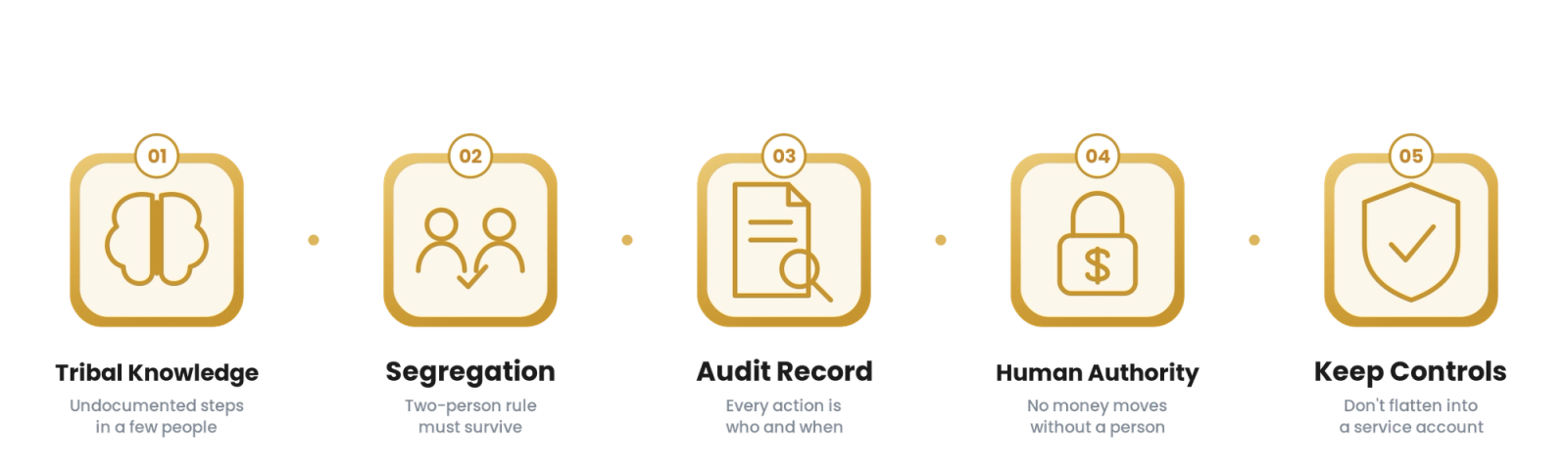
Key Takeaway: Automation flattens approval structures unless you build them in. If the manual step needed two people, the automated step needs two identities.
Real-World Runbook Automation for Fintech in Action
Let's take a look at how it operates with a real-world example.
We worked with a fintech platform team whose automated runbooks had collapsed segregation of duties into service accounts, with these constraints:
- Extract and write procedures before automating anything
- Preserve segregation of duties across separate identities
- Generate audit records for every execution
Step 1: Extract the Knowledge
Write it down.
- Procedures captured during incidents
- Reviewed by someone who did not write them
- Control requirements identified explicitly
Step 2: Preserve Segregation
Two identities, not one.
- Separate accounts for initiation and approval
- Service accounts scoped to one role
- No account both acts and authorises
Step 3: Automate Diagnostics
No side effects.
- Read-only context gathered automatically
- Attached to the alert on arrival
- Every execution logged
Step 4: Automate Remediation Carefully
Preconditions and data verification.
- Conditions checked before execution
- Outcome verified against data
- Nothing destructive without authority
Step 5: Keep Money Movement Human
Always.
- Money-moving steps human-authorised
- Irreversible actions gated
- Escalation explicit and tested
Where It Works Well
- Well-characterised recurring failures with proven procedures
- Read-only diagnostic collection on transaction paths
- Orgs that need evidence for every corrective action
Where It Does Not Work Well
- Any step that moves money or alters a ledger without human authority
- Novel failures nobody has characterised or written down
- Automation where one identity holds every required permission
Key Takeaway: Automate the mechanical steps and the record-keeping; keep money movement and approval authority with named humans.
Common Pitfalls
i) Collapsing segregation into a service account
The account that holds every permission the procedure needs is the easy implementation and it removes the control entirely. Use separate identities and prevent any single account from acting and authorising.
- Segregation of duties stops existing silently
- Nothing fails, so nobody notices
- Discovery happens during an audit
ii) Automating before writing
Building automation from one engineer's account encodes their assumptions including the wrong ones. Write, review, and prove manually first.
iii) Verifying process health instead of data
A remediation that leaves the process alive and the data inconsistent is the worst outcome on a transaction path. Verify against data.
iv) Runbooks as documents
Documents drift because nothing forces them to change when the system does. Store runbooks as code, review them, and test them.
Takeaway from these lessons: Runbook automation in fintech works through capture, control preservation, audit logging, then diagnostics before remediation.
Runbook Automation Best Practices for Fintech: What High-Performing Teams Do Differently
1. Review procedures for authority, not just correctness
Have someone who understands the control environment identify which steps required two people, before any of it becomes code.
2. Use separate identities for separate roles
Never let one service account both initiate and approve, because that is how segregation of duties disappears without any visible failure.
3. Automate read-only diagnostics first
Context gathering carries no risk and removes the largest share of incident time, so it is the highest-value starting point.
4. Verify against data
Confirm consistency after remediation rather than checking that a process is running, since a live process holding wrong state is the expensive case.
5. Keep money movement behind human authority
Automate the diagnosis and the preparation, and require a named person for anything that alters a ledger or moves funds.
Logiciel's value add is helping fintech platform teams turn operational knowledge into written, proven runbooks whose controls survive automation, so response gets faster without segregation of duties dissolving into a script.
Takeaway for High-Performing Teams: Capture the knowledge, preserve the controls across identities, log every execution, and keep money movement human.
Signals You Are Doing Runbook Automation Well in Fintech
How do you know it is working? Not by how many runbooks you automated, but by whether the controls still exist afterwards. These are the signals that separate captured knowledge from dissolved controls.
Procedures exist in writing. Response does not depend on asking a specific person.
Segregation survived. No identity can both initiate and approve the same action.
Records are automatic. Every corrective action carries its own evidence.
Verification checks data. Consistency is confirmed, not just process liveness.
Money movement is human. No automated path alters a ledger unauthorised.
Adjacent Capabilities and Connected Work
This work does not exist in isolation. Runbook automation depends on, and feeds into, the surrounding platform. Ignoring the adjacencies is the most common scoping mistake.
Observability supplies the data diagnostics collect. Secrets management issues the separate identities segregation requires. Self-healing infrastructure runs the proven remediations unattended. Your audit logging pipeline consumes the execution records. Naming these adjacencies upfront keeps the work scoped and helps leadership see runbook automation as control work rather than tooling.
The common mistake is treating each adjacency as someone else's problem. The identity separation is your problem. The audit record is your problem. The data verification is your problem. Pretend otherwise and you will automate away a control and find out during an audit.
Own the adjacencies you depend on, partner with the teams that hold them, and share the runbooks.
Conclusion
Runbook automation in fintech has two failure modes, and only one of them is technical. The first is automating a procedure nobody wrote down, which encodes a guess and runs it consistently.
The second, quieter and more expensive, is automating a procedure faithfully in every respect except the controls, so segregation of duties collapses into a service account with all the permissions and nothing appears to go wrong for a quarter.
Write the procedure, have it reviewed for authority as well as correctness, preserve separate identities, log every execution immutably, automate read-only diagnostics first, verify against data, and keep money movement behind a named human.
The 2026 QA Automation Benchmark: How Flaky Tests Tripled in Three Years
Benchmark flaky test growth and strengthen your QA automation strategy.
Key Takeaways:
- You cannot automate a procedure that has not been written down and proven
- Automation collapses approval structures unless segregation is built in deliberately
- Diagnostics automate cleanly; money movement should never automate at all
Building runbook automation requires preserving controls. When done correctly, it produces:
- Consistent response regardless of who is on call
- Corrective actions that carry their own evidence
- Segregation of duties that survives the move to code
- Faster diagnosis without new risk to a transaction path
What Logiciel Does Here
If your automated runbooks run under service accounts that can both act and approve, we help you rebuild them with segregation preserved, audit records generated, and money movement kept human.
Learn More Here:
- Self-Healing Infrastructure for Fintech
- Secrets Management for Fintech
- AI Incident Management for Fintech
At Logiciel Solutions, we work with fintech platform leaders on operational automation. Our reference patterns come from regulated payment environments.
Book a technical deep-dive on automating response without automating away your controls.