
A SaaS platform team decides to automate incident response, and the first thing they discover is that most of their runbooks do not exist. What exists is a document per service written eighteen months ago, three of which are accurate, and a handful of engineers who know what to actually do.
The knowledge lives in those people's heads, gets applied differently depending on who is on call, and disappears when they change teams. Automating that is not possible, because there is nothing to automate.
The work is not building the automation platform. It is extracting what those four engineers know into something written down, tested, and boring enough to hand to a machine.
You cannot automate a runbook that does not exist. Write it first, then run it, then automate it.
Runbook automation for SaaS means turning documented, proven operational procedures into executable steps that any engineer or system can run consistently, so response quality does not depend on who is on call across thirty teams and tribal knowledge stops leaving with people.
However, most teams start with the automation platform and discover the actual problem is that nobody wrote down what to do.
An Incident Response Runbook for the $336K-an-Hour Downtime Problem
Build a practical incident response plan to reduce costly downtime.
If you are a VP ofPlatform Engineering or Head of Developer Experience at a SaaS company, the intent of this article is:
- Define the path from tribal knowledge to executable response
- Show why writing and proving comes before automating
- Lay out what to automate and what to keep with a human
To do that, let's start with the basics.
What Is Runbook Automation for SaaS? The Basic Definition
At a high level, runbook automation in a SaaS org is converting operational procedures into code that executes consistently: diagnostic steps that gather context, remediation steps that fix known conditions, and verification steps that confirm the outcome.
The important part is what comes before the code. A runbook worth automating is one that has been written down, run manually enough times to be dull, and refined until it works the same way regardless of who executes it.
Automation removes the typing and the variance. It does not supply the knowledge, and it cannot improve a procedure that was never correct.
To compare:
A written runbook is a recipe. Automation is a food processor. The processor makes a good recipe faster and more consistent, and it makes a bad recipe fail identically every time at high speed.
Most SaaS platform teams buy the processor first, then discover the recipe was three bullet points and a phone number for someone who left. The value is in the recipe. The processor just removes the chopping.
Why Is Runbook Automation Necessary for SaaS?
Issues that it addresses or resolves:
- Response quality varying with who happens to be on call
- Operational knowledge living in a few engineers' heads
- Diagnostic steps repeated manually during every incident
Resolved Issues by Runbook Automation
- Consistent response regardless of who responds
- Knowledge captured in code rather than in individuals
- Diagnostic context gathered before a human even looks
Core Components of Runbook Automation in SaaS
- Written procedures proven manually before automation
- Diagnostics automated first, remediation second
- Verification confirming the outcome, not just the action
- Ownership tied to the service through the catalog
- Judgement steps left deliberately with a human
Modern Runbook Automation Tooling for SaaS
- Runbooks stored as code and reviewed like code
- Automated diagnostic collection triggered by alerts
- Parameterised remediation steps with clear preconditions
- Execution logs capturing what ran, when, and by whom
- Testing of runbooks against non-production environments
These tools make operational knowledge durable across thirty teams. Storing runbooks as reviewed code and automating diagnostics before remediation are what turn tribal knowledge into something the org owns.
Other Core Issues They Will Solve
- New on-call engineers respond as well as experienced ones
- Time to diagnosis falls because context arrives automatically
- Procedures improve because they are reviewed rather than remembered
In Summary: Runbook automation for SaaS turns proven written procedures into executable steps, so response is consistent across many teams and operational knowledge stops leaving with the people who hold it.
Importance of Runbook Automation for SaaS in 2026
Multi-team SaaS orgs have more services than any individual can understand. Four reasons explain why this matters now.
1. Service count exceeded human memory.
Thirty teams shipping independently produce more operational surface than any on-call rota can hold in their heads.
2. Tribal knowledge is a retention risk disguised as expertise.
When four people know how to fix things, four resignations are an operational crisis.
3. Diagnostics are the bulk of incident time.
Most of the minutes in an incident go to gathering context, which is exactly the part that automates cleanly.
4. Consistency matters more than speed.
An inconsistent response that is fast produces incidents that are hard to learn from.
Traditional vs. Modern SaaS Incident Response
- Knowledge in people's heads vs. procedures written and reviewed
- Documents that drift vs. runbooks stored and versioned as code
- Diagnostics repeated manually vs. context gathered automatically
- Response varying by responder vs. consistent execution
In summary: A modern SaaS approach writes procedures down, proves them manually, stores them as reviewed code, and automates the mechanical parts while keeping judgement with a human.
Details About the Core Components of Runbook Automation in SaaS: What Are You Designing?
Let's go through each component.
1. Capture Layer
Getting it written.
Capture decisions:
- Procedures extracted from the people who know them
- Written during or immediately after incidents
- Reviewed by someone who did not write them
2. Proving Layer
Manual before automatic.
Proving decisions:
- Run manually until execution is dull
- Variance between responders eliminated first
- Nothing automated that has not been proven
3. Diagnostic Layer
Context before action.
Diagnostic decisions:
- Data gathering automated first
- Context attached to the alert automatically
- No side effects from diagnostics
4. Remediation Layer
Doing the fix.
Remediation decisions:
- Preconditions checked before execution
- Steps parameterised, not improvised
- Outcome verified before completion
5. Judgement Layer
What stays human.
Judgement decisions:
- Diagnosis of novel failures kept with a person
- Irreversible actions gated
- Escalation paths explicit
Benefits Gained from Runbook Automation in SaaS
- Consistent response across thirty teams regardless of responder
- Faster diagnosis because context arrives with the alert
- Operational knowledge owned by the org rather than by individuals
How It All Works Together
The SaaS platform team starts by extracting knowledge rather than building automation. During and immediately after incidents, the procedure that was actually followed gets written down, then reviewed by someone who did not write it, which is usually where the missing steps surface.
That written runbook is executed manually the next several times the condition occurs, and the variance between responders gets ironed out until any on-call engineer produces the same result. Only then does automation begin, and it begins with diagnostics rather than remediation: the steps that gather logs, check dependency health, pull recent deploys, and assemble context have no side effects, so automating them is low risk and removes the largest share of incident minutes.
Remediation comes second, with explicit preconditions checked before anything executes and verification confirming the outcome rather than just the action. Runbooks live as code in version control, reviewed like code, so they improve rather than drift, and ownership resolves through the service catalog so the right team maintains the right procedure.
Judgement stays with a human deliberately: diagnosing something novel, deciding whether to fail over, anything irreversible. The goal is not autonomous response. It is that the mechanical eighty percent runs identically every time.
Common Misconception
Runbook automation means the system responds to incidents without a human.
That is a different and much harder goal, and pursuing it first is why many runbook automation efforts produce nothing usable. The realistic and considerably more valuable target is consistency and speed for the parts that are already understood.
Automated diagnostics remove the ten minutes an engineer spends opening dashboards and running the same four queries. Automated remediation of well-characterised conditions removes the variance between a senior engineer and someone in their second week on call.
Neither requires the system to understand the incident. Aim at autonomous response and you will spend a year building decision logic for situations nobody has characterised, while your engineers still open dashboards manually.
Aim at consistency and you get most of the value in a quarter.
Key Takeaway: The goal is consistency, not autonomy. Automate the understood mechanical steps and leave diagnosis of novel failures with a person.
Real-World Runbook Automation for SaaS in Action
Let's take a look at how it operates with a real-world example.
We worked with a SaaS platform team whose operational knowledge sat with four engineers, with these constraints:
- Extract and write procedures before automating anything
- Automate diagnostics before remediation
- Keep judgement steps explicitly with a human
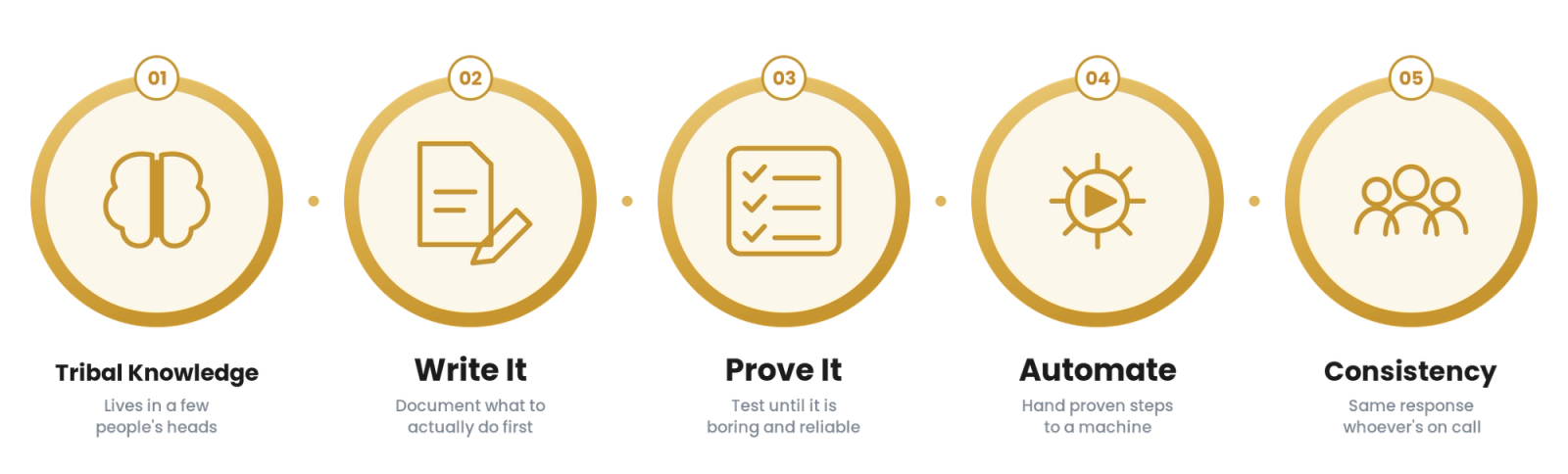
Step 1: Extract the Knowledge
Write it down.
- Procedures captured during incidents
- Reviewed by someone who did not write them
- Gaps surfaced through review
Step 2: Prove It Manually
Until it is boring.
- Executed manually several times
- Variance between responders removed
- Nothing automated unproven
Step 3: Automate Diagnostics
No side effects.
- Context gathered automatically
- Attached to the alert on arrival
- Read-only by construction
Step 4: Automate Remediation
With preconditions.
- Conditions checked before execution
- Steps parameterised
- Outcome verified
Step 5: Keep Judgement Human
Deliberately.
- Novel diagnosis stays with a person
- Irreversible actions gated
- Escalation explicit
Where It Works Well
- Well-characterised recurring failures with proven procedures
- Diagnostic collection, which automates cleanly and safely
- Orgs with a service catalog to resolve procedure ownership
Where It Does Not Work Well
- Novel failures nobody has characterised
- Procedures that exist only as tribal knowledge
- Orgs pursuing autonomous response before consistency
Key Takeaway: Automate what has been written and proven; automating tribal knowledge encodes a guess and runs it faster.
Common Pitfalls
i) Automating before writing
Teams build automation from a conversation with one engineer, and encode that person's assumptions including the wrong ones. Write the procedure, review it, and prove it manually first.
- The automation encodes a guess
- Failures are consistent and wrong
- Nobody trusts it after the first bad run
ii) Starting with remediation
Remediation carries risk and diagnostics do not. Automate the read-only context gathering first, which removes most incident minutes with almost no downside.
iii) Runbooks as documents
A document drifts because nothing forces it to change when the system does. Store runbooks as code, review them like code, and test them.
iv) Chasing autonomous response
Building decision logic for uncharacterised situations consumes quarters and delivers little. Target consistency for understood conditions instead.
Takeaway from these lessons: Runbook automation works through capture, proving, diagnostics, then remediation, in that order, with judgement kept human.
Runbook Automation Best Practices for SaaS: What High-Performing Teams Do Differently
1. Capture during the incident
Write the procedure while it is being followed, because reconstructing it a week later loses the details that mattered.
2. Prove it manually until it is dull
Run the written runbook by hand several times and eliminate variance between responders before automating anything.
3. Automate diagnostics first
Read-only context gathering carries no risk and removes the largest share of incident time, so it is the highest-value starting point.
4. Store runbooks as reviewed code
Version them, review them, and test them against non-production, so they improve instead of drifting like documents do.
5. Keep judgement with a human
Leave novel diagnosis and irreversible actions to a person, and be explicit about where that boundary sits.
Logiciel's value add is helping SaaS platform teams turn tribal operational knowledge into written, proven, executable runbooks, so response quality across thirty teams stops depending on who is on call.
Takeaway for High-Performing Teams: Capture, prove, then automate diagnostics before remediation, and keep the judgement steps human on purpose.
Signals You Are Doing Runbook Automation Well in SaaS
How do you know it is working? Not by how many runbooks you automated, but by whether a new on-call engineer performs like an experienced one. These are the signals that separate captured knowledge from encoded guesses.
Procedures exist in writing. Response does not depend on asking a specific person.
Runbooks are code. They are versioned, reviewed, and tested rather than drifting as documents.
Context arrives automatically. Diagnostics are attached to the alert before a human looks.
Response is consistent. Two different responders produce the same outcome.
Judgement is explicit. Everyone knows which steps a human must decide.
Adjacent Capabilities and Connected Work
This work does not exist in isolation. Runbook automation depends on, and feeds into, the surrounding platform. Ignoring the adjacencies is the most common scoping mistake.
Observability supplies the data diagnostics collect. Self-healing infrastructure is what runs the proven remediations unattended. Incident management is where escalation lands. The service catalog resolves which team owns which procedure. Naming these adjacencies upfront keeps the work scoped and helps leadership see runbook automation as knowledge capture rather than tooling.
The common mistake is treating each adjacency as someone else's problem. The written procedure is your problem. The diagnostic quality is your problem. The judgement boundary is your problem. Pretend otherwise and you automate a guess and run it thirty times faster.
Own the adjacencies you depend on, partner with the teams that hold them, and share the runbooks.
Conclusion
Runbook automation is knowledge work before it is engineering work. Extract what your experienced engineers actually do, write it down, have someone else review it, run it manually until execution is dull, and only then automate.
Start with diagnostics, because read-only context gathering removes most incident minutes at almost no risk. Move to remediation with explicit preconditions and outcome verification. Store everything as reviewed code so it improves instead of drifting.
And keep diagnosis of novel failures and anything irreversible with a human, deliberately. Automating a runbook nobody wrote down produces a consistent wrong answer at speed.
See What Elite-Tier SaaS Engineering Teams Actually Look Like in 2026
See what elite SaaS engineering performance looks like across key metrics.
Key Takeaways:
- You cannot automate a procedure that has not been written down and proven
- Diagnostics automate cleanly and deliver most of the value; start there
- The goal is consistency across responders, not autonomous response
Building runbook automation requires capturing knowledge first. When done correctly, it produces:
- Consistent response regardless of who is on call
- Faster diagnosis because context arrives with the alert
- Operational knowledge owned by the org rather than by individuals
- Procedures that improve through review instead of drifting
What Logiciel Does Here
If your operational knowledge lives with four engineers, we help you extract it into written, proven runbooks and automate the mechanical parts without encoding anyone's guesses.
Learn More Here:
- Self-Healing Infrastructure for Technology & SaaS
- AI Incident Management for Technology & SaaS
- OpenTelemetry for Technology & SaaS
At Logiciel Solutions, we work with SaaS platform leaders on operational automation. Our reference patterns come from platforms serving many product teams.
Book a technical deep-dive on turning tribal knowledge into executable response.