
A SaaS platform team moves a substantial share of its compute to spot capacity and the savings are immediate and large. Six weeks later a capacity event reclaims a chunk of one instance type across a zone, three services that had been quietly running only on that type go down together, and the postmortem finds that diversification had been configured as a preference rather than a requirement.
The savings were real. The assumption underneath them, that reclamation would always be gradual and partial, had never been tested and was never true.
Spot savings are easy. Spot resilience is a set of assumptions you should test before you rely on them.
Spot instance strategy for SaaS means running interruption-tolerant workloads on spot capacity with enforced instance and zone diversification, graceful interruption handling, and a tested fallback, so savings do not rest on reclamation being gentle.
Is Your Engineering Velocity Real, or Just a Reporting Illusion?
Discover whether your engineering velocity reflects real output or hidden inefficiency.
However, most adoptions configure diversification as a preference and discover during a capacity event that preference is not the same as requirement.
If you are a VP of Engineering or Head of Infrastructure at a SaaS company, the intent of this article is:
- Define which workloads genuinely tolerate interruption
- Show why diversification must be enforced rather than preferred
- Lay out how to test the fallback before you need it
To do that, let's start with the basics.
What Is Spot Instance Strategy for SaaS? The Basic Definition
At a high level, spot capacity is compute offered at a substantial discount in exchange for the provider reclaiming it with short notice. Using it well means identifying workloads that genuinely tolerate interruption, spreading across instance types and zones so a single reclamation event cannot take a workload out, handling the interruption notice gracefully, and having a tested fallback to on-demand when spot capacity is unavailable.
The savings are straightforward. The engineering is in the assumptions: that interruption will be handled, that diversification is real, and that fallback works.
To compare:
Running on spot without enforced diversification is buying standby tickets on one airline and assuming a cancellation will only ever affect some passengers. Most of the time that holds. When the airline cancels the route, everyone who relied on that assumption is in the same place, and the fact that each individual booking was cheap does not help.
Why Does Spot Instance Strategy Matter for SaaS?
Issues that it addresses or resolves:
- Substantial compute spend on workloads that tolerate interruption
- Diversification configured as preference rather than requirement
- Fallback to on-demand untested until a capacity event
Resolved Issues by Spot Done Well
- Savings on genuinely interruption-tolerant workloads
- Diversification enforced so reclamation stays partial
- Fallback tested before it is needed
Core Components of Spot Instance Strategy in SaaS
- Workload interruption tolerance assessed honestly
- Instance type and zone diversification enforced
- Interruption notice handled gracefully
- Fallback to on-demand tested regularly
- Savings expectations set against realistic coverage
Modern Spot Tooling for SaaS
- Capacity providers with diversification requirements
- Interruption notice handling in workload configuration
- Automated fallback to on-demand
- Spot coverage and interruption rate monitoring
- Chaos testing of reclamation scenarios
These tools make savings durable. Enforced diversification with chaos testing is what converts an assumption into a verified property.
Other Core Issues They Will Solve
- Compute cost reduced on suitable workloads
- Interruptions absorbed without user impact
- Capacity events handled rather than survived
In Summary: Spot instance strategy for SaaS delivers real savings on interruption-tolerant workloads, provided diversification is enforced and fallback is tested rather than assumed.
Importance of Spot Instance Strategy for SaaS in 2026
Compute is a large share of SaaS infrastructure spend. Four reasons explain why this matters now.
1. The discount is substantial.
Spot pricing is a large enough reduction to matter on any meaningful compute footprint.
2. Many SaaS workloads tolerate interruption.
Batch processing, CI, asynchronous jobs, and stateless request handling with adequate replicas often qualify.
3. Diversification defaults are permissive.
Configurations frequently express diversification as a preference, which behaves like a requirement until the day it does not.
4. Fallback is rarely tested.
The on-demand path exists in configuration and has usually never executed under real capacity pressure.
Traditional vs. Modern SaaS Spot Adoption
- On-demand everywhere vs. spot on interruption-tolerant workloads
- Diversification preferred vs. enforced
- Interruption handling assumed vs. implemented and tested
- Fallback configured vs. exercised regularly
In summary: A modern SaaS approach enforces diversification, implements graceful interruption handling, and tests the fallback deliberately.
Details About the Core Components of Spot Instance Strategy in SaaS: What Are You Designing?
Let's go through each component.
1. Tolerance Layer
Which workloads qualify.
Tolerance decisions:
- Interruption tolerance assessed per workload
- Stateful and latency-critical workloads excluded
- Replica counts checked against reclamation scenarios
2. Diversification Layer
Enforced, not preferred.
Diversification decisions:
- Multiple instance types required
- Multiple zones required
- Configuration enforcing rather than expressing preference
3. Interruption Layer
Handling the notice.
Interruption decisions:
- Notice handled with graceful drain
- In-flight work completed or checkpointed
- Handling tested rather than assumed
4. Fallback Layer
When spot is unavailable.
Fallback decisions:
- On-demand fallback configured
- Fallback exercised regularly
- Cost impact of fallback understood
5. Monitoring Layer
Knowing what is happening.
Monitoring decisions:
- Spot coverage tracked
- Interruption rate monitored
- Concentration in single types alerted
Benefits Gained from Spot Instance Strategy in SaaS
- Substantial compute savings on suitable workloads
- Interruptions absorbed without user-visible impact
- Capacity events handled by tested fallback
How It All Works Together
The SaaS platform team assesses interruption tolerance honestly per workload before configuring anything, excluding stateful services and latency-critical paths and checking that replica counts survive a realistic reclamation scenario rather than a gentle one.
Diversification is then enforced rather than preferred: multiple instance types and multiple zones are requirements in the capacity configuration, and the monitoring alerts when actual placement has concentrated into a single type regardless of what the configuration expresses, because drift toward whatever is cheapest is the normal behaviour.
Interruption notice handling is implemented with graceful drain so in-flight work completes or checkpoints, and that handling is tested rather than assumed, because a drain path that has never executed will not behave as expected the first time.
Fallback to on-demand is configured and exercised regularly, with the cost impact understood so a capacity event does not produce a surprising bill alongside the incident. And chaos testing exercises reclamation scenarios deliberately.
Common Misconception
Diversification is configured, so we are diversified.
Configuration frequently expresses diversification as a preference and the scheduler optimises for cost within that preference, which means actual placement drifts toward whichever type is currently cheapest. You end up concentrated in one instance type while the configuration says three, and the difference only becomes visible when that type gets reclaimed across a zone.
This is not a misconfiguration in the usual sense; the system did what it was asked. The fix is enforcing minimum spread as a requirement and monitoring actual placement rather than intended placement, because intent and reality diverge quietly and the divergence is invisible until the event that punishes it.
Key Takeaway: Configured diversification and actual diversification differ. Monitor placement, not intent.
Real-World Spot Instance Strategy for SaaS in Action
Let's take a look at how it operates with a real-world example.
We worked with a SaaS platform team whose three services concentrated on one instance type and failed together, with these constraints:
- Assess interruption tolerance honestly per workload
- Enforce diversification and monitor actual placement
- Test interruption handling and fallback deliberately
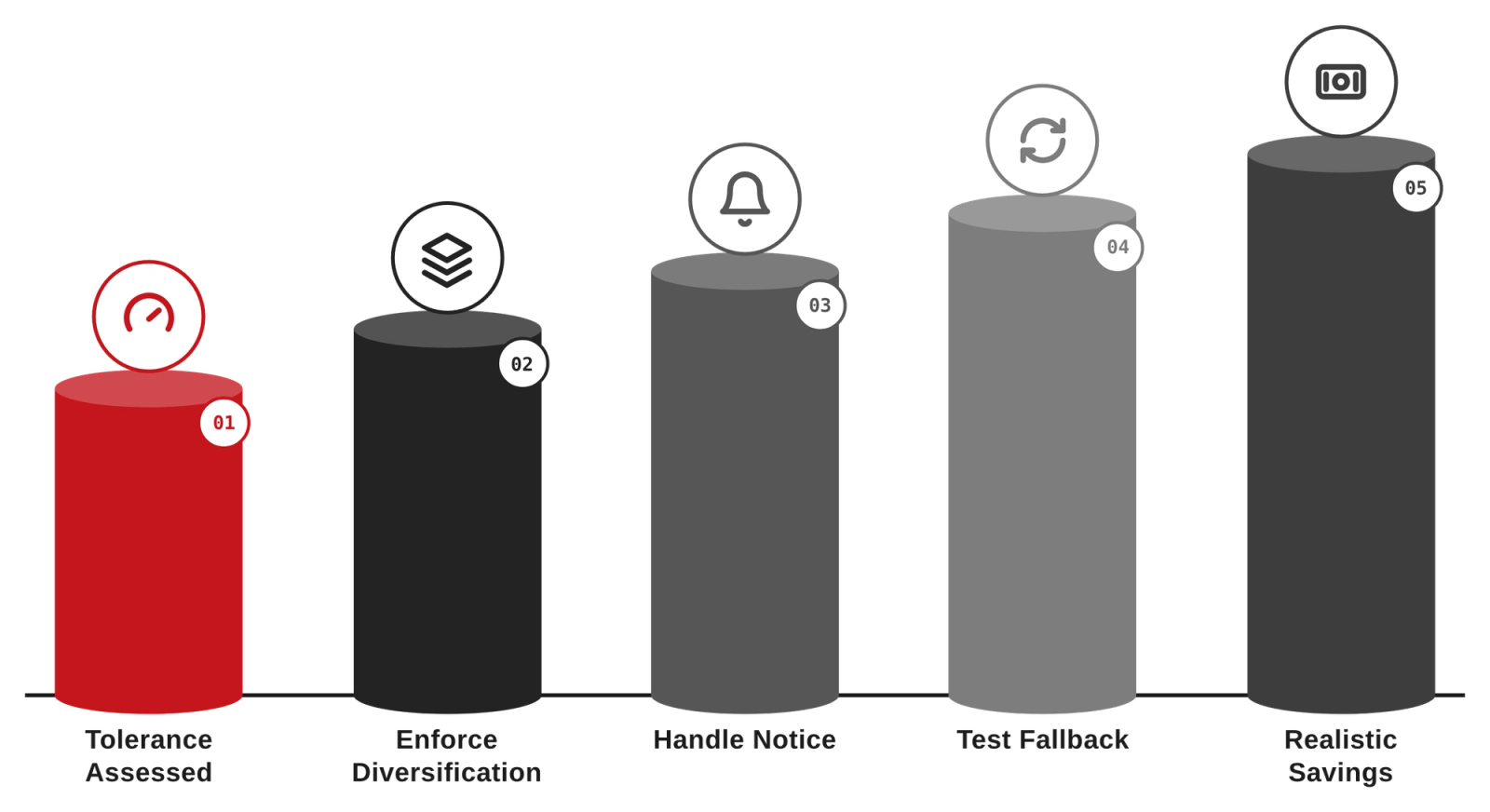
Step 1: Assess Tolerance
Per workload.
- Interruption tolerance evaluated
- Stateful and latency-critical excluded
- Replica counts checked against reclamation
Step 2: Enforce Diversification
Not prefer it.
- Multiple types and zones required
- Enforcement in configuration
- Actual placement monitored
Step 3: Handle the Notice
Gracefully.
- Drain implemented on notice
- In-flight work completed or checkpointed
- Handling tested
Step 4: Test the Fallback
Before you need it.
- On-demand fallback configured
- Exercised regularly
- Cost impact understood
Step 5: Monitor Concentration
And alert.
- Coverage and interruption rate tracked
- Single-type concentration alerted
- Chaos testing of reclamation
Where It Works Well
- Batch, CI, and asynchronous workloads
- Stateless services with adequate replica spread
- Estates where diversification can be enforced
Where It Does Not Work Well
- Stateful services without checkpointing
- Latency-critical paths with tight availability requirements
- Configurations expressing diversification as a preference
Key Takeaway: Assess tolerance honestly, enforce spread, test the drain and the fallback, and monitor actual placement.
Common Pitfalls
i) Diversification as a preference
The scheduler optimises within the preference and placement concentrates in the cheapest type. Enforce minimum spread and monitor actual placement.
- Three services end up on one type
- A single reclamation event takes them together
- The configuration said three types
ii) Untested interruption handling
A drain path that has never executed will not work as expected under real reclamation. Test it deliberately with chaos exercises.
iii) Untested fallback
The on-demand path exists in configuration and has never run under capacity pressure. Exercise it regularly and know the cost impact.
iv) Overstating tolerance
A service is interruption-tolerant only if replica spread survives a realistic reclamation, not a gentle one. Check against the bad case.
Takeaway from these lessons: The savings are easy and the assumptions underneath them need testing before you depend on them.
Spot Best Practices for SaaS: What High-Performing Teams Do Differently
1. Assess tolerance against realistic reclamation
Check that replica spread survives a zone-wide event rather than a gradual one, because gradual is the common case and not the one that hurts.
2. Enforce diversification and monitor placement
Make minimum spread a requirement and alert on actual concentration, since intent and reality diverge quietly.
3. Implement and test graceful drain
Handle the interruption notice properly and exercise the path, because an untested drain fails the first time it matters.
4. Exercise the fallback regularly
Run the on-demand path deliberately and know its cost impact, so a capacity event is not also a billing surprise.
5. Chaos test reclamation scenarios
Simulate the event you are protecting against rather than trusting the configuration that claims to.
Logiciel's value add is helping SaaS platform teams take spot savings on genuinely tolerant workloads with diversification enforced and interruption paths tested rather than assumed.
Takeaway for High-Performing Teams: Assess honestly, enforce spread, monitor placement, test the drain, exercise the fallback.
Signals You Are Doing Spot Instance Strategy Well in SaaS
How do you know it is working? Not by savings alone, but by whether a reclamation event is uneventful. These are the signals that separate durable savings from a deferred incident.
Placement is monitored. Actual spread is tracked, not just configured.
Concentration alerts. Drift into a single instance type raises a signal.
Drain is tested. The interruption path has executed deliberately.
Fallback is exercised. The on-demand path has run under real conditions.
Events are boring. Reclamation produces no user-visible impact.
Adjacent Capabilities and Connected Work
This work does not exist in isolation. Spot strategy depends on, and feeds into, the surrounding platform. Ignoring the adjacencies is the most common scoping mistake.
Karpenter or equivalent autoscaling determines how capacity is requested and diversified. FinOps guardrails supply the cost context. Cloud waste work identifies workloads suitable for migration. Kubernetes multi-tenancy determines blast radius when capacity disappears. Naming these adjacencies upfront keeps the work scoped and helps leadership see diversification as a requirement.
The common mistake is treating each adjacency as someone else's problem. The placement monitoring is your problem. The drain testing is your problem. The fallback exercise is your problem. Pretend otherwise and a zone-wide reclamation will take three services together.
Own the adjacencies you depend on, partner with the teams that hold them, and share the tests.
Conclusion
Spot capacity delivers substantial savings on workloads that genuinely tolerate interruption, and the savings are the easy part. What needs engineering is the set of assumptions underneath: that the workload survives a realistic reclamation rather than a gentle one, that diversification is enforced rather than preferred and actual placement matches intent, that the interruption notice triggers a drain path that has been tested, and that the on-demand fallback works under real capacity pressure.
Configure diversification as a requirement, monitor actual placement, chaos test reclamation, exercise the fallback, and the savings become durable rather than a deferred incident.
Key Takeaways:
- Configured diversification and actual placement diverge quietly toward the cheapest type
- Interruption tolerance should be assessed against zone-wide reclamation, not gradual
- Untested drain and fallback paths fail the first time they execute
Running spot well requires testing the assumptions. When done correctly, it produces:
- Substantial savings on suitable workloads
- Interruptions absorbed without user-visible impact
- Capacity events handled by a tested fallback
The Architecture Layer That Decides If Your AI Product Survives Production
Build the architecture layers that make AI products production-ready.
- Placement that matches the configuration
What Logiciel Does Here
If your diversification is configured as a preference, we help you enforce spread, monitor actual placement, and test the drain and fallback paths before a capacity event does.
Learn More Here:
- Karpenter for Technology & SaaS
- FinOps Guardrails for Technology & SaaS
- Kubernetes Multi-Tenancy for Technology & SaaS
At Logiciel Solutions, we work with SaaS engineering leaders on compute cost. Our reference patterns come from estates running substantial spot footprints.
Book a technical deep-dive on making your spot savings survive a reclamation event.
—Content End—