
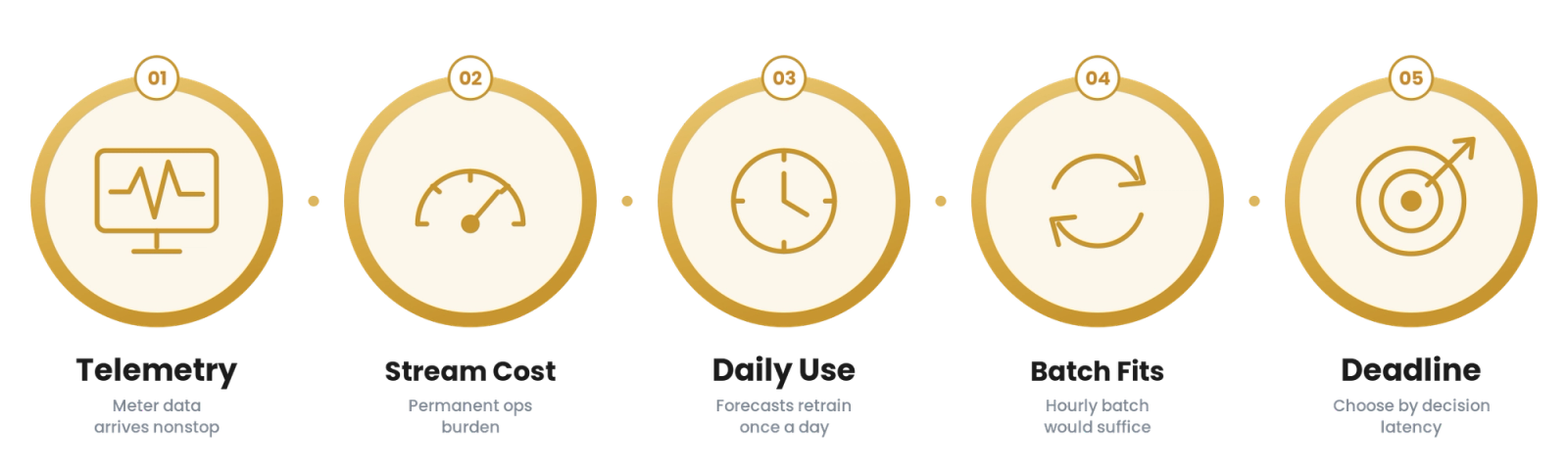
An energy company builds a streaming pipeline for meter telemetry because the data arrives continuously and streaming seemed like the obvious match. Two years later the pipeline is the most operationally demanding thing the data team runs, requiring specialist knowledge, careful state management, and a genuinely difficult backfill story.
The consumers, it turns out, are a load forecasting model that retrains daily and a regulatory report produced monthly. Nothing downstream acts on data faster than once a day. The pipeline delivers sub-minute latency to systems that would be entirely satisfied by an hourly batch, and the cost of that gap is paid every week in operational effort.
The data arriving continuously does not mean the decision happens continuously. That distinction is the whole question.
Streaming versus batch for energy means choosing processing architecture based on how fast a downstream decision must actually be made, not on how the data arrives, because streaming carries permanent operational cost that only latency-sensitive decisions justify.
How a Healthcare Platform Moved Batch to Streaming in One Quarter
See how healthcare workloads moved from batch to streaming in one quarter.
However, most teams choose based on the shape of the source rather than the deadline of the decision, and pay streaming complexity for batch requirements.
If you are a CDO or VP of Data at an energy company, the intent of this article is:
- Define the actual decision criterion, which is decision latency
- Show where genuine streaming requirements exist in energy
- Lay out how to choose honestly and what streaming really costs
To do that, let's start with the basics.
What Is the Streaming and Batch Choice for Energy? The Basic Definition
At a high level, batch processing collects data over a window and processes it together on a schedule, while stream processing handles records continuously as they arrive. The correct question is not which is more modern but how quickly a downstream decision has to be made.
If a forecasting model retrains daily, an hourly batch is more than sufficient and simpler in every dimension: easier to test, easier to backfill, easier to reason about when a number looks wrong.
If a protection or alarm decision must be made in seconds, batch cannot serve it. Most energy analytics falls firmly in the first category, and a meaningful minority genuinely falls in the second.
To compare:
Streaming is an ambulance. Fast, expensive, staffed by specialists, and absolutely the right answer when someone is having a heart attack. Batch is a scheduled bus. Slower, far cheaper, and entirely adequate for getting to a monthly appointment.
Running an ambulance service to deliver people to monthly appointments is not a modernisation; it is an expensive misreading of the requirement. The data arriving continuously is the patient walking in steadily, not an emergency.
Why Does Choosing Honestly Matter for Energy?
Issues that it addresses or resolves:
- Streaming complexity adopted for consumers that act daily or monthly
- Operational burden concentrated in pipelines nobody can easily debug
- Backfill and correction becoming genuinely hard problems
Resolved Issues by Choosing on Decision Latency
- Architecture matched to what downstream consumers actually require
- Operational effort proportional to the value of latency
- Backfill and reprocessing remaining tractable
Core Components of the Streaming and Batch Decision in Energy
- Decision latency documented per consumer, not assumed
- Genuine real-time requirements identified and separated
- Batch used wherever the deadline permits it
- Operational cost of streaming stated honestly
- Backfill and correction strategy defined before building
Modern Processing Tooling for Energy
- Stream processors with state management for genuine real-time needs
- Incremental batch frameworks narrowing the latency gap cheaply
- Micro-batch approaches serving minute-level requirements
- Replayable ingestion supporting reprocessing in either model
- Monitoring that distinguishes lateness from loss
These tools mean the choice is less binary than it was. Incremental and micro-batch approaches serve a large middle ground at a fraction of the operational cost of full streaming.
Other Core Issues They Will Solve
- Teams stop paying for latency nobody consumes
- Corrections and backfills stay manageable
- Genuine real-time paths get the attention they deserve
In Summary: Streaming versus batch for energy is decided by how fast a downstream decision must be made, and most energy analytics has daily or monthly deadlines that batch serves better and cheaper.
Importance of This Decision for Energy in 2026
Energy data volumes keep growing and so does the temptation to stream everything. Four reasons explain why choosing honestly matters now.
1. Data arriving continuously is not a requirement.
Telemetry streams in because assets emit continuously. The consumers still mostly act on a daily cycle.
2. Streaming operational cost is permanent.
Specialist knowledge, state management, and difficult debugging continue for the life of the pipeline, long after the build enthusiasm fades.
3. Backfill is where streaming hurts most.
In an estate with late-arriving data and corrections, reprocessing history in a streaming system is materially harder than rerunning a batch.
4. The middle ground got much better.
Incremental and micro-batch approaches now serve minute-level latency without full streaming complexity.
Traditional vs. Modern Energy Processing Choices
- Choose by source shape vs. choose by decision latency
- Streaming as modernisation vs. streaming where seconds matter
- Backfill considered later vs. reprocessing designed upfront
- Binary streaming or nightly batch vs. incremental and micro-batch options
In summary: A modern energy approach documents decision latency per consumer and uses the cheapest architecture that meets the deadline.
Details About the Core Components of This Decision in Energy: What Are You Designing?
Let's go through each component.
1. Requirement Layer
What the deadline is.
Requirement decisions:
- Decision latency documented per consumer
- Stated deadlines validated against actual behaviour
- Aspirations distinguished from requirements
2. Real-Time Layer
Where seconds matter.
Real-time decisions:
- Genuine second-level needs identified explicitly
- Those paths separated from analytical processing
- Operational investment concentrated there
3. Batch Layer
Everything else.
Batch decisions:
- Schedule set by the tightest downstream deadline
- Incremental processing used where volume demands
- Simplicity preserved deliberately
4. Reprocessing Layer
Corrections and history.
Reprocessing decisions:
- Backfill strategy defined before building
- Late-arriving data handled explicitly
- Replay capability retained
5. Cost Layer
What streaming actually costs.
Cost decisions:
- Specialist capability requirement acknowledged
- Ongoing operational effort estimated
- Cost compared against the value of latency
Benefits Gained from Choosing Honestly in Energy
- Operational effort proportional to the value latency delivers
- Backfill and correction remaining tractable
- Real-time investment concentrated where it matters
How It All Works Together
The energy data team starts by documenting decision latency per consumer, which is a short exercise that changes most architectural conversations. For each downstream use, the question is how quickly a decision must be made: a load forecast retraining daily has a daily deadline, a regulatory report has a monthly one, an operational alarm may have a deadline measured in seconds.
Stated deadlines get validated against actual behaviour, because teams routinely claim to need real-time data for dashboards nobody opens before nine. The genuine second-level requirements are identified and separated, and operational investment concentrates there, which is where streaming complexity is worth paying for.
Everything else runs on batch, with the schedule set by the tightest downstream deadline rather than by tradition, using incremental processing where volume demands it and micro-batch where the requirement sits at minutes rather than hours.
Reprocessing is designed before building, because in an energy estate with late-arriving telemetry and corrections, the ability to rerun history cleanly matters more than the latency of the first pass. And the cost of streaming is stated honestly upfront: the specialist capability, the ongoing operational effort, the debugging difficulty.
Common Misconception
Streaming is the modern architecture and batch is legacy.
Batch is not a legacy technique; it is a deliberate design choice that trades latency for simplicity, testability, and tractable reprocessing. Those are not small advantages. A batch job that produces a wrong number can be rerun after a fix, and the corrected output replaces the original cleanly.
The equivalent operation in a stateful streaming system is a genuine engineering project, which is why streaming estates accumulate known-wrong historical data that nobody has the appetite to reprocess. In an energy context, where late-arriving readings and corrections are routine rather than exceptional, that asymmetry is decisive.
Streaming earns its complexity when a decision genuinely cannot wait. Adopting it because it sounds current means paying permanent operational cost for latency no consumer uses.
Key Takeaway: Batch trades latency for simplicity and clean reprocessing. In an estate with routine corrections, that trade is usually the right one.
Real-World Processing Choices for Energy in Action
Let's take a look at how it operates with a real-world example.
We worked with an energy data team whose streaming telemetry pipeline served only daily and monthly consumers, with these constraints:
- Document decision latency per consumer honestly
- Separate genuine real-time requirements from analytics
- Choose the cheapest architecture meeting each deadline
Step 1: Document the Deadlines
Per consumer.
- Decision latency recorded for each use
- Stated needs validated against behaviour
- Aspirations separated from requirements
Step 2: Isolate Real Real-Time
Where seconds matter.
- Second-level needs identified explicitly
- Those paths separated architecturally
- Operational investment concentrated
Step 3: Batch the Rest
Schedule to the deadline.
- Frequency set by tightest requirement
- Incremental processing where volume demands
- Simplicity preserved
Step 4: Design Reprocessing First
Corrections are routine.
- Backfill strategy defined before building
- Late-arriving data handled explicitly
- Replay capability retained
Step 5: State the Cost
Before committing.
- Specialist capability acknowledged
- Ongoing operational effort estimated
- Compared against value of latency
Where It Works Well
- Streaming for genuine second-level operational decisions
- Batch and incremental processing for forecasting and reporting
- Micro-batch for minute-level requirements without full streaming
Where It Does Not Work Well
- Streaming for consumers that act daily or monthly
- Streaming in estates with heavy correction and backfill needs
- Any choice made on source shape rather than decision deadline
Key Takeaway: Match architecture to decision deadline, concentrate streaming where seconds matter, and keep reprocessing tractable everywhere else.
Common Pitfalls
i) Choosing on source shape
Continuous arrival feels like it demands continuous processing, but the consumers determine the requirement. Document decision latency before selecting an architecture.
- Streaming complexity serves daily consumers
- Operational burden is permanent and specialist
- Nobody downstream notices the latency they paid for
ii) Deferring the backfill question
Reprocessing history in a stateful streaming system is a project, not a rerun. Design correction and replay before building anything.
iii) Accepting stated latency requirements uncritically
Teams claim real-time needs for dashboards opened at nine in the morning. Validate stated deadlines against observed behaviour.
iv) Treating the choice as binary
Incremental and micro-batch approaches serve a large middle ground cheaply. Consider them before committing to full streaming.
Takeaway from these lessons: The decision criterion is downstream decision latency, and the cheapest architecture meeting it is the right one.
Processing Architecture Best Practices for Energy: What High-Performing Teams Do Differently
1. Document decision latency per consumer
Write down how fast each downstream decision must be made, because that list resolves most architectural arguments in an afternoon.
2. Validate stated requirements against behaviour
Check when dashboards are actually opened and when models actually retrain, since claimed real-time needs are frequently aspirational.
3. Concentrate streaming where seconds matter
Invest the specialist capability in the genuinely latency-sensitive paths rather than spreading it across analytics that acts daily.
4. Design reprocessing before building
In an estate with routine corrections, the ability to rerun history cleanly matters more than first-pass latency.
5. Use the middle ground
Incremental and micro-batch approaches serve minute-level requirements at a fraction of full streaming cost.
Logiciel's value add is helping energy data teams choose processing architecture from documented decision latency, so streaming complexity is paid for only where it buys something a consumer actually uses.
Takeaway for High-Performing Teams: Document the deadlines, validate them, concentrate streaming where seconds matter, and keep everything else simple and rerunnable.
Signals You Are Doing This Well in Energy
How do you know it is working? Not by how modern the architecture sounds, but by whether latency matches requirements. These are the signals that separate a considered choice from a fashionable one.
Deadlines are documented. Every consumer's decision latency is written down.
Streaming is concentrated. Only genuinely latency-sensitive paths use it.
Reprocessing works. History can be corrected and rerun cleanly.
Operational load is proportional. Pipeline complexity matches the value of its latency.
The middle ground is used. Incremental and micro-batch serve minute-level needs.
Adjacent Capabilities and Connected Work
This work does not exist in isolation. Processing architecture depends on, and feeds into, the surrounding data platform. Ignoring the adjacencies is the most common scoping mistake.
Data products define what consumers can expect, including freshness. Data quality SLAs formalise those expectations. Your lakehouse table format determines how tractable reprocessing is. Data contracts govern how sources change. Naming these adjacencies upfront keeps the work scoped and helps leadership see the choice as a requirements question rather than a technology preference.
The common mistake is treating each adjacency as someone else's problem. The documented deadlines are your problem. The reprocessing design is your problem. The operational cost estimate is your problem. Pretend otherwise and you will run a demanding pipeline for consumers who act once a day.
Own the adjacencies you depend on, partner with the teams that hold them, and share the requirements.
Conclusion
The streaming versus batch decision is settled by one question: how fast does a downstream decision have to be made. Data arriving continuously is not a requirement; it is a property of physical assets emitting readings.
In most energy estates the consumers are forecasting models retraining daily and reports produced monthly, and for those an hourly batch is simpler to test, simpler to debug, and vastly simpler to correct when a number turns out wrong.
Concentrate streaming on the genuinely latency-sensitive operational paths where seconds matter. Use incremental and micro-batch for the middle. And design reprocessing before you build anything, because corrections are routine here.
Key Takeaways:
- Choose on downstream decision latency, never on how the source data arrives
- Batch trades latency for simplicity and clean reprocessing, which usually wins
- Reprocessing history in a stateful streaming system is a project, not a rerun
Choosing architecture honestly requires documented requirements. When done correctly, it produces:
- Operational effort proportional to the value latency delivers
- Corrections and backfills that remain tractable
How an Energy Operator Built a Real-Time Event Pipeline for Grid Signals
Build real-time grid pipelines that detect anomalies with lower latency.
- Real-time investment concentrated where seconds genuinely matter
- Architecture decisions somebody can justify from a written requirement
What Logiciel Does Here
If you are running streaming infrastructure for consumers that act once a day, we help you document decision latency, right-size the architecture, and make reprocessing tractable.
Learn More Here:
- Apache Iceberg for Energy
- Data Quality SLAs for Energy
- Data Products for Energy
At Logiciel Solutions, we work with energy data leaders on processing architecture. Our reference patterns come from estates handling high-volume telemetry with routine corrections.
Book a technical deep-dive on matching your processing architecture to actual deadlines.