
A SaaS platform team writes a Terraform module for provisioning a service, and by the time thirty product teams are using it, the module has ninety-four input variables. Most of them exist because one team once needed to override one provider argument.
Nobody can change the module now, because any change might break someone, and nobody knows who is passing what. The module is technically shared and functionally frozen. This is the standard end state for modules designed by accretion, and it happens because teams treat a module as a place to put configuration rather than as an interface with an owner and a contract.
A module is an API. Ninety-four inputs is not an API; it is a shrug with a version number.
Why Engineering Is Heading Toward Agent-to-Agent, Not Just AI-Assisted
Explore how connected agents reshape engineering beyond AI-assisted development.
Terraform modules for SaaSmeans designing reusable infrastructure components with a deliberate interface, sensible opinionated defaults, semantic versioning, and a named owner, so thirty product teams can provision infrastructure consistently without the module becoming an unchangeable dependency.
However, most platform teams grow modules by adding a variable every time someone asks, and end up with an interface too wide to evolve and too complex to use.
If you are a VP of Platform Engineering or Head of Developer Experience at a SaaS company, the intent of this article is:
- Define a module as an interface with a contract, not a config container
- Show why input sprawl freezes modules at multi-team scale
- Lay out how to design, version, and own modules many teams consume
To do that, let's start with the basics.
What Are Terraform Modules for SaaS? The Basic Definition
At a high level, a Terraform module in a SaaS org is a reusable unit of infrastructure with a defined input interface, a defined output contract, and an owner who is responsible for both.
The important framing is that it is consumed by teams you do not control, which makes every input variable a promise you will have to keep. A well-designed module exposes the small number of choices a caller genuinely needs to make, encodes the rest as opinionated defaults that reflect your standards, and returns outputs that callers can compose with.
A badly designed module exposes everything, which means it encodes no opinion at all and provides no value beyond saving some typing.
To compare:
A well-designed module is a light switch. You choose on or off; you do not choose the wire gauge. A badly designed module is a fuse box with every wire exposed and a note asking you to be careful.
Both technically deliver electricity. Only one can be safely used by thirty teams who have not read the manual. The narrowness of the interface, not the resources inside it, is what makes a module useful at scale.
Why Are Well-Designed Modules Necessary for SaaS?
Issues that it addresses or resolves:
- Every product team writing slightly different infrastructure for the same thing
- Modules with sprawling inputs that cannot be changed without breaking someone
- Standards documented in a wiki rather than encoded in the thing teams use
Resolved Issues by Well-Designed Modules
- Consistent infrastructure across many teams without central review
- Interfaces narrow enough to evolve without breaking consumers
- Standards enforced by defaults rather than by policy documents
Core Components of Terraform Modules in SaaS
- A narrow input interface exposing only genuine choices
- Opinionated defaults encoding your standards
- Outputs designed for composition by callers
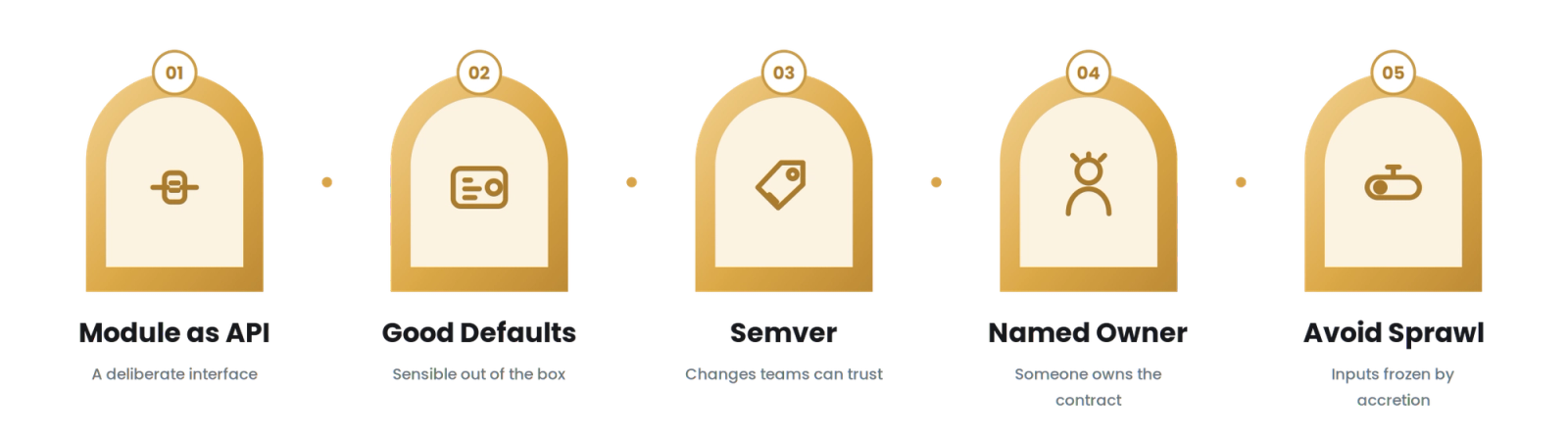
- Semantic versioning with a real deprecation policy
- A named owning team and documented support model
Modern Terraform Module Tooling for SaaS
- A private module registry with versioned releases
- Automated testing of modules against real cloud providers
- Policy as code validating module output at plan time
- Documentation generated from the interface itself
- Dependency scanning to see who consumes which version
These tools make modules maintainable across many teams. Versioning, testing, and consumer visibility are what let you change a module that thirty teams depend on without a coordination nightmare.
Other Core Issues They Will Solve
- Product teams provision infrastructure without learning provider details
- Standards apply automatically because they are in the defaults
- Platform changes roll out through version bumps rather than migrations
In Summary: Terraform modules for SaaS are versioned interfaces with narrow inputs and opinionated defaults, so many product teams provision consistent infrastructure while the platform team retains the ability to change things.
Importance of Module Design for SaaS in 2026
Infrastructure as code is universal now, and the differentiator is whether the code composes. Four reasons explain why module design matters.
1. Modules are the platform's actual product surface.
For most product teams, the module interface is the platform. It carries your standards or it does not.
2. Wide interfaces freeze quickly.
Every exposed variable is a promise, and at thirty consumers you cannot break promises without a migration project.
3. Defaults are how standards actually get applied.
A standard in a document is followed sometimes. A standard in a module default is followed always.
4. Agents are becoming consumers too.
AI-assisted provisioning generates module calls, and a narrow, well-documented interface produces far better results than ninety-four optional inputs.
Traditional vs. Modern SaaS Infrastructure Reuse
- Copied configuration between teams vs. versioned shared modules
- Every provider argument exposed vs. a narrow interface with defaults
- Standards in a wiki vs. standards encoded in module defaults
- Unversioned shared code vs. semantic versioning with deprecation
In summary: A modern SaaS approach treats modules as versioned APIs with narrow interfaces, rather than as shared configuration files everyone edits around.
Details About the Core Components of Terraform Modules in SaaS: What Are You Designing?
Let's go through each component.
1. Interface Layer
The inputs.
Interface decisions:
- Only genuine choices exposed as variables
- Provider details hidden behind opinionated defaults
- Every new input treated as a permanent commitment
2. Defaults Layer
Your opinions.
Defaults decisions:
- Standards encoded so the easy path is the compliant path
- Tagging, encryption, and logging on by default
- Overrides possible but deliberately inconvenient
3. Output Layer
What callers get.
Output decisions:
- Outputs designed for composition, not debugging
- Stable across versions where possible
- Internal implementation not leaked through outputs
4. Versioning Layer
Change management.
Versioning decisions:
- Semantic versioning applied honestly
- Breaking changes signalled and scheduled
- Deprecation windows published
5. Ownership Layer
Who maintains it.
Ownership decisions:
- A named owning team with a support model
- Consumer list visible to the owner
- Testing and release process defined
Benefits Gained from Well-Designed Modules in SaaS
- Consistent infrastructure across teams without central gatekeeping
- Standards applied automatically through defaults
- Platform improvements delivered through version bumps
How It All Works Together
TheSaaS platformteam designs each module around the decisions a product team genuinely needs to make, which is usually a much shorter list than it first appears. Everything else, encryption settings, tagging conventions, logging destinations, network placement, becomes an opinionated default that reflects the org's standards, so the easy path is automatically the compliant one.
Overrides exist for real edge cases but are deliberately inconvenient, because an override that is easy becomes the norm. Outputs are designed for composition, exposing what callers need to wire things together without leaking internal implementation that would prevent later change.
The module is published to a private registry with semantic versioning applied honestly, so consumers can pin a version and platform teams can ship improvements without surprising anyone. Automated tests exercise the module against real providers, including upgrade paths from previous versions, because a module that thirty teams depend on cannot be validated by hope.
The owning team can see who consumes which version, which turns a breaking change from a coordination nightmare into a scheduled conversation with a known list. And when an input must be added, it is treated as a permanent commitment rather than a quick accommodation, because that is exactly how modules reach ninety-four variables.
Common Misconception
A more flexible module is a more useful module.
Flexibility is what kills shared modules, and it does so slowly enough that nobody attributes the death to the cause. Every variable you expose is a decision you have delegated to the caller and a promise you must keep across versions.
Expose enough of them and you have not built an abstraction. You have built a thin wrapper that provides no opinion, no standard, and no ability to improve, while still carrying all the coordination cost of a shared dependency.
The most useful module for thirty teams is the one that makes most decisions for them and exposes the few that genuinely vary. When a team asks for a new input, the right first response is to ask what they are trying to achieve, because roughly half the time the answer reveals a gap in your defaults rather than a legitimate need for a new choice.
Key Takeaway: Every exposed variable is a permanent promise. Narrow interfaces stay changeable; flexible ones freeze.
Real-World Terraform Modules for SaaS in Action
Let's take a look at how it operates with a real-world example.
We worked with a SaaS platform team whose core module had accumulated ninety-four inputs and could no longer be changed, with these constraints:
- Narrow the interface to genuine choices
- Encode standards as defaults rather than optional variables
- Version and own the module so it can evolve again
Step 1: Narrow the Interface
Genuine choices only.
- Inputs reduced to real decisions
- Provider detail hidden behind defaults
- New inputs treated as commitments
Step 2: Encode the Standards
Opinionated defaults.
- Tagging, encryption, and logging on by default
- The easy path is the compliant path
- Overrides possible but inconvenient
Step 3: Design the Outputs
For composition.
- Outputs support wiring, not debugging
- Stability preserved across versions
- Implementation not leaked
Step 4: Version Honestly
Semantic versioning.
- Breaking changes signalled and scheduled
- Deprecation windows published
- Consumers able to pin versions
Step 5: Own and Test It
A real product.
- Named owning team and support model
- Automated tests against real providers
- Consumer list visible to the owner
Where It Works Well
- Infrastructure patterns many teams need in nearly the same shape
- Orgs with a private registry and versioned release process
- Platform teams willing to hold an opinion and defend it
Where It Does Not Work Well
- Genuinely unique infrastructure used by one team
- Modules with no owner or no versioning discipline
- Orgs where every request for flexibility gets granted
Key Takeaway: Modules pay off when the interface is narrow and versioned; they freeze when flexibility is granted on request.
Common Pitfalls
i) Growing the interface by request
Each new variable seems small and reasonable in isolation, and the cumulative result is a module nobody can change. Ask what the requester is trying to achieve before adding an input, because the answer usually points at a default.
- The interface becomes too wide to evolve
- Consumers pass combinations you never tested
- Every change risks breaking someone unknown
ii) No versioning discipline
A shared module without semantic versioning forces every consumer to track the main branch, which means every improvement is a potential outage. Version properly and let teams pin.
iii) Leaking implementation through outputs
Outputs that expose internal resource attributes lock you into your current implementation forever. Design outputs for composition and treat them as part of the contract.
iv) No owner
An unowned shared module becomes a dependency nobody can safely change, which is worse than the duplication it replaced. Name a team, publish a support model, and mean it.
Takeaway from these lessons: Modules succeed when the interface is narrow, versioned, tested, and owned, and fail when flexibility is granted faster than it is designed.
Terraform Module Best Practices for SaaS: What High-Performing Teams Do Differently
1. Design the interface for the caller
Expose the decisions a product team genuinely needs and hide everything else, because a wide interface delegates your job back to them.
2. Encode standards as defaults
Put tagging, encryption, and logging in the defaults so the compliant path is the path of least effort, not a checklist item.
3. Treat every input as permanent
Before adding a variable, ask what problem it solves, because half of those requests reveal a missing default instead.
4. Version and test honestly
Apply semantic versioning, publish deprecation windows, and test upgrade paths against real providers so consumers can pin and move deliberately.
5. Name an owner and know your consumers
Track who uses which version, so a breaking change is a scheduled conversation rather than a discovery process during an incident.
Logiciel's value add is helping SaaS platform teams design Terraform module interfaces narrow enough to evolve and opinionated enough to carry standards, with the versioning and ownership that keeps them usable at thirty teams.
Takeaway for High-Performing Teams: Design modules as versioned APIs with narrow interfaces and strong defaults, and resist flexibility requests until you understand the underlying need.
Signals You Are Doing Modules Well in SaaS
How do you know it is working? Not by how many modules you publish, but by whether you can still change them. These are the signals that separate an interface from a config container.
The interface is short. Callers make a handful of decisions, not dozens.
Defaults carry standards. Compliant infrastructure requires no extra effort.
Versions are pinned. Consumers choose when to upgrade rather than tracking main.
Changes ship regularly. The module has improved this quarter without breaking anyone.
Ownership is clear. A named team responds to consumer issues within a stated window.
Adjacent Capabilities and Connected Work
This work does not exist in isolation. Module design depends on, and feeds into, the surrounding platform. Ignoring the adjacencies is the most common scoping mistake.
Golden paths are how teams discover which module to use. Policy as code validates that module output meets standards even when overrides are used. Self-service infrastructure is what consumes the modules. Your private registry is what makes versioning real.
Naming these adjacencies upfront keeps the work scoped and helps leadership see modules as a product surface rather than shared utility code.
The common mistake is treating each adjacency as someone else's problem. The interface design is your problem. The version discipline is your problem. The consumer relationship is your problem. Pretend otherwise and the module freezes and teams start forking it.
Own the adjacencies you depend on, partner with the teams that hold them, and share the roadmap.
Conclusion
A Terraform module consumed by thirty teams is an API, and the discipline that applies to APIs applies here. Expose the decisions callers genuinely need and hide the rest behind defaults that encode your standards.
Treat every new input as a permanent commitment, because that is what it is. Version honestly so teams can pin and upgrade deliberately, test against real providers including upgrade paths, and name an owning team that knows who its consumers are.
Modules built this way keep improving. Modules grown by accretion reach ninety-four variables, freeze, and get forked by the teams who needed something slightly different.
Why Great CTOs Don't Just Build, They Evaluate
Learn how disciplined evaluation separates credible AI systems from hype.
Key Takeaways:
- A module is an interface with a contract, not a place to put configuration
- Every exposed input is a permanent promise that makes the module harder to change
- Standards land through defaults, not through documentation
Designing modules well requires holding an opinion. When done correctly, it produces:
- Consistent infrastructure across many teams without central gatekeeping
- Standards applied automatically through defaults
- Platform improvements delivered as version bumps
- Modules that can still be changed a year after launch
What Logiciel Does Here
If your shared module has accumulated dozens of inputs and can no longer be changed, we help you narrow the interface, move standards into defaults, and put versioning and ownership behind it.
Learn More Here:
- Golden Paths for Technology & SaaS
- Policy as Code for Infrastructure Standards
- Self-Service Infrastructure for Technology & SaaS
At Logiciel Solutions, we work with SaaS platform leaders on infrastructure as code design. Our reference patterns come from module libraries consumed by many product teams.
Book a technical deep-dive on making your module library changeable again.