
An energy company automates incident management across its IT estate and the process works well. Then an incident affecting a data platform that feeds operational reporting raises a question nobody had scoped: is this a reportable event.
The answer depends on whether the affected system falls inside a regulatory boundary, which the incident tooling does not know because service criticality was configured on availability impact rather than on regulatory classification.
The determination takes two days and involves three teams reading control documentation.
Severity and regulatory classification are different attributes. Most incident tooling only has the first.
AI incident management for energy means automating detection, routing, and documentation while carrying regulatory classification alongside severity, so reportability is determined from configuration rather than from a two day investigation.
Why Engineering Is Heading Toward Agent-to-Agent, Not Just AI-Assisted
Explore how connected agents reshape engineering beyond AI-assisted development.
However, most implementations configure severity on availability and customer impact, which is correct for prioritisation and silent on whether an incident is reportable.
If you are a VP of Engineering or Head of Infrastructure at an energy company, the intent of this article is:
- Define why regulatory classification belongs alongside severity
- Show how the IT and OT distinction shapes incident handling
- Lay out what recurrence tracking prevents
To do that, let's start with the basics.
What Is AI Incident Management for Energy? The Basic Definition
At a high level, AI incident management means automating the incident lifecycle: detection, grouping, routing, context assembly, timeline capture, communications, and postmortem drafting. In an energy estate the additional requirement is classification.
An incident's severity describes how much it hurts; its regulatory classification describes whether it must be reported and to whom, and those are independent attributes. A low severity incident on a system inside a control boundary may be reportable while a high severity one outside it is not, which means reportability cannot be inferred from severity and needs carrying separately.
To compare:
Configuring incident tooling on severity alone in an energy estate is triaging a hospital by pain level while ignoring which patients are subject to notifiable disease reporting. The triage is correct for treatment and silent on the obligation, and the obligation does not wait for someone to look it up afterwards.
Why Does AI Incident Management Matter for Energy?
Issues that it addresses or resolves:
- Reportability determined by investigation rather than configuration
- Severity and regulatory classification conflated
- Recurring incidents repeating a reporting exercise
Resolved Issues by Incident Management Done Well
- Regulatory classification carried alongside severity
- Reportability determined from configuration in minutes
- Recurrence tracked so reporting does not repeat
Core Components of AI Incident Management in Energy
- Detection and routing with severity criteria
- Regulatory classification carried per service
- The IT and OT distinction explicit in handling
- Timeline retained as evidence including decisions
- Recurrence and action item completion tracked
Modern AI Incident Management Tooling for Energy
- Alert correlation creating incidents with severity
- Service classification including regulatory scope
- Timeline capture including determination points
- Notification obligation tracking per classification
- Recurrence classification and action tracking
These tools make reportability fast. Carrying regulatory classification per service is what turns a two day determination into a lookup.
Other Core Issues They Will Solve
- Notification obligations identified promptly
- Post-incident questions answered from records
- Recurring classes addressed rather than repeatedly reported
In Summary: AI incident management for energy automates response while carrying regulatory classification alongside severity, so reportability is configured rather than investigated.
Importance of AI Incident Management for Energy in 2026
Energy incidents can carry reporting obligations that severity does not reveal. Four reasons explain why this matters now.
1. Reportability is independent of severity.
A minor incident inside a control boundary may be reportable while a major one outside it is not.
2. Determination by investigation is slow.
Reading control documentation across three teams takes days, and obligations have windows.
3. The IT and OT distinction changes handling.
Incidents touching or adjacent to operational systems follow different paths, and the tooling needs to know which is which.
4. Recurrence repeats the obligation.
A recurring class means repeating assessment and reporting, which costs well beyond recovery.
Traditional vs. Modern Energy Incident Practice
- Severity only vs. severity plus regulatory classification
- Reportability investigated vs. determined from configuration
- IT and OT handled identically vs. distinguished explicitly
- Resolution time measured vs. recurrence measured alongside
In summary: A modern energy approach carries classification with the service so reportability is answered from configuration.
Details About the Core Components of AI Incident Management in Energy: What Are You Designing?
Let's go through each component.
1. Classification Layer
Beyond severity.
Classification decisions:
- Regulatory scope recorded per service
- Classification maintained as scope changes
- Carried into every incident automatically
2. Boundary Layer
IT versus OT.
Boundary decisions:
- Operational adjacency recorded per service
- Handling paths differentiated
- Automated action excluded near OT
3. Detection Layer
Creating the incident.
Detection decisions:
- Correlated signals creating incidents
- Severity from defined criteria
- Classification attached at creation
4. Obligation Layer
Notification and reporting.
Obligation decisions:
- Windows tracked per classification
- Determination time recorded
- Decisions and basis captured
5. Learning Layer
Not repeating it.
Learning decisions:
- Recurrence classified across incidents
- Action items tracked to completion
- Repeat classes escalated
Benefits Gained from AI Incident Management in Energy
- Reportability determined in minutes rather than days
- Handling differentiated between IT and operationally adjacent systems
- Recurring classes addressed rather than repeatedly reported
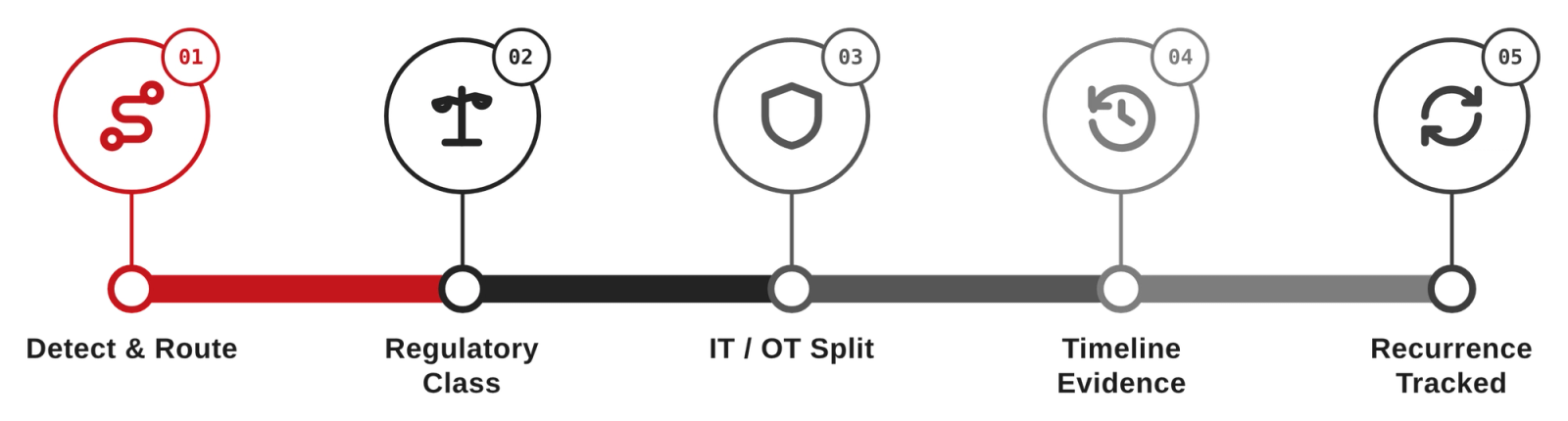
How It All Works Together
The energy engineering team records regulatory classification and operational adjacency per service in the catalog, maintained as scope changes rather than captured once, and the incident tooling carries both attributes automatically at creation alongside severity.
That single configuration change converts reportability from a two day cross-team investigation into an attribute visible on the incident. Handling paths differentiate by adjacency, so an incident on a system near operational technology follows a different route with automated action excluded, enforced in credentials rather than in a runbook note.
Detection creates incidents from correlated signals with severity from defined criteria and classification attached. Obligation windows are tracked per classification, with determination time recorded and the decision and its basis captured in the timeline, so what was known when is evidenced.
And recurrence is classified with action items tracked to completion, since a recurring class in a reportable category repeats the assessment and reporting exercise as well as the recovery.
Common Misconception
Severity tells us how serious an incident is, so it tells us what we need to do about it.
Severity describes operational and customer impact, which is the right basis for prioritising response and the wrong basis for determining obligation. A brief outage on a system inside a regulatory control boundary can be reportable while a longer outage on an internal tool is not, and no severity scale expresses that because the two attributes measure different things.
Conflating them means the reporting question is asked after the incident, answered by reading control documentation across several teams, and answered slowly. Carrying regulatory classification as its own attribute on every service costs a mapping exercise once and answers the question thereafter from configuration.
Key Takeaway: Severity measures impact and classification measures obligation. Neither substitutes for the other.
Real-World AI Incident Management for Energy in Action
Let's take a look at how it operates with a real-world example.
We worked with an energy engineering team whose reportability determination took two days and three teams, with these constraints:
- Carry regulatory classification per service alongside severity
- Differentiate handling by operational adjacency
- Track recurrence so reporting does not repeat
Step 1: Classify the Services
Beyond severity.
- Regulatory scope recorded per service
- Operational adjacency recorded
- Classification maintained as scope changes
Step 2: Attach Classification at Creation
Automatically.
- Incidents carry classification
- Severity assigned separately
- Reportability visible on the incident
Step 3: Differentiate Handling
By adjacency.
- Paths differentiated for operationally adjacent systems
- Automated action excluded near OT
- Enforcement in credentials
Step 4: Track Obligations
Per classification.
- Windows tracked
- Determination time recorded
- Decisions and basis captured
Step 5: Classify Recurrence
And track actions.
- Failure classes identified
- Action items tracked to completion
- Repeat classes escalated
Where It Works Well
- Estates where regulatory scope can be mapped per service
- Incidents where reportability is not inferable from severity
- Programmes measuring recurrence alongside resolution time
Where It Does Not Work Well
- Tooling configured on severity alone
- Handling identical across IT and operationally adjacent systems
- Postmortems filed without action item tracking
Key Takeaway: Carry classification per service, differentiate by adjacency, track obligations, and classify recurrence.
Common Pitfalls
i) Severity as the only classification
Reportability is independent of impact, so severity cannot answer it. Record regulatory scope per service and carry it into every incident.
- Determination takes days and several teams
- Obligation windows are consumed by the investigation
- The answer arrives after it was needed
ii) Uniform handling across the boundary
Incidents on operationally adjacent systems need different paths with automated action excluded. Record adjacency and differentiate.
iii) Classification captured once
Regulatory scope changes as systems and rules change, and a stale classification is worse than none because it is trusted. Maintain it.
iv) Unclassified recurrence
A recurring reportable class repeats assessment and reporting. Classify and escalate at a threshold.
Takeaway from these lessons: Reportability is a configuration question, and configuring it costs a mapping exercise once rather than an investigation each time.
AI Incident Management Best Practices for Energy: What High-Performing Teams Do Differently
1. Record regulatory classification per service
Map it once, maintain it, and carry it into every incident so reportability is an attribute rather than an investigation.
2. Record operational adjacency and differentiate handling
Let the tooling know which systems sit near operational technology and exclude automated action there structurally.
3. Track obligation windows per classification
Run clocks from recorded determination times with alerting as deadlines approach.
4. Capture decisions in the timeline
Record what was determined, when, on what basis, and by whom, since that is what a review examines.
5. Classify recurrence and escalate
A recurring reportable class costs the reporting exercise repeatedly, which strengthens the case for remediation.
Logiciel's value add is helping energy engineering teams carry regulatory classification and operational adjacency into incident handling, so reportability is determined from configuration rather than investigation.
Takeaway for High-Performing Teams: Classify services, attach at creation, differentiate by adjacency, track obligations, classify recurrence.
Signals You Are Doing AI Incident Management Well in Energy
How do you know it is working? Not by resolution time, but by how quickly reportability is known. These are the signals that separate configured obligation from investigated obligation.
Classification is attached. Every incident carries regulatory scope alongside severity.
Reportability is fast. The question is answered in minutes from configuration.
Adjacency is differentiated. Operationally adjacent systems follow distinct paths.
Decisions are captured. Determination time, basis, and author are recorded.
Recurrence is classified. Repeated reportable classes are visible as patterns.
Adjacent Capabilities and Connected Work
This work does not exist in isolation. Incident management depends on, and feeds into, the surrounding platform. Ignoring the adjacencies is the most common scoping mistake.
The service catalog supplies classification and adjacency. AIOps supplies correlated signals with asset and IT signals separated. Runbook automation supplies proven remediations with obligations encoded. Master data management supplies asset identity. Naming these adjacencies upfront keeps the work scoped and helps leadership see classification as configuration work.
The common mistake is treating each adjacency as someone else's problem. The classification mapping is your problem. The adjacency recording is your problem. The obligation tracking is your problem. Pretend otherwise and a reporting window will be consumed by a determination exercise.
Own the adjacencies you depend on, partner with the teams that hold them, and share the classification.
Conclusion
In an energy estate an incident carries two independent attributes, and most tooling only records one. Severity describes impact and drives prioritisation. Regulatory classification describes whether the incident is reportable and to whom, and it cannot be inferred from severity, because a brief outage inside a control boundary can be reportable while a longer one outside it is not.
Configuring severity alone means the reporting question gets answered afterwards by reading control documentation across several teams, which takes days that an obligation window does not have. Map regulatory scope and operational adjacency per service, carry both into every incident automatically, and classify recurrence so the reporting exercise does not repeat.
Key Takeaways:
- Severity measures impact; regulatory classification measures obligation
- Reportability determined by investigation consumes the window it needs to meet
- A recurring reportable class repeats the reporting exercise, not just the recovery
Running incident management well requires classification as configuration. When done correctly, it produces:
- Reportability determined in minutes from configuration
- Handling differentiated for operationally adjacent systems
Why Great CTOs Don't Just Build, They Evaluate
Learn how disciplined evaluation separates credible AI systems from hype.
- Timelines that evidence what was determined and when
- Recurring classes addressed rather than repeatedly reported
What Logiciel Does Here
If determining whether an incident is reportable takes two days and three teams, we help you carry regulatory classification per service and answer it from configuration.
Learn More Here:
- AIOps for Energy
- Runbook Automation for Energy
- Master Data Management for Energy
At Logiciel Solutions, we work with energy engineering leaders on incident practice. Our reference patterns come from estates spanning IT and operationally adjacent systems.
Book a technical deep-dive on making reportability a configuration lookup.