
A SaaS platform team automates incident management end to end. Detection, grouping, routing, timeline capture, and postmortem drafting all work, and mean time to resolution improves by a third. Six months later someone notices that the same class of failure has recurred eleven times, each incident resolved efficiently, each postmortem drafted and filed, and no action item from any of them completed.
The process got faster at handling incidents and stopped producing the thing incidents are for, which is fewer incidents.
Faster resolution with no learning is a treadmill running at higher speed.
AI incident management for SaaS means automating detection, routing, capture, and drafting so response is fast and consistent across many teams, while protecting the learning loop that turns incidents into fewer future incidents.
An Incident Response Runbook for the $336K-an-Hour Downtime Problem
Build a practical incident response plan to reduce costly downtime.
However, most programmes optimise mean time to resolution, which improves visibly while the recurrence rate that actually matters goes unmeasured.
If you are a VP of Engineering or Head of Infrastructure at a SaaS company, the intent of this article is:
- Define why recurrence rate matters more than resolution time
- Show how automation can accelerate response and weaken learning
- Lay out what a working learning loop requires
To do that, let's start with the basics.
What Is AI Incident Management for SaaS? The Basic Definition
At a high level, AI incident management means using automation across the incident lifecycle: detecting and grouping signals, routing to owners, assembling context, capturing a timeline, drafting communications, and producing a postmortem.
In a multi-team estate this is genuinely valuable because consistency across thirty teams is otherwise impossible. The part that automation does not supply is learning. A drafted postmortem is a document. The reduction in future incidents comes from action items being completed and recurrence being tracked, and neither of those is a drafting problem.
To compare:
Automated incident management is an excellent hospital admissions process: fast triage, correct ward, complete notes. If nobody reads the notes to notice that the same patient has been admitted eleven times for the same thing, the process is efficient and the outcome is unchanged.
The admissions improvement is real. It is measured on throughput, and throughput was never the point.
Why Does AI Incident Management Matter for SaaS?
Issues that it addresses or resolves:
- Inconsistent incident response across thirty teams
- Timeline and postmortem work competing with recovery
- Recurrence unmeasured while resolution time improves
Resolved Issues by Incident Management Done Well
- Consistent response regardless of which team is affected
- Documentation produced without competing with recovery
- Recurrence tracked so learning is visible
Core Components of AI Incident Management in SaaS
- Detection and grouping across many teams' services
- Ownership routing from a maintained catalog
- Timeline captured during the incident
- Postmortem drafted from artefacts
- Recurrence and action item completion tracked
Modern AI Incident Management Tooling for SaaS
- Alert correlation feeding incident creation
- Ownership resolution and routing
- Automated timeline construction
- Postmortem drafting from incident artefacts
- Recurrence classification and action item tracking
These tools make response consistent. Recurrence classification is the component that keeps faster response from becoming a treadmill.
Other Core Issues They Will Solve
- Handovers that preserve context across shifts
- Communications drafted without pulling a responder away
- Recurring failure classes visible as a pattern
In Summary: AI incident management for SaaS automates response and documentation, and it only improves reliability if recurrence and action item completion are tracked alongside resolution time.
Importance of AI Incident Management for SaaS in 2026
Multi-team estates need consistency that manual process cannot deliver. Four reasons explain why this matters now.
1. Consistency across thirty teams is otherwise impossible.
Each team developing its own incident practice produces variance that makes learning across the org difficult.
2. Documentation competes with recovery.
An engineer writing a timeline during an incident is not resolving it, which is why timelines get reconstructed badly afterwards.
3. Resolution time is the metric everyone reports.
It improves with automation and says nothing about whether incidents are becoming rarer.
4. Recurrence is where reliability actually comes from.
A failure class recurring eleven times is a signal that no resolution time improvement addresses.
Traditional vs. Modern SaaS Incident Practice
- Per-team practice vs. consistent automated process
- Timelines reconstructed vs. captured during the incident
- Resolution time as the metric vs. recurrence tracked alongside
- Postmortems filed vs. action items tracked to completion
In summary: A modern SaaS approach automates response and documentation while measuring recurrence and action completion as the outcomes that matter.
Details About the Core Components of AI Incident Management in SaaS: What Are You Designing?
Let's go through each component.
1. Detection Layer
Creating the incident.
Detection decisions:
- Correlated signals creating incidents
- Severity assigned from defined criteria
- Duplicate incidents merged
2. Routing Layer
Reaching the owner.
Routing decisions:
- Ownership resolved from the catalog
- Escalation paths per severity
- Unowned services flagged
3. Capture Layer
Documentation during.
Capture decisions:
- Timeline built live from actions and signals
- Handover summaries at shift change
- Communications drafted for review
4. Learning Layer
What incidents are for.
Learning decisions:
- Recurrence classified across incidents
- Action items tracked to completion
- Repeat classes escalated
5. Measurement Layer
The right outcomes.
Measurement decisions:
- Recurrence rate reported alongside resolution time
- Action item completion tracked per team
- Trends reviewed with owning teams
Benefits Gained from AI Incident Management in SaaS
- Consistent response across many teams
- Documentation that exists and is accurate
- Recurring failure classes visible and addressed
How It All Works Together
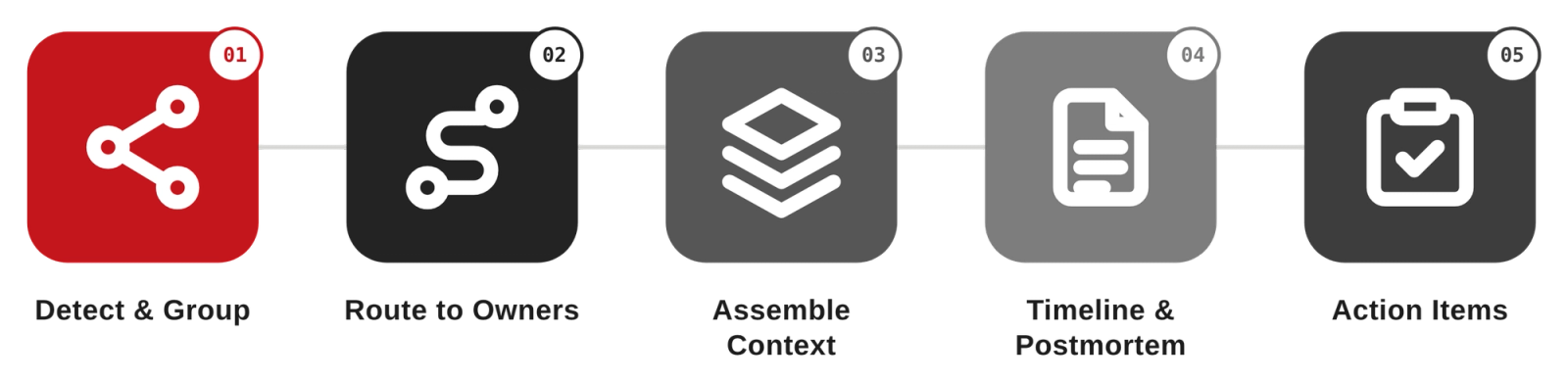
The SaaS platform team automates the response mechanics and instruments the learning loop, because the first improves visibly and the second is what actually reduces incidents. Correlated signals create incidents with severity assigned from defined criteria and duplicates merged, ownership resolves from the catalog with escalation paths per severity, and context assembles automatically so a responder begins from a picture rather than a search.
The timeline builds live from actions and signals rather than being reconstructed a week later when the detail that mattered has gone, handover summaries generate at shift change, and communications draft for review so nobody is pulled from recovery to write an update.
Then the part most programmes omit: incidents are classified for recurrence so a failure class appearing eleven times is visible as one pattern rather than eleven resolved tickets, action items are tracked to completion per team rather than filed with the postmortem, and recurrence rate is reported alongside resolution time so improvement in the second cannot disguise stagnation in the first.
Common Misconception
Mean time to resolution is the measure of incident management quality.
It measures how quickly you recover, which is worth improving and is not what incident management exists to produce. The output that matters is fewer incidents, and that comes from action items being completed and recurring classes being addressed, neither of which appears in a resolution time figure.
An organisation can halve its resolution time while its incident rate stays flat, and every individual incident will have been handled well. Automation makes this failure more likely rather than less, because it removes the friction that used to make repeated incidents feel painful enough to fix.
When each recurrence is resolved efficiently and documented automatically, the pressure to address the cause quietly disappears.
Key Takeaway: Automation removes the friction that made recurring incidents painful enough to fix. Track recurrence or the pressure disappears.
Real-World AI Incident Management for SaaS in Action
Let's take a look at how it operates with a real-world example.
We worked with a SaaS platform team whose resolution time improved a third while one failure class recurred eleven times, with these constraints:
- Classify incidents for recurrence across teams
- Track action items to completion rather than filing them
- Report recurrence rate alongside resolution time
Step 1: Automate Detection and Routing
Consistently.
- Correlated signals creating incidents
- Ownership resolved from the catalog
- Escalation per severity
Step 2: Capture During the Incident
Not afterwards.
- Timeline built live
- Handover summaries at shift change
- Communications drafted for review
Step 3: Classify for Recurrence
Across incidents.
- Failure classes identified
- Repeats counted as a pattern
- Classes escalated at a threshold
Step 4: Track Action Items
To completion.
- Items tracked per team
- Completion reported
- Overdue items escalated
Step 5: Measure the Right Outcomes
Recurrence alongside speed.
- Recurrence rate reported
- Completion tracked
- Trends reviewed with owning teams
Where It Works Well
- Multi-team estates needing consistent response
- Documentation produced during rather than after incidents
- Programmes measuring recurrence alongside resolution time
Where It Does Not Work Well
- Resolution time as the sole reported metric
- Postmortems filed without action item tracking
- Recurrence unclassified so repeats look like separate incidents
Key Takeaway: Automate the mechanics, classify recurrence, and track action items, because faster response alone is a treadmill.
Common Pitfalls
i) Measuring resolution time alone
It improves with automation while incident rate stays flat, and every individual incident looks well handled. Report recurrence rate alongside it.
- The same class recurs repeatedly
- Each occurrence is resolved efficiently
- No action item from any of them completed
ii) Filing postmortems without tracking
A drafted postmortem is a document. Track action items to completion per team and escalate overdue ones.
iii) Unclassified recurrence
Eleven occurrences of one failure class look like eleven separate incidents unless something classifies them. Classify and count.
iv) Timelines reconstructed later
Detail that mattered is gone within days. Build the timeline live from actions and signals.
Takeaway from these lessons: Automation improves response and removes the friction that used to force learning, so learning needs instrumenting.
AI Incident Management Best Practices for SaaS: What High-Performing Teams Do Differently
1. Report recurrence rate alongside resolution time
Make the outcome that matters visible next to the one that improves easily.
2. Classify failure classes across incidents
Turn eleven tickets into one pattern, because that is the unit worth fixing.
3. Track action items to completion
Treat a filed postmortem with open items as an unfinished incident rather than a closed one.
4. Capture timelines during the incident
Build from actions and signals live, since reconstruction loses the detail that explains the failure.
5. Escalate repeat classes at a threshold
Give a recurring class a mandatory intervention point rather than relying on someone noticing.
Logiciel's value add is helping SaaS platform teams automate incident response consistently across many teams while instrumenting the learning loop that turns incidents into fewer incidents.
Takeaway for High-Performing Teams: Automate mechanics, classify recurrence, track completion, capture live, escalate repeats.
Signals You Are Doing AI Incident Management Well in SaaS
How do you know it is working? Not by resolution time, but by whether incidents are becoming rarer. These are the signals that separate learning from a faster treadmill.
Recurrence is reported. The rate appears alongside resolution time.
Classes are visible. Repeated failures are counted as one pattern.
Action items complete. Overdue items are escalated rather than aged.
Timelines are live. Documentation is captured during the incident.
Incident rate is falling. The outcome that matters is moving.
Adjacent Capabilities and Connected Work
This work does not exist in isolation. Incident management depends on, and feeds into, the surrounding platform. Ignoring the adjacencies is the most common scoping mistake.
AIOps supplies correlated signals creating incidents. The service catalog supplies ownership routing. Runbook automation handles proven remediations. Self-healing infrastructure absorbs known failures while reporting recurrence. Naming these adjacencies upfront keeps the work scoped and helps leadership see recurrence as the outcome.
The common mistake is treating each adjacency as someone else's problem. The recurrence classification is your problem. The action tracking is your problem. The measurement framing is your problem. Pretend otherwise and you will run an excellent process around a failure class that never gets fixed.
Own the adjacencies you depend on, partner with the teams that hold them, and share the metrics.
Conclusion
Automating incident management across thirty teams delivers consistency that manual practice cannot, and it improves resolution time visibly, which is why most programmes stop there. The output incidents exist to produce is fewer incidents, and that comes from completed action items and addressed recurring classes rather than from faster recovery.
Automation makes this failure more likely, because efficient resolution and automatic documentation remove the friction that used to make a repeated incident annoying enough to fix. Classify failure classes across incidents, count repeats as one pattern, track action items to completion per team, escalate recurring classes at a threshold, and report recurrence rate next to resolution time.
Key Takeaways:
- Resolution time improves with automation while incident rate can stay flat
- Automation removes the friction that used to force teams to fix recurring causes
- Recurrence classification and action item completion are the learning loop
Running incident management well requires instrumenting learning. When done correctly, it produces:
- Consistent response across many teams
- Documentation that exists and is accurate
The Governance Operating Model That Cuts Compliance Incidents
Apply federated governance and automated enforcement to reduce compliance incidents.
- Recurring failure classes visible and addressed
- An incident rate that actually falls
What Logiciel Does Here
If your resolution time improved while the same failures keep recurring, we help you classify recurrence, track action items to completion, and measure the outcome that matters.
Learn More Here:
- AI-Assisted SRE for Technology & SaaS
- Self-Healing Infrastructure for Technology & SaaS
- AIOps for Technology & SaaS
At Logiciel Solutions, we work with SaaS engineering leaders on incident practice. Our reference patterns come from estates serving many product teams.
Book a technical deep-dive on making faster response produce fewer incidents.