
An energy company's platform team debates adding an AI assistant to their internal developer platform, treating it as a bold experiment that will need a steering committee. Meanwhile their peers already shipped one, and their own engineers, the ones building grid analytics, outage management, and field service tooling, already expect to ask the platform questions and get answers in plain language.
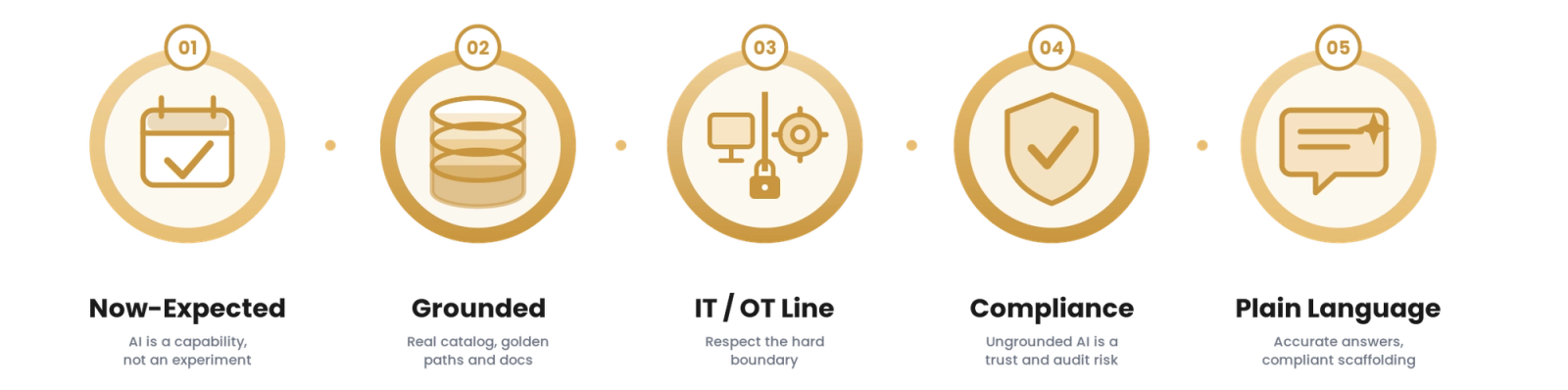
AI on the platform has quietly become expected. The interesting question in a regulated energy org is not whether to add AI, but how to ground it in your real services, standards, and the hard line between IT and OT, so it helps engineers instead of confidently guessing about infrastructure it cannot see.
This is more than an AI experiment. It is a now-expected capability, grounded or not.
AI meeting platform engineering for energy means embedding AI assistants into the developer platform, grounded in the org's real service catalog, golden paths, docs, and regulatory standards, so engineers get accurate natural-language help and compliant scaffolding, rather than a generic model guessing about systems that sit next to critical infrastructure.
However, many energy teams bolt on a generic assistant with no grounding, and discover that an AI confidently wrong about a regulated environment is worse than no assistant at all.
Where AI Should (and Should Never) Act Alone in Your Delivery Pipeline
Define where AI can act freely, require gates, or stop.
If you are a VP of Platform Engineering or Head of Developer Experience at an energy company, the intent of this article is:
- Define AI assistants as a platform capability for energy engineering
- Show why ungrounded assistants are a compliance and trust problem here
- Lay out how to ground AI in your real systems and standards
To do that, let's start with the basics.
What Is AI in Platform Engineering for Energy? The Basic Definition
At a high level, AI in platform engineering for an energy org means embedding AI assistants into the developer platform so engineers get help in natural language, grounded in the org's real systems: asking about services, ownership, and dependencies, generating compliant scaffolding on golden paths, and surfacing the right runbook or standard.
The value comes from grounding. The assistant answers from your catalog, your golden paths, and your NERC CIP and data-classification rules, not from a generic model's training data. In an energy org, where a wrong answer can point someone toward a system that touches operational technology, grounding is the entire product.
To compare:
An ungrounded assistant in an energy org is a confident contractor on day one answering questions about your grid systems, fluent and frequently wrong, with no idea which side of the IT/OT boundary anything sits on.
A grounded assistant has read your catalog, your golden paths, and your control standards before answering. Both sound equally confident. Only one is safe to act on. The grounding, not the model, is what makes an AI assistant a platform capability rather than a liability in a regulated environment.
Why Is Grounded AI Necessary for Energy?
Issues that it addresses or resolves:
- A generic assistant guessing about systems adjacent to critical infrastructure
- Confident wrong answers that engineers act on in a regulated environment
- AI bolted on without access to real catalogs, standards, or ownership data
Resolved Issues by Grounded AI
- Answers grounded in the org's real systems and control standards
- Scaffolding generated compliant with golden paths and audit requirements
- Trust preserved because answers can be traced back to a source
Core Components of AI in Platform Engineering for Energy
- Assistants grounded in the service catalog and docs
- Natural-language help on services, ownership, and dependencies
- Scaffolding generation on golden paths with controls baked in
- Standards and runbooks surfaced in context
- Guardrails on what the AI can see and do near OT
Modern Platform AI Tools for Energy
- Retrieval grounding on catalog, golden paths, and control standards
- AI in the developer portal alongside the service catalog
- Scaffolding generation from approved templates
- Guardrails, permissions, and IT/OT scoping on AI actions
- Feedback loops that catch wrong answers before they spread
These tools make platform AI reliable in a regulated setting. Grounding assistants in real systems and guarding their reach is what turns AI from a liability into a capability an energy engineering org can defend to an auditor.
Other Core Issues They Will Solve
- Engineers get accurate, in-context help instead of stale wiki search
- Scaffolding stays compliant because AI generates from golden paths
- Trust holds because answers come from real, citable data
In Summary: AI in platform engineering for energy embeds assistants grounded in the org's real systems, so engineers get accurate natural-language help, compliant scaffolding, and guided golden paths, rather than a generic model confidently guessing about infrastructure it cannot see.
Importance of AI in Platform Engineering for Energy in 2026
AI assistants are now expected on developer platforms, including in slower-moving, heavily regulated sectors. Four reasons explain why doing it well matters now.
1. It is table stakes.
Most platform teams have shipped an assistant, and your engineers use one somewhere already, sanctioned or not. The question is how well, not whether.
2. Ungrounded AI is a regulatory problem, not just an accuracy problem.
An assistant confidently wrong about which systems fall under a control scope creates audit exposure. Grounding keeps it defensible.
3. Grounding is the differentiator.
A generic model is a commodity. An assistant grounded in your catalog, golden paths, and control standards is the thing that actually helps your engineers.
4. Actions near OT need hard limits.
An assistant that can act on infrastructure needs scoping, so a wrong action stays in a sandbox and nowhere near operational systems.
Traditional vs. Modern Energy Platform Help
- Search a stale wiki vs. ask a grounded assistant
- Generic model guessing vs. answers from your real systems
- Manual scaffolding vs. AI-generated compliant scaffolding
- No AI or ungrounded AI vs. grounded, guarded, scoped assistants
In summary: A modern energy approach embeds AI grounded in real systems with hard guardrails, so it helps engineers reliably, rather than bolting on a generic model that guesses near critical infrastructure.
Details About the Core Components of AI in Platform Engineering for Energy: What Are You Designing?
Let's go through each component.
1. Grounding Layer
Real data, real standards.
Grounding decisions:
- Assistant grounded in the catalog, docs, and control standards
- Answers from real systems, with a citable source
- Golden paths and classification rules included
2. Help Layer
Natural language.
Help decisions:
- Questions on services, ownership, and dependencies answered
- Help delivered in plain language, not link dumps
- Context surfaced for the engineer's actual environment
3. Generation Layer
Scaffolding.
Generation decisions:
- Scaffolding generated from approved templates
- Golden paths followed by default
- Controls and logging present at creation
4. Guardrail Layer
What AI can see and do.
Guardrail decisions:
- Permissions scoped to IT systems, never OT
- Blast radius limited and reversible
- Dangerous or regulated actions gated behind a human
5. Feedback Layer
Catching errors.
Feedback decisions:
- Wrong answers reported and triaged, not shrugged at
- The grounding corpus improved from real failures
- Accuracy monitored and reported like any other platform SLO
Benefits Gained from Grounded Platform AI for Energy
- Engineers get accurate, in-context help without hunting through wikis
- Scaffolding stays compliant because AI uses golden paths
- Trust holds because every answer traces to a real source
How It All Works Together
The energy platform team layers AI onto the platform with grounding as the foundation. The assistant is grounded in the service catalog, golden paths, runbooks, and control standards, so it answers questions about services, ownership, and how to do things from your real systems rather than a generic model's training data.
Engineers get help in natural language with context surfaced, not just a list of links to documents that were last accurate two reorganizations ago. When a team asks for a new service, the assistant generates scaffolding from approved templates, so what it produces already carries the logging, tagging, and access controls an auditor will look for.
Actions the assistant can take are scoped hard: it operates on IT systems inside a defined boundary, it never reaches operational technology, and genuinely consequential steps are gated behind a human confirmation.
Feedback loops catch wrong answers and improve the grounding corpus, with accuracy monitored the way you would monitor any other platform service. Because the assistant is grounded and scoped, it helps engineers reliably and survives an audit conversation, unlike an ungrounded model that is confidently wrong about systems sitting next to critical infrastructure.
Common Misconception
Adding AI to the energy platform is just plugging in a good language model.
The model is the easy part and the least differentiating, and in a regulated energy org an ungrounded model is a liability rather than a shortcut. A powerful model with no grounding in your systems will answer questions about your infrastructure by guessing, fluently and often wrong, and in an environment where classification and control scope actually matter, a confident wrong answer creates real exposure.
What makes platform AI valuable is the grounding in your catalog, golden paths, and standards, plus the guardrails on what it can reach. Energy teams that plug in a model and skip the grounding ship something that sounds authoritative and cannot be defended. The model is a commodity. The grounding is the product.
Key Takeaway: The model is not the hard part; the grounding is. An assistant grounded in your real systems helps engineers, while an ungrounded one confidently misleads them in an environment that punishes wrong answers.
Real-World Platform AI for Energy in Action
Let's take a look at how it operates with a real-world example.
We worked with an energy platform team whose bolted-on assistant was confidently wrong about their systems, with these constraints:
- Ground the assistant in real systems and control standards, not guesses
- Generate compliant scaffolding on golden paths
- Keep the assistant strictly on the IT side of the OT boundary
Step 1: Ground in Real Data
Catalog and standards.
- Grounded in catalog, docs, and control standards
- Answers traceable to a real source
- Golden paths and classification included
Step 2: Answer in Natural Language
In context.
- Questions on services and ownership answered directly
- Help in plain language
- Context surfaced for the engineer's environment
Step 3: Generate Compliant Scaffolding
Golden paths.
- Scaffolding from approved templates
- Golden paths followed by default
- Logging and access controls present at creation
Step 4: Guard Actions
Blast radius.
- Permissions scoped to IT systems only
- Blast radius limited and reversible
- Regulated actions gated behind a human
Step 5: Close the Feedback Loop
Catch errors.
- Wrong answers reported and triaged
- The grounding corpus improved
- Accuracy monitored as a platform SLO
Where It Works Well
- Energy orgs with a maintained catalog and golden paths to ground on
- Teams that scope AI actions hard and monitor accuracy
- Engineering groups that want plain-language help across a sprawling estate
Where It Does Not Work Well
- As an ungrounded generic model guessing about regulated systems
- When AI actions have no scoping near operational technology
- If wrong answers are never caught, reported, or corrected
Key Takeaway: Energy platform AI helps when grounded in real systems and scoped tightly. It becomes exposure when it is a generic model guessing without limits.
Common Pitfalls
i) Bolting on an ungrounded assistant
A generic model guesses about your systems and misleads engineers in an environment where wrong answers carry regulatory weight. Ground it in your catalog, golden paths, and standards.
- Answers are confidently wrong
- Engineers act on them and get burned
- The assistant becomes a liability nobody wants to own
ii) No scoping near the OT boundary
An assistant with broad infrastructure permissions in an energy org is a risk you cannot explain to a regulator. Scope it to IT, define the boundary explicitly, and enforce it in permissions rather than in documentation.
iii) Improvised scaffolding
AI-generated code that ignores golden paths drifts away from your controls immediately. Generate from approved templates so compliance is present at creation, not retrofitted during an audit.
iv) No feedback loop
Wrong answers that are never caught keep misleading engineers and quietly compound. Monitor accuracy, make reporting a wrong answer trivial, and close the loop.
Takeaway from these lessons: Energy platform AI works when grounded, scoped, template-based, and monitored, not when a generic model is bolted on without limits.
Platform AI Best Practices for Energy: What High-Performing Teams Do Differently
1. Ground the assistant in real systems
Retrieve from your catalog, golden paths, and control standards, because grounding, not the model, is what makes answers reliable and citable.
2. Generate scaffolding from approved templates
Have the AI produce compliant scaffolding on golden paths, so what it generates already carries the controls an auditor expects.
3. Scope what the AI can reach
Limit permissions to IT systems, keep the OT boundary enforced in code, and gate consequential actions behind a human.
4. Monitor accuracy and close the loop
Catch wrong answers through feedback and improve the grounding, because a confident wrong answer in a regulated environment costs more than a slow one.
5. Treat AI as a capability, not a novelty
Ship it as a first-class part of the platform, with an owner and an SLO, because it is now expected rather than experimental.
Logiciel's value add is helping energy platform teams ship AI assistants grounded in real systems and scoped away from operational technology, so AI helps engineers reliably rather than becoming a confident source of wrong answers in a regulated estate.
Takeaway for High-Performing Teams: Ship AI grounded in your real systems and scoped on actions, so it helps engineers reliably and stays defensible, not a generic model that guesses.
Signals You Are Doing Platform AI Well in Energy
How do you know it is working? Not by whether you have an assistant, but by whether engineers trust its answers enough to act on them. These are the signals that separate grounded AI from a confident liability.
Answers are accurate. The assistant answers from real systems, with a source you can check.
Engineers trust it. They ask it before they ask a colleague, because it has earned reliability.
Scaffolding is compliant. AI-generated services follow approved templates and carry controls from day one.
Actions are safe. Scoping means a wrong step is contained, reversible, and nowhere near OT.
Errors are caught. Wrong answers are reported easily and the grounding improves.
Adjacent Capabilities and Connected Work
This work does not exist in isolation. Platform AI depends on, and feeds into, the surrounding platform. Ignoring the adjacencies is the most common scoping mistake.
The service catalog and golden paths are what the assistant grounds on. The scaffolding templates are what it generates from. Policy as code guards what it can do, and your data classification defines what it can see.
Naming these adjacencies upfront keeps the work scoped and helps leadership see platform AI as a grounded capability rather than a bolted-on chatbot.
The common mistake is treating each adjacency as someone else's problem. The grounding data is your problem. The guardrails are your problem. The accuracy monitoring is your problem. Pretend otherwise and the assistant becomes a confident liability.
Own the adjacencies you depend on, partner with the teams that hold them, and share the grounding.
Conclusion
AI assistants on the developer platform have crossed from experiment to expected capability, even in energy, so the question is how well, not whether. The value is not the model; it is the grounding.
An assistant grounded in your catalog, golden paths, and control standards, generating compliant scaffolding and scoped hard on its actions, helps engineers reliably and holds up under audit. An ungrounded one is confidently wrong about systems next to critical infrastructure.
Ground the AI in your real systems, scope what it can reach, and it becomes a capability rather than a liability.
Key Takeaways:
- AI assistants are now an expected platform capability in energy, not an experiment
- An ungrounded assistant confidently wrong about regulated systems creates real exposure
- Grounding in real systems and hard scoping on actions are what make platform AI work here
Shipping platform AI well requires grounding and guardrails. When done correctly, it produces:
- Engineers getting accurate, in-context help
- Scaffolding that stays compliant because AI uses golden paths
- Trust that holds because answers come from real, citable data
- AI treated as a first-class capability, not a novelty
How a Platform Team Shipped an Internal Developer Platform in 120 Days
Learn how to launch an internal developer platform in 120 days.
What Logiciel Does Here
If your energy platform assistant is confidently wrong about your systems, we help you ship grounded, scoped AI: answers from your real catalog and golden paths, compliant scaffolding, and actions that stay on the right side of the OT boundary.
Learn More Here:
- Grounding AI in the Service Catalog and Golden Paths
- Scaffolding Generation on Golden Paths
- Policy as Code Guarding AI Actions
At Logiciel Solutions, we work with energy platform leaders on AI assistants for the developer platform. Our reference patterns come from production grounded-AI deployments in regulated environments.
Book a technical deep-dive on shipping an energy platform assistant your engineers actually trust.