
A fintech deploys AIOps and alert volume drops by half within a quarter, which everyone is pleased about. Then a payment authorisation service starts degrading slowly, its alerts get grouped with an unrelated infrastructure cluster and suppressed as duplicate noise, and the degradation runs for forty minutes before a customer complaint surfaces it.
The suppression logic did what it was configured to do. What nobody had done was tell the platform that alerts from certain services should never be suppressed regardless of how well they correlate with something else.
Correlation treats all signals as equal. On a transaction path, some signals are not.
AIOps for fintech means using correlation and pattern recognition to reduce alert volume and route signals, with suppression exemptions for transaction-critical services, full audit of what was suppressed, and expectations set on triage rather than autonomy.
The AIOps Use Cases Worth Your Budget (and the Ones That Aren't)
Prioritize AIOps use cases that deliver real operational value.
However, most deployments apply uniform suppression logic across the estate, which is efficient everywhere and unacceptable on the services where a forty minute delay costs money and explanation.
If you are a VP of Engineering or Head of Infrastructure at a fintech company, the intent of this guide is:
- Define what AIOps delivers and what it does not
- Show why transaction-critical services need suppression exemptions
- Lay out what audit of suppression requires
To do that, let's start with the basics.
What Is AIOps for Fintech? The Basic Definition
At a high level, AIOps means applying correlation, clustering, and anomaly detection to operational telemetry so related signals group together, noise is suppressed, and fewer more meaningful items reach a human. In a financial estate the complication is that services are not equally consequential.
An alert from a reporting job and an alert from a payment authorisation path are both alerts to a correlation engine, and treating them identically means the second can be suppressed as noise.
Criticality tiering, with suppression exemptions for the top tier, is what makes the efficiency safe.
To compare:
Uniform suppression across a financial estate is a mailroom that discards anything resembling a duplicate. Efficient, correct almost always, and occasionally it discards a legal notice because three similar envelopes arrived together.
The fix is not less efficiency generally. It is a rule that certain senders are never treated as duplicates regardless of how much they look like one.
Why Does AIOps Matter for Fintech?
Issues that it addresses or resolves:
- Alert volume exceeding triage capacity
- Related signals arriving as separate items during an incident
- Uniform suppression applied to transaction-critical services
Resolved Issues by AIOps Done Well
- Alert volume reduced through correlation
- Transaction-critical services exempt from suppression
- Every suppression auditable after the fact
Core Components of AIOps in Fintech
- Correlation and grouping across telemetry sources
- Service criticality tiering with suppression exemptions
- Full audit of suppression decisions
- Ownership routing from a service catalog
- Expectations set on triage, not autonomy
Modern AIOps Tooling for Fintech
- Event correlation across infrastructure and application sources
- Criticality-aware suppression rules
- Suppression audit logs retained to policy
- Ownership routing with escalation paths
- Anomaly detection tuned per service tier
These tools make noise reduction safe. Criticality-aware suppression is the component that separates efficient triage from a suppressed payment alert.
Other Core Issues They Will Solve
- Triage starting from grouped context
- On-call load reduced without hiding critical signals
- Suppression explainable during a post-incident review
In Summary: AIOps for fintech delivers correlation and routing, and it works safely when service criticality drives suppression rules and every suppression is auditable.
Importance of AIOps for Fintech in 2026
Financial platforms generate high signal volume with uneven consequence. Four reasons explain why this matters now.
1. Volume has outgrown triage.
A large estate produces more alerts daily than a rota can meaningfully review, which is what makes correlation valuable.
2. Services are not equally consequential.
A suppressed reporting alert costs nothing and a suppressed authorisation alert costs money and an explanation.
3. Suppression needs explaining afterwards.
A post-incident review will ask why an alert did not page someone, and the answer has to be retrievable.
4. Expectations were set on autonomy.
The category was sold on self-healing operations and delivers triage, which makes success look like shortfall.
Traditional vs. Modern Fintech Operational Signal Handling
- Every alert to a human vs. correlated groups to a human
- Uniform suppression vs. criticality-aware exemptions
- Suppression unlogged vs. fully auditable
- Autonomy expected vs. triage expected
In summary: A modern fintech approach uses correlation broadly and exempts transaction-critical services from suppression entirely.
Details About the Core Components of AIOps in Fintech: What Are You Designing?
Let's go through each component.
1. Correlation Layer
Grouping related signals.
Correlation decisions:
- Sources included deliberately
- Grouping rules readable and challengeable
- Coincidental correlation guarded against
2. Criticality Layer
Not all services are equal.
Criticality decisions:
- Service tiers defined explicitly
- Transaction paths in the top tier
- Tier assignment reviewed
3. Suppression Layer
Where efficiency stops.
Suppression decisions:
- Top tier exempt from suppression
- Suppression rules per tier
- Exemptions enforced rather than advisory
4. Audit Layer
Explaining afterwards.
Audit decisions:
- Every suppression logged with reason
- Logs retained to policy
- Retrievable during review
5. Routing Layer
Reaching the right team.
Routing decisions:
- Ownership resolved from the catalog
- Escalation paths defined per tier
- Routing accuracy monitored
Benefits Gained from AIOps in Fintech
- Alert volume reduced across the estate
- Transaction path signals never suppressed
- Suppression explainable in a post-incident review
How It All Works Together
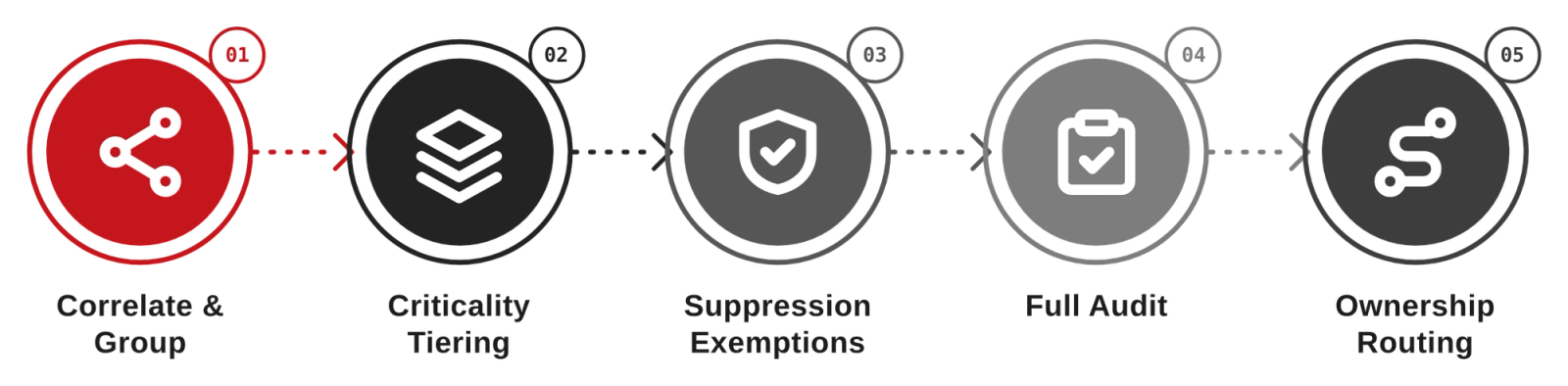
The fintech engineering team defines service criticality tiers before configuring any suppression, because suppression logic without criticality is uniform by default and uniform is wrong here. Transaction paths, authorisation, settlement, and anything customer-facing sit in a top tier exempt from suppression entirely, so an alert from those services always reaches a human regardless of how well it correlates with an unrelated cluster.
That exemption is enforced in configuration rather than described as a guideline. Correlation and grouping run broadly across everything else, with grouping rules that engineers can read and challenge rather than an opaque model, which matters because a correlation nobody can inspect is a correlation nobody can dispute.
Every suppression decision is logged with its reason and retained, because a post-incident review will ask why an alert did not page someone and the answer needs to be a lookup. Ownership routes from the service catalog with escalation paths defined per tier.
And the expectation is set on triage load reduction rather than autonomous remediation.
Common Misconception
Suppression is safe because correlation is accurate.
Correlation accuracy is a statement about the average case, and suppression risk is entirely about the tail. A grouping engine that is right ninety-eight percent of the time is excellent and will still suppress a genuine signal roughly one time in fifty, and the question that matters is what that signal was.
On a reporting job it is nothing. On a payment authorisation path it is forty minutes of degradation surfaced by a customer rather than by a page. Accuracy does not address this because the failure is not frequency, it is consequence, and the only structural fix is exempting the services where consequence is high from suppression altogether, accepting the extra alert volume as the price.
Key Takeaway: Suppression risk is about consequence, not accuracy. Exempt the services where a missed signal costs money.
Real-World AIOps for Fintech in Action
Let's take a look at how it operates with a real-world example.
We worked with a fintech whose suppression logic had grouped and silenced a payment authorisation degradation, with these constraints:
- Define criticality tiers before configuring suppression
- Exempt transaction paths from suppression entirely
- Log every suppression with a retrievable reason
Step 1: Define the Tiers
Before suppression.
- Service tiers assigned explicitly
- Transaction paths in the top tier
- Assignments reviewed
Step 2: Exempt the Top Tier
Enforced, not advisory.
- Top tier never suppressed
- Exemption in configuration
- Extra volume accepted as the price
Step 3: Correlate Broadly Elsewhere
With readable rules.
- Grouping rules inspectable
- Coincidental correlation guarded
- Sources included deliberately
Step 4: Log Every Suppression
With reason.
- Suppression logged and retained
- Reason recorded
- Retrievable during review
Step 5: Route and Escalate
Per tier.
- Ownership from the catalog
- Escalation defined per tier
- Routing accuracy monitored
Where It Works Well
- Estates with alert volume beyond triage capacity
- Programmes that tier criticality before configuring suppression
- Teams accepting higher volume on critical paths
Where It Does Not Work Well
- Uniform suppression across services of differing consequence
- Suppression with no retrievable reason
- Business cases built on autonomous remediation
Key Takeaway: Tier criticality first, exempt the transaction paths, correlate broadly elsewhere, and log every suppression.
Common Pitfalls
i) Uniform suppression
Applying one suppression policy across services of wildly different consequence means a payment alert can be silenced as a duplicate. Tier criticality and exempt the top tier.
- A degradation runs for forty minutes
- A customer surfaces it rather than a page
- The suppression was configured correctly
ii) Unlogged suppression
A post-incident review asking why an alert did not page someone needs an answer. Log every suppression with its reason and retain it.
iii) Opaque grouping rules
A correlation nobody can inspect is one nobody can dispute, so wrong groupings persist. Keep rules readable and challengeable.
iv) Autonomy in the business case
The category delivers triage, so a case built on self-healing makes a good outcome look like a shortfall. Fund it on load reduction.
Takeaway from these lessons: Correlation is safe broadly and unsafe on the paths where a missed signal costs money.
AIOps Best Practices for Fintech: What High-Performing Teams Do Differently
1. Tier criticality before configuring suppression
Decide which services can never be suppressed before you tune anything, because uniform is the default and uniform is wrong here.
2. Exempt transaction paths entirely
Accept the extra alert volume on those services as the price of never missing a degradation.
3. Log every suppression with a reason
Make the post-incident question a lookup rather than an investigation.
4. Keep grouping rules inspectable
Let engineers read and challenge correlations, since an opaque wrong grouping persists indefinitely.
5. Fund it on triage load reduction
State the outcome honestly so success is recognisable rather than measured against autonomy.
Logiciel's value add is helping fintech engineering teams deploy AIOps with criticality-aware suppression, full audit, and expectations that make a good result look like one.
Takeaway for High-Performing Teams: Tier first, exempt the critical, correlate elsewhere, log suppression, fund on triage.
Signals You Are Doing AIOps Well in Fintech
How do you know it is working? Not by suppression rate, but by whether a critical signal has ever been silenced. These are the signals that separate safe correlation from efficient risk.
Tiers exist. Service criticality is assigned and reviewed.
Critical paths are exempt. Top tier services are never suppressed.
Suppression is logged. Every decision has a retrievable reason.
Rules are inspectable. Engineers can read and challenge groupings.
Volume fell. Triage load dropped materially on non-critical services.
Adjacent Capabilities and Connected Work
This work does not exist in isolation. AIOps depends on, and feeds into, the surrounding platform. Ignoring the adjacencies is the most common scoping mistake.
Observability supplies the telemetry being correlated. The service catalog supplies criticality and ownership. Runbook automation acts on grouped signals. Self-healing infrastructure handles proven remediations with audit. Naming these adjacencies upfront keeps the work scoped and helps leadership see criticality tiering as the prerequisite.
The common mistake is treating each adjacency as someone else's problem. The tiering is your problem. The exemptions are your problem. The suppression audit is your problem. Pretend otherwise and a correctly configured platform will silence a payment alert.
Own the adjacencies you depend on, partner with the teams that hold them, and share the tiers.
Conclusion
AIOps reduces alert volume through correlation, which is genuinely valuable in a large financial estate and structurally unsafe if applied uniformly. A grouping engine that is right ninety-eight percent of the time will suppress a real signal occasionally, and whether that matters depends entirely on which service it came from.
Define criticality tiers before configuring any suppression, exempt transaction paths entirely and accept the extra volume, correlate broadly everywhere else with rules engineers can inspect, log every suppression with a retrievable reason, and fund the programme on triage load reduction rather than autonomy so a good outcome reads as one.
Key Takeaways:
- Suppression risk is about consequence rather than accuracy
- Transaction-critical services should be exempt from suppression entirely
- Every suppression needs a logged reason, because a review will ask
Deploying AIOps well requires criticality tiering. When done correctly, it produces:
- Alert volume reduced across the bulk of the estate
- Transaction path signals that always reach a human
See What Elite-Tier SaaS Engineering Teams Actually Look Like in 2026
See what elite SaaS engineering performance looks like across key metrics.
- Suppression explainable during post-incident review
- A business case that success actually satisfies
What Logiciel Does Here
If your suppression logic treats a payment alert like a reporting alert, we help you tier criticality, build exemptions, and make every suppression auditable.
Learn More Here:
- Runbook Automation for Fintech
- Self-Healing Infrastructure for Fintech
- AI Incident Management for Fintech
At Logiciel Solutions, we work with fintech engineering leaders on operational tooling. Our reference patterns come from regulated estates with transaction-critical paths.
Read the guide on making alert correlation safe on payment infrastructure.