
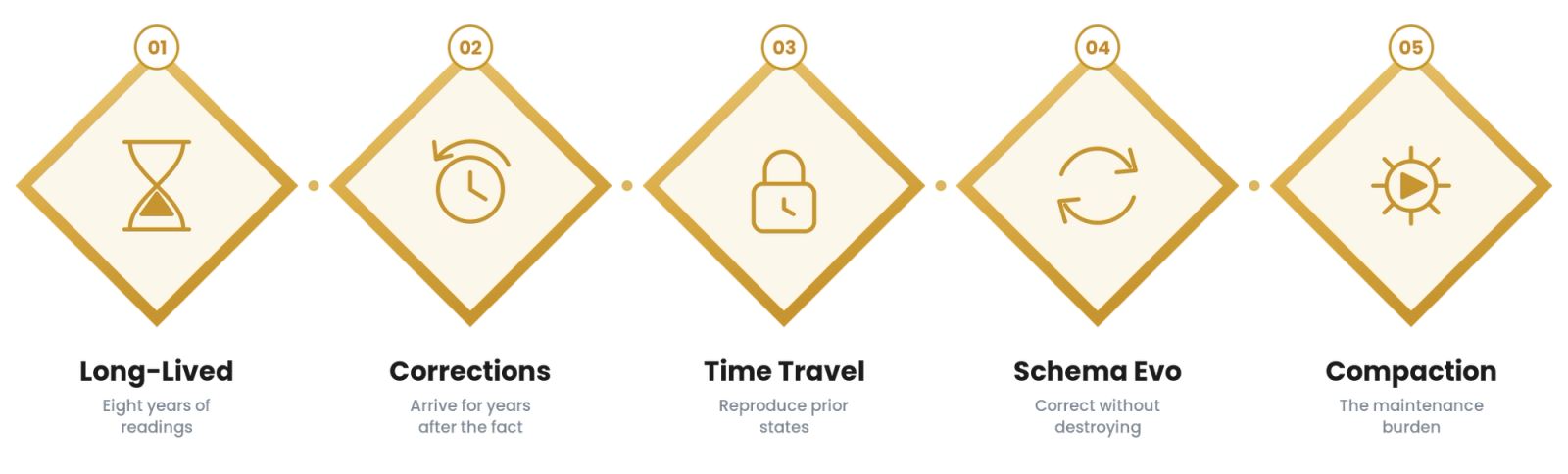
An energy company keeps eight years of meter and sensor readings in a lakehouse, and every month a batch of corrections arrives for intervals up to two years old. Under their existing setup, applying those corrections means rewriting partitions, and reproducing what a dataset said before a correction is not possible because the old version is gone.
When a forecasting model's performance drifts, nobody can compare its training inputs against what the table holds today. The data is well organised and the storage is cheap. What is missing is the ability to correct history without destroying it, and that is the specific property Iceberg exists to provide.
Energy data gets corrected for years. Snapshots and schema evolution are not conveniences here.
Apache Iceberg for energy means adopting an open table format providing schema evolution, snapshot isolation, time travel, and engine independence over object storage, which suits long-lived time-series estates where corrections arrive continuously and historical states must remain reproducible.
Iceberg, Delta Lake, or Hudi: The Open Table Format Endgame
Compare Iceberg, Delta Lake, and Hudi for open lakehouse decisions.
However, most teams adopt it as a format decision and skip the maintenance, so compaction debt from high-frequency writes erodes the benefit within a year.
If you are a CDO or VP of Data at an energy company, the intent of this article is:
- Define what Iceberg provides and why it fits long-lived time-series data
- Show how corrections and reproducibility drive the case here
- Lay out the compaction burden that high-frequency writes create
To do that, let's start with the basics.
What Is Apache Iceberg for Energy? The Basic Definition
At a high level, Iceberg is an open table format sitting over files in object storage, adding properties a directory of Parquet files lacks: atomic commits, snapshot isolation so readers are unaffected by concurrent writes, schema evolution including renames and type changes without rewriting data, partition evolution, time travel to query a table as of a past snapshot, and multi-engine access to the same tables.
In an energy estate two of these carry unusual weight. Time travel matters because corrections to historical intervals are routine and reproducibility is required for model validation and reporting. Partition evolution matters because eight-year-old partitioning choices rarely suit current query patterns.
To compare:
A directory of Parquet files is a filing cabinet where correcting last year's record means replacing the page and losing what it said. Iceberg adds a version history: the correction is applied, and the previous state remains answerable.
For a business that receives corrections to two-year-old readings every month and must occasionally explain what a report was based on, that is not a convenience feature. It is the difference between being able to answer a question and not.
Why Does Iceberg Matter for Energy?
Issues that it addresses or resolves:
- Corrections to historical intervals destroying the previous state
- Partitioning decisions made years ago that no longer suit queries
- Concurrent readers seeing partial writes during correction runs
Resolved Issues by Iceberg
- Corrections applied while previous snapshots remain queryable
- Partition strategy changed without rewriting the whole table
- Snapshot isolation protecting readers during correction batches
Core Components of Iceberg Adoption in Energy
- Time travel retention matched to reproducibility requirements
- Partition evolution used as query patterns change
- Compaction sized for high-frequency time-series writes
- Snapshot expiry balancing reproducibility against storage
- Migration targeting tables where benefit exists
Modern Iceberg Tooling for Energy
- Catalog implementations integrated with your query engines
- Compaction jobs tuned for frequent small writes
- Snapshot expiry policies aligned to retention obligations
- Partition evolution tooling for changing query patterns
- Metadata monitoring for table health at scale
These tools make Iceberg operable on time-series data. Compaction tuned for frequent writes is the maintenance responsibility that decides whether the benefit persists past the first year.
Other Core Issues They Will Solve
- Model validation can reproduce exact training inputs
- Reports can be tied to the data state they were built on
- Query performance survives years of accumulated writes
In Summary: Iceberg for energy provides correction-without-destruction through snapshots, schema and partition evolution, and engine independence, which suits long-lived time-series estates provided compaction is maintained.
Importance of Iceberg for Energy in 2026
Energy data estates are large, long-lived, and continuously corrected. Four reasons explain why this fit matters now.
1. Corrections are routine, not exceptional.
Meter and sensor data receives adjustments for months or years, and destroying the prior state each time removes your ability to explain anything.
2. Model validation needs exact inputs.
Forecasting models are validated against what they trained on, which requires the table state at that time rather than the current one.
3. Partitioning ages badly.
A strategy chosen for an eight-year-old query pattern is rarely right now, and rewriting a large table to change it is prohibitive.
4. Compaction debt accrues fast on time-series.
High-frequency writes generate small files quickly, and unmanaged accumulation degrades performance without an obvious cause.
Traditional vs. Iceberg Lakehouse Tables in Energy
- Corrections overwrite history vs. corrections create new snapshots
- Partitioning fixed at creation vs. partition evolution over time
- Readers affected by write batches vs. snapshot isolation
- Single engine ownership vs. multiple engines on the same tables
In summary: A modern energy approach uses Iceberg for the correction and reproducibility properties, and treats compaction as a first-class ongoing job.
Details About the Core Components of Iceberg Adoption in Energy: What Are You Designing?
Let's go through each component.
1. Snapshot Layer
Correcting without destroying.
Snapshot decisions:
- Retention matched to reproducibility requirements
- Regulatory reporting states identified for preservation
- Expiry policy set deliberately, not defaulted
2. Schema Layer
Change without rewrite.
Schema decisions:
- Column additions and renames handled in metadata
- Type changes assessed for consumer impact
- Evolution policy documented
3. Partition Layer
Query patterns change.
Partition decisions:
- Current strategy assessed against current queries
- Evolution used rather than rewrite
- New partitioning applied going forward
4. Compaction Layer
The maintenance that decides everything.
Compaction decisions:
- Sized for high-frequency time-series writes
- File size targets set and monitored
- Schedule tuned as volume grows
5. Migration Layer
Where benefit exists.
Migration decisions:
- Tables with correction and reproducibility needs first
- Nothing rewritten without reason
- Formats coexisting during transition
Benefits Gained from Iceberg in Energy
- Corrections applied while prior states stay queryable
- Partitioning changed as query patterns evolve
- Readers unaffected by monthly correction batches
How It All Works Together
The energy data team adopts Iceberg on the tables where corrections and reproducibility genuinely matter, which in this estate is most of the time-series data and considerably less of the reference data.
Snapshot retention is set from the actual reproducibility requirement: how far back model validation needs to reach, and which report-generating states must remain answerable, rather than accepting a default that either loses what you need or accumulates without bound.
Corrections then become new snapshots rather than destructive rewrites, so applying an adjustment to a two-year-old interval leaves the previous state queryable and a report can be tied to the data it was built on.
Schema evolution handles the column additions that arrive with new sensor types, in metadata rather than through rewrites. Partition evolution matters more here than most places, because a strategy chosen years ago for different query patterns can be changed going forward without rewriting eight years of history.
And compaction is treated as a first-class ongoing job, tuned for the file counts that high-frequency time-series writes generate, with size targets monitored, because this is the maintenance that quietly determines whether queries stay fast three years in.
Common Misconception
Time travel is a nice extra we probably will not use.
In an estate where corrections arrive continuously, time travel is closer to the primary reason to adopt the format. The question it answers is asked constantly, usually without anyone realising it is a time travel question: why does this report differ from the one we produced in March, what did the model actually train on, was this figure correct at the time we submitted it.
Without snapshots those questions are unanswerable, and the usual response is to accept the current state as authoritative and quietly stop asking. That is a real loss of analytical rigour, and it becomes an evidential problem the moment someone external asks about a submitted figure.
Teams that treat time travel as optional generally have not yet had the conversation that makes them need it.
Key Takeaway: In a continuously corrected estate, time travel answers questions asked weekly. Treating it as optional means those questions stop being asked.
Real-World Iceberg for Energy in Action
Let's take a look at how it operates with a real-world example.
We worked with an energy data team whose monthly corrections destroyed the prior state of eight years of readings, with these constraints:
- Apply corrections without losing what the data previously said
- Change partitioning without rewriting historical data
- Keep query performance stable under high-frequency writes
Step 1: Set Snapshot Retention
From the requirement.
- Reproducibility needs documented
- Report-generating states identified
- Expiry policy set deliberately
Step 2: Make Corrections Non-Destructive
New snapshots, not rewrites.
- Adjustments applied as commits
- Prior states remaining queryable
- Reports tied to data states
Step 3: Evolve the Schema
In metadata.
- New sensor columns added without rewrite
- Type changes assessed for consumers
- Evolution policy documented
Step 4: Evolve the Partitioning
Forward, not retroactively.
- Current strategy assessed against queries
- New partitioning applied going forward
- History left in place
Step 5: Own Compaction
The decisive maintenance.
- Sized for time-series write frequency
- File size targets monitored
- Schedule tuned as volume grows
Where It Works Well
- Long-lived time-series data receiving routine corrections
- Estates needing reproducible historical states for validation or reporting
- Tables whose partitioning strategy has aged badly
Where It Does Not Work Well
- Small static reference data with no correction history
- Teams unwilling to own compaction on high-frequency writes
- Migrations undertaken for format positioning rather than need
Key Takeaway: Iceberg fits energy because corrections and reproducibility are constant here, and compaction discipline is what keeps the fit working.
Common Pitfalls
i) Skipping compaction on time-series tables
High-frequency writes generate small files fast, and accumulation degrades query performance gradually with no obvious cause. Size compaction for your write frequency from day one.
- Queries slow steadily over months
- The cause is invisible in query plans
- Teams add compute instead of fixing files
ii) Defaulting snapshot expiry
Either you lose the historical states you needed or you accumulate storage without bound. Derive the policy from your actual reproducibility and retention requirements.
iii) Treating corrections as rewrites
Applying an adjustment by rewriting a partition destroys the prior state and with it your ability to explain past figures. Let corrections create new snapshots.
iv) Migrating static reference data
Small stable tables with no correction history gain almost nothing. Target the time-series tables where the properties actually apply.
Takeaway from these lessons: Iceberg fits long-lived corrected time-series data, and compaction plus a deliberate snapshot policy are what sustain the benefit.
Iceberg Best Practices for Energy: What High-Performing Teams Do Differently
1. Derive snapshot retention from requirements
Set expiry from how far back validation and reporting genuinely need to reach, rather than accepting a default in either direction.
2. Make corrections additive
Apply adjustments as commits creating new snapshots, so prior states remain answerable and reports can be tied to the data behind them.
3. Size compaction for time-series writes
Tune it for your actual write frequency and monitor file sizes, because this is the maintenance that decides whether performance holds.
4. Use partition evolution rather than rewrites
Change strategy going forward when query patterns shift, and leave historical partitioning in place.
5. Target tables where properties apply
Migrate the corrected time-series data and leave small static reference tables alone, since uniformity is not a benefit.
Logiciel'svalue add is helping energy data teams adopt Iceberg for the correction and reproducibility properties their estate actually needs, with compaction sized for high-frequency time-series writes.
Takeaway for High-Performing Teams: Set retention from requirements, make corrections additive, own compaction, and evolve partitioning forward.
Signals You Are Doing Iceberg Well in Energy
How do you know it is working? Not by how much is migrated, but by whether you can explain a past figure. These are the signals that separate a fitting adoption from a format exercise.
Past states are queryable. You can reproduce what a table said before a correction.
Corrections are additive. Adjustments create snapshots rather than replacing partitions.
Retention is derived. Snapshot expiry comes from a stated requirement.
Compaction runs. File sizes are monitored and query performance is stable over years.
Partitioning evolved. Strategy has changed as query patterns did, without rewrites.
Adjacent Capabilities and Connected Work
This work does not exist in isolation. Table format choice depends on, and feeds into, the surrounding data platform. Ignoring the adjacencies is the most common scoping mistake.
Data products define what consumers expect, including completeness and reproducibility. Data quality SLAs formalise those expectations. Streaming and batch decisions determine write patterns and therefore compaction load. Schema evolution policy governs how much you exercise Iceberg's schema features.
Naming these adjacencies upfront keeps the work scoped and helps leadership see format choice as a workload fit question.
The common mistake is treating each adjacency as someone else's problem. The compaction schedule is your problem. The snapshot policy is your problem. The correction pattern is your problem. Pretend otherwise and either performance degrades or history disappears.
Own the adjacencies you depend on, partner with the teams that hold them, and share the maintenance.
Conclusion
Iceberg fits energy data estates unusually well, and for a specific reason: corrections to historical intervals arrive continuously, and destroying the prior state each time removes your ability to explain past reports or validate models against what they actually trained on.
Snapshots turn corrections into additive events. Partition evolution lets a strategy chosen eight years ago change without rewriting eight years of data. Schema evolution handles new sensor types in metadata. The obligation attached to all of it is compaction, sized for the file counts high-frequency time-series writes generate, because unmanaged accumulation degrades performance slowly enough that teams add compute instead of fixing the cause.
Key Takeaways:
- Time travel is a primary reason to adopt Iceberg in a continuously corrected estate
- Partition evolution matters here because strategies chosen years ago rarely still fit
- Compaction sized for time-series write frequency is what sustains the benefit
Adopting Iceberg well requires maintenance discipline. When done correctly, it produces:
- Corrections applied while prior states remain queryable
- Reports that can be tied to the data state behind them
How an Energy Company Stopped Paying for Silent Data Quality Failures
Detect silent data quality failures faster and reduce operational risk.
- Partitioning that changes as query patterns evolve
- Query performance that holds across years of writes
What Logiciel Does Here
If your monthly corrections destroy the state your reports were built on, we help you adopt Iceberg for the snapshot and evolution properties you need, with compaction sized for your write volume.
Learn More Here:
- Delta Lake vs Iceberg for Energy
- Data Products for Energy
- Streaming vs Batch for Energy
At Logiciel Solutions, we work with energy data leaders on lakehouse architecture. Our reference patterns come from long-lived time-series estates with routine corrections.
Book a technical deep-dive on making corrections additive rather than destructive.