
A fintech company's API gateway was designed around human-driven traffic: a user taps something in an app, one request arrives, someone waits a moment, and rate limits assume a person who eventually gives up.
Then business customers start pointing agents at the payments and data APIs. One agent retries a timed-out payment initiation four times in six seconds because it received no response, and the only thing standing between that and four transfers is whether your idempotency handling is genuinely correct rather than mostly correct.
The gateway did not fail. The assumption that a client would wait, or would stop, failed, and in a financial API that assumption was carrying more weight than anyone realised.
The Architecture Layer That Decides If Your AI Product Survives Production
Build the architecture layers that make AI products production-ready.
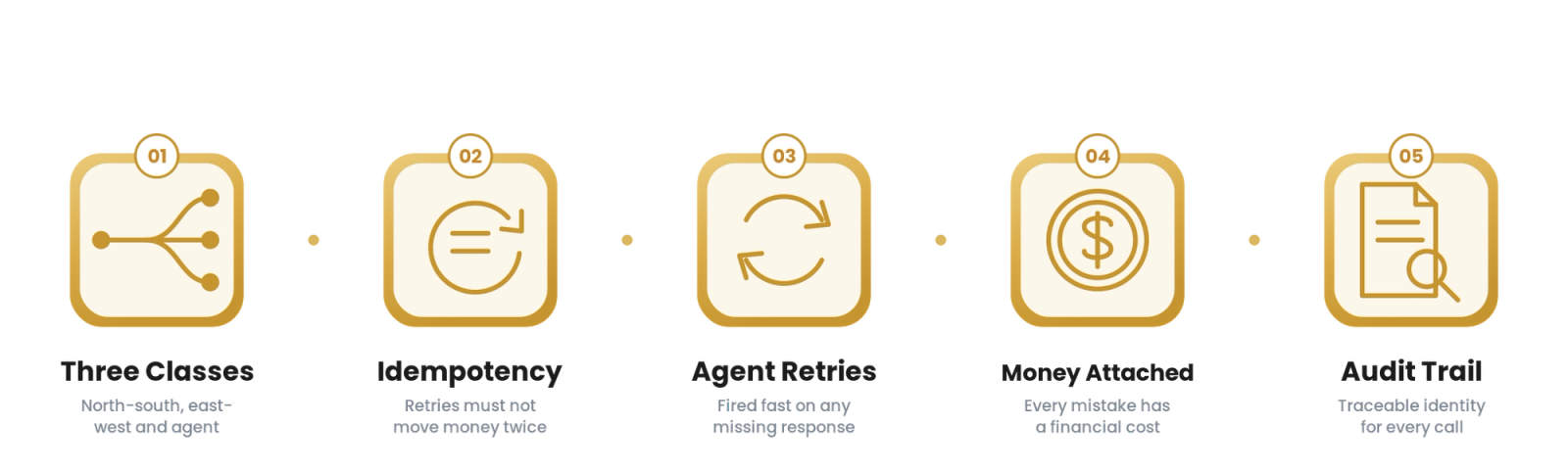
North-south, east-west, and agent traffic are three different problems. In fintech, the agent one has money attached.
API gateway strategy for fintech means separating externally-facing north-south traffic, internal east-west service traffic, and machine-driven agent traffic into distinct paths with their own rate limits, identity, and retry behavior, because machine clients stress idempotency, auditability, and capacity in ways human traffic never did.
However, most teams run one gateway with limits inherited from a human-traffic world, and discover agent retries testing whether their payment APIs are truly idempotent.
If you are a VP of Platform Engineering or Head of Developer Experience at a fintech company, the intent of this article is:
- Define the three traffic classes and why they differ
- Show why agent retries make idempotency a gateway concern
- Lay out how to separate paths without losing the audit trail
To do that, let's start with the basics.
What Is API Gateway Strategy for Fintech? The Basic Definition
At a high level, API gateway strategy in a fintech org is deciding how traffic enters and moves through your system, and what policy applies at each boundary. North-south traffic comes from outside: customers, partner institutions, and their applications.
East-west traffic moves between your own services, where latency budgets are tight and an extra hop is often pure cost. Agent traffic is externally-originated but machine-driven, and it behaves differently from both: bursty, exploratory, retry-heavy, and completely indifferent to the response times humans tolerate.
In a financial API there is a fourth consideration layered across all of them, which is that every request needs to be attributable and every retry needs to be safe.
To compare:
A gateway built for human traffic is a bank branch with one door and staffing based on how fast people walk. Agent traffic is a courier who tries the door four times in ten seconds because nobody answered immediately, then asks every teller the same question to see which answers fastest.
In a shop that is annoying. In a bank it is four attempts at the same transfer, and whether that costs anything depends entirely on how carefully you built the till.
Why Is Deliberate Gateway Strategy Necessary for Fintech?
Issues that it addresses or resolves:
- Rate limits designed for humans throttling legitimate partner automation
- Agent retries stressing idempotency on transaction endpoints
- Requests that cannot be attributed to a specific client for audit
Resolved Issues by Separating Traffic Classes
- Limits shaped to actual client behavior rather than a human model
- Retries made provably safe on every state-changing endpoint
- Every call attributable to a client, tenant, and purpose
Core Components of API Gateway Strategy in Fintech
- Distinct paths for north-south, east-west, and agent traffic
- Rate limiting shaped per class and per tenant
- Identity that names the client type and carries through to audit
- Idempotency enforced on every state-changing operation
- Backoff enforced at the boundary rather than requested
Modern API Gateway Tooling for Fintech
- Gateways supporting per-tenant and per-class rate limiting
- Service mesh handling east-west policy without a gateway hop
- Token issuance distinguishing automation from user sessions
- Idempotency key handling at the edge with durable storage
- Traffic analytics separating machine from human patterns
These tools make gateway strategy work in a regulated environment. Identifying the client, enforcing safe retries, and keeping the audit trail intact are what let agent traffic be supported rather than feared.
Other Core Issues They Will Solve
- Partner automation supported without unbounded consumption
- Duplicate transactions prevented rather than reconciled afterwards
- Capacity planning that reflects the real client mix
In Summary: API gateway strategy for fintech separates north-south, east-west, and agent traffic into paths with their own limits, identity, and retry semantics, because machine clients test assumptions that human traffic never did.
Importance of Gateway Strategy for Fintech in 2026
The client population changed faster than most financial API designs did. Four reasons explain why this matters now.
1. Partner and customer automation is normal.
Business clients are pointing agents at your APIs whether or not you planned for it, and open banking patterns accelerated that.
2. Retries on payment endpoints are a correctness problem.
A human gives up. An agent retries immediately, which turns weak idempotency from a theoretical gap into a duplicate transfer.
3. Attribution is a regulatory requirement.
"An API client did it" is not an answer. You need to know which client, which tenant, and under whose authority.
4. Human-shaped limits fail both ways.
The same threshold either throttles a legitimate partner into uselessness or lets one client consume a tenant's entire budget.
Traditional vs. Modern Fintech Gateway Design
- One gateway for everything vs. separate paths per traffic class
- Idempotency assumed vs. idempotency enforced at the boundary
- Agents indistinguishable from users vs. identity that names the client type
- Retries left to clients vs. backoff enforced and logged
In summary: A modern fintech approach shapes policy to client behavior and makes every retry safe, rather than forcing one human-shaped configuration to serve machine clients moving money.
Details About the Core Components of Gateway Strategy in Fintech: What Are You Designing?
Let's go through each component.
1. North-South Layer
External human-driven traffic.
North-south decisions:
- Limits shaped to interactive use patterns
- Authentication tied to user sessions
- Latency budgets set by human expectation
2. East-West Layer
Internal service traffic.
East-west decisions:
- Gateway hops avoided where a mesh suffices
- Mutual authentication applied without added latency
- Failure handling tuned for tight budgets
3. Agent Layer
Machine-driven external traffic.
Agent decisions:
- Automation identified distinctly at authentication
- Limits shaped to bursty, retry-heavy patterns
- Backoff enforced rather than politely requested
4. Idempotency Layer
Safe retries.
Idempotency decisions:
- Keys required on every state-changing operation
- Duplicate detection durable across restarts
- Replayed requests returning the original result
5. Audit Layer
Attribution.
Audit decisions:
- Client, tenant, and authority recorded per request
- Retries logged as retries, not as new intents
- Records retained to policy and queryable
Benefits Gained from Deliberate Gateway Strategy in Fintech
- Partner automation supported without unbounded consumption
- Duplicate transactions prevented at the edge
- Every request attributable for audit and dispute handling
How It All Works Together
The fintech platform team stops treating the gateway as one policy surface and starts treating it as three, with two properties applied across all of them. External human-driven traffic keeps limits shaped to interactive use.
Internal service traffic moves to a mesh where mutual authentication and policy are applied without a gateway hop, because adding latency to every internal call in a payment path is a poor trade.
Agent traffic gets its own treatment, starting with identity: tokens issued to automation are distinguishable from user sessions, so the gateway knows the client type before deciding what to allow, and that identity flows into every log line.
Agent limits are shaped to bursty exploratory behavior with per-tenant budgets, and backoff is enforced at the boundary rather than suggested in a header that automation ignores. Then the two properties that make this a financial API rather than any other: every state-changing operation requires an idempotency key, with duplicate detection durable enough to survive a restart and a replayed request returning the original result rather than doing the work again.
And every request carries attribution, client, tenant, and authority, into a log that a dispute or an audit can query later. Retries are logged as retries rather than as fresh intents, which matters enormously when reconstructing what a client actually asked for.
Common Misconception
Idempotency is the client's responsibility, since they send the key.
The key is the client's contribution. The guarantee is entirely yours, and treating it as a shared responsibility is how duplicate transfers happen. An agent that receives no response has no way to know whether the request succeeded, so it will retry, and it will retry faster and more often than a human ever would.
If your idempotency handling stores keys in memory, or in a cache with an eviction policy nobody checked, or only covers the happy path and not the timeout path, then the correctness of your payment API depends on client behavior you do not control.
That is not a design; it is a hope. Enforce the key at the boundary, store duplicate detection durably, return the original result on replay, and test the timeout path specifically, because that is the exact scenario an agent retry creates and the exact one most implementations never exercise.
Key Takeaway: The client sends the key; you own the guarantee. Test the timeout path, because that is where agent retries actually land.
Real-World Gateway Strategy for Fintech in Action
Let's take a look at how it operates with a real-world example.
We worked with a fintech platform team whose human-shaped limits were throttling partners while agent retries stressed their payment endpoints, with these constraints:
- Separate traffic classes with distinct policy
- Make every retry provably safe
- Keep full attribution for audit and disputes
Step 1: Separate the Classes
Three problems, not one.
- North-south, east-west, and agent paths defined
- Policy shaped per class
- Internal traffic moved off the gateway hop
Step 2: Identify the Clients
Know who is calling.
- Automation tokens distinguishable from user sessions
- Client type available at policy decision time
- Identity carried into every log line
Step 3: Enforce Idempotency
Safe retries.
- Keys required on state-changing operations
- Duplicate detection durable across restarts
- Replays return the original result
Step 4: Enforce Backoff
Not a suggestion.
- Backoff applied at the boundary
- Retry storms damped automatically
- Retries logged as retries
Step 5: Keep the Audit Trail
Attribution per request.
- Client, tenant, and authority recorded
- Records queryable for disputes
- Retention aligned to policy
Where It Works Well
- APIs with growing partner and customer automation
- Orgs able to distinguish client types at authentication
- Teams with durable idempotency infrastructure in place
Where It Does Not Work Well
- State-changing endpoints without enforced idempotency keys
- Gateways that cannot tell automation from user sessions
- Internal payment paths routed through an external gateway
Key Takeaway: Separate the classes, identify the client, and make every retry safe, because agent traffic will find the endpoint where idempotency was assumed rather than enforced.
Common Pitfalls
i) Idempotency stored in a cache
Duplicate detection in an in-memory cache with an eviction policy nobody reviewed will fail during exactly the conditions that produce retries. Store keys durably and test the restart path.
- Duplicate transactions reach the ledger
- Reconciliation finds them days later
- The cause is invisible because both requests looked valid
ii) One rate limit for all clients
A limit tuned for interactive use either throttles a legitimate partner or lets one client consume a tenant's entire budget. Shape limits per class and per tenant.
iii) Requesting backoff instead of enforcing it
Retry-After headers are advisory and automation frequently ignores them. Enforce backoff at the boundary so a brief degradation cannot be extended by client retries.
iv) Losing attribution on retries
If a retry is logged as a fresh request, reconstructing what a client actually intended becomes guesswork during a dispute. Log retries as retries, linked to the original.
Takeaway from these lessons: Gateway strategy in fintech works when policy matches client behavior and every state-changing path is provably safe to retry.
Gateway Strategy Best Practices for Fintech: What High-Performing Teams Do Differently
1. Separate the three traffic classes
Give north-south, east-west, and agent traffic distinct paths and policy, because they place incompatible demands on the same infrastructure.
2. Own idempotency completely
Require keys, store duplicate detection durably, return the original result on replay, and test the timeout path specifically, since that is where agent retries land.
3. Identify client type at authentication
Issue tokens that distinguish automation from user sessions, because you cannot apply different policy or produce clean attribution for a client you cannot recognise.
4. Enforce backoff at the boundary
Damp retry storms in the gateway rather than trusting clients to honour headers, so degradation cannot amplify itself on a payment path.
5. Keep attribution intact through retries
Log retries as retries linked to the original request, so disputes and audits can reconstruct intent rather than infer it.
Logiciel's value add is helping fintech platform teams separate traffic classes and make agent retries provably safe, so partner automation is supported without duplicate transactions or gaps in the audit trail.
Takeaway for High-Performing Teams: Treat agents as a distinct client class, own idempotency end to end, enforce backoff, and never lose attribution on a retry.
Signals You Are Doing Gateway Strategy Well in Fintech
How do you know it is working? Not by how few incidents you had, but by whether a retry storm on a payment endpoint would be uneventful. These are the signals that separate a deliberate design from an inherited one.
Client types are distinguishable. The gateway knows whether a caller is automation or a user session.
Retries are safe. Every state-changing endpoint enforces idempotency with durable storage.
Backoff is enforced. Retry storms damp automatically rather than amplifying.
Attribution survives. Every request, including retries, is traceable to a client and tenant.
Internal calls skip the gateway. East-west policy is applied without an extra hop on payment paths.
Adjacent Capabilities and Connected Work
This work does not exist in isolation. Gateway strategy depends on, and feeds into, the surrounding platform. Ignoring the adjacencies is the most common scoping mistake.
Your service mesh handles east-west policy the gateway should not. Identity and token issuance determine whether client types are distinguishable. Your audit logging pipeline consumes the attribution the gateway produces. Observability tells you what the traffic mix actually is.
Naming these adjacencies upfront keeps the work scoped and helps leadership see gateway strategy as a correctness and control decision rather than a product selection.
The common mistake is treating each adjacency as someone else's problem. The idempotency guarantee is your problem. The client identity model is your problem. The retry attribution is your problem. Pretend otherwise and a partner's agent will eventually produce a duplicate transfer that takes a week to trace.
Own the adjacencies you depend on, partner with the teams that hold them, and share the guarantees.
Conclusion
The client population changed and most financial API gateways did not. North-south traffic from humans, east-west traffic between your services, and agent traffic from partner automation are three different problems with different limits and different failure behavior.
In fintech, two things sit across all of them: every state-changing operation must be genuinely safe to retry, and every request including retries must be attributable. Identify client type at authentication, shape limits per class and tenant, enforce backoff at the boundary rather than asking for it, store duplicate detection durably, and test the timeout path. Agent retries will find whichever of those you skipped.
Is Your Engineering Velocity Real, or Just a Reporting Illusion?
Discover whether your engineering velocity reflects real output or hidden inefficiency.
Key Takeaways:
- North-south, east-west, and agent traffic need distinct policy and paths
- The client sends the idempotency key; the guarantee is entirely yours
- Attribution must survive retries or disputes become guesswork
Getting gateway strategy right requires shaping policy to behavior. When done correctly, it produces:
- Partner automation supported without unbounded consumption
- Duplicate transactions prevented at the edge rather than reconciled later
- Retry storms damped before they extend an incident
- A complete audit trail across every client and every retry
What Logiciel Does Here
If agent retries are testing whether your payment APIs are really idempotent, we help you separate traffic classes, enforce safe retries at the boundary, and keep attribution intact.
Learn More Here:
- Service Mesh and East-West Policy
- Policy as Code for Fintech
- Self-Healing Infrastructure for Fintech
At Logiciel Solutions, we work with fintech platform leaders on API traffic architecture. Our reference patterns come from gateways handling machine-driven load on regulated payment paths.
Book a technical deep-dive on making your API safe for agent traffic.