
A retailer builds extra capacity ahead of peak: additional node groups, a larger cache tier, standby environments for the war room, a few clusters for load testing. Peak goes well. In January the cleanup is on someone's list, in February it is still on the list, and by the time anyone has capacity to do it the reasoning behind each item has been forgotten, which makes deleting any of it feel risky.
The following October more capacity is added on top. The waste is not accidental. It is peak capacity that nobody wrote a removal date against.
Peak provisioning has a reason and a date. Peak removal has neither unless you write one down.
Cloud waste for retail means detecting idle resources and, more importantly, giving every peak provisioning decision a recorded removal date and owner, so seasonal capacity does not become permanent through the absence of a decision.
The Cloud Waste Report: Why Wasted Spend Is Rising Again in 2026
Identify rising cloud waste and where AI workloads drive overspending.
However, most cleanups happen in the quiet season if at all, by which time nobody remembers why each resource was created, which makes removal feel riskier than it is.
If you are a VP of Engineering or Head of Infrastructure at a retail company, the intent of this article is:
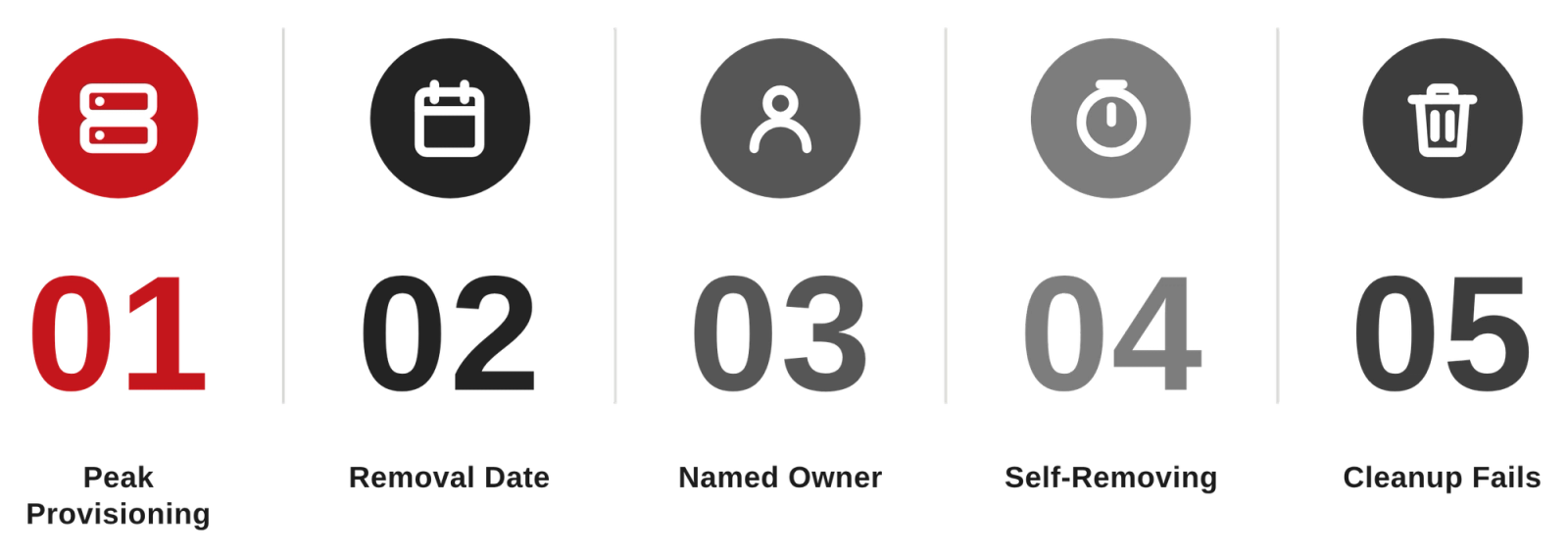
- Define why peak provisioning needs a removal date at creation
- Show why post-peak cleanup fails structurally
- Lay out how to make seasonal capacity self-removing
To do that, let's start with the basics.
What Is Cloud Waste for Retail? The Basic Definition
At a high level, cloud waste is spend on resources delivering no value: idle compute, orphaned storage, over-provisioned tiers, environments outliving their purpose. In retail the dominant category is seasonal. Capacity added for peak with good justification remains afterwards because removing it requires someone to act in a quiet month on infrastructure that is working fine, and the reasoning behind each item has decayed by then.
The fix is not a better cleanup process, it is recording a removal date and owner at the moment of provisioning, while the reason is still fresh and the temporary nature is obvious.
To compare:
Peak capacity without a removal date is scaffolding left up after the building work finished. Everyone knows it is temporary while it is being erected, and six months later nobody is certain which parts are structural.
Taking it down becomes a project requiring investigation, so it stays, and the next round of work goes up around it.
Why Does Cloud Waste Matter for Retail?
Issues that it addresses or resolves:
- Peak capacity persisting because removal has no date or owner
- Cleanup deferred until the reasoning has decayed
- Freeze windows blocking removal at the point it becomes possible
Resolved Issues by Waste Management Done Well
- Seasonal capacity removed on a recorded date
- Removal decisions made while the reason is fresh
- Cleanup scheduled outside freeze windows
Core Components of Cloud Waste Management in Retail
- Removal dates and owners recorded at provisioning
- Seasonal resources tagged distinctly from permanent
- Detection of idle resources with usage evidence
- Deletion authority granted per team
- Cleanup scheduled against the trading calendar
Modern Cloud Waste Tooling for Retail
- Tagging with lifecycle and removal date at creation
- Automated expiry on seasonal resources
- Idle detection with usage windows
- Team level waste reporting
- Calendar-aware scheduling for cleanup work
These tools make seasonal capacity temporary. Recording a removal date at provisioning is what turns a permanent increase into a scheduled one.
Other Core Issues They Will Solve
- Baseline capacity that can be compared year on year
- Load testing and war room environments disappearing after use
- Cleanup happening in a window where it is permitted
In Summary: Cloud waste in retail is dominated by seasonal capacity that outlived its reason, so the fix is recording removal dates at provisioning rather than improving cleanup.
Importance of Cloud Waste for Retail in 2026
Seasonal provisioning is structural and one-way by default. Four reasons explain why this matters now.
1. Provisioning has a trigger and removal has none.
Peak approaches and capacity is added. Nothing prompts its removal.
2. Reasoning decays fast.
By February nobody remembers why a particular cluster was created, which makes removing it feel risky.
3. Freeze windows block the obvious cleanup period.
The weeks immediately after peak are frequently still restricted, and by the time change is permitted attention has moved.
4. Each peak builds on the last.
Capacity added on top of an inflated baseline compounds year on year.
Traditional vs. Modern Retail Waste Management
- Cleanup after peak vs. removal date recorded at provisioning
- Seasonal and permanent resources tagged alike vs. distinguished
- Removal by judgement vs. by scheduled expiry
- Cleanup unscheduled vs. planned against the trading calendar
In summary: A modern retail approach makes seasonal capacity self-removing by recording the date when the reason is still fresh.
Details About the Core Components of Cloud Waste Management in Retail: What Are You Designing?
Let's go through each component.
1. Provisioning Layer
Recording the exit.
Provisioning decisions:
- Removal date recorded at creation
- Owner assigned for removal
- Reason captured while fresh
2. Tagging Layer
Seasonal versus permanent.
Tagging decisions:
- Seasonal resources tagged distinctly
- Lifecycle expressed in tags
- Enforcement at admission
3. Expiry Layer
Automatic removal.
Expiry decisions:
- Automated expiry on seasonal resources
- Extension deliberate and logged
- Notification before expiry
4. Detection Layer
Catching what escaped.
Detection decisions:
- Idle detection with usage windows
- Evidence presented with findings
- Attribution to owning teams
5. Calendar Layer
When cleanup can happen.
Calendar decisions:
- Cleanup scheduled outside freeze
- Removal windows planned in advance
- Owner availability confirmed
Benefits Gained from Waste Management in Retail
- Seasonal capacity that removes itself
- Baseline comparable year on year
- Cleanup happening within permitted windows
How It All Works Together
The retail engineering team records the exit at the entrance. Every peak provisioning decision captures a removal date, an owner, and the reason, at the moment of creation while the temporary nature is obvious and the justification is fresh.
Seasonal resources are tagged distinctly from permanent ones with lifecycle expressed in tags and enforced at admission, so a resource cannot be created for peak without declaring itself temporary. Automated expiry then does the removal, with notification before it happens and extension possible but deliberate and logged, which inverts the default: continuing costs an action rather than being what happens when nobody acts.
Idle detection catches what escaped the process, with usage evidence presented and attribution to owning teams so findings are actionable rather than informational. And cleanup work is scheduled against the trading calendar, because the weeks immediately after peak are frequently still frozen and by the time change is permitted the attention has gone elsewhere unless a window was planned.
Common Misconception
We will clean up after peak.
The intention is genuine and the process reliably fails, for reasons that are structural rather than about discipline. After peak the team is tired, the backlog deferred for ten weeks is long, change may still be restricted, and the infrastructure in question is working fine.
Removing it requires investigating why each item exists, because the reasoning has decayed, and that investigation competes against work with visible value. Nothing forces the question, so it loses. Recording a removal date at provisioning costs thirty seconds when the reason is fresh and removes the need for anyone to investigate or decide later.
It is a procedural fix for a procedural failure, which is why it works where good intentions do not.
Key Takeaway: Post-peak cleanup fails because reasoning decayed and nothing forces the question. Record the removal date when you provision.
Real-World Cloud Waste for Retail in Action
Let's take a look at how it operates with a real-world example.
We worked with a retailer whose peak capacity had accumulated across two seasons, with these constraints:
- Record removal dates and owners at provisioning
- Tag seasonal resources distinctly with automated expiry
- Schedule cleanup against the trading calendar
Step 1: Record the Exit at Entry
While the reason is fresh.
- Removal date captured at creation
- Owner assigned
- Reason recorded
Step 2: Tag Seasonal Distinctly
Enforced at admission.
- Seasonal versus permanent distinguished
- Lifecycle in tags
- Untagged rejected
Step 3: Automate Expiry
Invert the default.
- Automated expiry on seasonal resources
- Notification before removal
- Extension deliberate and logged
Step 4: Detect What Escaped
With evidence.
- Idle detection with usage windows
- Evidence presented
- Attribution to teams
Step 5: Schedule Against the Calendar
When change is permitted.
- Cleanup windows planned in advance
- Freeze periods respected
- Owner availability confirmed
Where It Works Well
- Seasonal capacity that can be tagged at creation
- Estates with tagging enforced at admission
- Programmes planning cleanup windows in advance
Where It Does Not Work Well
- Reliance on post-peak cleanup intentions
- Seasonal and permanent resources tagged identically
- Cleanup attempted during freeze windows
Key Takeaway: Record the removal date at provisioning, automate expiry, and plan the cleanup window before you need it.
Common Pitfalls
i) Relying on post-peak cleanup
Tired teams, long backlogs, restricted change, and decayed reasoning mean cleanup loses to everything else. Record removal dates at provisioning instead.
- Capacity persists into the new baseline
- Removal becomes an investigation
- The next peak builds on top
ii) Seasonal and permanent tagged alike
If the tooling cannot tell which resources were temporary, expiry cannot be automated and removal needs human judgement. Tag distinctly at admission.
iii) Extension as the default
If seasonal resources continue unless removed, they continue. Make expiry the default and extension a logged deliberate act.
iv) Cleanup unscheduled
The weeks after peak are frequently still frozen, and unscheduled work slips indefinitely. Plan the window and confirm owner availability.
Takeaway from these lessons: The fix is procedural and cheap at provisioning, and expensive at every later point.
Cloud Waste Best Practices for Retail: What High-Performing Teams Do Differently
1. Record the removal date at provisioning
Capture it with the owner and the reason while the temporary nature is obvious, because thirty seconds now replaces an investigation later.
2. Tag seasonal distinctly and enforce it
Make the tooling able to distinguish temporary from permanent so expiry can be automated.
3. Make expiry the default and extension deliberate
Invert the asymmetry that produces accumulation, so continuing costs an action.
4. Present usage evidence for anything that escapes
Give owning teams a window of non-use so removal is obvious rather than a verification task.
5. Plan the cleanup window against the calendar
Schedule it outside freeze with confirmed owner availability, since unscheduled cleanup slips.
Logiciel's value add is helping retail engineering teams record removal dates at provisioning and automate seasonal expiry, so peak capacity stops becoming the new baseline.
Takeaway for High-Performing Teams: Record the exit at entry, tag seasonal, default to expiry, evidence the rest, and plan the window.
Signals You Are Doing Cloud Waste Well in Retail
How do you know it is working? Not by how much you found, but by whether the baseline came back down. These are the signals that separate seasonal capacity from permanent.
Removal dates exist. Every peak resource has a date and an owner.
Seasonal is tagged. Tooling can distinguish temporary from permanent.
Expiry is default. Resources disappear unless someone acts to keep them.
The baseline fell. Post-peak capacity returned to pre-peak levels.
Cleanup was scheduled. It happened in a planned window rather than slipping.
Adjacent Capabilities and Connected Work
This work does not exist in isolation. Waste management depends on, and feeds into, the surrounding platform. Ignoring the adjacencies is the most common scoping mistake.
FinOps guardrails supply tagging enforcement and the same seasonal reversal discipline for capacity. Terraform module defaults are where expiry gets set. Warehouse cost work faces the identical ratchet in the data platform.
The freeze calendar determines when removal is permitted. Naming these adjacencies upfront keeps the work scoped and helps leadership see provisioning-time recording as the fix.
The common mistake is treating each adjacency as someone else's problem. The removal date capture is your problem. The seasonal tagging is your problem. The cleanup scheduling is your problem. Pretend otherwise and next October will build on top of this year's leftovers.
Own the adjacencies you depend on, partner with the teams that hold them, and share the dates.
Conclusion
Retail cloud waste is mostly one pattern: capacity added for peak with good reason and removed by nobody. Post-peak cleanup fails structurally rather than through indiscipline, because the team is tired, the backlog is long, change may be restricted, and the reasoning behind each resource has decayed enough that removing it feels risky.
Record a removal date, an owner, and the reason at the moment of provisioning, while the temporary nature is obvious and the justification is fresh. Tag seasonal resources distinctly so expiry can be automated.
Make expiry the default and extension a logged act. Then plan the cleanup window before you need it.
Key Takeaways:
- Seasonal capacity persists because removal has no trigger and reasoning decays
- Recording the removal date at provisioning replaces a later investigation
- Expiry as the default inverts the asymmetry that produces accumulation
Managing retail cloud waste requires recording the exit at entry. When done correctly, it produces:
- Seasonal capacity that removes itself
- A baseline comparable year on year
- Findings owning teams can act on without verification
- Cleanup that happens inside a permitted window
Learn More Here:
- FinOps Guardrails for Retail
- Warehouse Cost Optimization for Retail
- Terraform Modules and Lifecycle Defaults
At Logiciel Solutions, we work with retail engineering leaders on cloud cost. Our reference patterns come from estates with pronounced seasonal provisioning.
Book a technical deep-dive on making peak capacity remove itself.
—Content End—
What Logiciel Does Here
If your peak capacity has become the new baseline, we help you record removal dates at provisioning, tag seasonal resources, and automate the expiry that stops the ratchet.