
It’s 2:11am … a critical pipeline silently fails (no alert or owner assigned), and by the time our team finds out about it, downstream dashboards are incorrect, we’ve lost all stakeholder trust, and engineers are racing frantically to trace the issue throughout our disconnected systems.
This is where the discussion around data mesh architecture begins.
As a data engineering lead responsible for scaling your company's data platform, you may find yourself faced with the question of whether to evolve your existing model towards a more decentralized approach - by way of data mesh architectures - or move towards native cloud platforms based on data fabric technologies.
This guide is designed for you. Upon conclusion, you will:
- Have an understanding of the REAL differences between data mesh and data fabric.
- Be knowledgeable about where each of these approaches apply well, as well as where they do not.
- Be equipped with a practical decision framework that allows you to apply your learning immediately.
Evaluation Differnitator Framework
Why great CTOs don’t just build they evaluate. Use this framework to spot bottlenecks and benchmark performance.
First, let’s discuss why this is an important decision at this current point in time.
The Importance of Choosing Between Data Mesh Architecture vs Data Fabric in 2026
The decision between a data mesh architecture and a data fabric technology solution is no longer simply a theory-based approach. It is an active, real-world response to the true engineering pressures faced by organizations today.
Data growth has outpaced the capability of centralized models.
Typically, organizations' data is made up of multiple distributed data sources, which invariably will be housed across multiple domains (business units). Additionally, you now have complex batch and live streaming data systems working together on top of each other to deliver real-time insight to decision makers at all levels. Centralized data teams are simply unable to maintain all these disparate data sources due the sheer volume and technological complexities involved.Data Ownership: AI & Advanced Analytics
Requirements For AI Systems
- Consistent schemas
- Reliable data products
- Clear ownership
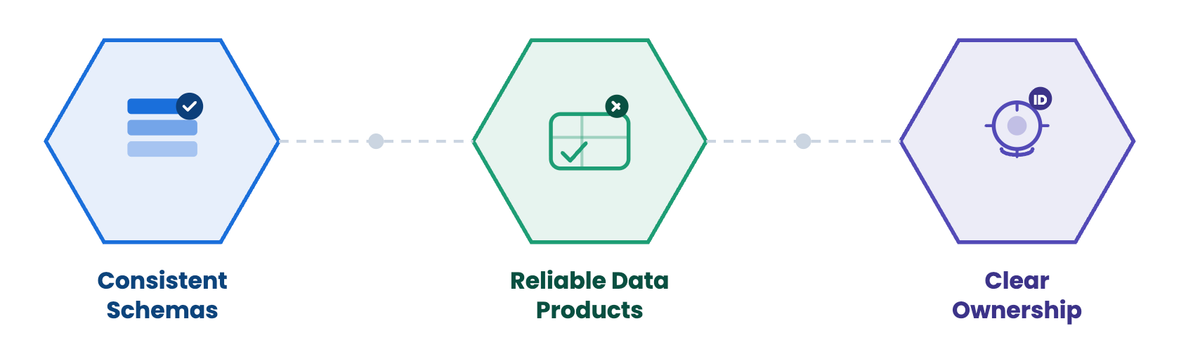
If you miss any of these, your models can fail quietly.
Engineering Teams Are Being More Domain Centric
Modern organizations:
- Have decentralized ownership
- Are aligned with business domains
- Expect faster delivery
Who Is Making These Decisions?
Typically by:
- Data Engineering Leads
- Platform Architects
- CTO’s
What's On The Line?
- Decision Area Impact
- Choice of architecture
- Scalability and Reliability
- Choice of ownership model
- Productive team
- Choice of tooling strategy
- Cost and Complexity
Key Insight
There is no absolute best answer
The best decision is based on:
- Team’s maturity
- The organization’s structure
- Complexity of data.
Takeaway: This is a Design Decision not Tooling Choice.
Understanding Data Mesh Architecture: The Strengths, Limits, And Best Fit
What Is Data Mesh Designed For?
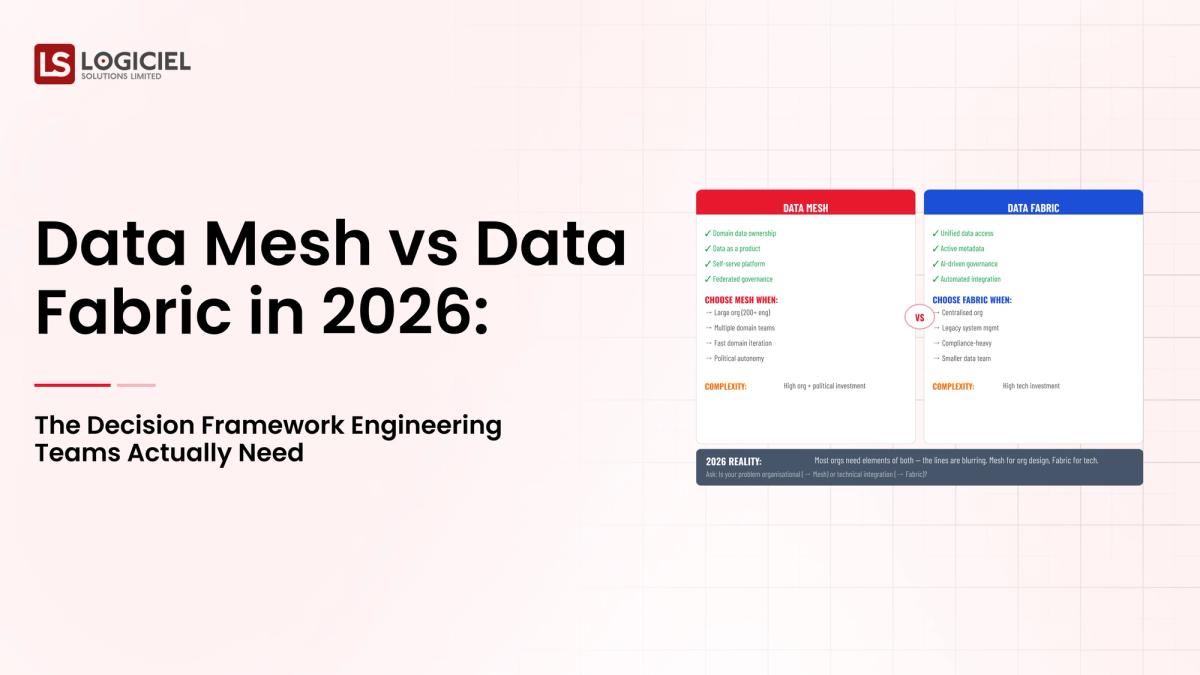
Data mesh architectures treat data as a product owned by domain teams which decentralizes data ownership. Core principles include:
- Ownership by domains
- Data is a product
- Federated governance
- Self-serve infrastructure.
Architectural Assumptions of data meshes
Assumes the following:
- Teams own their data end-to-end
- Strong engineering maturity
- Distributed Governance.
Where Data Mesh Works Well
In large organizations with multiple domains, teams needing data quicker, or systems requiring high scalability.
Where Data Mesh Fails
In organizations with high complexity (Needs)
- Cultural change
- Clear ownership models
- Governance issues (Federated governance may result in inconsistency).Increased Operational Overhead
Every team has to manage the following:
Pipelines Data quality Infrastructure
When It Comes to Data Mesh
Use data mesh if:
- You have several independent teams
- You require scalability across domains
- Your business supports decentralization
Summary: Data mesh is suited to large, sophisticated companies who can support distributed ownership.
Understanding Data Fabric in 2026: Strengths, Weaknesses and Where It Will Work Well
What Data Fabric is Intended to Achieve
Data fabric focuses on combining access to data from several different systems by applying metadata, automation and integration layers.
Assumptions About Data Fabric Architecture
Data fabric is based on:
- Centralized visibility is necessary
- Automation reduces complexity
- Integration is more important than ownership
Where Data Fabric Works Well
- Organizations with disparate systems
- Teams looking for a way to access unified data
- An environment with diverse tools
Where Data Fabric Fails
Hidden Complexity
Abstraction layers may mask problems.
Scaling Issues
At very large scales, metadata systems can act as a bottleneck for data fabric.
Vendor Dependency
Some implementations can create lock-in to particular vendors.
Best Fits for Data Fabric
Use data fabric if:
- You require centralized visibility
- You have disparate systems
- You desire quicker integration
Summary: Data fabric is suited to organizations that place a higher value on buying, integrating and unifying access to information rather than decentralizing information.
Comparison: Criteria that Help You Decide
Head-to-Head: Criteria that Help You Decide Between
- Criteria/Data Mesh Architecture/Data Fabric
- Scalability: High-Distributed/Mid-Central
- Ownership Model: Decentralized/Centralized
- Performance: Dependent/Centrally Optimized
- Operational Complexity: High/Moderate
- Cost Structure: Distributed/Centralizing
- Ecosystem Fit: Flexible
Key Insight:
Data Mesh=Ownership+Scalability Data Fabric=Integration+Simplicity
Conclusion
Selection should be based on how your organization is structured (culture, organizational maturity, etc.) rather than simply on technology.
When to Use Data Mesh Architecture
Use Data Mesh if:
- Strong domain-driven teams exist
- You require distributed scalably
- Your organization supports decentralized ownership
Do Not Use Data Mesh if:
Teams are not mature Governance is unclear You want time to implementation
Common Regrets Teams Have:
Teams use a mesh without having the appropriate culture established There is chaos created due to lack of defined ownership
When to Use Data Fabric in 2026
Use Data Fabric if:
- There is a need for corporate-wide access to information
- You need to unify fragmented systems
- You want a faster time-to-market
Do Not Use Data Fabric if:
- You want to develop strong domain-centered ownership
- Using a data fabric exceeds stored metadata
- You want to keep vendor locks
Cogeniendo au Logiciel
Most teams struggle not regarding what architecture they want to run but how to operationalize that architecture.
Logiciel helps OPERATIONALLY by:
Providing Infrastructure using AI Automating Governance and Transparency Reducing Complexity within Systems
Instead of just choosing extremes, Teams are able to use Hybrid, System Level Approaches.
Final Thoughts
For today's data teams, selecting between a data mesh and a data fabric architecture is one of the key decisions to make.
Remember these three main points:
- The Data Mesh is based on distributed ownership with a focus on scalability
- The Data Fabric is based on integration and accessibility
- The perfect system is based on your company, not current trends
This is a complicated decision because it involves people, processes and technology.
When done correctly, this decision results in:
- More timely access to data
- Enhanced reliability of systems
- Architectures built upon scalability
- reater inter-team alignment
Things Your Organization Should Do
If you are currently exploring your organization's data architecture, your next step should involve examining the historical performance of these types of designs within real-life situations.
Read On:
- What Is Data Mesh Architecture?
- How Do Data Fabrics and Data Meshes Compare?
- Data Design Practices for AI-First Engineering Teams
Logiciel Solutions helps provide AI-first organizations with system designs which grow at a rate much higher than organizational complexity.
The Logiciel Solution incorporates system-level designs with enhanced automation technologies to allow for greater performance and reliability.
Learn how Logiciel Solutions can help build your future-proof data platform.
AI Velocity Blueprint
Measure and multiply engineering velocity using AI-powered diagnostics and sprint-aligned teams.
Frequently Asked Questions
What is data mesh?
Data Mesh refers to a decentralised/data-driven way for domain-based teams to create/manage their data as products. The mesh operates as a product development team and will leverage examples across the company as its design principles in developing prototypical data architecture frameworks.
What is a data fabric?
A Data Fabric is a unified architectural approach to gaining access to all of a business' digital assets; it uses an integration methodology combined with a unified layer of metadata to grant data discover/re-use across multiple systems.
Which is better, a Data Mesh or a Data Fabric?
There is no correct answer. However, in general, a Data Mesh system is more appropriate for organizations that have decentralised data owners, while a data fabric would be best suited for organizations that want to use data from all parts of the organization as if it were all part of one entity.
Are Data Meshes and Data Fabrics able to be integrated together?
Yes! Several organizations are now leveraging hybrid solutions that include components of both systems; such as the combined ownership of information via a Data Mesh and the associated integrated layer support provided via a Data Fabric model.
What is the biggest mistake one would make when choosing between Data Mesh and Data Fabric concepts?
Selecting based upon current trends and not actual company needs or levels of availability (company readiness) are the largest mistake any company could make during the assessment of the appropriate data architecture framework.