
A real estate platform packages its transaction and listing data into a market analytics product, and the commercial case looks excellent because the data is already collected and the buyers are obvious.
Then legal starts tracing provenance. Some of the listing data came from MLS feeds with redistribution restrictions. Some came from public records that are free to use but licensed through an aggregator whose terms prohibit resale.
Some came from agents who agreed to a platform listing agreement that says nothing about analytics products. Six months in, roughly a third of the dataset cannot legally be included, and the product that made the business case viable is not the product that can ship.
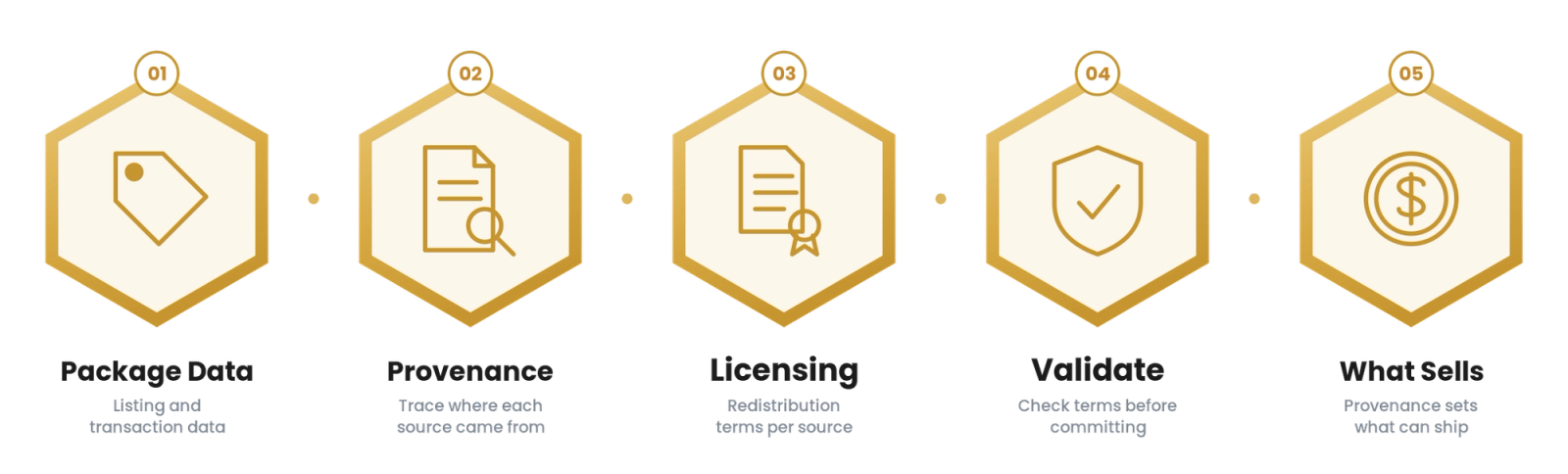
Provenance decides what you can sell. The pipeline is trivial by comparison.
Data monetization for real estate means turning property, transaction, and behavioral data into revenue through products or partnerships, with provenance traced and licensing terms validated per source before anything is committed commercially.
How a Real Estate Platform Stabilized 200+ Data Pipelines
Stabilize complex data pipelines and reduce operational pages across the platform.
However, most programmes model revenue against the dataset they can see, and discover afterwards that a substantial portion of it arrived under terms that prohibit exactly what they planned.
If you are a CDO or VP of Data at a real estate company, the intent of this article is:
- Define why provenance is the constraint that decides feasibility here
- Show what the governance bill actually contains
- Lay out how to validate source terms before committing
To do that, let's start with the basics.
What Is Data Monetization for Real Estate? The Basic Definition
At a high level, data monetization in real estate means generating revenue from data assets: market analytics products sold to investors and lenders, valuation and comparables services, listing and behavioral data licensed to partners, or insight services where you sell analysis rather than the data itself.
The distinguishing characteristic of this sector is that very little of the data originated with you. It arrives from MLS feeds, public records, aggregators, agent submissions, and partner integrations, each with its own licensing terms about redistribution, derivation, and resale.
Which of those terms apply to your intended product determines what you can build, and that question is legal before it is technical.
To compare:
Monetizing real estate data looks like reselling stock you already hold. It is closer to selling a dish made from ingredients supplied under different contracts, some of which say you may cook with them but not sell the result.
The kitchen work is straightforward. Knowing which supplier permits what, and being able to prove it, is the business. Most programmes plan the menu first and read the supply contracts after the launch date is set.
Why Does Provenance Matter So Much for Real Estate?
Issues that it addresses or resolves:
- Data arriving under terms that prohibit redistribution or resale
- Derived products assumed to be unrestricted when the source was not
- Revenue models built on datasets that cannot legally be included
Resolved Issues by Tracing Provenance
- Feasibility established before commercial commitment
- Product scope matched to what the terms actually permit
- Derivation rights understood per source rather than assumed
Core Components of Data Monetization in Real Estate
- Provenance traced per source with licensing terms recorded
- Derivation and redistribution rights assessed explicitly
- Products built with owners, contracts, and service levels
- Access control and audit evidence for external consumers
- A cost model including recurring governance effort
Modern Data Monetization Tooling for Real Estate
- Lineage tracking source terms alongside data flow
- Source registries recording licence terms per feed
- Data contracts and SLAs defined as code
- Access control with logging suitable for partner audits
- Usage metering for commercial reconciliation
These tools make monetization defensible. Carrying licence terms alongside lineage is what lets you answer whether a specific product may include a specific field without a legal review each time.
Other Core Issues They Will Solve
- Product scope decided from evidence rather than optimism
- Partners get dependable data with a stated service level
- Licence compliance demonstrable rather than asserted
In Summary: Data monetization for real estate turns property and behavioral data into revenue, and feasibility is determined by provenance and licensing terms rather than by what the data contains.
Importance of Getting This Right for Real Estate in 2026
Property data products are commercially attractive and legally intricate. Four reasons explain why provenance discipline matters now.
1. Most of the data is not originally yours.
MLS feeds, public record aggregators, and partner integrations all carry terms, and the terms differ.
2. Derived products are not automatically unrestricted.
Many licences constrain derivation as well as redistribution, which surprises teams who assumed aggregation resolved everything.
3. Buyers are increasingly sophisticated.
Investors and lenders ask about data provenance because their own compliance depends on it.
4. The remedy is expensive after launch.
Removing a third of a dataset post-launch means rebuilding the product and renegotiating the commercial terms.
Traditional vs. Modern Real Estate Data Monetization
- Model revenue on available data vs. model on permissible data
- Licence terms in a filing cabinet vs. recorded per source alongside lineage
- Derivation assumed unrestricted vs. derivation rights assessed explicitly
- Compliance asserted vs. compliance demonstrable from lineage
In summary: A modern real estate approach establishes what may be sold before deciding what to build, and carries licence terms with the data.
Details About the Core Components of Data Monetization in Real Estate: What Are You Designing?
Let's go through each component.
1. Provenance Layer
Where it came from.
Provenance decisions:
- Every source registered with its licence terms
- Terms recorded in a form engineers can query
- Unknown provenance treated as unusable
2. Rights Layer
What you may do.
Rights decisions:
- Redistribution and derivation assessed separately
- Aggregation thresholds checked against terms
- Product scope matched to permissions
3. Product Layer
What you are selling.
Product decisions:
- Named owner and published contract
- Service level stated and monitored
- Field-level inclusion justified by rights
4. Control Layer
Who can access it.
Control decisions:
- External access scoped per partner
- Access reviews scheduled and evidenced
- Logging suitable for a partner audit
5. Cost Layer
The real model.
Cost decisions:
- Recurring governance effort estimated honestly
- Legal review cadence included
- Margin recalculated after obligations
Benefits Gained from Provenance Discipline in Real Estate
- Product scope that survives legal review
- Commercial commitments made against permissible data
- Licence compliance demonstrable to sophisticated buyers
How It All Works Together
The real estate data team establishes what may be sold before deciding what to build, which inverts the usual sequence and saves considerably more than it costs. Every source is registered with its licence terms recorded in a queryable form rather than filed as a PDF nobody reads, and data of unknown provenance is treated as unusable rather than as probably fine.
Redistribution and derivation rights are assessed separately, because many licences permit internal analysis and constrain derived products, and aggregation does not automatically resolve that constraint the way teams assume. Product scope is then designed against what the terms permit, field by field where necessary, so the business case rests on the dataset that can actually ship.
Lineage carries licence terms alongside data flow, which means the question of whether a specific product may include a specific field is answerable from the system rather than requiring a legal review every time somebody proposes a change.
What gets sold is built as a data product with a named owner and a monitored contract, because buyers here are institutional and their expectations are contractual. Access is scoped per partner with audit-standard logging.
And the cost model includes recurring legal review, governance, and support effort.
Common Misconception
Aggregating or deriving from licensed data removes the licensing restriction.
Sometimes it does and frequently it does not, and assuming it does is the most expensive mistake in this sector. Many data licences explicitly address derived works, and some restrict them regardless of how much processing has occurred, particularly where the derived product competes with the licensor's own offering.
Aggregation thresholds, where they exist, are specified in the terms rather than being a general principle, and a threshold that satisfies one source will not satisfy another. The workable approach is to treat derivation rights as a per-source question answered from the recorded terms, not as a general legal principle applied once.
Teams that assume aggregation resolves everything build a product, launch it, and then discover which licensor disagrees.
Key Takeaway: Derivation rights are per-source contract terms, not a general principle. Aggregation does not automatically clear a restriction.
Real-World Data Monetization for Real Estate in Action
Let's take a look at how it operates with a real-world example.
We worked with a real estate platform whose analytics product could not legally include a third of its dataset, with these constraints:
- Register every source with its licence terms before scoping
- Assess derivation rights separately from redistribution
- Design product scope against what is permissible
Step 1: Register Every Source
Terms in a queryable form.
- Licence terms recorded per source
- Unknown provenance treated as unusable
- Registry maintained rather than filed
Step 2: Assess the Rights
Redistribution and derivation.
- Both assessed separately per source
- Aggregation thresholds checked against terms
- Findings recorded against fields
Step 3: Scope the Product
To what is permitted.
- Field-level inclusion justified by rights
- Business case built on permissible data
- Gaps identified before commitment
Step 4: Build It as a Product
Owner and contract.
- Named owning team
- Service level stated and monitored
- Support path established
Step 5: Recalculate the Margin
With obligations included.
- Recurring legal review included
- Governance and support cost estimated
- Opportunity reassessed honestly
Where It Works Well
- Products built on data you originated or licensed with resale rights
- Insight services where analysis rather than data is sold
- Orgs willing to register provenance and treat it as an engineering concern
Where It Does Not Work Well
- Datasets with unknown or partially documented provenance
- Products assumed permissible because they are aggregated
- Business cases modelled on all available data
Key Takeaway: Establish what may be sold first, build second, and treat derivation rights as a per-source question rather than a principle.
Common Pitfalls
i) Assuming aggregation clears restrictions
Many licences address derived works explicitly, especially where the derivative competes with the licensor. Check terms per source rather than applying a general rule.
- A launched product turns out to breach terms
- Removing a source rebuilds the product
- Commercial terms need renegotiating from a weak position
ii) Provenance recorded as documents
Licence terms filed as PDFs cannot be queried by an engineer designing a product. Record them in a form the system can use alongside lineage.
iii) Treating unknown provenance as probably fine
Data whose origin cannot be traced is a liability in a product you are selling. Treat it as unusable until traced.
iv) Modelling revenue on all available data
The business case should rest on the permissible subset, which is often materially smaller. Scope first, model second.
Takeaway from these lessons: Provenance and rights determine feasibility in real estate data, and both need to be engineering-visible rather than legal-department-only.
Data Monetization Best Practices for Real Estate: What High-Performing Teams Do Differently
1. Register sources with their terms
Record licence terms per source in a queryable form, so product design can check permissibility without a legal review per question.
2. Assess derivation separately from redistribution
Treat them as distinct rights per source, because many licences permit internal use and restrict derived products.
3. Scope the product before modelling revenue
Build the business case on the permissible subset, which is usually smaller than the dataset you can see.
4. Carry terms alongside lineage
Make licence constraints visible in the same system as data flow, so a field's usability is answerable rather than researched.
5. Include recurring legal review in the cost
Terms change and new sources arrive, so ongoing rights assessment is an operating cost rather than a one-off project.
Logiciel's value add is helping real estate data teams make provenance and licensing rights engineering-visible, so product scope is decided from evidence rather than discovered during legal review.
Takeaway for High-Performing Teams: Register sources with their terms, assess derivation per source, scope before modelling, and treat rights as queryable data.
Signals You Are Doing Data Monetization Well in Real Estate
How do you know it is working? Not by revenue booked, but by whether you can answer a rights question in minutes. These are the signals that separate a defensible product from an optimistic one.
Provenance is complete. Every field traces to a source with recorded terms.
Rights are queryable. Whether a field may be sold is answerable from the system.
Scope matched rights. The product includes only permissible data.
Products have owners. Every commercial dataset has a team and a monitored SLA.
Margin was recalculated. The model includes recurring legal and governance cost.
Adjacent Capabilities and Connected Work
This work does not exist in isolation. Data monetization depends on, and feeds into, the surrounding data platform. Ignoring the adjacencies is the most common scoping mistake.
Lineage is what carries provenance and terms. Data products are what you actually sell. Data quality SLAs are what the contract commits you to. Access logging produces the audit evidence buyers request.
Naming these adjacencies upfront keeps the work scoped and helps leadership see monetization as a rights question with an operating cost rather than an asset sale.
The common mistake is treating each adjacency as someone else's problem. The provenance registry is your problem. The rights visibility is your problem. The service level is your problem. Pretend otherwise and you will build a product legal cannot approve.
Own the adjacencies you depend on, partner with the teams that hold them, and share the terms.
Conclusion
In real estate, almost none of the valuable data originated with you. It arrives from MLS feeds, public record aggregators, agent submissions, and partner integrations, each carrying terms about redistribution and derivation that differ from each other and rarely permit exactly what a monetization plan assumes.
Register every source with its licence terms in a form engineers can query, assess derivation rights separately per source, scope the product to what is permissible, and only then model revenue. Build what you sell as a real product with an owner and a contract, and include recurring legal review in the cost. Provenance decides feasibility. The pipeline never did.
Key Takeaways:
- Provenance and licence terms determine what can be sold, before any technical work
- Derivation rights are per-source contract terms, not a general principle
- Unknown provenance should be treated as unusable in a commercial product
Costing monetization properly requires rights discipline. When done correctly, it produces:
- Product scope that survives legal review
- Business cases modelled on permissible rather than available data
How a Real Estate Platform Cut Pipeline Cost 45% Without Missing an SLA
Reduce pipeline compute costs without sacrificing reliability or SLA performance.
- Rights questions answerable from the system in minutes
- Compliance demonstrable to institutional buyers
What Logiciel Does Here
If your data product scope keeps shrinking during legal review, we help you make provenance and licensing rights engineering-visible so scope is decided from evidence upfront.
Learn More Here:
- Data Products and Contracts
- AI Data Catalogs and Lineage
- Master Data Management for Property Data
At Logiciel Solutions, we work with real estate data leaders on data monetization programmes. Our reference patterns come from estates built on heavily licensed third-party sources.
Book a technical deep-dive on making licensing rights queryable before you scope.