
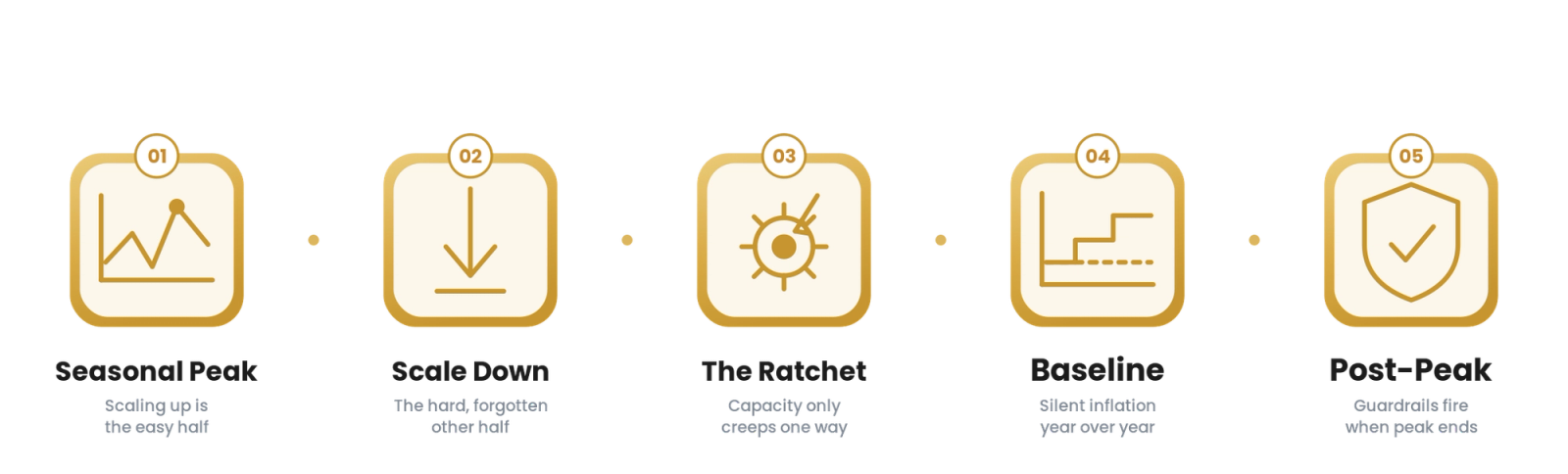
A retailer scales up for peak in October, gets through the season without incident, and then does not scale back down. Not deliberately. Nobody decided to keep the extra capacity. The freeze ended, everyone moved to the next thing, and the January bill looked high but explicable because December always is.
By March the elevated baseline has become the new normal, and next October it gets scaled up again from there. Two peaks later the platform is running at a level nobody ever chose, and every cost review compares against last year, which was also inflated.
The ratchet only turns one way, and annual targets cannot see it.
Seasonal spend needs seasonal guardrails. Scaling up is the easy half.
FinOps guardrails for retail means making budgets, cost attribution, and scale-down primitives of the platform, enforced when infrastructure is provisioned and when peak ends, so capacity added for a season does not silently become permanent baseline.
How a Real Estate Platform Hit 5x Scale Without a Re-Platform
Scale platform capacity dramatically without the cost of re-platforming.
However, most teams treat FinOps as an annual reporting exercise, and in a seasonal business that means comparing an inflated year against a previously inflated one.
If you are a VP of Platform Engineering or Head of Developer Experience at a retail company, the intent of this article is:
- Define guardrails as provisioning-time and post-peak controls
- Show why the scale-down ratchet is the dominant retail waste pattern
- Lay out how to make budgets a platform primitive against a seasonal baseline
To do that, let's start with the basics.
What Are FinOps Guardrails for Retail? The Basic Definition
At a high level, FinOps guardrails in a retail org are controls built into the provisioning path and into the seasonal cycle, so cost is a property of infrastructure at creation and a reviewed decision when peak ends.
Every resource carries attribution to a team and system. Capacity added for a season is tagged as seasonal with an expiry rather than provisioned permanently. Baseline cost is tracked separately from peak cost, so the two cannot hide inside each other.
Budgets exist per team with automated behavior. And scale-down is a scheduled, owned piece of work after every peak, not an intention that competes with a backlog.
To compare:
An annual cost review in a seasonal business is a bathroom scale you step on once a year, on the same day each time, after the same large meal. The number is accurate and tells you nothing about the trend.
A guardrail is the decision, made on a specific date with a specific owner, about which of the capacity you added in October is still needed in January. Most retailers measure carefully and never make that decision.
Why Are FinOps Guardrails Necessary for Retail?
Issues that it addresses or resolves:
- Peak capacity becoming permanent baseline by default
- Seasonal and baseline spend indistinguishable in the same numbers
- Scale-down competing with a post-peak backlog and losing
Resolved Issues by Guardrails
- Seasonal capacity provisioned with an expiry rather than permanently
- Baseline tracked separately from peak so the ratchet is visible
- Scale-down owned and scheduled rather than intended
Core Components of FinOps Guardrails in Retail
- Mandatory attribution tags enforced at admission
- Seasonal resources tagged and given expiry at creation
- Baseline and peak cost tracked as separate figures
- Per-team budgets with automated responses
- A scheduled post-peak scale-down with a named owner
Modern FinOps Tooling for Retail
- Policy as code rejecting untagged or untiered resources
- Terraform modules distinguishing seasonal from permanent capacity
- Autoscaling configured to scale down as aggressively as it scales up
- Budget alerts routed to owning teams
- Cost estimates surfaced in pull requests
These tools make seasonal cost controllable. Tagging capacity as seasonal at creation and separating baseline from peak in reporting are what stop the ratchet from turning invisibly.
Other Core Issues They Will Solve
- Engineers see cost consequences while the choice is still open
- Seasonal capacity disappears without anyone remembering it
- Central FinOps effort shifts from explaining to preventing
In Summary: FinOps guardrails for retail make attribution, seasonal expiry, and scale-down platform primitives, so capacity provisioned for one peak does not become the baseline for the next.
Importance of FinOps Guardrails for Retail in 2026
Retail margins are tight and cloud spend is a visible line. Four reasons explain why guardrails matter now.
1. The ratchet compounds silently.
Each peak scales up from an already inflated baseline, and year-on-year comparisons hide it because both years are inflated.
2. Post-peak is the worst time to rely on intention.
After a season everyone is exhausted and the backlog is long. Scale-down loses unless it is scheduled and owned.
3. Autoscaling is usually asymmetric.
Most configurations scale up quickly and down slowly or not at all, which is a sensible bias during peak and expensive afterwards.
4. Reporting does not change behavior.
Cost dashboards have existed for years. Spend kept rising, because a dashboard is not a decision point.
Traditional vs. Modern Retail Cost Control
- Annual cost review vs. controls at provisioning and post-peak
- Seasonal capacity provisioned permanently vs. provisioned with expiry
- One blended cost number vs. baseline and peak tracked separately
- Cost discovered in January vs. cost shown in the pull request
In summary: A modern retail approach separates baseline from seasonal, gives seasonal capacity an expiry, and treats scale-down as scheduled work with an owner.
Details About the Core Components of FinOps Guardrails in Retail: What Are You Designing?
Let's go through each component.
1. Attribution Layer
Whose spend is it.
Attribution decisions:
- Ownership tags mandatory at admission
- Untagged resources rejected, not reported
- Tags sourced from the service catalog
2. Seasonal Layer
Temporary means temporary.
Seasonal decisions:
- Peak capacity tagged as seasonal at creation
- Expiry set before the resource exists
- Extension possible but deliberate
3. Baseline Layer
Seeing the ratchet.
Baseline decisions:
- Baseline cost tracked separately from peak
- Year-on-year compared at baseline, not blended
- Baseline growth challenged explicitly
4. Scaling Layer
Down as well as up.
Scaling decisions:
- Scale-down policies as considered as scale-up
- Asymmetry allowed during peak, reviewed after
- Minimum capacity set deliberately
5. Scale-Down Layer
Scheduled work.
Scale-down decisions:
- A named owner and a date after every peak
- Treated as committed work, not intention
- Result reported against baseline
Benefits Gained from FinOps Guardrails in Retail
- Seasonal capacity that actually disappears after the season
- A visible baseline that can be challenged year on year
- Every cost attributable to a team and system
How It All Works Together
The retail platform team starts with attribution, because nothing else works without it. Ownership tags become mandatory at admission, sourced from the service catalog, and untagged resources are rejected rather than logged.
The retail-specific control comes next: capacity provisioned for peak is tagged as seasonal and given an expiry at creation, before it exists, so removing it later does not depend on anyone remembering why it was added.
Reporting separates baseline from peak so the two cannot hide inside each other, which is the only way the ratchet becomes visible, and year-on-year comparisons are made at baseline rather than blended across a season.
Autoscaling policies are written with scale-down given the same attention as scale-up, with the asymmetry deliberately loosened during the peak window and tightened again afterwards as a scheduled change rather than a hopeful one.
That scheduled post-peak scale-down has a named owner and a date, and it is treated as committed work competing on equal terms with feature backlog rather than as an intention that will lose to it.
Budgets sit with owning teams, alerts route to them, and cost estimates appear in pull requests so the choice is informed while it is still open.
Common Misconception
We scale up for peak and scale back down afterwards, so seasonal capacity is temporary by design.
The design says temporary. The behavior says otherwise, and the gap between them is the single largest source of retail cloud waste. Scaling down after peak is unglamorous work that competes with a backlog everyone deferred for ten weeks, performed by a team that is tired, on infrastructure that is currently working fine.
It reliably loses that competition, not through negligence but because nothing forces the question. Meanwhile the elevated baseline becomes next year's starting point, and the following peak scales up from there. The fix is not more discipline.
It is removing the need for discipline: tag seasonal capacity with an expiry at creation, so the default outcome is removal and continuing requires a deliberate act.
Key Takeaway: Post-peak scale-down loses to the backlog every time. Make expiry the default so keeping capacity requires a decision.
Real-World FinOps Guardrails for Retail in Action
Let's take a look at how it operates with a real-world example.
We worked with a retail platform team whose baseline had ratcheted upward across two peaks, with these constraints:
- Enforce attribution before attempting anything else
- Give seasonal capacity an expiry at creation
- Track baseline separately so the ratchet becomes visible
Step 1: Enforce Attribution
Reject, do not report.
- Ownership tags mandatory at admission
- Untagged resources rejected
- Tags sourced from the catalog
Step 2: Tag Seasonal at Creation
Expiry before existence.
- Peak capacity marked as seasonal
- Expiry set when provisioned
- Extension deliberate
Step 3: Separate Baseline from Peak
See the ratchet.
- Baseline tracked as its own figure
- Year-on-year compared at baseline
- Baseline growth challenged
Step 4: Fix Scale-Down Policies
Symmetry after peak.
- Scale-down given equal attention
- Asymmetry loosened only during peak
- Minimum capacity set deliberately
Step 5: Schedule the Scale-Down
Owner and date.
- Named owner, fixed date
- Treated as committed work
- Result reported against baseline
Where It Works Well
- Businesses with a pronounced seasonal load pattern
- Orgs with shared modules that can enforce expiry
- Teams willing to schedule scale-down as real work
Where It Does Not Work Well
- Estates with no reliable attribution
- Orgs that compare cost only year on year at blended figures
- Any approach relying on post-peak good intentions
Key Takeaway: In retail the dominant waste pattern is capacity that never came back down, and the only reliable fix is making removal the default.
Common Pitfalls
i) Relying on post-peak intention
Scale-down competes with a ten-week backlog and a tired team, and it loses. Tag seasonal capacity with an expiry so removal happens by default.
- Peak capacity becomes permanent baseline
- Next peak scales up from the inflated level
- The ratchet is invisible in blended reporting
ii) Blending baseline and peak
One combined cost figure lets a rising baseline hide inside seasonal variation. Track them separately and compare year on year at baseline.
iii) Asymmetric autoscaling left in place
Aggressive scale-up with slow scale-down is correct during peak and expensive for the other ten months. Tighten it as a scheduled change.
iv) Tagging by convention
A tagging standard in a document gives partial coverage, which makes every cost conversation an argument about data. Enforce tags at admission.
Takeaway from these lessons: Guardrails work in retail through enforced attribution, seasonal expiry, separated baseline reporting, and a scheduled scale-down with an owner.
FinOps Guardrail Best Practices for Retail: What High-Performing Teams Do Differently
1. Enforce attribution first
Reject untagged resources at admission, because every later control depends on knowing whose spend it is.
2. Give seasonal capacity an expiry at creation
Set the removal date before the resource exists, so continuing costs a deliberate act rather than being the default.
3. Track baseline separately from peak
Report two figures, not one, and make year-on-year comparisons at baseline so a ratcheting floor cannot hide.
4. Schedule scale-down as committed work
Give it a named owner and a date, so it competes with the backlog on equal terms rather than losing by default.
5. Review autoscaling asymmetry seasonally
Loosen scale-down during peak deliberately and tighten it afterwards as a planned change, not as something someone might get to.
Logiciel's value add is helping retail platform teams turn FinOps into provisioning-time and post-peak guardrails, so capacity added for one season does not quietly become the baseline for the next.
Takeaway for High-Performing Teams: Enforce attribution, expire seasonal capacity by default, separate baseline from peak, and schedule scale-down as real work.
Signals You Are Doing FinOps Guardrails Well in Retail
How do you know it is working? Not by how detailed your cost reports are, but by whether the baseline came back down. These are the signals that separate guardrails from reporting.
Attribution is complete. Every resource maps to a team and system without investigation.
Seasonal capacity expires. Peak resources disappear without anyone remembering them.
Baseline is visible. You can state this year's baseline and compare it to last year's.
Scale-down happened. It has an owner, a date, and a reported result.
Cost appears in diffs. Engineers see the number while the choice is still open.
Adjacent Capabilities and Connected Work
This work does not exist in isolation. FinOps guardrails depend on, and feed into, the surrounding platform. Ignoring the adjacencies is the most common scoping mistake.
Terraform module defaults are where most cost control lives. Policy as code enforces attribution and expiry at admission. Your autoscaling configuration determines the shape of seasonal cost. The freeze and change calendar determines when scale-down can safely happen.
Naming these adjacencies upfront keeps the work scoped and helps leadership see FinOps as platform engineering rather than an annual finance exercise.
The common mistake is treating each adjacency as someone else's problem. The expiry enforcement is your problem. The baseline reporting is your problem. The scheduled scale-down is your problem. Pretend otherwise and the ratchet turns again next October.
Own the adjacencies you depend on, partner with the teams that hold them, and share the budgets.
Conclusion
Retail cloud waste is mostly one pattern: capacity added for a peak that never came back down, becoming the baseline the next peak scales up from. Annual cost reviews cannot see it because both years are inflated.
Fix it by removing the need for post-peak discipline: enforce attribution so every cost has an owner, tag seasonal capacity with an expiry set before the resource exists, report baseline separately from peak so the floor is visible, tighten autoscaling asymmetry as a scheduled change, and give scale-down a named owner and a date so it competes with the backlog instead of losing to it quietly.
Where to Put Cost Controls Before They Ever Reach the Cloud Bill
Embed cost controls early across architecture, provisioning, and deployment.
Key Takeaways:
- The dominant retail waste pattern is seasonal capacity that became permanent baseline
- Blended cost reporting hides a ratcheting floor inside seasonal variation
- Post-peak scale-down needs an expiry default, not better intentions
Building FinOps guardrails requires making removal the default. When done correctly, it produces:
- Seasonal capacity that disappears after the season
- A visible baseline that can be challenged year on year
- Every cost attributable to a team and system
- Scale-down that actually happens because it is scheduled work
What Logiciel Does Here
If your baseline has ratcheted up across the last two peaks, we help you move cost controls into the provisioning path with enforced attribution, seasonal expiry, and a scale-down that actually happens.
Learn More Here:
- Cloud Waste for Retail
- Terraform Modules and Cost-Aware Defaults
- Platform Engineering ROI for Retail
At Logiciel Solutions, we work with retail platform leaders on cost guardrails. Our reference patterns come from platforms running pronounced seasonal load.
Book a technical deep-dive on stopping the post-peak cost ratchet.