
A fintech platform team runs card processing, ledger services, and internal analytics in the same cluster, separated by namespaces. It works fine operationally. Then an auditor asks how workloads inside the cardholder data environment are separated from those outside it, and the answer, namespaces with network policy, turns into a three-week evidence exercise that nobody planned for.
The technical isolation may well have been adequate. The problem is that the decision was never made deliberately, never documented, and never mapped to a control. In fintech, an isolation model you cannot justify is a finding waiting to happen, regardless of whether it actually works.
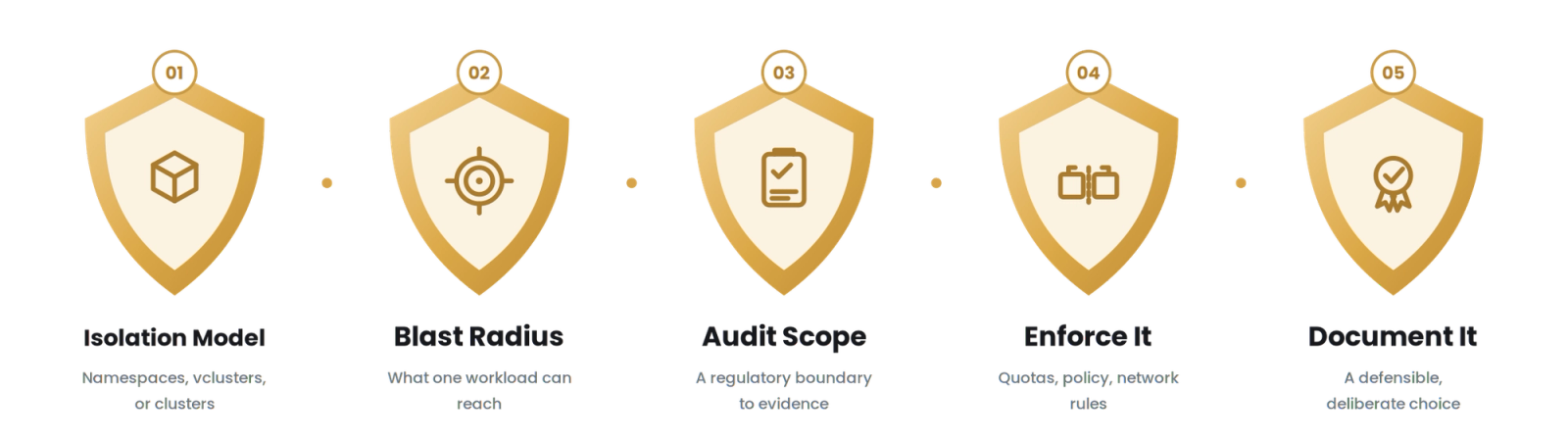
Namespaces, virtual clusters, or separate clusters is a blast-radius and audit-scope decision at the same time.
Three PHI Isolation Gaps Standard RBAC Doesn't Cover in Multi-Tenant AI
Identify PHI isolation gaps standard RBAC misses in multi-tenant AI systems.
Kubernetes multi-tenancy for fintech means choosing an isolation model that matches both the blast radius you can tolerate between workloads and the regulatory boundaries you must be able to evidence, then enforcing it with quotas, policy, and network controls rather than convention.
However, most teams inherit namespaces from their first cluster and never revisit the decision, then discover that scope boundaries drawn with labels are hard to defend.
If you are a VP of Platform Engineering or Head of Developer Experience at a fintech company, the intent of this article is:
- Define the three isolation models and what each actually isolates
- Show why regulatory scope, not just contention, drives the choice here
- Lay out how to pick and evidence a boundary that holds
To do that, let's start with the basics.
What Is Kubernetes Multi-Tenancy for Fintech? The Basic Definition
At a high level, Kubernetes multi-tenancy in a fintech org is how you let multiple workloads and teams share infrastructure without letting them affect each other, and without blurring the boundaries an auditor cares about.
There are three practical models. Namespaces give logical separation inside one cluster with a shared control plane. Virtual clusters give each tenant its own API server view while sharing nodes. Separate clusters isolate everything at the highest operational cost.
In fintech there is an additional axis: whichever model you choose must produce evidence. A boundary you cannot demonstrate is a boundary you will be asked to defend twice, once technically and once on paper.
To compare:
Namespaces are flatmates sharing a house: separate rooms, one fuse box, and a landlord who will ask why the tenant handling cash shares a circuit with everyone else. Virtual clusters are separate flats: your own fuse box, shared foundations.
Separate clusters are separate houses with separate paperwork. The mistake is assuming the technical adequacy of namespaces settles the question. In a regulated environment the model must also be explainable, evidenced, and stable enough that the scope boundary does not move every time someone edits a label.
Why Is a Deliberate Multi-Tenancy Model Necessary for Fintech?
Issues that it addresses or resolves:
- Regulated and non-regulated workloads sharing infrastructure without a documented boundary
- One workload's failure degrading services that process transactions
- Scope boundaries defined by labels that anyone can change
Resolved Issues by a Deliberate Model
- Blast radius matched to the criticality of the workloads involved
- Regulatory scope boundaries that can be evidenced, not argued
- Isolation enforced with quotas, policy, and network controls
Core Components of Kubernetes Multi-Tenancy in Fintech
- A chosen isolation model with a documented rationale
- Regulatory scope boundaries aligned to the isolation boundary
- Resource quotas and limit ranges enforced at admission
- Network policy denying cross-tenant traffic by default
- Control plane protection and per-tenant monitoring
Modern Multi-Tenancy Tooling for Fintech
- Virtual clusters for control plane isolation without cluster sprawl
- Admission policy enforcing quotas, labels, and security context
- Network policy as a default-deny baseline with explicit allows
- API priority and fairness protecting the shared control plane
- Node pools and taints separating regulated from non-regulated workloads
These tools make multi-tenancy defensible. The isolation model is the decision; enforced policy and per-tenant evidence are what turn that decision into a boundary an auditor will accept.
Other Core Issues They Will Solve
- Noisy neighbours contained rather than tolerated near payment paths
- Scope boundaries stable enough to evidence consistently
- Predictable behavior as workload count and criticality grow
In Summary:Kubernetes multi-tenancy for fintech matches the isolation model to both blast radius and regulatory scope, then enforces it with quotas, policy, and control plane protection rather than convention.
Importance of Multi-Tenancy Decisions for Fintech in 2026
Financial platforms consolidate onto shared infrastructure for good reasons, but the boundaries get scrutinised. Four reasons explain why the isolation model matters now.
1. Scope questions are getting sharper.
Auditors increasingly ask specifically how containerised workloads are separated, and generic answers invite deeper inspection.
2. Control plane contention hits transaction paths.
An API server saturated by an analytics controller can degrade the services processing payments, which is a very expensive way to learn about isolation.
3. Label-based boundaries are fragile.
A scope boundary that depends on a label anyone can edit is difficult to evidence and easy to breach accidentally.
4. Virtual clusters changed the economics.
Control plane isolation without full cluster separation is now practical, which makes the old namespaces-or-nothing trade-off obsolete.
Traditional vs. Modern Fintech Cluster Tenancy
- Namespaces by default vs. an isolation model chosen and documented
- Quotas as guidance vs. quotas enforced at admission
- Open cluster networking vs. default-deny network policy
- Scope defined by labels vs. scope aligned to a hard isolation boundary
In summary: A modern fintech approach picks isolation based on blast radius and regulatory scope, enforces it in policy, and can evidence it on demand.
Details About the Core Components of Multi-Tenancy in Fintech: What Are You Designing?
Let's go through each component.
1. Isolation Layer
The model itself.
Isolation decisions:
- Namespaces, virtual clusters, or separate clusters chosen with a rationale
- Regulated workloads separated at a boundary you can evidence
- The model revisited as criticality and scope change
2. Resource Layer
Quotas and limits.
Resource decisions:
- Quotas and limit ranges per tenant, enforced at admission
- Node pools separating regulated from general workloads
- Requests and limits mandatory, never optional
3. Network Layer
Traffic between tenants.
Network decisions:
- Default-deny between namespaces and tenants
- Explicit allow rules for genuine dependencies, documented
- Egress controlled and logged
4. Access Layer
Who can do what.
Access decisions:
- RBAC scoped so teams cannot reach other tenants
- Cluster-scoped resources tightly restricted
- Access changes logged for audit
5. Control Plane Layer
Protecting the shared brain.
Control plane decisions:
- API priority and fairness configured
- Rate limits on high-volume clients
- Per-tenant control plane usage monitored
Benefits Gained from Deliberate Multi-Tenancy in Fintech
- One workload's failure stays away from transaction paths
- Scope boundaries that can be evidenced rather than argued
- Predictable cluster behavior as criticality grows
How It All Works Together
The fintech platform team starts with two questions instead of one: what can one tenant do to another, and where does the regulatory scope boundary need to sit. Those answers together determine the model.
Workloads inside a defined scope, anything touching cardholder data or the ledger, are separated at a boundary strong enough to evidence, which in practice usually means at least a virtual cluster and often a separate cluster with its own node pools.
Less critical workloads share namespaces with strong policy, because the operational cost of separating everything is real and permanent. Whatever the model, the boundary is enforced rather than assumed: quotas and limit ranges are mandatory at admission, network policy denies cross-tenant traffic by default with documented explicit allows, RBAC prevents teams reaching cluster-scoped resources, and egress is controlled and logged rather than open.
API priority and fairness protects the control plane so an analytics workload cannot degrade a payment service through the API server. Per-tenant control plane usage is monitored so a misbehaving client is visible before it becomes an incident.
And the whole design is written down with its rationale, because in a regulated environment the ability to explain the boundary is part of the boundary.
Common Misconception
Namespaces plus network policy is sufficient isolation for regulated workloads.
It may be technically adequate, and it is frequently indefensible, which is a different problem that costs just as much. The isolation is only as strong as the labels and policies that define it, and those are edited routinely by people under time pressure.
A scope boundary that moves when someone adds a label is not a boundary an auditor will accept without extended evidence, and gathering that evidence repeatedly is expensive. There is also the control plane, which namespaces do not isolate at all: an analytics workload with a badly written controller can degrade the API server that your payment services depend on, and no network policy prevents that.
The right question is not whether namespaces can be made to work but whether the resulting boundary is stable, evidenced, and matched to what the workload is worth.
Key Takeaway: Technical adequacy is not the same as defensibility. In fintech, a boundary you cannot evidence cheaply is a boundary you will pay for repeatedly.
Real-World Multi-Tenancy for Fintech in Action
Let's take a look at how it operates with a real-world example.
We worked with a fintech platform team whose regulated and general workloads shared a cluster with only namespace separation, with these constraints:
- Align the isolation boundary with the regulatory scope boundary
- Protect transaction paths from control plane contention
- Make the boundary evidenceable without a three-week exercise
Step 1: Decide the Model
Blast radius and scope.
- Namespaces, virtual clusters, or separate clusters chosen deliberately
- Regulated workloads separated at an evidenceable boundary
- Rationale documented and reviewed
Step 2: Enforce Resource Limits
Quotas at admission.
- Quotas and limit ranges per tenant
- Requests and limits mandatory
- Node pools separating regulated workloads
Step 3: Lock Down the Network
Default deny.
- Cross-tenant traffic denied by default
- Explicit allows documented
- Egress controlled and logged
Step 4: Scope Access
RBAC boundaries.
- Teams cannot reach other tenants
- Cluster-scoped resources restricted
- Access changes logged
Step 5: Protect the Control Plane
Fairness and limits.
- API priority and fairness configured
- Rate limits on heavy clients
- Per-tenant usage monitored
Where It Works Well
- Separate clusters or virtual clusters for regulated workloads
- Namespaces for general workloads with enforced policy
- Teams that document the rationale and can produce evidence quickly
Where It Does Not Work Well
- Regulated workloads separated only by labels anyone can edit
- Shared control planes serving both analytics and payment services
- Any boundary maintained by convention rather than admission policy
Key Takeaway: In fintech, isolate regulated workloads at a boundary you can evidence, and never let scope depend on a mutable label.
Common Pitfalls
i) Scope defined by labels
A boundary that exists because of a label is one careless edit away from not existing. Align regulatory scope with a hard isolation boundary such as a separate cluster or virtual cluster.
- Evidence gathering becomes a manual exercise
- Accidental scope breaches are hard to detect
- Auditors ask increasingly detailed questions
ii) Ignoring the control plane
Teams protect nodes and leave the API server unprotected, so an analytics controller can degrade payment services. Configure priority and fairness and monitor usage per tenant.
iii) Quotas as guidance
An unenforced quota is a suggestion. Reject workloads without requests and limits at admission, or capacity planning near transaction paths becomes guesswork.
iv) Undocumented rationale
Even a good isolation model is a finding if nobody can explain why it was chosen. Write the rationale down and review it when criticality changes.
Takeaway from these lessons: Multi-tenancy in fintech holds when the model is chosen for scope as well as contention, enforced technically, and documented well enough to evidence quickly.
Multi-Tenancy Best Practices for Fintech: What High-Performing Teams Do Differently
1. Align isolation with regulatory scope
Put the technical boundary where the scope boundary is, so evidence is a configuration export rather than a research project.
2. Isolate the control plane for critical paths
Keep payment and ledger services off a control plane shared with heavy or experimental workloads, because API server contention does not respect criticality.
3. Enforce quotas at admission
Reject workloads without requests and limits, so one tenant cannot starve services that process transactions.
4. Default-deny the network and log egress
Allow only documented dependencies and control outbound traffic, because lateral movement is precisely what the boundary exists to prevent.
5. Document the rationale
Write down why this model, for these workloads, reviewed on this cadence, because in a regulated environment the explanation is part of the control.
Logiciel's value add is helping fintech platform teams choose an isolation model that satisfies blast radius and regulatory scope at once, then enforce and evidence it without a manual exercise every audit cycle.
Takeaway for High-Performing Teams: Put the isolation boundary where the scope boundary is, enforce it in admission policy, and keep the rationale current.
Signals You Are Doing Multi-Tenancy Well in Fintech
How do you know it is working? Not by how few clusters you run, but by how quickly you can prove the boundary. These are the signals that separate a real control from a diagram.
The model is documented. Someone can explain the choice and when it gets reviewed.
Scope matches isolation. Regulated workloads sit behind a hard boundary, not a label.
Quotas are enforced. Workloads without requests and limits are rejected at admission.
The control plane is protected. Priority, fairness, and rate limits are configured and monitored.
Evidence is quick. Demonstrating the boundary takes an export, not three weeks.
Adjacent Capabilities and Connected Work
This work does not exist in isolation. Multi-tenancy depends on, and feeds into, the surrounding platform. Ignoring the adjacencies is the most common scoping mistake.
Policy as code enforces quotas, labels, and security context at admission. Secrets management determines what a compromised tenant could reach. Your audit logging pipeline is what turns the boundary into evidence. Observability tells you which tenant is saturating the control plane.
Naming these adjacencies upfront keeps the work scoped and helps leadership see tenancy as a control rather than a cluster setup task.
The common mistake is treating each adjacency as someone else's problem. The admission policy is your problem. The evidence trail is your problem. The review cadence is your problem. Pretend otherwise and the boundary quietly stops matching the scope.
Own the adjacencies you depend on, partner with the teams that hold them, and share the controls.
Conclusion
Multi-tenancy in fintech is a blast-radius decision and a scope decision at the same time. Namespaces isolate resources and, with policy, network traffic, but they share a control plane and they define boundaries with labels that anyone can change.
Virtual clusters isolate the control plane. Separate clusters isolate everything at the highest cost. Put regulated workloads behind a boundary you can evidence in minutes, keep transaction paths off control planes shared with heavy or experimental workloads, enforce every rule in admission policy, and write down why the model was chosen.
Technical adequacy is not enough here. The boundary has to be explainable.
Why More Regions Doesn't Mean a More Resilient System
Identify hidden dependencies that undermine resilience across multi-region architectures.
Key Takeaways:
- Isolation is a blast-radius and regulatory-scope decision, not a cost decision
- Namespaces do not isolate the control plane, which sits under your transaction paths
- A scope boundary defined by mutable labels is expensive to evidence and easy to breach
Getting multi-tenancy right requires deliberate choice. When done correctly, it produces:
- Failures contained away from payment and ledger services
- Scope boundaries that can be evidenced from configuration
- Predictable cluster behavior as criticality grows
- An isolation model with a documented, reviewable rationale
What Logiciel Does Here
If your regulated workloads are separated by labels and hope, we help you choose an isolation model that satisfies both blast radius and audit scope, and enforce it in policy.
Learn More Here:
- Policy as Code for Fintech
- Secrets Management for Fintech
- Kubernetes Operators and Control Plane Load
At Logiciel Solutions, we work with fintech platform leaders on cluster tenancy design. Our reference patterns come from production clusters in regulated payment environments.
Book a technical deep-dive on whether your isolation model would survive an audit question.