
Modernizing a data architecture is expensive and disruptive, so the ROI question is fair and usually answered badly: teams justify it on "the old one is outdated," which is not a number.
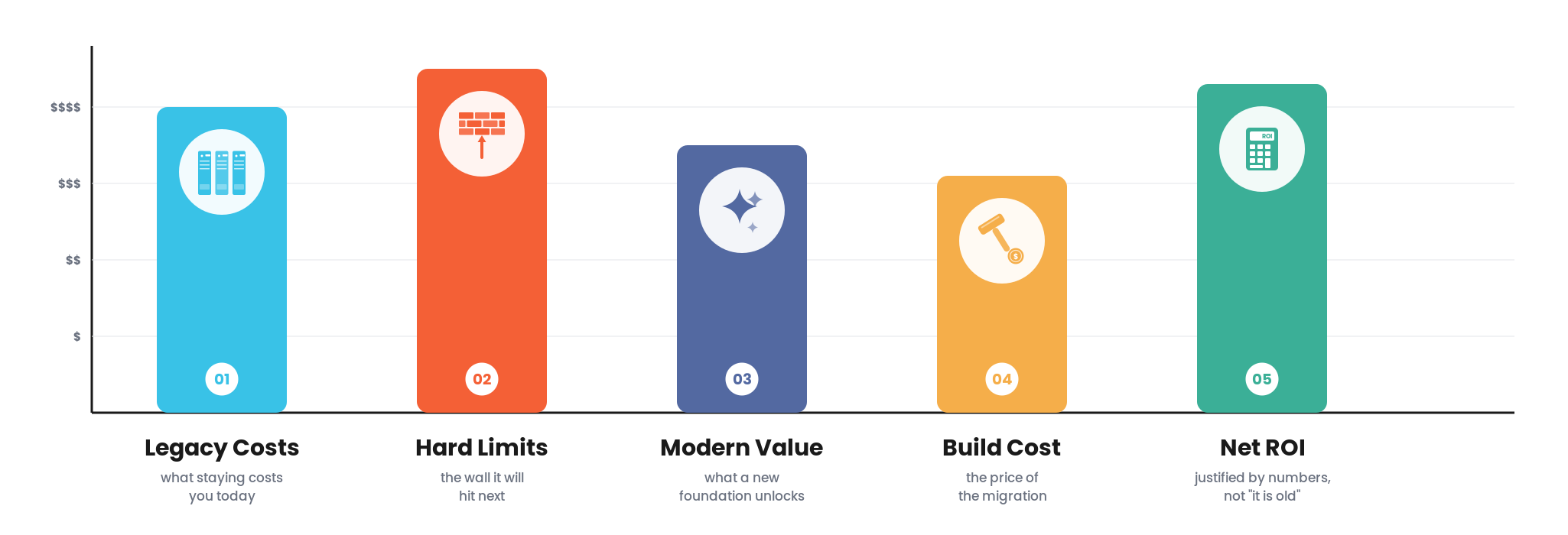
The honest ROI compares the cost of staying on the legacy foundation, the cost it imposes now plus the wall it will hit, against the value a modern architecture enables, weighed against the cost to build it.
Measuring modern data architecture ROI means quantifying what the legacy foundation costs and caps, and what the modern one unlocks, so the investment is justified by numbers rather than "it's old."
Find the Hidden Cost Your Data Infrastructure Is Racking Up
Identify hidden infrastructure costs before they quietly drain your data budget.
Modern data architecture is a data foundation built to scale with volume, velocity, and variety, real-time and batch ingestion, scalable storage and compute, governance, replacing a legacy foundation that is hitting its limits.
The ROI weighs the cost and limits of the legacy foundation, and the value the modern one enables, against the cost to build it. The benefit is real; proving it means measuring both sides.
Where Modern Data Architecture Value Comes From
A legacy data foundation imposes costs and caps: it is slow and expensive to operate at growing scale, it cannot support real-time or new data types, it limits the analytics and AI the business could do, and it will eventually hit a wall that forces a rushed rebuild.
A modern architecture removes those: it scales, supports real-time and varied data, and enables analytics and AI the legacy one cannot. The value is the legacy cost and limits removed plus the capabilities unlocked. ROI is quantifying that against the cost to modernize.
How to Measure the ROI
- Quantify the legacy foundation's cost. Measure what the legacy architecture costs now: operational cost at scale, engineering time worked around its limits, slow delivery, and the cost of capabilities it cannot support.
- Quantify the limits and the looming wall. Estimate what the legacy foundation caps (analytics and AI it cannot support) and the cost of the wall it will hit, since a forced rebuild under load is far more expensive than planned modernization.
- Value what the modern architecture enables. Estimate the value of the capabilities a modern foundation unlocks, real-time, new data types, scalable analytics and AI, that the legacy one cannot.
- Weigh against the modernization cost. Compare the legacy cost and limits removed plus enabled value against the cost to build the modern architecture, producing an ROI.
- Prove it over time. Track the reduced operational cost, faster delivery, and capabilities used after modernization, so the ROI is demonstrated.
Common Misconception
The misconception that stalls modernization: the data architecture is outdated, so modernizing is obviously worth it.
"Outdated" is not a number, and "obviously worth it" does not survive a budget review of an expensive, disruptive modernization. The legacy foundation's cost is often invisible, absorbed in workarounds and slow delivery, so the value of removing it looks like nothing.
Quantifying what the legacy architecture costs and caps, and what the modern one enables, is what turns an obvious-sounding modernization into a provable ROI. Treating it as self-evidently worth it is why modernization stalls at budget.
Key Takeaway: Modern data architecture ROI is the quantified cost and limits of the legacy foundation removed, plus the value the modern one enables, weighed against the build cost. "It's outdated" is not an ROI.
Where Modern Data Architecture ROI Measurement Goes Right
- The legacy foundation's cost and limits quantified
- The value the modern architecture enables estimated
- A business case weighed against build cost, proven over time
Where It Goes Wrong
- Justifying modernization on "it's outdated," not numbers
- Ignoring the invisible cost the legacy foundation imposes
- Not valuing the capabilities the modern architecture unlocks
Key Takeaway: The modernization that gets funded quantifies the legacy cost and limits and the enabled value; the one that stalls relies on "it's outdated."
What High-Performing Teams Do Differently
- Quantify the legacy foundation's operational cost and workarounds.
- Estimate the limits it caps and the cost of the looming wall.
- Value the capabilities the modern architecture enables.
- Weigh against the modernization cost.
- Prove the ROI over time with reduced cost and used capabilities.
Logiciel's value add is helping teams measure and prove modern data architecture ROI, quantifying the legacy foundation's cost and limits, valuing what the modern one enables, and weighing against the build cost, so modernization is justified by numbers rather than "it's outdated."
Takeaway for High-Performing Teams: Measure modern data architecture ROI as the quantified legacy cost and limits removed plus the value the modern foundation enables. The legacy cost is invisible only because it is never totaled.
Quantify both sides, and the modernization becomes a justified investment rather than an "it's outdated" assertion.
Adjacent Capabilities and Connected Work
Modern data architecture ROI shares infrastructure with the data platform, the ingestion pipelines, and the analytics and AI consuming the data, and shares team capacity with data engineering, analytics, and finance. The common scoping mistake is treating each adjacency as someone else's problem: the legacy-cost accounting is your problem, the enabled-value estimation is your problem, the business case is your problem.
Pretending otherwise returns later as a stalled or unproven modernization. Own the adjacencies, partner with the teams that own them, share the timeline.
Conclusion
Modern data architecture ROI is the quantified cost and limits of the legacy foundation removed, operational cost, workarounds, capped capabilities, the looming wall, plus the value the modern foundation enables, weighed against the cost to build it.
"It's outdated" is not an ROI, and the legacy cost is invisible only because it is never totaled. Quantify both sides and prove it over time, and modernization becomes a justified investment rather than an assertion that stalls at budget.
Key Takeaways:
- Modern data architecture ROI is legacy cost and limits removed plus enabled value
- The legacy cost is invisible only because it is never totaled
- Quantify both sides, weigh against build cost, and prove it over time
The Architecture Layer That Decides If Your AI Product Survives Production
Build the architecture layers that make AI products production-ready.
What Logiciel Does Here
If your data architecture modernization is justified on "it's outdated," measure the ROI: quantify the legacy foundation's cost and limits, value what the modern one enables, and weigh against the build cost.
Learn More Here:
- Why Data Architectures Break at 10x
- Modern Data Architecture vs. the Status Quo: A Decision Guide for VP Engineering
- Why Modern Data Architecture Matters for Scaling Energy & Utilities Teams
At Logiciel Solutions, we work with teams on modern data architecture ROI, legacy-cost accounting, enabled-value estimation, and business cases. Our reference patterns come from production data platforms.
Explore how to measure and prove modern data architecture ROI.