
A SaaS platform team adopts OpenTelemetry across thirty product teams and instrumentation coverage climbs quickly. Then a cross-service investigation reveals the problem: one team names the customer identifier attribute one way, another another, a third puts it in a span event rather than an attribute, and two teams have included a high-cardinality field that is quietly costing more than the rest of the telemetry combined.
Every team instrumented correctly according to the guidance they read. There was no enforced convention, so the traces exist and cannot be joined.
Instrumentation without enforced semantic conventions produces telemetry that is present and unjoinable.
OpenTelemetry for SaaS means adopting a vendor-neutral instrumentation standard with semantic conventions enforced at collection, sampling strategy set centrally, and cardinality controlled, so telemetry from thirty teams composes into something answerable.
Why “Context” Is Becoming the New Cloud Infrastructure Layer
Understand how context infrastructure is reshaping retrieval and intelligent systems.
However, most adoptions measure instrumentation coverage, which rises quickly while the attribute naming drift that makes cross-service investigation possible goes unmanaged.
If you are a VP of Engineering or Head of Infrastructure at a SaaS company, the intent of this article is:
- Define why semantic conventions must be enforced not documented
- Show how cardinality quietly dominates telemetry cost
- Lay out how sampling strategy belongs centrally
To do that, let's start with the basics.
What Is OpenTelemetry for SaaS? The Basic Definition
At a high level, OpenTelemetry is a vendor-neutral standard for generating and collecting traces, metrics, and logs, with a collector layer that processes and exports to backends. The portability is genuine and it is not the main benefit in a multi-team estate.
The main benefit is that thirty teams can produce telemetry that composes, provided semantic conventions are enforced so the same concept carries the same attribute name everywhere. Without that, you have adopted a standard for the wire format and not for the meaning, which is the half that determines whether a cross-service investigation is possible.
To compare:
OpenTelemetry without enforced conventions is thirty teams writing in the same alphabet and different languages. The transport works, the storage works, and joining a request path across four services requires someone to translate each hop. The standard solved the encoding problem, which was never the one blocking the investigation.
Why Does OpenTelemetry Matter for SaaS?
Issues that it addresses or resolves:
- Telemetry from many teams that cannot be joined
- Attribute naming drifting per team
- Cardinality quietly dominating telemetry cost
Resolved Issues by OpenTelemetry Done Well
- Conventions enforced so traces compose across services
- Sampling strategy set centrally rather than per team
- Cardinality controlled before it dominates the bill
Core Components of OpenTelemetry Adoption in SaaS
- Semantic conventions defined and enforced at collection
- Sampling strategy set centrally with tail-based options
- Cardinality limits applied in the collector
- Collector configuration owned centrally
- Vendor portability preserved deliberately
Modern OpenTelemetry Tooling for SaaS
- Collector deployments with processing pipelines
- Attribute normalisation and validation at collection
- Tail-based sampling for trace completeness
- Cardinality limiting and attribute dropping
- Per-team telemetry volume and cost attribution
These tools make thirty teams' telemetry composable. Attribute normalisation at collection is what corrects drift without requiring thirty teams to change code simultaneously.
Other Core Issues They Will Solve
- Cross-service investigation possible without translation
- Telemetry cost attributable per team
- Backend changes without re-instrumenting
In Summary: OpenTelemetry for SaaS delivers composable telemetry across many teams when semantic conventions are enforced at collection and cardinality is controlled centrally.
Importance of OpenTelemetry for SaaS in 2026
Multi-team estates generate telemetry faster than they standardise it. Four reasons explain why this matters now.
1. Cross-service investigation is the point.
A trace that stops at a service boundary because the next hop named things differently does not help.
2. Convention drift is invisible until needed.
Every team's instrumentation looks correct in isolation, and the incompatibility appears during an incident.
3. Cardinality dominates cost quietly.
One high-cardinality attribute in one service can exceed the cost of everything else.
4. The collector is the enforcement point.
Correcting drift in thirty codebases is slow; correcting it at collection is a configuration change.
Traditional vs. Modern SaaS Telemetry
- Per-team instrumentation choices vs. enforced semantic conventions
- Sampling per service vs. strategy set centrally
- Cardinality unmanaged vs. limited at collection
- Vendor-specific agents vs. portable instrumentation
In summary: A modern SaaS approach enforces conventions and cardinality limits at the collector, which is the only point that can correct thirty teams at once.
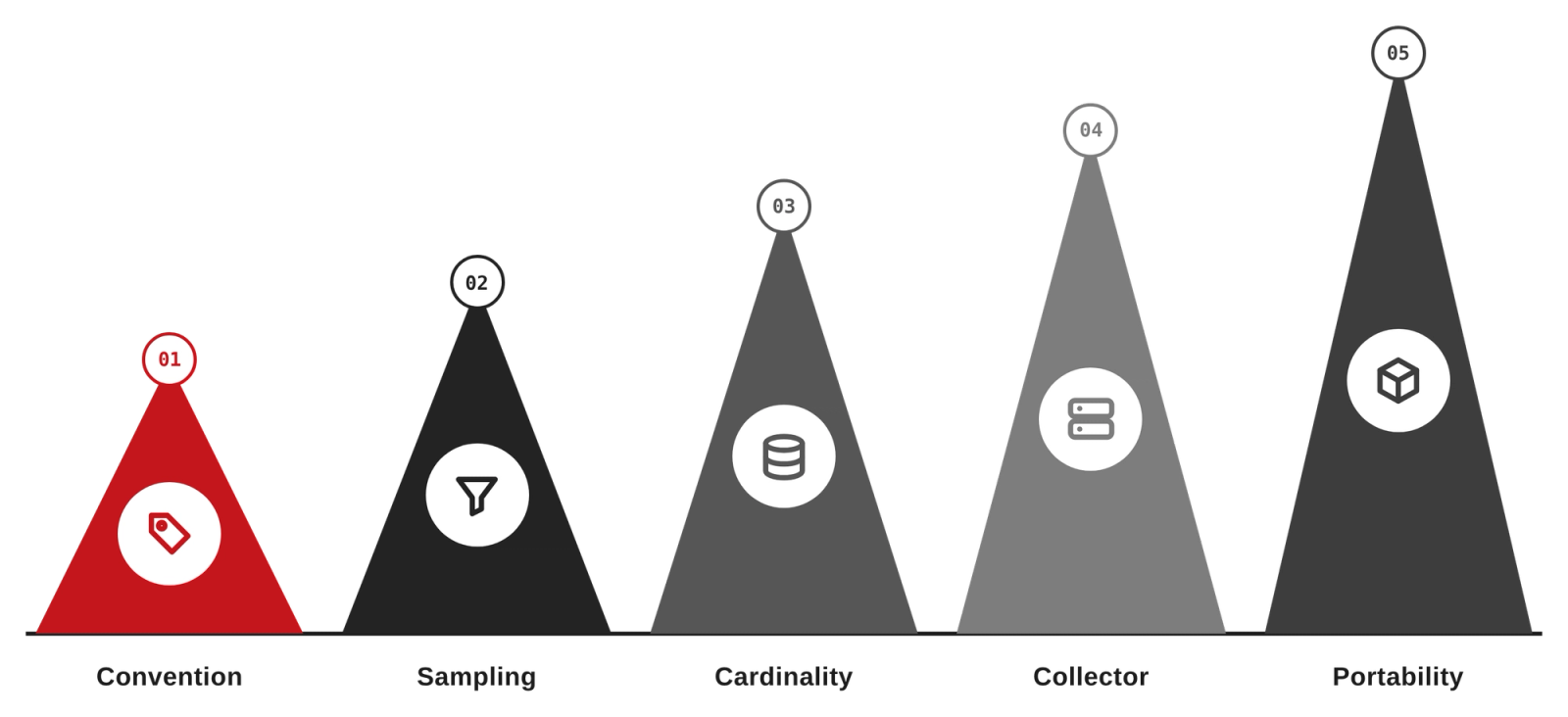
Details About the Core Components of OpenTelemetry Adoption in SaaS: What Are You Designing?
Let's go through each component.
1. Convention Layer
The same name everywhere.
Convention decisions:
- Semantic conventions defined for shared concepts
- Enforcement at collection rather than in documentation
- Drift detected and normalised
2. Sampling Layer
Centrally decided.
Sampling decisions:
- Strategy set centrally, not per service
- Tail-based sampling where trace completeness matters
- Rates reviewed against investigation needs
3. Cardinality Layer
Controlling the cost driver.
Cardinality decisions:
- Limits applied in the collector
- High-cardinality attributes identified and dropped
- Cost attributed per team
4. Collector Layer
The enforcement point.
Collector decisions:
- Configuration owned centrally
- Processing pipelines normalising attributes
- Changes deployable without team involvement
5. Portability Layer
Keeping the option.
Portability decisions:
- Vendor-specific features used deliberately
- Export configuration separable from instrumentation
- Backend change cost understood
Benefits Gained from OpenTelemetry in SaaS
- Traces that join across service boundaries
- Telemetry cost attributable and controllable
- Backend changes without re-instrumenting thirty services
How It All Works Together
The SaaS platform team defines semantic conventions for the concepts that appear across services, customer identifier, tenant, request identifier, operation name, and enforces them at collection rather than publishing guidance and hoping.
That enforcement point matters enormously: correcting attribute naming drift across thirty codebases requires thirty teams to prioritise a change, while normalising at the collector is a configuration deployment. Sampling strategy is set centrally with tail-based sampling where trace completeness matters, because per-service sampling produces traces with gaps that make cross-service investigation unreliable.
Cardinality limits are applied in the collector with high-cardinality attributes identified and dropped, since a single such attribute in one service can exceed the telemetry cost of everything else and nobody notices until the bill.
Cost is attributed per team so the conversation is specific. And export configuration is kept separable from instrumentation so vendor portability remains real rather than theoretical.
Common Misconception
We adopted OpenTelemetry, so our telemetry is standardised.
You standardised the wire format and the SDK, which is the easy and less consequential half. What determines whether a trace can be followed across four services is whether all four named the same concept identically, and nothing in the standard enforces that by itself.
Semantic conventions exist and are frequently treated as guidance, so thirty teams each make locally reasonable choices and the incompatibility surfaces during an incident when someone tries to join a request path.
The adoption was real. The standardisation that mattered was never enforced, and enforcing it at the collector is considerably faster than asking thirty teams to change code.
Key Takeaway: The standard covers the wire format. Whether traces join depends on conventions, which need enforcing at collection.
Real-World OpenTelemetry for SaaS in Action
Let's take a look at how it operates with a real-world example.
We worked with a SaaS platform team whose traces existed and could not be joined across services, with these constraints:
- Enforce semantic conventions at collection
- Set sampling strategy centrally
- Control cardinality before it dominates cost
Step 1: Define the Conventions
For shared concepts.
- Conventions defined for cross-service concepts
- Documented and published
- Drift identified in current telemetry
Step 2: Enforce at Collection
Not in documentation.
- Attribute normalisation in the collector
- Validation rejecting or correcting drift
- Changes deployable centrally
Step 3: Set Sampling Centrally
With tail-based where needed.
- Strategy owned centrally
- Tail-based sampling for completeness
- Rates reviewed against needs
Step 4: Control Cardinality
Before the bill.
- Limits applied in the collector
- High-cardinality attributes dropped
- Cost attributed per team
Step 5: Preserve Portability
Deliberately.
- Export configuration separable
- Vendor features used knowingly
- Backend change cost understood
Where It Works Well
- Multi-team estates needing cross-service investigation
- Collector deployments able to normalise attributes
- Programmes controlling cardinality centrally
Where It Does Not Work Well
- Conventions published as guidance without enforcement
- Sampling decided per service
- Cardinality unmanaged until it appears on the bill
Key Takeaway: Enforce conventions at the collector, set sampling centrally, and limit cardinality before it dominates cost.
Common Pitfalls
i) Conventions as guidance
Thirty teams each make locally reasonable naming choices and traces stop joining at boundaries. Enforce and normalise at collection instead.
- Cross-service investigation requires translation per hop
- The incompatibility surfaces during an incident
- Every team instrumented correctly
ii) Cardinality unmanaged
One high-cardinality attribute in one service can exceed everything else in cost. Limit at the collector and attribute cost per team.
iii) Sampling per service
Independent sampling decisions produce traces with gaps, which makes cross-service paths unreliable. Set strategy centrally with tail-based sampling where completeness matters.
iv) Vendor coupling through instrumentation
Using vendor-specific features in instrumentation rather than in export configuration removes the portability you adopted the standard for.
Takeaway from these lessons: The collector is the only place you can correct thirty teams at once, which makes it the enforcement point.
OpenTelemetry Best Practices for SaaS: What High-Performing Teams Do Differently
1. Enforce conventions at the collector
Normalise attribute naming centrally rather than asking thirty teams to change code, because one is a deployment and the other is a quarter.
2. Set sampling strategy centrally
Use tail-based sampling where trace completeness matters, since per-service decisions produce gaps that break cross-service investigation.
3. Limit cardinality and attribute cost
Control it in the collector and report cost per team, because a single attribute can dominate the bill invisibly.
4. Keep export configuration separable
Preserve real portability by keeping vendor-specific choices out of instrumentation.
5. Detect drift continuously
Monitor for attributes that do not match conventions, since new services introduce drift constantly.
Logiciel's value add is helping SaaS platform teams enforce semantic conventions and cardinality control at the collector, so telemetry from thirty teams composes into something answerable.
Takeaway for High-Performing Teams: Enforce at the collector, sample centrally, limit cardinality, keep export separable, detect drift.
Signals You Are Doing OpenTelemetry Well in SaaS
How do you know it is working? Not by instrumentation coverage, but by whether a trace crosses four services. These are the signals that separate composable telemetry from present telemetry.
Traces join. A request path can be followed across service boundaries.
Conventions are enforced. Attribute naming is normalised at collection.
Cardinality is controlled. No single attribute dominates cost.
Sampling is central. Trace completeness is a deliberate decision.
Cost is attributed. Telemetry spend is visible per team.
Adjacent Capabilities and Connected Work
This work does not exist in isolation. OpenTelemetry adoption depends on, and feeds into, the surrounding platform. Ignoring the adjacencies is the most common scoping mistake.
AIOps consumes the telemetry for correlation and depends on its consistency. AI-assisted SRE assembles context from it. The service catalog supplies ownership for attribution. FinOps guardrails supply the cost discipline. Naming these adjacencies upfront keeps the work scoped and helps leadership see the collector as the enforcement point.
The common mistake is treating each adjacency as someone else's problem. The convention enforcement is your problem. The cardinality control is your problem. The sampling strategy is your problem. Pretend otherwise and you will have complete instrumentation and unjoinable traces.
Own the adjacencies you depend on, partner with the teams that hold them, and share the conventions.
Conclusion
Adopting OpenTelemetry standardises the wire format and the SDK, which is the straightforward half. Whether a trace can be followed across four services depends on all four naming the same concept identically, and semantic conventions treated as published guidance produce thirty locally reasonable choices that do not compose.
Enforce conventions at the collector, because that is the only point where thirty teams can be corrected with a configuration deployment rather than a quarter of coordinated code changes. Set sampling strategy centrally with tail-based sampling where completeness matters, limit cardinality before it dominates the bill invisibly, attribute cost per team, and keep export configuration separable so portability stays real.
Key Takeaways:
- The standard covers wire format; conventions determine whether traces join
- The collector is the only point that can correct thirty teams at once
- A single high-cardinality attribute can exceed all other telemetry cost
Adopting OpenTelemetry well requires central enforcement. When done correctly, it produces:
- Traces that join across service boundaries
- Telemetry cost attributable and controllable per team
The AI Product Playbook: Launch Faster, Scale Smarter, Fund with Confidence
Launch faster, scale smarter, and approach funding with greater confidence.
- Trace completeness as a deliberate decision
- Backend changes without re-instrumenting
What Logiciel Does Here
If your traces exist and cannot be joined across services, we help you enforce semantic conventions at the collector, set central sampling, and control cardinality.
Learn More Here:
- AIOps for Technology & SaaS
- AI-Assisted SRE for Technology & SaaS
- FinOps Guardrails for Technology & SaaS
At Logiciel Solutions, we work with SaaS engineering leaders on observability. Our reference patterns come from estates with many instrumenting teams.
Book a technical deep-dive on making thirty teams' telemetry compose.