
A fintech platform team ships automation that restarts any unhealthy service, and the on-call rota gets noticeably quieter. Two months later, a reconciliation service that had been silently restarting several times an hour turns out to have been dropping a small number of in-flight messages each time.
The count is small. The consequence is not, because in payments a dropped message is a transaction someone has to find, explain, and remediate by hand. The automation did exactly what it was built to do.
It also spent two months converting a visible defect into an invisible one, and it left no clean record of when each restart happened or why.
Self-healing is not about fixing more. It is about fixing narrow known things, verifying the fix, and staying loud.
Audit-Ready Beats Audit-Survived Every Time. Here's the Difference
Build audit readiness that prevents repeat findings before follow-up reviews.
Self-healing infrastructure for fintech means automated remediation loops that detect a specific known failure condition, apply a documented fix, verify recovery, log the action for audit, and escalate to a human when the fix does not hold, so operational toil disappears without hiding defects or losing the record.
However, most teams build blanket automation that restarts anything unhealthy, and end up masking chronic defects in systems where a masked defect becomes a reconciliation problem.
If you are a VP of Platform Engineering or Head of Developer Experience at a fintech company, the intent of this article is:
- Define self-healing as narrow, verified, auditable remediation
- Show why blanket automation is a data integrity risk in payments
- Lay out how to build remediation loops your engineers and auditors both trust
To do that, let's start with the basics.
What Is Self-Healing Infrastructure for Fintech? The Basic Definition
At a high level, self-healing infrastructure in a fintech org is a set of automated loops that recognize one specific known failure, apply the exact remediation already documented for it, verify that the system actually recovered, record the whole thing in a form an auditor can read, and escalate when the fix does not hold.
The critical word is specific. These are not general recovery mechanisms. Each loop automates one remediation your engineers have already performed manually many times, and each one is rate-limited and reports its own frequency, because in a financial system a remediation that keeps firing is a defect with money attached to it.
To compare:
Blanket automation that restarts anything unhealthy is a smoke detector wired to a fan. The alarm stops and the room looks fine. A narrow remediation loop is a specific fix for a specific known problem that reports every time it fires and leaves an audit record, so the underlying defect stays visible while the symptom is handled.
Both quiet the pager in month one. Only one still tells you the truth in month six, and only one survives a conversation about why transactions went missing. The narrowness and the record, not the automation, are what make self-healing safe in fintech.
Why Is Narrow Self-Healing Necessary for Fintech?
Issues that it addresses or resolves:
- Recurring failures burning engineer time on the same manual fix
- Blanket automation masking defects that cause transaction-level damage
- Remediation running without verification, logging, or escalation
Resolved Issues by Narrow Self-Healing
- Known failures fixed automatically with a documented, verified remediation
- Chronic defects surfaced through recurrence tracking rather than hidden
- Every automated action logged and attributable for audit
Core Components of Self-Healing Infrastructure in Fintech
- Detection tied to a specific, well-defined failure condition
- A remediation drawn from an existing, proven runbook
- Verification that the system genuinely recovered
- Audit-grade logging of every automated action
- Rate limits and escalation when the fix does not hold
Modern Self-Healing Tooling for Fintech
- Health checks precise enough to name the failure, not just flag unhealthiness
- Runbook automation executing documented steps without improvisation
- Post-remediation verification before the loop declares success
- Immutable logging of intent, action, and outcome
- Alerting on remediation frequency, not only on failure
These tools make self-healing defensible in a regulated financial environment. Narrow detection, verified remediation, and a complete record are what keep automation from becoming a system that quietly destroys evidence.
Other Core Issues They Will Solve
- Engineers stop repeating the same manual fix at three in the morning
- Recovery happens in seconds instead of after a page and a login
- Chronic problems become tickets instead of background noise
In Summary: Self-healing infrastructure for fintech automates specific documented remediations with verification, audit logging, and escalation, so toil disappears while defects and their records stay intact.
Importance of Self-Healing Infrastructure for Fintech in 2026
Financial platforms run continuously and are judged on both uptime and correctness. Four reasons explain why narrow self-healing matters now.
1. Correctness matters more than uptime.
A service that restarts cleanly but drops in-flight work has traded an outage for a reconciliation problem, which is a worse trade.
2. Toil compounds and burns your best engineers.
The same manual fix twice a week is a full engineer-week per year, performed by the people you least want doing it.
3. Audit expects a record of every change.
An automated action with no log is a change nobody can explain, and in fintech unexplained changes become findings.
4. Masked defects surface in the ledger.
A hidden problem in a financial system does not stay hidden. It shows up in reconciliation, and by then it is expensive.
Traditional vs. Modern Fintech Recovery
- Page a human for every failure vs. automate the known ones and page for the rest
- Restart anything unhealthy vs. apply a specific fix to a specific condition
- Assume the fix worked vs. verify recovery before closing the loop
- Silent remediation vs. logged, attributable actions with recurrence alerting
In summary: A modern fintech approach automates narrow, verified, fully logged remediations and gets louder as they repeat, rather than suppressing symptoms in systems where symptoms carry money.
Details About the Core Components of Self-Healing Infrastructure in Fintech: What Are You Designing?
Let's go through each component.
1. Detection Layer
A specific condition.
Detection decisions:
- Health checks identify the exact failure, not general unhealthiness
- Conditions defined narrowly enough to match one remediation
- In-flight work considered before anything is restarted
2. Remediation Layer
A documented fix.
Remediation decisions:
- Steps drawn from an existing proven runbook
- One remediation per condition, no improvised branching
- Graceful draining preferred over hard restarts
3. Verification Layer
Did it work.
Verification decisions:
- Recovery confirmed before the loop declares success
- Data consistency checked, not just process health
- Failure to recover escalates immediately
4. Audit Layer
The record.
Audit decisions:
- Intent, action, and outcome logged together
- Actions attributable to a specific loop and trigger
- Logs immutable and retained to policy
5. Escalation Layer
When humans take over.
Escalation decisions:
- Rate limits enforced, with escalation past the cap
- Repeated remediation raises a defect ticket
- Recurrence trends reviewed with the owning team
Benefits Gained from Narrow Self-Healing in Fintech
- Recurring failures resolved in seconds without a human
- Chronic defects surfaced before they reach reconciliation
- A complete, auditable record of every automated action
How It All Works Together
The fintech platform team starts from the runbook, not the automation tooling. They look for failures engineers have already fixed the same way repeatedly, because those are the only remediations whose behavior is predictable.
Detection is then written to identify that specific condition precisely, so a loop built for a stuck consumer cannot fire on an unrelated memory problem. The remediation is the documented runbook step, and in a financial system that usually means draining in-flight work gracefully rather than killing a process, because a hard restart is how transactions go missing.
After the fix runs, verification confirms not just that the process is alive but that the data is consistent, and if it is not, the loop escalates rather than retrying. Every action is logged with intent, action, and outcome together, in a form an auditor can read months later, because an unexplained automated change is a finding waiting to happen.
Rate limits cap how often each loop may run, and hitting that cap stops the automation and raises a human. Remediation frequency is alerted on, so a loop firing thirty times a week produces a defect ticket rather than a quiet success metric.
The result is that known toil disappears while unknown problems get louder and remain fully documented.
Common Misconception
The goal is to automate as many failure types as possible.
Coverage is the wrong target, and in fintech chasing it is actively dangerous. Every remediation you automate without fully understanding it is a place where the loop will act on a condition it misread, or keep suppressing a symptom whose cause is drifting toward the ledger.
The right target is not the percentage of failures automated; it is the percentage of your automated remediations that are narrow, verified, logged, and loud. Four trustworthy loops beat forty that restart things.
And in a payments environment, a hard restart is not a neutral action: it can drop in-flight work, break idempotency assumptions, and create exactly the kind of discrepancy that takes a week to trace.
Automate what you have already proven by hand, verify the data afterward, and leave everything else to a page.
Key Takeaway: Coverage is not the goal. A few narrow, verified, auditable remediations beat broad automation that suppresses symptoms in systems carrying money.
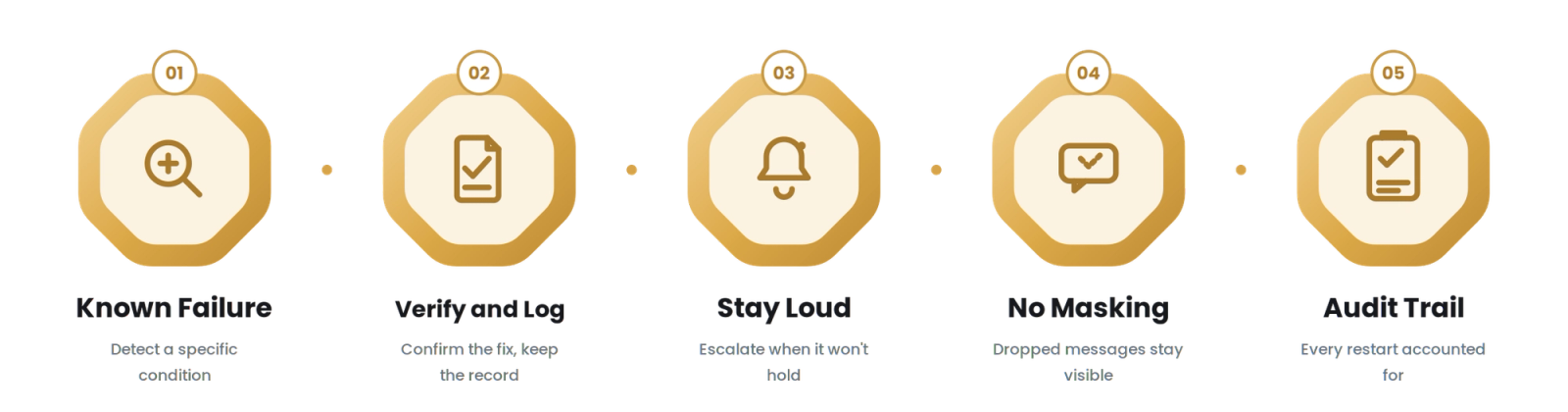
Real-World Self-Healing for Fintech in Action
Let's take a look at how it operates with a real-world example.
We worked with a fintech platform team whose blanket restart automation had been dropping in-flight messages for weeks, with these constraints:
- Automate only remediations already proven manually
- Verify data consistency, not just process health
- Keep an audit-grade record of every automated action
Step 1: Detect a Specific Condition
Precise, not general.
- Health checks identify the exact failure
- Conditions matched to one remediation
- In-flight work accounted for
Step 2: Apply the Documented Fix
Runbook, unchanged.
- Steps taken directly from the runbook
- Graceful draining over hard restart
- No improvised branching
Step 3: Verify Recovery
Did it hold.
- Data consistency checked after the fix
- Failure escalates immediately
- No silent retries
Step 4: Log for Audit
The record.
- Intent, action, and outcome logged together
- Actions attributable to loop and trigger
- Logs immutable and retained
Step 5: Escalate on Recurrence
Surface the defect.
- Rate limits enforced with escalation
- Repeated fixes raise a ticket
- Trends reviewed with the owning team
Where It Works Well
- Well-understood failures with a proven, non-destructive manual remediation
- Services where recovery can be verified against data, not just liveness
- Teams that treat remediation frequency as a defect signal
Where It Does Not Work Well
- Services holding in-flight financial state with no graceful drain
- Novel or ambiguous failures nobody has diagnosed yet
- Orgs that measure success purely by page volume
Key Takeaway: Self-healing works in fintech where the failure is understood, the fix is non-destructive, and the record is complete. It fails where automation restarts things holding money.
Common Pitfalls
i) Restarting services that hold in-flight work
A hard restart is not neutral in a payments system. Drain gracefully, confirm the queue is empty, and never automate a restart on a service whose in-flight state is not recoverable.
- In-flight transactions are lost
- Reconciliation problems appear weeks later
- The cause is buried under successful restarts
ii) No verification of data consistency
A process that is alive is not a system that is correct. Verify the data after remediation, not just the liveness probe, and escalate when the check fails.
iii) No audit record
An automated change with no log is a change you cannot explain to an auditor. Log intent, action, and outcome together, immutably, for every loop.
iv) Silent success
Automation that fixes quietly deletes the evidence a defect exists. Alert on remediation frequency so recurring fixes become tickets for the owning team.
Takeaway from these lessons: Self-healing earns trust in fintech through narrowness, verified data consistency, complete audit records, and loud recurrence, not through coverage.
Self-Healing Best Practices for Fintech: What High-Performing Teams Do Differently
1. Start from the runbook, not the platform
Automate remediations your engineers already perform reliably by hand, because only those have predictable behavior under pressure.
2. Drain, do not kill
Prefer graceful shutdown and drain over hard restarts anywhere in-flight financial state exists, because dropped work is more expensive than downtime.
3. Verify the data, not just the process
Confirm consistency after remediation and escalate when it fails, since a healthy process holding wrong state is the worst outcome.
4. Log everything for audit
Record intent, action, and outcome immutably, because an automated change you cannot explain becomes a finding.
5. Make recurrence loud
Alert on how often each loop fires so chronic defects produce tickets rather than disappearing into an uptime number.
Logiciel's value add is helping fintech platform teams build narrow, verified, fully auditable remediation loops that remove real toil while keeping defects and their records visible.
Takeaway for High-Performing Teams: Automate a few remediations you fully understand, drain rather than kill, verify the data, log for audit, and make repetition impossible to ignore.
Signals You Are Doing Self-Healing Well in Fintech
How do you know it is working? Not by how quiet the pager got, but by whether defects still surface and every action is explainable. These are the signals that separate trustworthy remediation from quiet suppression.
Loops are narrow. Each one handles a single well-understood failure condition.
Nothing is killed abruptly. Services holding in-flight work drain gracefully.
Recovery is verified against data. Consistency is checked, not just liveness.
Actions are auditable. Every automated fix has an immutable, attributable record.
Repetition is loud. A loop firing frequently produces a defect ticket.
Adjacent Capabilities and Connected Work
This work does not exist in isolation. Self-healing depends on, and feeds into, the surrounding platform. Ignoring the adjacencies is the most common scoping mistake.
Observability is what makes detection precise enough to be safe. Runbook automation is what the remediation executes. Incident management is where escalation lands. Your audit logging pipeline is what makes automated actions defensible.
Naming these adjacencies upfront keeps the work scoped and helps leadership see self-healing as an operational and control discipline rather than a way to shrink the on-call rota.
The common mistake is treating each adjacency as someone else's problem. The detection quality is your problem. The audit record is your problem. The recurrence reporting is your problem. Pretend otherwise and the automation becomes the place where defects and their evidence both disappear.
Own the adjacencies you depend on, partner with the teams that hold them, and share the signal.
Conclusion
Self-healing infrastructure in fintech earns trust one narrow remediation at a time. Automate the failures your engineers already fix the same way every time, detect those conditions precisely, drain rather than kill anything holding in-flight financial state, verify data consistency after the fix, log every action in a form an auditor can read, cap how often a loop may run, and make repetition loud enough to produce a defect ticket.
Blanket automation that restarts anything unhealthy will quiet your pager and hand you a reconciliation problem three months later. Build a handful of loops you fully trust instead.
Key Takeaways:
- Self-healing means narrow, verified, auditable remediation, not blanket recovery
- Hard restarts in payments systems trade an outage for a reconciliation problem
- Rate limits, recurrence alerting, and audit logs are what keep remediation honest
Building self-healing well requires restraint. When done correctly, it produces:
- Recurring failures resolved in seconds without a human
- Chronic defects surfaced before they reach the ledger
- A complete, attributable record of every automated action
- Engineers who trust the automation enough to leave it enabled
How an Energy Company Stopped Paying for Silent Data Quality Failures
Detect silent data quality failures faster and reduce operational risk.
What Logiciel Does Here
If your remediation automation is quietly restarting services that hold in-flight transactions, we help you rebuild it as narrow, verified, fully logged loops with escalation that keeps defects visible.
Learn More Here:
- Runbook Automation for Fintech
- Observability and Precise Failure Detection
- AI Incident Management for Fintech
At Logiciel Solutions, we work with fintech platform leaders on remediation automation. Our reference patterns come from production self-healing systems in regulated payment environments.
Book a technical deep-dive on remediation loops your engineers and auditors both trust.