
A real estate company gives its analysts a text to SQL interface over the warehouse. It works impressively in demos. Then someone asks for average price per square foot by submarket, and the generated query joins a listings table to a transactions table on a property identifier that means different things in each, silently double counting properties with multiple listing events.
The answer looks reasonable, is wrong by a material margin, and nobody catches it because the number is plausible and the query was not read.
The failure mode is not a broken query. It is a plausible wrong number nobody checked.
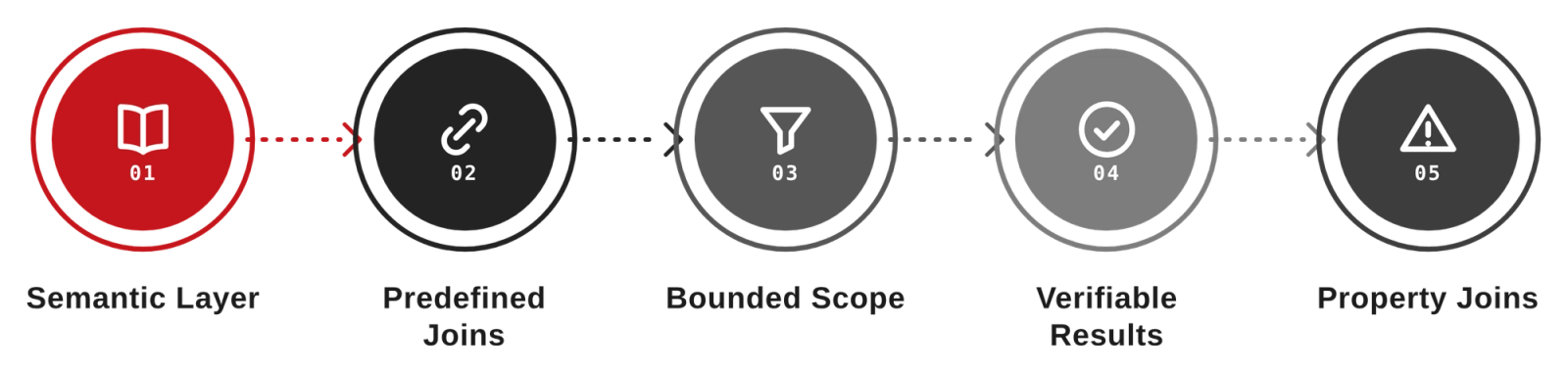
Text-to-SQL for real estate means generating queries from natural language over a curated semantic layer rather than raw tables, with join paths predefined, question scope bounded, and results verifiable, so plausible wrong answers are structurally hard to produce.
What Spider 2.0 and EntSQL 2026 Reveal About Text-to-SQL in Production
Understand where text-to-SQL benchmarks expose real production readiness gaps.
However, most deployments point a model at the warehouse schema, which maximises coverage and guarantees that the hard joins get guessed.
If you are a CDO or VP of Data at a real estate company, the intent of this article is:
- Define why a semantic layer, not the raw schema, is the right target
- Show why property data joins are unusually easy to get wrong
- Lay out how to bound scope so plausible wrong answers are rare
To do that, let's start with the basics.
What Is Text-to-SQL for Real Estate? The Basic Definition
At a high level, text to SQL turns a natural language question into a query and returns a result. The quality of that result depends almost entirely on what the model is generating against.
Pointed at raw tables it must infer which of several identifiers to join on, how to handle one-to-many relationships, and which of four date columns represents the event in question. Pointed at a curated semantic layer with predefined join paths, agreed metric definitions, and a bounded set of dimensions, it is choosing from a much smaller and safer space.
In property data, where the same identifier commonly appears with different grain across listings, transactions, and valuations, that difference decides correctness.
To compare:
Text to SQL over raw tables is a capable new analyst on day one with database access and no context. They will write syntactically perfect queries and get the joins wrong, because knowing that the listing identifier is not unique per property is institutional knowledge rather than schema information.
A semantic layer is that institutional knowledge written down, which is what makes the new analyst useful in week one rather than dangerous.
Why Does Text-to-SQL Matter for Real Estate?
Issues that it addresses or resolves:
- Analysts waiting on a queue for routine property questions
- Generated queries guessing join paths across mismatched grain
- Plausible wrong numbers circulating unchecked
Resolved Issues by Text-to-SQL Done Well
- Routine questions answered without a queue
- Join paths predefined rather than inferred
- Answers verifiable against a definition someone owns
Core Components of Text-to-SQL in Real Estate
- A curated semantic layer as the generation target
- Predefined join paths and grain handling
- Agreed metric definitions with owners
- Bounded question scope with graceful refusal
- Result verification and query visibility
Modern Text-to-SQL Tooling for Real Estate
- Semantic layers exposing metrics and dimensions
- Generation constrained to the semantic layer
- Query display alongside results
- Refusal when a question falls outside scope
- Feedback capture on wrong answers
These tools reduce plausible wrong answers. Constraining generation to a semantic layer is the single change that matters most, because it removes the joins that get guessed.
Other Core Issues They Will Solve
- Consistent metric definitions across answers
- Fewer analyst hours on routine lookups
- Wrong answers surfaced rather than circulated
In Summary: Text to SQL for real estate works when generation targets a curated semantic layer with predefined joins and bounded scope, not the raw warehouse schema.
Importance of Text-to-SQL for Real Estate in 2026
Property questions are frequent, repetitive, and easy to get subtly wrong. Four reasons explain why this matters now.
1. Property data has grain traps everywhere.
Listings, transactions, valuations, and units relate at different grain, and joining them naively double counts.
2. Plausible wrong answers travel.
A price per square foot figure that looks reasonable gets quoted in a deck before anyone validates it.
3. Analyst queues are the bottleneck.
Routine lookups consume analyst time that could go to genuine analysis.
4. Definitions differ between teams.
Without agreed metrics, two correct queries produce two different answers to the same question.
Traditional vs. Modern Real Estate Analytics Access
- Generation over raw tables vs. over a curated semantic layer
- Joins inferred vs. predefined with grain handled
- Answers returned bare vs. with query and definition visible
- Any question attempted vs. scope bounded with graceful refusal
In summary: A modern real estate approach constrains generation to curated definitions and refuses questions outside scope.
Details About the Core Components of Text-to-SQL in Real Estate: What Are You Designing?
Let's go through each component.
1. Semantic Layer
The generation target.
Semantic decisions:
- Metrics and dimensions curated deliberately
- Join paths predefined
- Grain handled explicitly per entity
2. Definition Layer
Agreed meanings.
Definition decisions:
- Metric definitions documented with owners
- Ambiguous terms resolved before exposure
- Definitions surfaced with answers
3. Scope Layer
What it will attempt.
Scope decisions:
- Answerable question space bounded
- Out-of-scope questions refused clearly
- Refusal preferred to a guess
4. Transparency Layer
Showing the work.
Transparency decisions:
- Generated query displayed with the result
- Definition used shown alongside
- Assumptions stated
5. Feedback Layer
Learning from errors.
Feedback decisions:
- Wrong answers reportable in one action
- Reports routed to the semantic layer owner
- Patterns used to extend curation
Benefits Gained from Text-to-SQL in Real Estate
- Routine property questions answered immediately
- Consistent answers because definitions are shared
- Wrong answers caught through visible queries and feedback
How It All Works Together
The real estate data team builds the semantic layer before exposing any natural language interface, because the interface is only as safe as what it generates against. Metrics and dimensions are curated deliberately, join paths between listings, transactions, valuations, and units are predefined with grain handled explicitly, and the identifiers that mean different things in different tables are reconciled once rather than guessed per query.
Metric definitions are documented with named owners, so price per square foot means one thing and the answer says which. Question scope is bounded, and a question outside it gets a clear refusal rather than a generated attempt, because a refusal costs a minute and a plausible wrong answer costs a decision.
Every answer displays the generated query and the definition used, which is what makes verification possible for anyone who cares to look. And wrong answers can be reported in one action, routed to the semantic layer owner, with patterns used to extend curation rather than fixed case by case.
Common Misconception
A better model will handle the joins correctly.
Model capability improves and the information required is not in the schema. Whether a listing identifier is unique per property, whether a transaction row represents a whole property or a unit within it, and which of several date columns represents the event a question is about are facts about your data that no amount of reasoning derives from column names and types.
A stronger model produces a more confident wrong join. The fix is not a better generator, it is giving the generator less to guess: predefined join paths, explicit grain, curated metrics. Teams waiting for a model good enough to point at raw tables are optimising a variable that does not address the failure they are experiencing.
Key Takeaway: The joins that get wrong require knowledge absent from the schema. Better models guess more confidently rather than more correctly.
Real-World Text-to-SQL for Real Estate in Action
Let's take a look at how it operates with a real-world example.
We worked with a real estate data team whose generated queries double counted properties with multiple listings, with these constraints:
- Generate against a curated semantic layer, not raw tables
- Predefine join paths and handle grain explicitly
- Refuse out-of-scope questions rather than guessing
Step 1: Build the Semantic Layer
Before the interface.
- Metrics and dimensions curated
- Join paths predefined
- Grain handled per entity
Step 2: Agree the Definitions
With owners.
- Metric definitions documented
- Ambiguous terms resolved
- Definitions surfaced with answers
Step 3: Bound the Scope
And refuse clearly.
- Answerable space defined
- Out-of-scope questions refused
- Refusal preferred to a guess
Step 4: Show the Work
Query and definition.
- Generated query displayed
- Definition used shown
- Assumptions stated
Step 5: Capture Feedback
And extend curation.
- Wrong answers reportable in one action
- Routed to the semantic layer owner
- Patterns extend the layer
Where It Works Well
- Repetitive questions over curated metrics and dimensions
- Estates willing to invest in a semantic layer first
- Users who will read a displayed query when the number matters
Where It Does Not Work Well
- Generation directly over raw property tables
- Unbounded question scope with no refusal path
- Answers returned without the query or definition
Key Takeaway: Curate first, bound scope, show the query, and refuse rather than guess.
Common Pitfalls
i) Generating over raw tables
Property data grain mismatches guarantee wrong joins, and the results are plausible. Constrain generation to a semantic layer with predefined paths.
- Double counting produces believable numbers
- Nobody reads the query because the answer looks fine
- The figure reaches a deck before validation
ii) Unbounded scope
A system that attempts every question will answer some of them wrongly with confidence. Bound the space and refuse clearly outside it.
iii) Hiding the query
An answer without its query cannot be verified by anyone. Display both the query and the definition used.
iv) Fixing wrong answers individually
Each wrong answer is a curation gap. Route reports to the semantic layer owner and extend the layer rather than patching cases.
Takeaway from these lessons: Safety here comes from reducing what the generator must guess, not from improving the guess.
Text-to-SQL Best Practices for Real Estate: What High-Performing Teams Do Differently
1. Build the semantic layer first
Curate metrics, dimensions, and join paths before exposing any natural language interface, because the interface inherits whatever ambiguity remains.
2. Handle grain explicitly
Reconcile identifiers that mean different things across listings, transactions, and units once, centrally, rather than per query.
3. Bound scope and refuse clearly
Make a refusal the default outside the curated space, since a refusal costs a minute and a plausible wrong answer costs a decision.
4. Display the query and definition
Give anyone who cares the means to verify, and state assumptions alongside the number.
5. Route feedback to curation
Treat every wrong answer as a gap in the semantic layer rather than a case to patch.
Logiciel's value add is helping real estate data teams build the semantic layer that makes text to SQL safe, with predefined joins, explicit grain, and bounded scope.
Takeaway for High-Performing Teams: Curate the layer, handle grain, bound scope, show the query, extend from feedback.
Signals You Are Doing Text-to-SQL Well in Real Estate
How do you know it is working? Not by how many questions it answers, but by how rarely it answers wrongly with confidence. These are the signals that separate a safe interface from a plausible one.
Generation is constrained. Queries target a semantic layer, not raw tables.
Grain is handled. Identifier mismatches are reconciled centrally.
Refusals happen. Out-of-scope questions are declined rather than attempted.
Queries are visible. Every answer shows how it was produced.
Feedback extends curation. Wrong answers change the layer, not just a case.
Adjacent Capabilities and Connected Work
This work does not exist in isolation. Text to SQL depends on, and feeds into, the surrounding data platform. Ignoring the adjacencies is the most common scoping mistake.
Master data management supplies property entity resolution. dbt practice is where curated models live. Data quality SLAs formalise what the layer can promise. Data catalogs supply the definitions surfaced with answers. Naming these adjacencies upfront keeps the work scoped and helps leadership see the semantic layer as the actual deliverable.
The common mistake is treating each adjacency as someone else's problem. The semantic layer is your problem. The grain reconciliation is your problem. The refusal behaviour is your problem. Pretend otherwise and a double counted price per square foot will end up in an investment discussion.
Own the adjacencies you depend on, partner with the teams that hold them, and share the definitions.
Conclusion
Text to SQL over property data fails by being plausible. Listings, transactions, valuations, and units relate at different grain, identifiers mean different things in different tables, and a generated query that joins them naively produces a believable number that is wrong by a material margin.
No model derives that knowledge from a schema, so a stronger generator just guesses more confidently. Build a curated semantic layer with predefined join paths and explicit grain, agree metric definitions with owners, bound the question space and refuse clearly outside it, display the query with every answer, and route wrong answers back into curation.
Key Takeaways:
- Constrain generation to a curated semantic layer, never raw property tables
- The joins that go wrong depend on knowledge absent from the schema
- A clear refusal is cheaper than a plausible wrong answer
Making text to SQL work requires curation. When done correctly, it produces:
- Routine property questions answered immediately
- Consistent answers because definitions are shared and shown
How a Real Estate Platform Stabilized 200+ Data Pipelines
Stabilize complex data pipelines and reduce operational pages across the platform.
- Wrong answers caught through visible queries
- A semantic layer that improves from feedback
What Logiciel Does Here
If your generated queries produce plausible wrong numbers, we help you build the semantic layer, reconcile property grain, and bound scope so refusals replace guesses.
Learn More Here:
- Master Data Management and Entity Resolution
- Data Quality SLAs and Contracts
- AI Data Catalogs and Definitions
At Logiciel Solutions, we work with real estate data leaders on analytics access. Our reference patterns come from property estates with complex listing and transaction grain.
Book a technical deep-dive on making natural language querying safe over property data.