
A retailer sizes up its warehouse for peak, because queries need to complete before the morning reporting deadline and volumes are several times normal. Peak passes successfully. The sizing stays. In January the bill is high and explicable, by March it is the new baseline, and the following October it gets sized up again from there.
Two years later the warehouse is provisioned at a level nobody chose, and every cost review compares against a prior year that was also inflated. The peak decision was correct each time. Nothing ever reversed it.
Peak sizing is a decision. Leaving it in place is not a decision, which is why it never gets reviewed.
Warehouse cost optimization for retail means attributing spend, reversing peak capacity decisions after the season, tiering the clickstream that dominates storage, and matching refresh frequency to consumption rather than to the deadline that justified it.
How the Lakehouse Ends the Warehouse-vs-Lake Trade-Off
Understand how lakehouses reduce the trade-off between cost and flexibility.
However, most retailers optimise queries and never revisit the seasonal sizing, so the baseline ratchets upward through decisions that were individually correct.
If you are a CDO or VP of Data at a retail company, the intent of this article is:
- Define the seasonal capacity ratchet as the dominant retail pattern
- Show why clickstream storage needs its own tiering decision
- Lay out how to reverse peak decisions on a schedule
To do that, let's start with the basics.
What Is Warehouse Cost Optimization for Retail? The Basic Definition
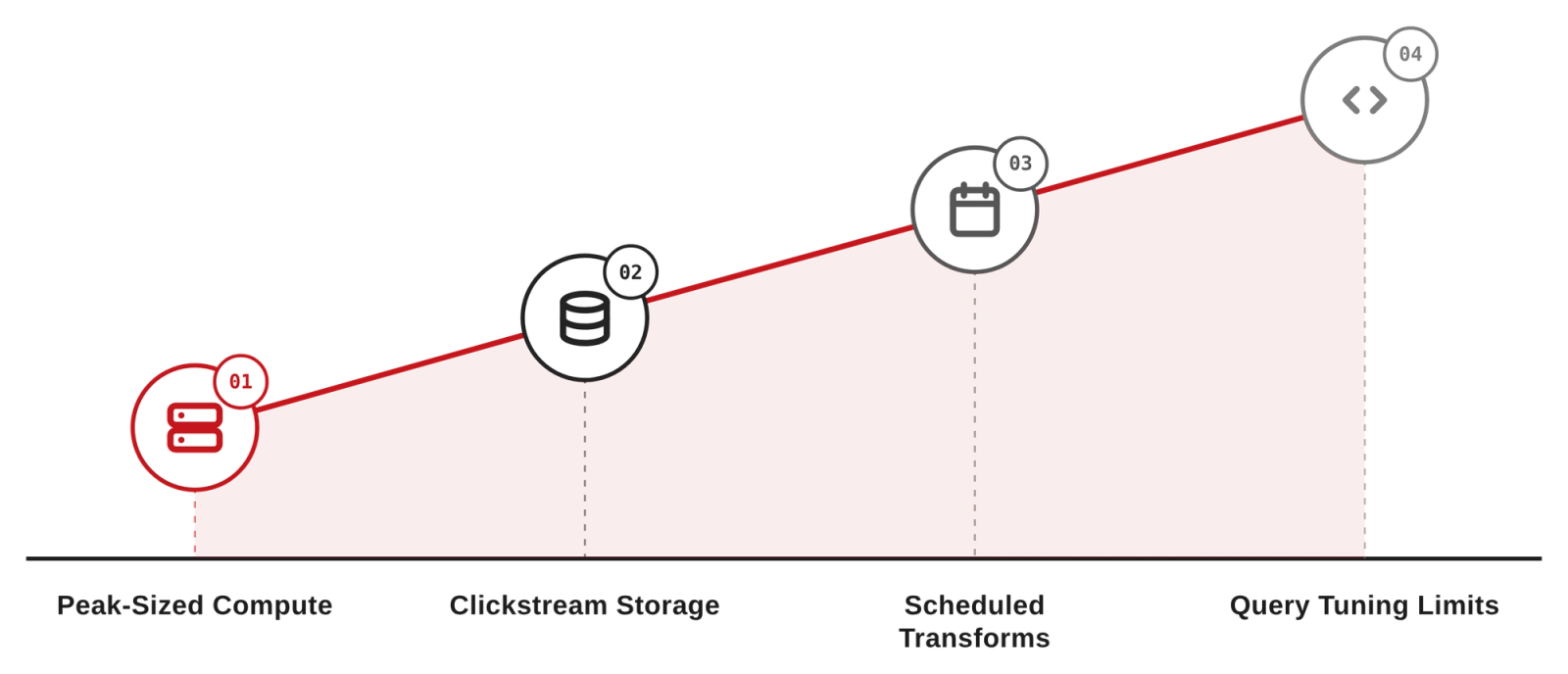
At a high level, warehouse cost optimization means reducing analytical platform spend without reducing what it delivers. In retail three components dominate. Compute capacity, which gets sized up for peak and rarely comes back down.
Clickstream storage and scanning, which is usually the largest dataset in the estate and grows continuously. And scheduled transformation, much of which runs at a frequency inherited from a deadline that only applies during peak.
Query tuning addresses part of the third and none of the first two, which is why retail cost programmes that begin there deliver little.
To compare:
Retail warehouse spend behaves like a wardrobe that expands each winter and never contracts. Every individual purchase was justified by cold weather. Nobody removes anything in spring, because the items are all technically still wearable and disposing of something feels riskier than keeping it.
Two winters later you need a bigger wardrobe, and the decision to have one was never made by anyone.
Why Does Warehouse Cost Optimization Matter for Retail?
Issues that it addresses or resolves:
- Peak capacity decisions that never reverse
- Clickstream storage growing without a tiering decision
- Refresh frequency inherited from peak deadlines year-round
Resolved Issues by Optimization Done Well
- Seasonal capacity reversed on a schedule
- Clickstream tiered with rollups for older periods
- Refresh frequency matched to non-peak requirements
Core Components of Warehouse Cost Optimization in Retail
- Query and job cost attribution
- Peak capacity changes recorded with a reversal date
- Clickstream tiering with aggregate rollups
- Refresh frequency differentiated between peak and non-peak
- Baseline spend tracked separately from seasonal
Modern Cost Optimization Tooling for Retail
- Query attribution from warehouse metadata
- Capacity change tracking with scheduled reviews
- Tiered storage with rollup automation
- Frequency scheduling that varies by season
- Baseline versus seasonal cost reporting
These tools stop the ratchet. Recording a reversal date with every peak capacity change is what turns a permanent increase into a temporary one.
Other Core Issues They Will Solve
- Baseline spend that can be compared year on year honestly
- Storage growth matched to analytical value
- Peak readiness without permanent cost
In Summary: Warehouse cost optimization for retail reverses seasonal capacity decisions, tiers the clickstream, and differentiates peak from non-peak frequency, rather than relying on query tuning.
Importance of Warehouse Cost Optimization for Retail in 2026
Retail platform spend ratchets structurally. Four reasons explain why this matters now.
1. Peak decisions are one-way by default.
Sizing up has an occasion and a trigger; sizing down has neither.
2. Blended reporting hides the ratchet.
One cost figure compared year on year conceals a rising baseline inside seasonal variation.
3. Clickstream dominates storage.
It is typically the largest dataset in a retail estate and grows with traffic and instrumentation.
4. Peak deadlines set year-round frequency.
Hourly refreshes justified by a December deadline continue through February.
Traditional vs. Modern Retail Warehouse Cost Control
- Query tuning first vs. capacity reversal and tiering first
- One blended cost figure vs. baseline tracked separately from seasonal
- Capacity changes permanent vs. recorded with reversal dates
- Frequency uniform vs. differentiated by season
In summary: A modern retail approach records reversal dates on seasonal changes and reports baseline separately so the ratchet becomes visible.
Details About the Core Components of Warehouse Cost Optimization in Retail: What Are You Designing?
Let's go through each component.
1. Attribution Layer
Where spend comes from.
Attribution decisions:
- Cost attributed to jobs, models, and users
- Peak versus baseline spend separated
- Attribution refreshed continuously
2. Capacity Layer
Reversing seasonal changes.
Capacity decisions:
- Peak sizing recorded with a reversal date
- Reversal owned by a named person
- Reversal result reported
3. Storage Layer
Clickstream dominance.
Storage decisions:
- Raw events tiered by age
- Rollups replacing raw for older periods
- Retention decided explicitly
4. Frequency Layer
Peak versus normal.
Frequency decisions:
- Refresh schedules differentiated by season
- Peak frequency time-bounded
- Non-peak frequency matched to consumption
5. Reporting Layer
Making the ratchet visible.
Reporting decisions:
- Baseline reported separately from seasonal
- Year on year compared at baseline
- Baseline growth challenged explicitly
Benefits Gained from Warehouse Cost Optimization in Retail
- Peak capacity that actually comes back down
- Storage cost matched to analytical value
- A baseline that can be compared honestly across years
How It All Works Together
The retail data team treats every peak capacity increase as a temporary change with a recorded reversal date and a named owner, which is the intervention that stops the ratchet. Sizing up for peak remains the right call.
Leaving it in place through spring is a decision nobody makes and therefore nobody reviews, so the reversal is scheduled at the moment the increase is applied. Cost reporting separates baseline from seasonal spend and compares year on year at baseline, because a single blended figure lets a rising floor hide inside seasonal variation indefinitely.
Clickstream, usually the largest dataset in the estate, gets tiered by age with aggregate rollups replacing raw events for older periods and retention decided explicitly rather than inherited. Refresh schedules are differentiated by season, since hourly rebuilds justified by a December morning deadline are unnecessary in February, and peak frequency is time-bounded rather than permanent.
Attribution runs underneath all of it, so a rising baseline can be traced to specific jobs and teams rather than discussed in aggregate.
Common Misconception
Peak capacity has to stay because we need it again next year.
You need it again for six weeks, and paying for it during the other forty-six is not preparation, it is inertia with a justification attached. Modern warehouses scale, which means the capability to size up is retained without retaining the capacity, and the argument for keeping it usually reduces to the fact that reversing requires someone to do something and nobody owns that.
The fix is procedural rather than technical: record a reversal date at the moment the increase is applied, assign it to a person, and report the result. That single practice converts a permanent cost into a seasonal one, and it works because it removes the need for anyone to remember or to make a decision under their own initiative in March.
Key Takeaway: You need the capability again, not the capacity. Schedule the reversal when you apply the increase.
Real-World Warehouse Cost Optimization for Retail in Action
Let's take a look at how it operates with a real-world example.
We worked with a retailer whose warehouse baseline had ratcheted up across two peaks, with these constraints:
- Record reversal dates on every peak capacity change
- Report baseline separately from seasonal spend
- Tier clickstream storage with rollups
Step 1: Attribute the Spend
Peak versus baseline.
- Cost attributed to jobs and teams
- Peak separated from baseline
- Attribution refreshed continuously
Step 2: Record Reversal Dates
At the time of increase.
- Reversal date set with the change
- Named owner assigned
- Result reported
Step 3: Tier the Clickstream
Largest dataset first.
- Raw events tiered by age
- Rollups for older periods
- Retention decided explicitly
Step 4: Differentiate Frequency
Peak versus normal.
- Schedules varied by season
- Peak frequency time-bounded
- Non-peak matched to consumption
Step 5: Report the Baseline
Separately.
- Baseline versus seasonal reported
- Year on year at baseline
- Baseline growth challenged
Where It Works Well
- Estates with pronounced seasonal capacity swings
- Clickstream large enough to justify tiering
- Teams willing to schedule and own reversals
Where It Does Not Work Well
- Programmes starting with query tuning
- Blended cost reporting that hides the baseline
- Capacity changes with no reversal owner
Key Takeaway: Schedule reversals, report baseline separately, tier the clickstream, and vary frequency by season.
Common Pitfalls
i) Peak capacity with no reversal date
Sizing up has a trigger and sizing down has none, so the increase becomes permanent through inaction. Record the reversal date and owner at the time of the change.
- Baseline ratchets each season
- The following peak sizes up from an inflated floor
- No individual decision was wrong
ii) Blended cost reporting
One figure compared year on year lets a rising baseline hide inside seasonal variation. Report both and compare at baseline.
iii) Untiered clickstream
The largest dataset in the estate growing without a retention decision produces cost nobody chose. Tier by age with rollups.
iv) Uniform refresh frequency
Hourly rebuilds justified by a December deadline continue through February. Differentiate schedules by season.
Takeaway from these lessons: The retail pattern is a ratchet, and the fix is scheduling the reversal rather than relying on judgement in spring.
Warehouse Cost Best Practices for Retail: What High-Performing Teams Do Differently
1. Record a reversal date with every peak increase
Assign it to a person and report the outcome, because reversal never happens on initiative alone.
2. Report baseline separately from seasonal
Compare year on year at baseline so a rising floor cannot hide inside seasonal variation.
3. Tier the clickstream deliberately
Roll up older raw events and decide retention explicitly, since this is usually your largest dataset.
4. Differentiate refresh frequency by season
Time-bound peak frequency rather than letting a December deadline set February schedules.
5. Attribute spend continuously
Make a rising baseline traceable to jobs and teams rather than discussed in aggregate.
Logiciel's value add is helping retail data teams stop the seasonal cost ratchet through scheduled reversals, baseline reporting, and deliberate clickstream tiering.
Takeaway for High-Performing Teams: Schedule reversals, split the reporting, tier the clickstream, vary frequency, attribute continuously.
Signals You Are Doing Warehouse Cost Optimization Well in Retail
How do you know it is working? Not by peak performance, but by whether the baseline came back down. These are the signals that separate seasonal spend from a ratchet.
Reversals happen. Peak capacity increases have dates, owners, and reported outcomes.
Baseline is visible. It is reported separately and compared year on year.
Clickstream is tiered. Older raw events have been rolled up.
Frequency varies. Peak schedules are time-bounded.
Spend is attributable. A rising baseline traces to specific jobs and teams.
Adjacent Capabilities and Connected Work
This work does not exist in isolation. Cost optimization depends on, and feeds into, the surrounding data platform. Ignoring the adjacencies is the most common scoping mistake.
Clickstream analytics drives the storage volume being tiered. dbt practice determines refresh scheduling and model pruning. FinOps guardrails supply the broader cost discipline including the same seasonal ratchet on infrastructure. The freeze calendar governs when changes can be made.
Naming these adjacencies upfront keeps the work scoped and helps leadership see the ratchet as the primary pattern.
The common mistake is treating each adjacency as someone else's problem. The reversal scheduling is your problem. The baseline reporting is your problem. The clickstream tiering is your problem. Pretend otherwise and next October will size up from a floor nobody chose.
Own the adjacencies you depend on, partner with the teams that hold them, and share the numbers.
Conclusion
Retail warehouse spend ratchets, and it does so through decisions that were individually correct. Sizing up for peak is right. Leaving it in place through spring is not a decision, it is the absence of one, and it never gets reviewed because reversing requires someone to act on their own initiative in March.
Record a reversal date and a named owner at the moment you apply the increase. Report baseline separately from seasonal so the rising floor cannot hide. Tier the clickstream, which is almost certainly your largest dataset, and decide its retention.
Differentiate refresh frequency between peak and normal periods rather than letting a December deadline set the year.
Key Takeaways:
- Peak capacity increases are one-way by default because reversal has no trigger
- Blended cost reporting conceals a rising baseline inside seasonal variation
- Clickstream is usually the largest dataset and needs its own tiering decision
Reducing retail warehouse cost requires stopping the ratchet. When done correctly, it produces:
- Peak capacity that actually comes back down
- A baseline comparable year on year
How a Healthcare CIO Cut AI Model Cost 60% Without Losing Accuracy
Cut AI inference costs while preserving the accuracy healthcare demands.
- Storage cost matched to analytical value
- Refresh frequency suited to the season
What Logiciel Does Here
If your warehouse baseline has ratcheted up across two peaks, we help you schedule reversals with owners, split baseline from seasonal reporting, and tier your clickstream.
Learn More Here:
- Clickstream Analytics for Retail
- FinOps Guardrails for Retail
- dbt at Scale for Retail
At Logiciel Solutions, we work with retail data leaders on platform cost. Our reference patterns come from estates with severe seasonal swings.
Book a technical deep-dive on stopping the seasonal cost ratchet.