
A SaaS data team adopts a zero-ETL integration between their operational database and the warehouse, and the pipeline they had been maintaining disappears. This is a real win: no more connector failures, no more lag from a batch window, no more on-call for an ingestion job.
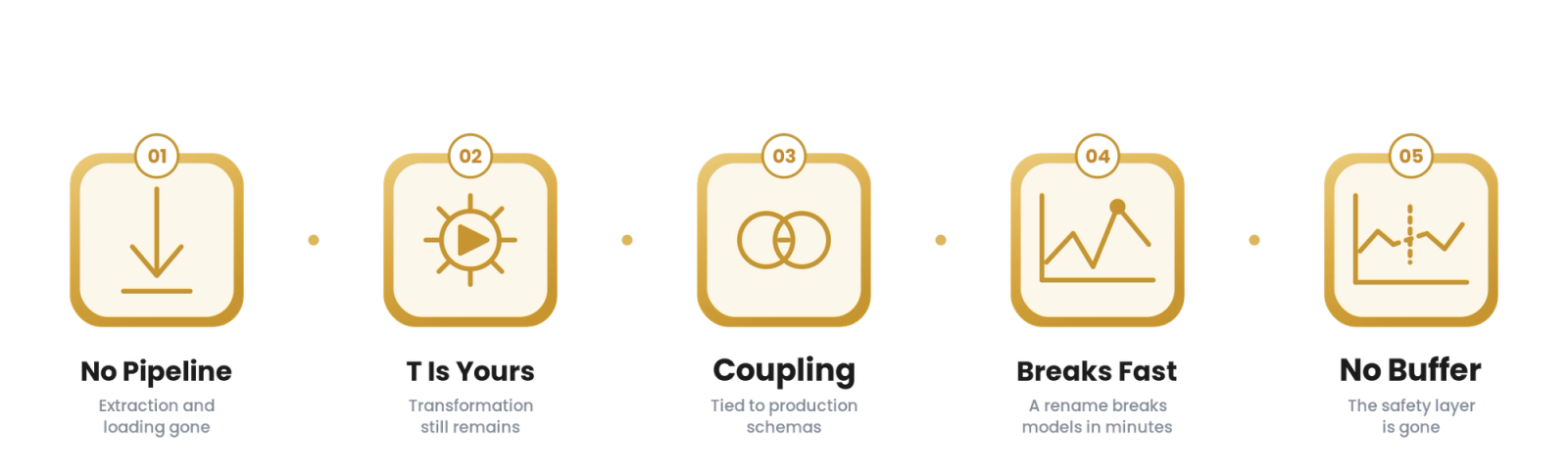
Then a product team renames a column in the source database during a routine migration, and every downstream model breaks within minutes rather than at the next scheduled run. The transformation work did not go away.
It moved from the pipeline into the modelling layer, and the buffer that used to absorb source schema changes went away with the pipeline.
Zero-ETL removes the E and the L. The T is still yours, and the buffer is gone.
Zero-ETL for SaaS means using managed integrations that replicate operational data into analytical stores without a pipeline you build or run, which removes extraction and loading work while leaving transformation entirely in place and coupling your analytical layer directly to production schemas.
Is Your Engineering Velocity Real, or Just a Reporting Illusion?
Discover whether your engineering velocity reflects real output or hidden inefficiency.
However, most teams read the name as removing the whole problem, and discover they have traded pipeline maintenance for schema coupling they now have to manage deliberately.
If you are a CDO or VP of Data at a SaaS company, the intent of this guide is:
- Define what zero-ETL actually removes and what it does not
- Show why direct schema coupling is the real trade-off
- Lay out when it is the right choice and when it is not
To do that, let's start with the basics.
What Is Zero-ETL for SaaS? The Basic Definition
At a high level, zero-ETL refers to managed integrations that move data from an operational store into an analytical one without you building or operating a pipeline. Cloud providers offer these between their own databases and warehouses, and the replication is continuous rather than batched.
What disappears is the extraction and loading code, the connector maintenance, the scheduling, and the on-call burden attached to them. What remains is everything about turning operational schemas into analytical models: naming, semantics, joins, business logic, testing, and documentation.
What is newly created is a direct dependency between your analytical layer and a production schema that another team changes for their own reasons.
To compare:
Zero-ETL is like removing the loading dock between the factory and the shop. Goods arrive faster and you stop staffing the dock. You also lose the place where someone used to check what arrived, repack it, and notice when the supplier changed the box size.
The shop still has to arrange everything on shelves, which was always the harder job. Anyone who read the removal of the dock as removing the shelving work is going to have a difficult quarter.
Why Does Understanding Zero-ETL Matter for SaaS?
Issues that it addresses or resolves:
- Connector maintenance and ingestion on-call consuming data team capacity
- Batch lag between operational events and analytical availability
- Duplicated extraction logic across multiple sources
Resolved Issues by Adopting Deliberately
- Pipeline operation removed where the integration genuinely fits
- Transformation effort planned rather than assumed away
- Schema coupling managed as a known dependency
Core Components of Zero-ETL Adoption in SaaS
- An honest assessment of what transformation work remains
- Schema change coordination with source-owning teams
- A modelling layer that isolates downstream consumers from source shape
- Monitoring for source schema changes, not just data quality
- Fallback plans where the managed integration does not cover a source
Modern Zero-ETL and Adjacent Tooling for SaaS
- Managed provider integrations between operational stores and warehouses
- Staging models isolating raw replicated data from consumers
- Schema change detection with alerting to the data team
- Contracts between product teams and the data platform
- Traditional pipelines retained for sources the integration does not support
These tools make zero-ETL workable. Staging models that absorb source shape and schema change detection are what replace the buffering the pipeline used to provide implicitly.
Other Core Issues They Will Solve
- Data team capacity shifts from operating pipelines to modelling
- Analytical data becomes near-current rather than batch-lagged
- Source changes are detected rather than discovered downstream
In Summary: Zero-ETL for SaaS removes extraction and loading through managed integrations, leaves transformation entirely in place, and creates direct schema coupling that needs deliberate management.
Importance of This Distinction for SaaS in 2026
Managed integrations have matured enough to be a genuine option rather than a demo. Four reasons explain why understanding the trade matters now.
1. The name oversells the benefit.
Removing extraction and loading is valuable and it is roughly a third of the work, which is not what zero implies.
2. Schema coupling is a real new dependency.
Your analytical layer now breaks when a product team renames a column, and breaks immediately rather than at the next run.
3. Coverage is uneven.
Managed integrations exist between specific source and target combinations, so most orgs will run them alongside conventional pipelines.
4. Capacity freed is capacity reallocated.
The engineers no longer maintaining connectors should move to modelling and quality, which needs planning rather than assuming.
Traditional vs. Zero-ETL Data Movement in SaaS
- Pipeline you build and operate vs. managed replication you configure
- Batch lag vs. near-continuous replication
- Extraction absorbing source changes vs. staging models absorbing them
- Ingestion on-call vs. schema change coordination with product teams
In summary: A modern SaaS approach uses managed integrations where they fit, plans the transformation work honestly, and manages the schema coupling it introduces.
Details About the Core Components of Zero-ETL Adoption in SaaS: What Are You Designing?
Let's go through each component.
1. Scope Layer
Where it fits.
Scope decisions:
- Source and target combinations checked against coverage
- Conventional pipelines retained where needed
- No expectation of uniform adoption
2. Transformation Layer
What remains yours.
Transformation decisions:
- Modelling effort estimated honestly, not discounted
- Semantics and business logic still designed
- Testing and documentation unchanged in scope
3. Isolation Layer
Absorbing source shape.
Isolation decisions:
- Staging models between raw replication and consumers
- Renames and type changes handled in staging
- Downstream models never referencing raw tables
4. Coordination Layer
Working with source owners.
Coordination decisions:
- Product teams aware their schema has analytical consumers
- Schema changes notified rather than discovered
- Contracts where the dependency is significant
5. Detection Layer
Knowing when the source moved.
Detection decisions:
- Schema change detection with alerting
- Type and nullability changes caught
- Alerts routed to the data team, not a shared inbox
Benefits Gained from Deliberate Zero-ETL Adoption in SaaS
- Pipeline operation removed where the integration genuinely fits
- Near-current analytical data without a batch window
- Data team capacity redirected to modelling and quality
How It All Works Together
The SaaS data team adopts managed integrations where the source and target combination is genuinely supported, and keeps conventional pipelines everywhere else, because uneven coverage is normal and pretending otherwise creates gaps.
The freed capacity is deliberately reallocated: the engineers who were maintaining connectors move to modelling, testing, and documentation, which is where the remaining work has always been. Critically, a staging layer sits between the raw replicated tables and every downstream consumer, and no model references raw tables directly.
That staging layer is what absorbs a column rename, a type change, or a new nullable field, so a source migration breaks one staging model rather than forty downstream ones. Schema change detection runs against the replicated source with alerts routed to the data team, since the buffer the old pipeline provided has been removed and detection has to replace it explicitly.
And the coordination side matters as much as the technical: product teams are told their database schema now has analytical consumers, schema changes are notified in advance where the dependency is significant, and a contract exists where the coupling is material. Without that conversation, the coupling is real and one-sided.
Common Misconception
Zero-ETL means we no longer need a data engineering team for this source.
Extraction and loading were the most operationally annoying part of the work and rarely the largest part of it. What remains after the pipeline disappears is the entire job of turning an operational schema designed for transactional writes into analytical models designed for questions: deciding what an entity means, resolving identity across sources, encoding business logic, writing tests, documenting semantics, and maintaining all of it as the business changes.
That work is unaffected by how the bytes arrived. Teams that read zero-ETL as headcount reduction typically discover within two quarters that their models are undocumented, untested, and coupled directly to production schemas, which is a worse position than the pipeline they retired.
The correct reading is that operational burden fell and modelling burden did not.
Key Takeaway: Zero-ETL removes operational burden, not modelling burden. The transformation work is unchanged and now has less buffering in front of it.
Real-World Zero-ETL for SaaS in Action
Let's take a look at how it operates with a real-world example.
We worked with a SaaS data team whose downstream models broke minutes after a product team renamed a source column, with these constraints:
- Keep the managed integration where it genuinely helps
- Isolate downstream consumers from raw source shape
- Coordinate schema change with the product teams involved
Step 1: Scope Where It Fits
Coverage is uneven.
- Source and target combinations checked
- Conventional pipelines retained elsewhere
- No uniform adoption assumed
Step 2: Plan the Transformation Work
Honestly.
- Modelling effort estimated, not discounted
- Freed capacity reallocated deliberately
- Testing and documentation scoped
Step 3: Build the Staging Layer
Absorb the shape.
- Staging models between raw and consumers
- Renames and type changes handled there
- No downstream model touching raw tables
Step 4: Coordinate With Source Owners
Make the dependency mutual.
- Product teams informed of analytical consumers
- Schema changes notified in advance
- Contracts where coupling is material
Step 5: Detect Source Changes
Replace the lost buffer.
- Schema change detection with alerting
- Type and nullability changes caught
- Alerts routed to the data team
Where It Works Well
- Supported source and target combinations with high ingestion overhead
- Cases where near-current analytical data has genuine value
- Teams willing to build a staging layer and coordinate schema change
Where It Does Not Work Well
- Sources the managed integration does not support
- Orgs treating it as a reason to reduce modelling capacity
- Environments where product teams change schemas without notice
Key Takeaway: Adopt zero-ETL where coverage fits, isolate consumers behind staging models, and coordinate schema change explicitly with source owners.
Common Pitfalls
i) Downstream models referencing raw tables
Without a staging layer, every source change breaks every consumer directly and immediately. Route everything through staging models that absorb shape changes.
- A column rename breaks forty models at once
- Failures arrive in minutes rather than at the next run
- Fixing it means editing forty files instead of one
ii) Reading zero as no work
Extraction and loading were roughly a third of the effort. Plan the modelling, testing, and documentation work that remains rather than assuming it disappeared with the pipeline.
iii) One-sided schema coupling
Product teams who do not know their schema has analytical consumers will change it freely. Make the dependency explicit and agree notification.
iv) Assuming uniform coverage
Managed integrations exist between specific combinations, so most estates will run both approaches. Plan for a mixed environment rather than a migration.
Takeaway from these lessons: Zero-ETL is a real improvement in operational burden that requires a staging layer, honest transformation planning, and explicit schema coordination.
Zero-ETL Best Practices for SaaS: What High-Performing Teams Do Differently
1. Never let consumers reference raw tables
Put staging models between replication and everything else, because that layer is what replaces the buffering the pipeline used to provide.
2. Plan the transformation work explicitly
Estimate modelling, testing, and documentation as if nothing changed, since from that perspective nothing did.
3. Make schema coupling mutual
Tell product teams their database has analytical consumers and agree notification for changes, so the dependency is not one-sided.
4. Detect schema changes actively
Alert on renames, type changes, and nullability shifts, because the pipeline that used to fail loudly is no longer there to do it.
5. Expect a mixed estate
Run managed integrations where coverage fits and conventional pipelines elsewhere, rather than pursuing uniform adoption.
Logiciel's value add is helping SaaS data teams adopt managed integrations where they genuinely reduce burden, with the staging layer and schema coordination that keep direct coupling manageable.
Takeaway for High-Performing Teams: Take the operational win, build the staging layer, plan the modelling honestly, and make schema coupling a two-way agreement.
Signals You Are Doing Zero-ETL Well in SaaS
How do you know it is working? Not by how many pipelines you retired, but by whether a source schema change is a minor fix. These are the signals that separate deliberate adoption from an optimistic migration.
Nothing references raw tables. Every consumer goes through a staging model.
Source changes are detected. Renames and type changes alert the data team.
Product teams know. Source owners are aware they have analytical consumers.
Modelling capacity held. Freed effort went to models, tests, and documentation.
The estate is mixed. Conventional pipelines run where coverage does not reach.
Adjacent Capabilities and Connected Work
This work does not exist in isolation. Zero-ETL adoption depends on, and feeds into, the surrounding data platform. Ignoring the adjacencies is the most common scoping mistake.
Schema evolution policy governs how source changes are handled. Data contracts formalise the coupling with product teams. dbt or equivalent modelling practice is where the remaining work lives. Data quality SLAs define what consumers can expect.
Naming these adjacencies upfront keeps the work scoped and helps leadership understand that operational savings do not reduce modelling need.
The common mistake is treating each adjacency as someone else's problem. The staging layer is your problem. The schema coordination is your problem. The modelling capacity is your problem. Pretend otherwise and a routine source migration becomes a day of downstream repair.
Own the adjacencies you depend on, partner with the teams that hold them, and share the dependency.
Conclusion
Zero-ETL is a genuine improvement in operational burden with a name that oversells it. Extraction and loading disappear, connector maintenance disappears, and ingestion on-call disappears, all of which is worth having. Transformation does not disappear, and it was always the larger and harder part: semantics, identity, business logic, tests, documentation.
What is newly created is direct coupling between your analytical layer and production schemas another team owns, with the pipeline that used to buffer that coupling now gone. Build a staging layer nothing bypasses, detect schema changes actively, agree notification with source owners, and plan the modelling work as if nothing changed. From that angle, nothing did.
Key Takeaways:
- Zero-ETL removes extraction and loading; transformation is untouched
- Direct schema coupling replaces the buffering the pipeline used to provide
- A staging layer that nothing bypasses is the single most important control
Adopting zero-ETL well requires honest scoping. When done correctly, it produces:
- Pipeline operation removed where the integration genuinely fits
- Near-current analytical data without a batch window
Why “Context” Is Becoming the New Cloud Infrastructure Layer
Understand how context infrastructure is reshaping retrieval and intelligent systems.
- Source schema changes handled in one place rather than forty
- Freed capacity redirected to modelling and quality
What Logiciel Does Here
If a source column rename can break your models within minutes, we help you build the staging layer, schema detection, and source coordination that make managed integrations safe.
Learn More Here:
- Schema Evolution for Technology & SaaS
- dbt at Scale for Technology & SaaS
- Data Products and Contracts
At Logiciel Solutions, we work with SaaS data leaderson data movement architecture. Our reference patterns come from estates running managed integrations alongside conventional pipelines.
Read the guide on adopting zero-ETL without inheriting brittle schema coupling.