When you bring in outside help for an AI build, you're really choosing between three models, each with a different price, a different kind of person doing the actual work, and a different failure mode.
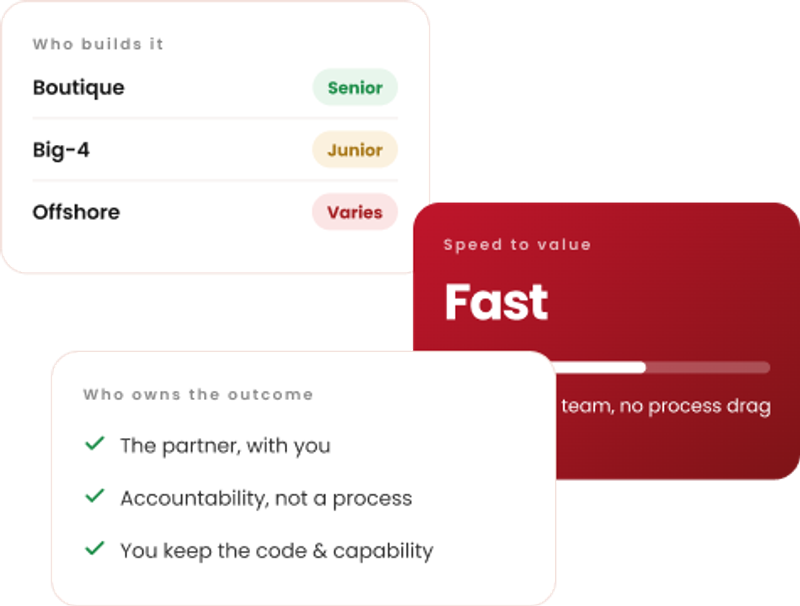
A Big-4 gives you brand cover and a big bench, but the people who sold the work often aren’t the ones who build it , and you pay a premium for the logo. An offshore shop gives you the lowest hourly rate, but you carry the architecture, the direction, and the risk. A boutique partner gives you senior people doing the actual work and accountability for the outcome, at a price between the two.
There’s a right answer for each situation. Sometimes it isn’t us , and we’ll say so.
If your board or regulator wants a name-brand consultancy for cover, or you need to staff hundreds across a multi-year transformation, a Big-4 has scale and brand a boutique can’t match.
If you have a strong internal architect giving clear, detailed direction and mainly need more hands at a low rate to execute a well-specified plan, an offshore shop can be very cost-effective.
You need production AI built well, soon, by people who’ve done it before , with one team accountable for the result rather than a process to manage.
For most AI builds the bigger risk isn’t a smaller bench , it’s paying senior rates for junior work, or owning architecture and quality you didn’t plan to.
What each path really costs , beyond the brand on the invoice.
| Factor | Boutique AI partner | Big-4 Consultancy | Offshore dev shop |
|---|---|---|---|
| Who writes the code | Senior engineers, the ones you met | Often junior staff under a senior name | Whoever's assigned; quality varies |
| Cost | Mid | Highest (brand premium) | Lowest hourly |
| Speed to value | Fast; small senior team | Slow: large process overhead | Variable; depends on direction you give |
| Who owns architecture & risk | The partner, with you | Shared, heavy process | You do |
| Domain depth (Healthcare, Energy, etc.) | Usually deep in a few areas | Broad but generalized | Rarely |
| Best when | You want senior delivery and accountability | You need brand cover for the board, or huge scale | You have strong internal direction and want cheap hands |
| Main risk | Smaller bench than a Big-4 | Paying senior rates for junior work | Architecture and quality fall on you |
We’re not going to pretend a boutique is always the answer. Choose the model that fits the job.
When the board needs name-brand cover, or you’re staffing hundreds across a multi-year transformation.
When a strong internal architect sets clear direction and you mainly need more hands at a low rate.
When you want production AI built right, soon, by people who’ve done it , with one team owning the result.
What we’d push back on is choosing a model for the wrong reason , paying for senior expertise and getting junior execution is the most expensive line in the whole budget.
We embed senior engineers as an extension of your team, build AI-native on AWS, and go deep in healthcare, energy, and real estate rather than claiming everything. You get senior people actually doing the work, deep experience in a few domains rather than shallow coverage of all of them, and a partner who owns the outcome with you. You keep the code and the capability.
The bench is smaller, which matters at huge scale. For most AI builds the bigger risk is the opposite: paying for senior expertise and getting junior execution. A boutique puts the senior people on your actual work.
Yes, and often better, because depth beats breadth here. We build HIPAA-aware in healthcare and to the security posture regulated workloads require, rather than treating compliance as a generic checklist.
Some large programs pair a boutique for the hard, senior engineering with cheaper hands for the rest. We’re happy to tell you when that’s the smarter structure.
Tell us what you’re optimizing for , cost, speed, brand cover, or senior delivery , and we’ll give you a straight answer on which model fits, even when it isn’t us.