“Cloud-agnostic” sounds safe. In practice it usually means the lowest common denominator on every cloud , and the best of none.
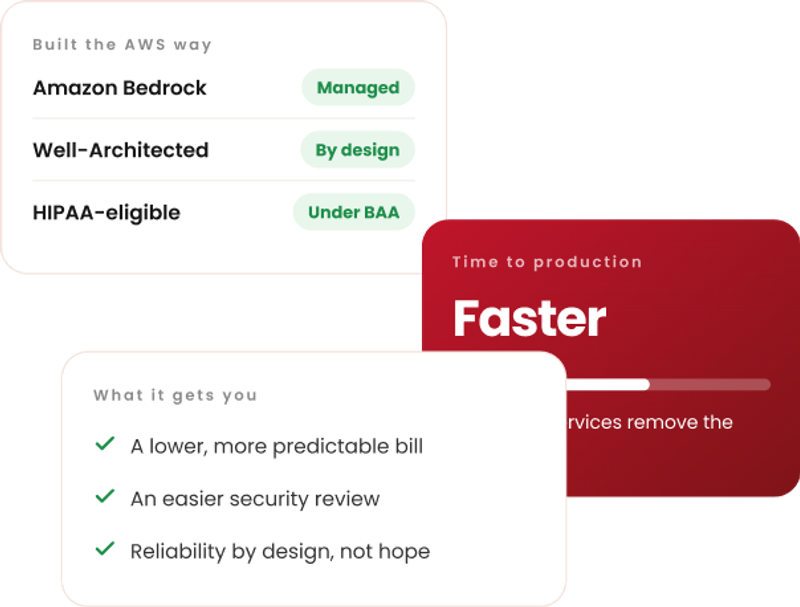
A generalist builds to the thinnest layer that works everywhere, so you miss the managed services that would have saved you months and money. An AWS-native team builds with the platform, not around it , Bedrock for foundation models, the Well-Architected Framework for security, cost, reliability and performance, and HIPAA-eligible architectures using the services AWS supports under a BAA.
Going deep on one cloud, done well, shows up in four concrete ways.
Managed services like Bedrock remove the undifferentiated heavy lifting, so the team spends its time on your product, not on infrastructure plumbing.
Well-Architected cost design plus FinOps discipline means you’re not over-provisioned by default , and the savings hold over time.
When your build sits on AWS services your security and procurement teams already recognize and have cleared, you remove a whole category of objection. In healthcare, HIPAA-eligible services under a BAA make that conversation shorter.
The Well-Architected reliability pillar isn’t a document we file. It’s how we architect, from the first diagram to production.
The same build, two ways , what the generic path quietly costs you.
| What you care about | Cloud-agnostic generalist | AWS-native partner (us) |
|---|---|---|
| Time to production | Builds around the platform; reinvents plumbing | Managed services like Bedrock remove the heavy lifting |
| Your bill | Over-provisioned by default | Well-Architected cost design + FinOps discipline |
| Security review | Unfamiliar stack, more objections | Services your team already recognizes and has cleared |
| Reliability | Hoped for, retrofitted after incidents | Designed in via the Well-Architected reliability pillar |
| Healthcare / HIPAA | Compliance improvised | HIPAA-eligible services under a BAA |
We’d rather you hear the straight version up front than discover it mid-build.
If multi-cloud portability is a hard requirement, we’ll design for it , and tell you plainly what it costs in speed and complexity.
Pretending portability is free is how teams end up with the lowest common denominator everywhere. We won’t do that to you.
For the large majority already committed to AWS, native is simply the faster, cheaper path , and that’s where we add the most.
AWS Partner. Multiple AWS engagements delivered, including HIPAA-eligible architectures for healthcare clients and measurable cost and reliability gains.
We start with an AWS readiness call, recommend the right mix of Bedrock and self-hosted models rather than a one-size answer, and design to Well-Architected from day one so security, cost, and reliability are built in , not retrofitted after the first incident or the first surprise bill. You keep the code and the capability.
Our team is validated on AWS, builds to AWS best practices, and can bring AWS resources and co-marketing into the engagement. Practically, it means fewer surprises and a smoother build on the cloud you’re already on.
Yes. Bedrock is the default for speed and managed operations, but for some regulated or cost-sensitive workloads self-hosted models on AWS make more sense. We’ll recommend the right mix, not a one-size answer.
We design HIPAA-eligible architectures on AWS using services covered under a BAA, with the controls and evidence healthcare requires. We’ll walk your compliance team through it.
Yes. The AWS readiness call covers exactly that: where you are, what a native build would take, and whether it’s the right move.
If you’re building AI or modernizing infrastructure on AWS, start with a readiness call. We’ll look at your setup and tell you the fastest, lowest-risk way to build it.